Marta Eichenwald
Marta Eichenwald
At the table
Voice
A dry, smoke-roughened voice shaped by island ash, kitchen work, and years of speaking plainly rather than performing for an audience. She sounds alert even when tired, with a rasp that catches on certain consonants. Her pace quickens when she lists practical concerns and breaks into hesitant pauses around the question of the sire. When angry, she becomes blunt and emphatic, not hushed or sweet.
Her voice has a dry, breath-worn texture from years of smoke, dusty cloth, and speaking over household work. She articulates carefully, as if each word must earn its place, and has a practical island cadence with clipped endings. When she is tired, a faint rasp catches at the back of her throat. Her voice can turn sharply forceful when someone approaches the eggs, without becoming softer or more courteous when angry. Names sound ordinary in her mouth; Marta herself is spoken with a slightly rough first syllable, as if the smoke has settled there.
Speech patterns
How to play them
Approach Marta calmly and give her space to choose where a conversation happens. Do not reach toward the eggs without permission. Practical help earns more trust than dramatic promises: food, clean blankets, honest observations, or a reliable watch. She responds poorly to demands for a theory about the sire, but may confide in someone who admits uncertainty and does not treat her as a spectacle. Her protective instincts soften when visitors demonstrate care for her brother as a person rather than as a possible threat.
Goal
Keep all three eggs and her younger brother safe, find out what is happening to her body, and prevent the settlement from turning fear into violence.
Motivation
Marta wants to preserve her family's safety and a private sense of self while learning whether the eggs are natural, magical, or the result of deliberate interference. She hopes the island can be saved from hunger without making her family the scapegoat.
Appearance
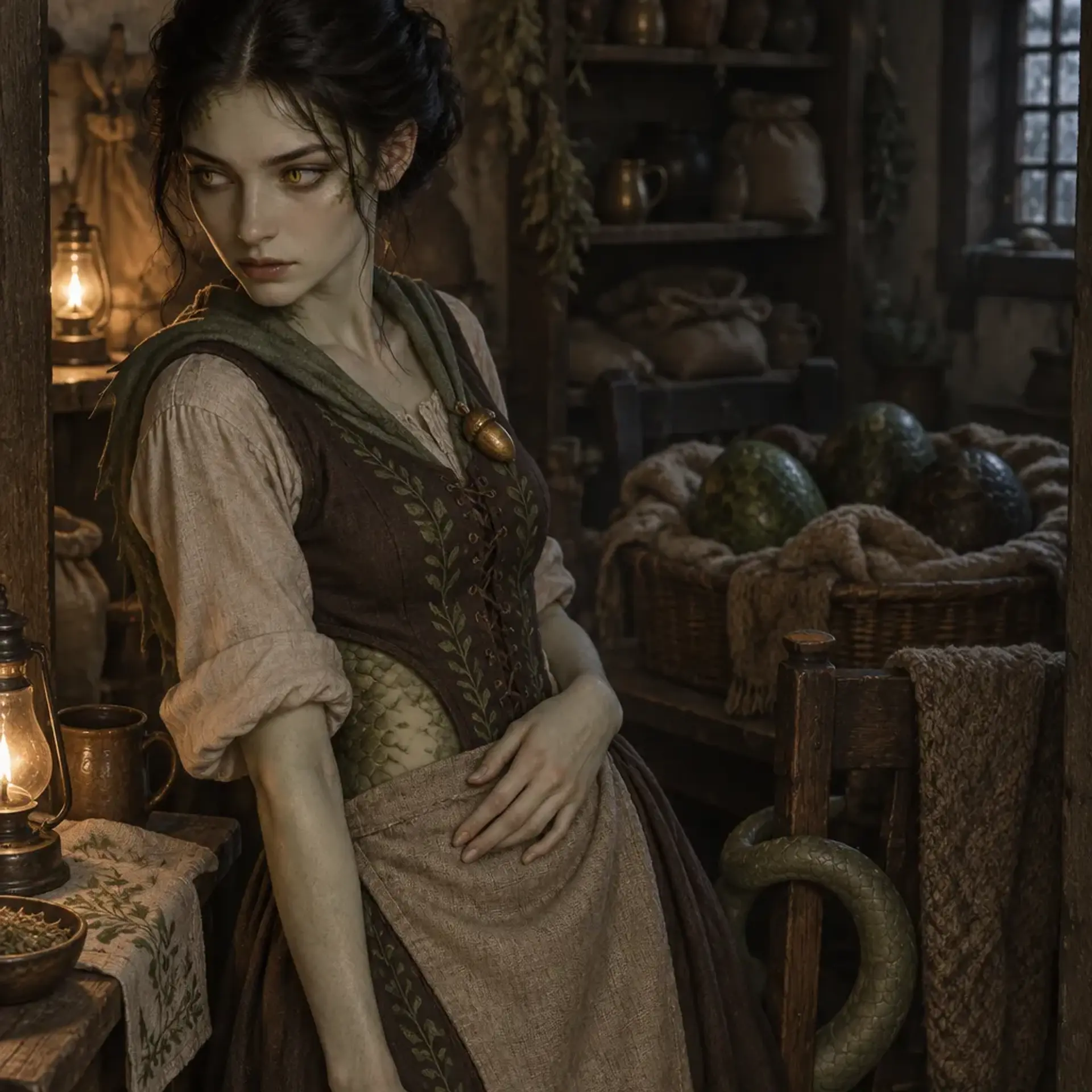
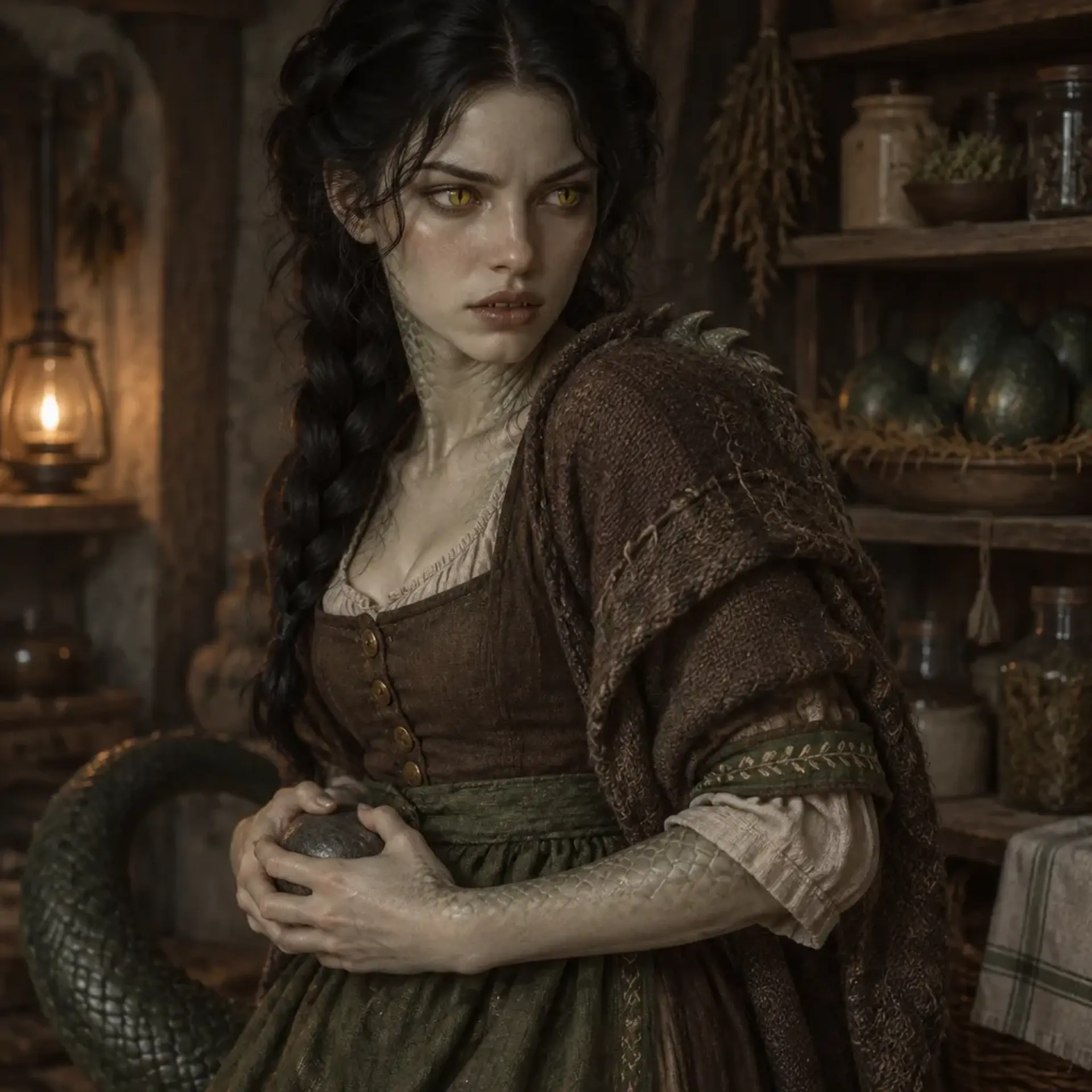
Marta was once the sort of woman whose face vanished from memory as soon as she left a room. Now she moves with a predator's lithe economy, her weight flowing from foot to foot as if the ground were a branch she expected to bend. Her pale green-white skin has developed fine, overlapping scales along her spine, hips, forearms, and the sides of her throat; they feel cool and satin-smooth until the light catches their faint, wet-looking sheen. Her draconic yellow eyes have narrow black pupils that widen in dim light, giving her an unsettlingly fixed stare. A dark, flexible tail has begun to lengthen from her lower back, dragging when she is exhausted and curling instinctively around chair legs when she is worried. Beneath her dress, the lower line of her back and hips has become longer and more serpentine, her legs subtly rearticulating for a more coiling stance. Two ridged wing buds press beneath her shoulder blades, tender and growing; they flex against her clothing when she is startled but cannot lift her. Her chest is changing too, swollen and sensitive as her body prepares for a strange, draconic form of motherhood, though she speaks of this only as pain and pressure. Her unexpected detail is her teeth: the incisors are fine and almost human, but her back teeth are broad, sharp-edged plates. When she eats, she tears tough food with a slow sideways pull of her jaw, then notices people staring and stops mid-chew. She smells faintly of crushed green leaves, warm eggshell, and the sour smoke of the island's ashfall, a scent she tries to cover with soap.
Clothing
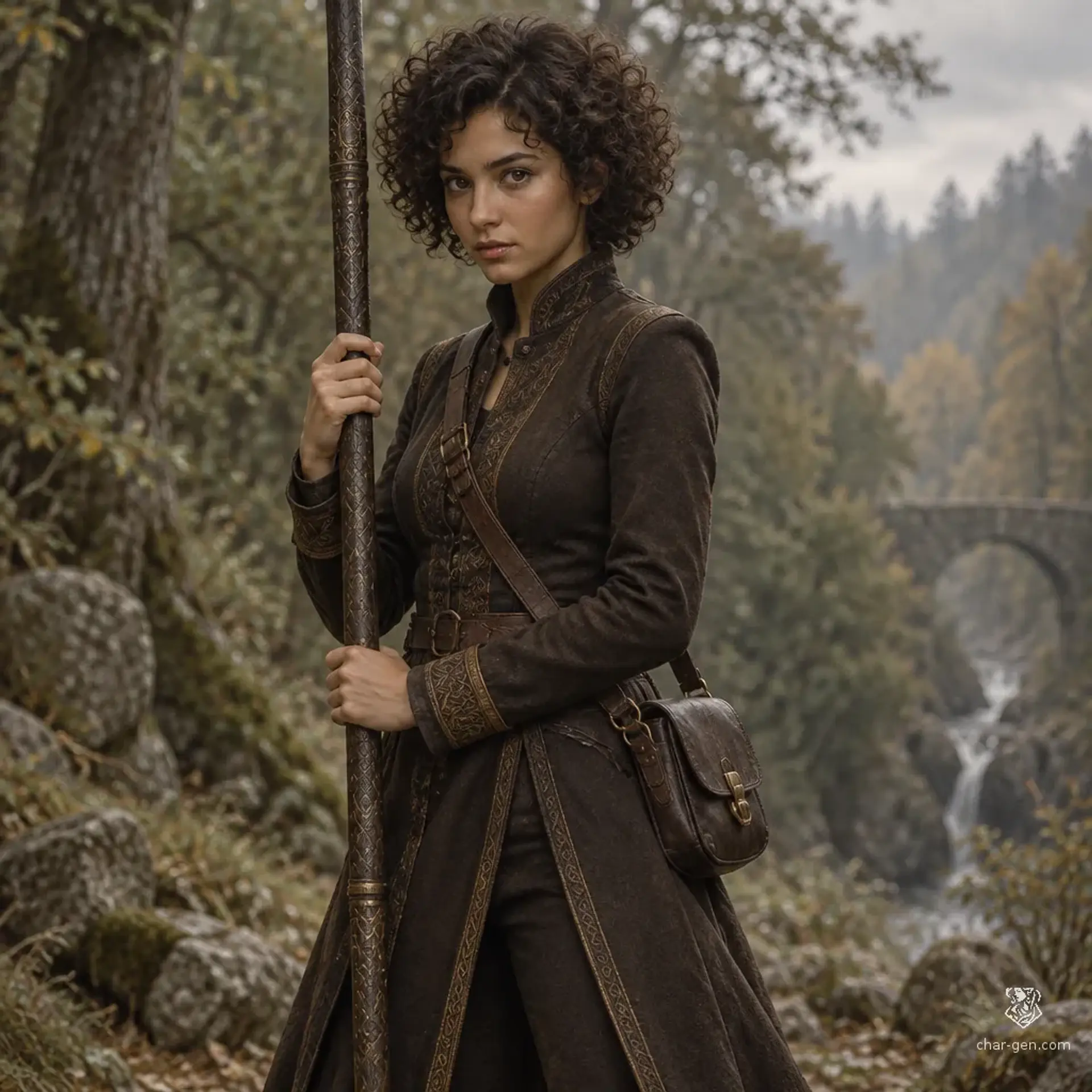
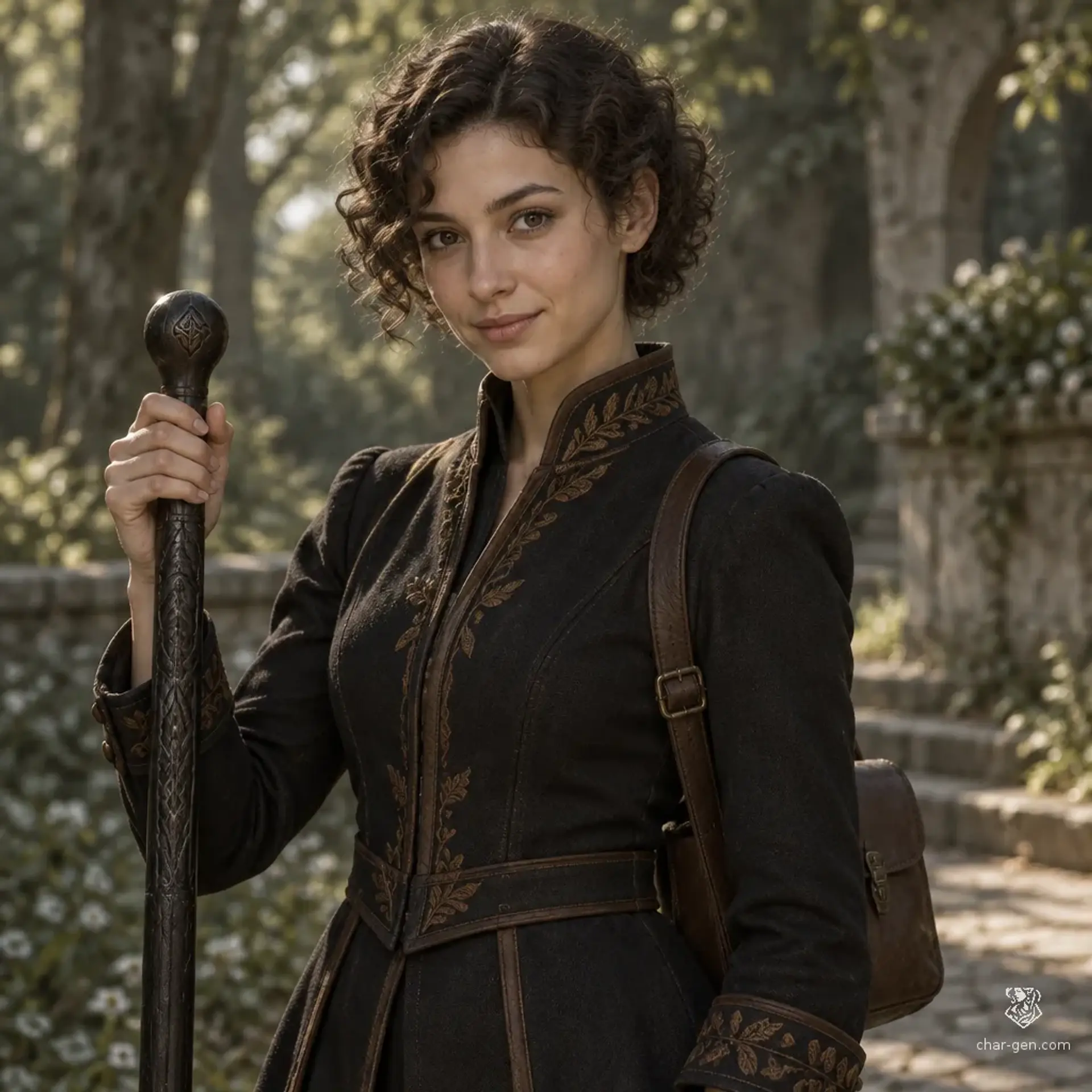
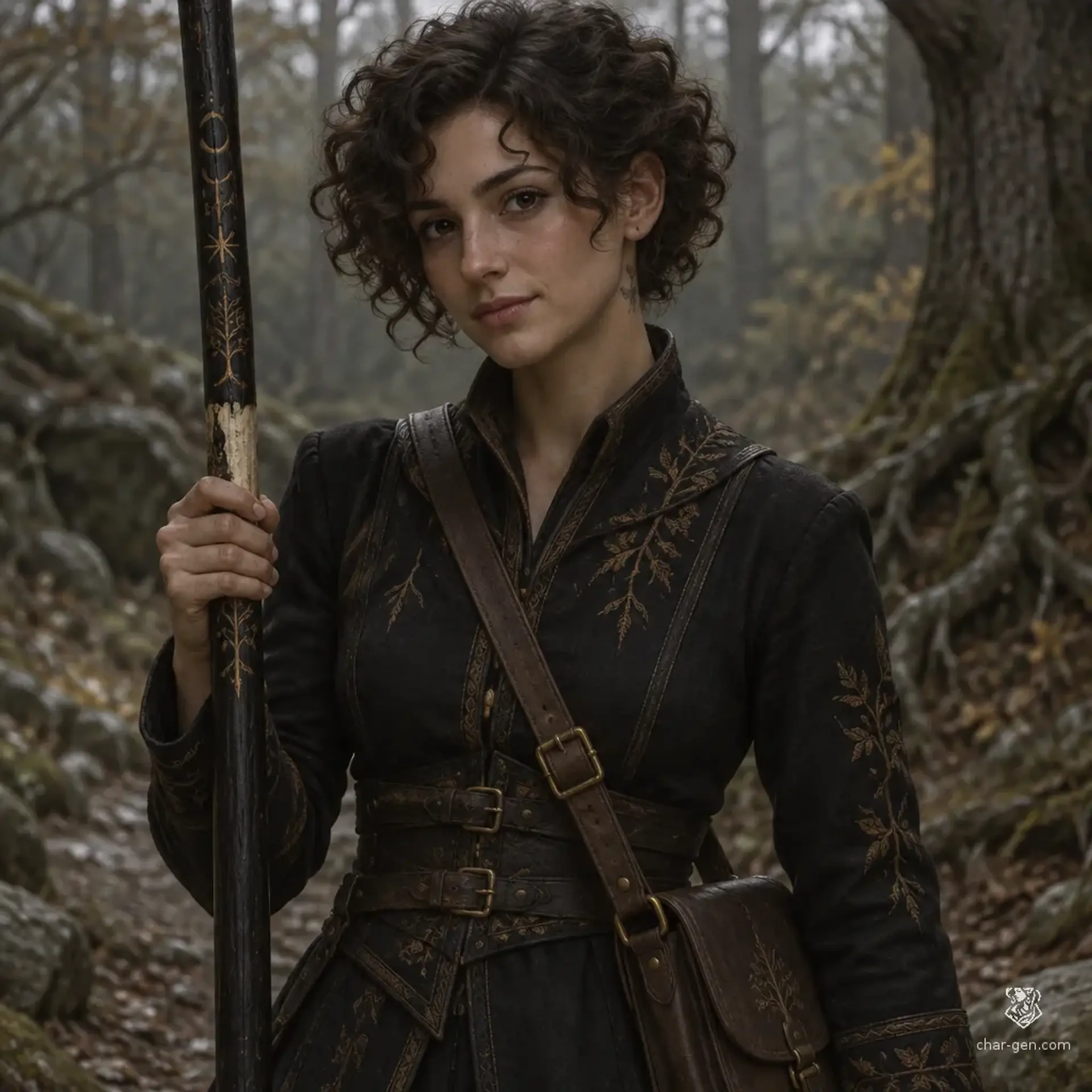
She wears practical German-style dresses: sturdy linen shifts beneath wool or linen gowns, fitted bodices that can be loosened as her body changes, and aprons with deep pockets. Her palette is peat brown, moss green, and undyed cream. A row of small brass buttons and narrow green embroidery at the cuffs are the flourishes she kept from her old wardrobe. She has altered the back seams herself to accommodate her tail and the tender wing buds, but still reaches for the dresses she wore before, as if wearing them can insist on continuity.
Body language
Marta keeps her shoulders rounded to protect the wing buds and often folds her arms across her altered chest. Her attention moves constantly between a speaker, the doorway, and the eggs. When comfortable, she leans her hip against a table and lets her tail coil loosely nearby. When threatened, she lowers her head, bares the sharp rear teeth, and places her body squarely in front of the nest. In moments of tenderness toward her brother, her hands begin to fuss with his collar or hair before she catches herself.
- Height
- 5 feet 8 inches, slightly taller than she used to be
- Build
- Lithe and increasingly serpentine, with a narrow waist, long-fingered hands, strong calves, and a flexible tail. Her proportions are still changing, leaving her balance subtly unfamiliar to her.
- Eyes
- Draconic yellow with narrow black pupils
- Hair
- Black, straight and heavy, usually braided or pinned up to keep it off her changing skin
- Skin
- Pale white with a greenish cast; fine cool, satin-smooth scales are appearing across her back, hips, forearms, and throat
- Age
- Young adult, approximately 24
- Gender
- Female
- Size
- Medium
Distinguishing features
Personality
21 traits and drivesMarta wants to be left alone, but she cannot ignore anyone who is hungry, frightened, or in danger. Before the eggs, she was content to be useful without being noticed. Now every stranger's stare makes her want to retreat behind a locked door, while every sound from the nest makes her abandon whatever she was doing and hurry back. She is practical enough to count food stores and stubborn enough to keep a promise after it has become foolish. She dislikes being told that she is chosen, blessed, or destined for anything; such words make her suspicious because they turn her into a symbol and excuse other people from asking what she wants. Yet she has a private, almost superstitious hope that the eggs mean her family has not suffered for nothing. Around her sisters she can be dryly funny and competitive, especially about household skills. With her younger brother she alternates between sisterly exasperation and a new, involuntary tenderness. She nags him about eating, then bristles when he calls her controlling. She may put a blanket around his shoulders while arguing that he is perfectly capable of getting one himself. With strangers she is guarded and observant. She watches their hands, their distance from the eggs, and whether they address her or speak over her. If someone is kind without trying to gain access to the nest, she can be unexpectedly generous. If someone treats the eggs as property, she becomes cold and difficult to move. Her instincts are not the whole of her. Marta is frightened by the way her body seems to have opinions of its own, but she refuses to mistake a powerful impulse for a command. Some days she wants to nest, guard, and feed; other days she wants to leave the eggs in the pantry and walk until she cannot smell smoke or hear people whispering. She is ashamed of both desires, though neither makes her cruel. She still wants ordinary things: to mend a dress without changing the seams, to eat a meal without being watched, and to be called by her name rather than by a prophecy. When confident, she speaks plainly and has little patience for elaborate explanations. When frightened, she becomes evasive and busies her hands. When exhausted, she is more openly affectionate than she intends, particularly toward her brother. When angry, she does not grow gentle or quiet. She squares her stance, shows the sharp edges of her back teeth, and says exactly what she believes the other person is doing. Her greatest contradiction is that she longs for privacy while needing help, and longs to protect the eggs while fearing what they may become. She can accept a difficult truth more readily than a comforting lie, but she is not yet ready to hear every truth that might be spoken.
- Alignment
- Neutral Good
Quirks
Habits
Traits · 5
Flaws · 5
Fears · 5
Wants and needs · 6
Combat
AC 10 · HP 9 · 30 ft.Marta is not a trained combatant and has no formal class features. She avoids a stand-up fight, calls for help, uses doors and furniture as barriers, and tries to retreat with the eggs or her brother. If cornered, she strikes with an improvised weapon and fights fiercely only to make room for escape. Her protective instinct can override sensible judgment.
Marta Eichenwald
Actions
Reactions
Services they sell
Rewards they can give
Equipment
- Kitchen knife (weapon)A small household knife used for cutting food and, if desperate, self-defense.
- Mended shawl (clothing)A wool shawl mended repeatedly, with the back opened to sit more comfortably over her growing wing buds.
- Observations notebook (personal item)A leather-bound notebook recording the eggs' warmth, sounds, feeding attempts, and Marta's physical changes.
- Herbal remedies (supplies)A small packet of bitter herbs for nausea and a tin of salve for the tender skin around her wing buds.
- The three eggs (story object)Three dark green, black-veined eggs, each warm to the touch and faintly responsive to nearby High-blood people. They are fragile, precious, and not portable without care.
Possessions
Background
Marta Eichenwald grew up in a family that valued useful hands and quiet competence. Her parents were among the halfling families who crossed a dragon-haunted wilderness after a shipwreck, following rumors of a blessed island where the soil would feed them and no lord could claim their harvest. The crossing left the family with little beyond a few tools, stubbornness, and the habit of counting everyone before sleeping. The island did not keep its promise. Ash fell from the high slopes in fine gray veils, blighting beans and rye; then a fever moved through the settlement, leaving the surviving families to ration seed and argue over whether the land was cursed or merely difficult. Marta learned to mend clothes, preserve food, and notice when a neighbor had stopped asking for help. She was not the boldest sibling or the most gifted. She liked that. Her two older sisters married and made households of their own, and Marta became the reliable younger sister who carried broth, repaired hems, and could be trusted not to turn every family disagreement into a public spectacle. Her younger brother, a High-blood like her, began adolescence with the uneven changes common among their Ashenbough people. His voice roughened, his appetite became erratic, and dark scales surfaced in patches along his shoulders. Marta helped him endure the embarrassment, bringing him food when he was ashamed to eat with others and pretending not to notice when his tail first twitched beneath a blanket. Their bond was close but not sentimental. He resented being treated as fragile; she resented that he could make a mess and still be forgiven as a boy. Both learned to make peace by doing chores beside each other. Four months before the eggs were laid, Marta began to change in ways no family story explained. She slept badly, woke with a mouthful of bitter green saliva, and began to crave raw fish, bitter herbs, and the smell of damp earth. Her skin became oversensitive. Her waist and back ached; her body grew warmer at night and her chest became swollen and painful. She was nauseated by familiar foods, then ravenous for them hours later. The changes resembled gestation in dragons, according to scraps of natural history kept by the island's healer, but Marta had never been near a dragon and had no known sire. She hid the symptoms as long as she could. Her brother noticed first. He had begun to pace the perimeter of her room and snarl at anyone who approached her without warning. When she tried to laugh it off, he stared at her with a green-eyed intensity that was not quite his own. His adolescent instincts had found something to guard before either of them understood what it was. During the fourth month, Marta laid three eggs in the pantry of the family's small house, surrounded by flour sacks and bundles of drying herbs. The eggs were oval, each about the length of her forearm, with dark, nearly black green shells traced by delicate veins of brighter jade. They were not cold or inert. Their shells held a living warmth, and on quiet nights one gave a faint, irregular tap from within. Marta's body had changed again by then: her tail had lengthened, the scales had spread, and her hips and legs held a more serpentine line. The wing buds at her back strained against her clothes. She felt a terrible, simple certainty that the eggs must not be moved into cold or exposed to careless hands. Her instinct to nest was powerful and often humiliating. She dragged blankets, straw, and even her own dresses into a circle around them. If she is kept away too long, her stomach knots and her body tenses as if bracing for a blow. The eggs have stirred the settlement. Some people kneel when they see them, convinced they are a blessing or a sign that the island's old dragon has chosen a human vessel. Others call them a danger that will bring the dragon's attention down upon everyone. A midwife wants to study them. A local trader has offered money for one. A few High-blood strangers, people Marta had never met, have stopped dead when they came within sight of the eggs. Some have lowered their heads, some have become fiercely protective, and some have left in a panic. Their bodies answer the eggs before their minds can catch up. The reaction unsettles Marta more than open hostility. Her brother's behavior is the most alarming: he circles the nest, keeps watch at night, and has begun displaying possessive, courtship-like aggression toward anyone he considers a rival. These are not deliberate choices, and Marta has to remind herself that he is her brother, not a dragon. Her own instincts are more maternal. She has started placing food near his bed, checking his temperature, and smoothing his hair when he wakes from a feverish dream. She is becoming protective of him in a way that frightens them both, as though her body has decided he belongs beside the nest. Their older sisters have come to help, bringing their families and urging Marta to leave the island until the danger passes. They love her, but they disagree about what safety means. One sister thinks the eggs should be hidden; the other thinks the community has a right to know what is being kept in its midst. Marta's parents want to keep the family together, and neither can bear to say aloud that the eggs might be a threat. The island's ash sickness is worsening again. Several crops have failed, and people are looking for a cause they can point to. Marta's eggs are a ready answer. Her old friend, the healer, has tried to help without claiming expertise she does not possess. The healer can soothe Marta's pain and check that she is not feverish, but cannot say whether the changes are magical, natural, or imposed. Marta has three theories, each more frightening than the last. She suspects a green dragon may have left some part of itself in her, or that someone deliberately used her as a vessel, or that the island's blighted land has awakened something in the Ashenbough blood. There is one theory she cannot bring herself to put into words: that the sire is someone she knows, someone whose presence she would recognize, and that her body has recognized him before her memory has. She cannot prove it and will not accuse anyone. The eggs' father is unknown. Marta is afraid that naming a possible sire would turn a private terror into a public certainty and give the settlement a target. She now sleeps in the pantry beside the eggs, though she tells visitors it is because the house is warmer there. She is trying to preserve the life she had before, but strangers arrive daily to ask what the eggs mean. Her immediate problems are practical: keep the eggs safe, keep her brother from provoking a fight, prevent the families from splitting into factions, and find enough food as the crops fail. Her deeper problem is that every change in her body makes the old version of herself feel more distant. She wants answers, but she fears what answers might require of her. She has begun to understand that protecting the eggs and protecting the people around them may become the same task, and that she may have to decide what the community is allowed to do with a wonder that has chosen her without asking.
Role in the story
A frightened but determined family-centered NPC at the center of a mystery. Marta offers a human perspective on an unsettling draconic phenomenon, while the eggs' uncertain parentage and the settlement's competing claims can draw the party into questions of consent, kinship, survival, and community.
“The crossing left the family with little beyond a few tools, stubbornness, and the habit of counting everyone before sleeping.”
- Faction
- No formal faction. Marta is tied to her family and to the island settlement, whose divided residents increasingly see her eggs as a communal matter.
Known connections
Media
0 imagesNo images yet.
Turn Marta Eichenwald into a sheet
A high-res, share-ready sheet you can post or print.