Marta Eichenwald
Marta Eichenwald
At the table
Voice
A dry, lightly rasped voice shaped by salt air, garden work, and years of speaking across busy rooms. Her family dialect gives her consonants a crisp edge. She does not sing or whisper when upset; anger makes her sentences shorter and her jaw visibly firm.
Her voice carries the dry rasp of someone used to talking over wind and household work, with crisp consonants inherited from her family's German-influenced island dialect. She speaks in complete, practical sentences and leaves a small pause before answering personal questions. When she is angry, her words become more direct and her jaw sets; she does not soften her volume. Around family, a wry warmth comes through, especially when she is teasing her sisters.
Speech patterns
How to play them
Treat Marta as a person first, not as a prophecy or a source of eggs. Ask permission before approaching the eggs. Offer specific, practical help and give her time to answer. If the party investigates, she may share her careful observations but will resist confident claims unsupported by evidence.
Goal
Keep the three eggs safe while discovering what happened, without letting the island or her family decide her identity for her.
Motivation
To preserve her agency, protect her family, and find a truthful explanation without allowing fear or wonder to become a substitute for evidence.
Appearance
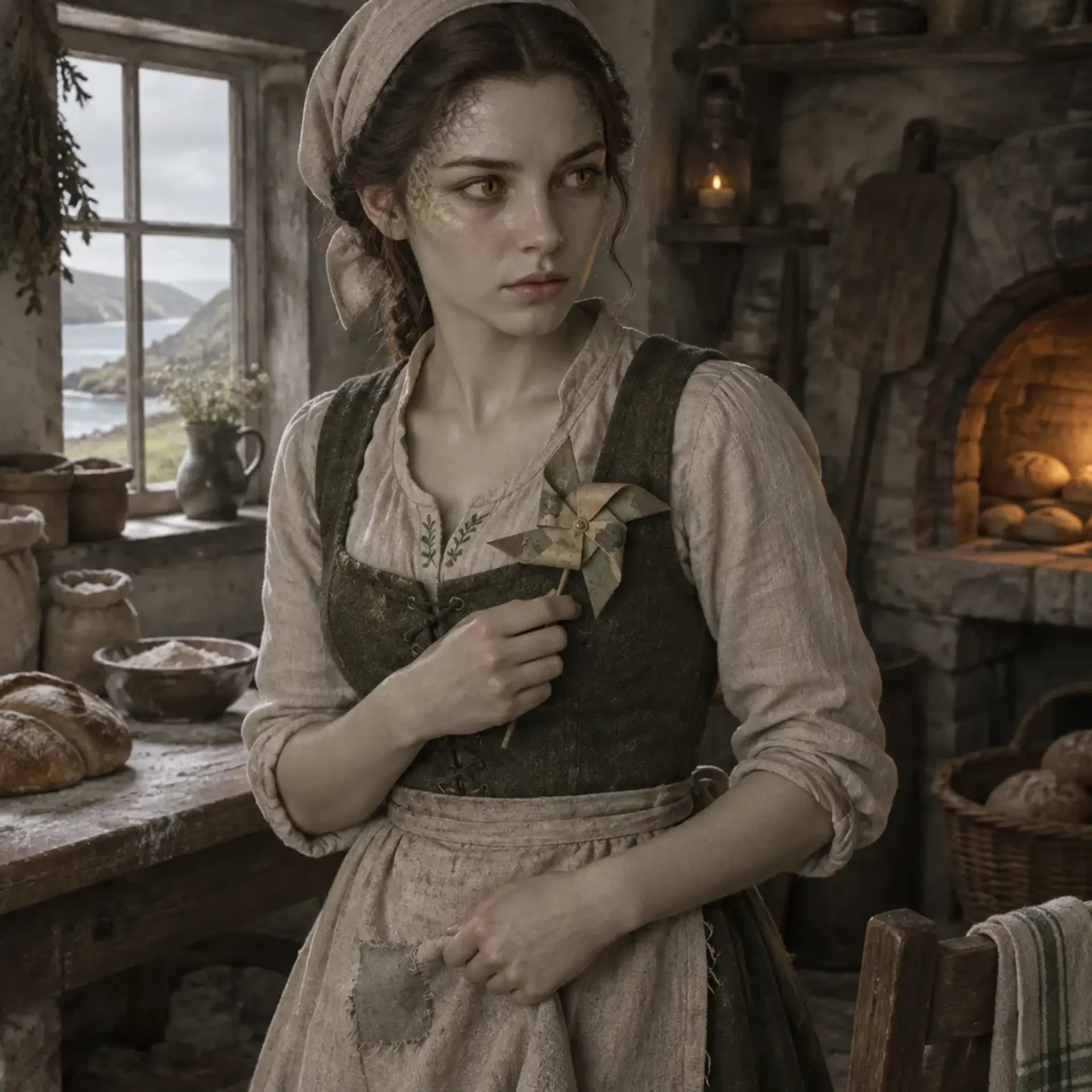
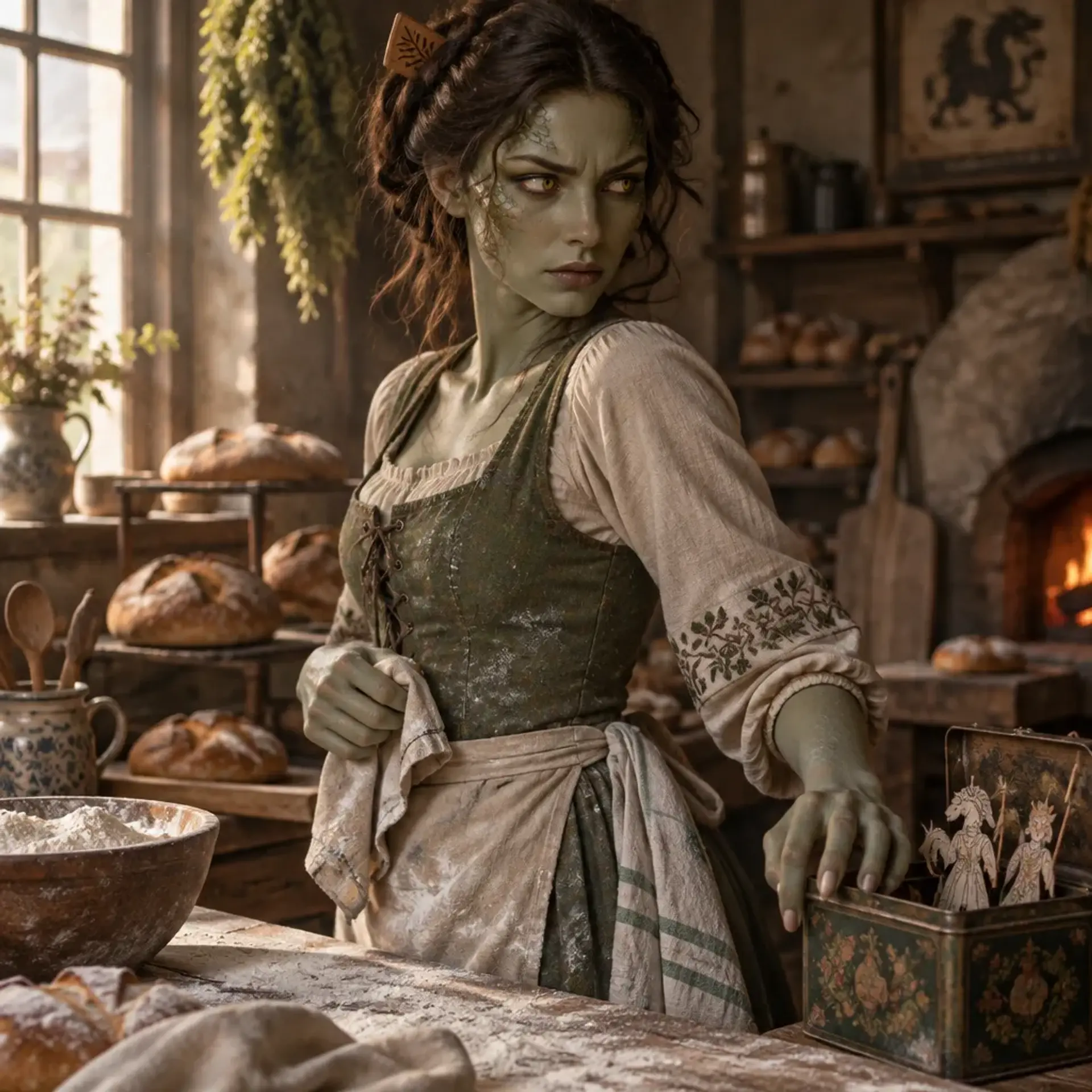
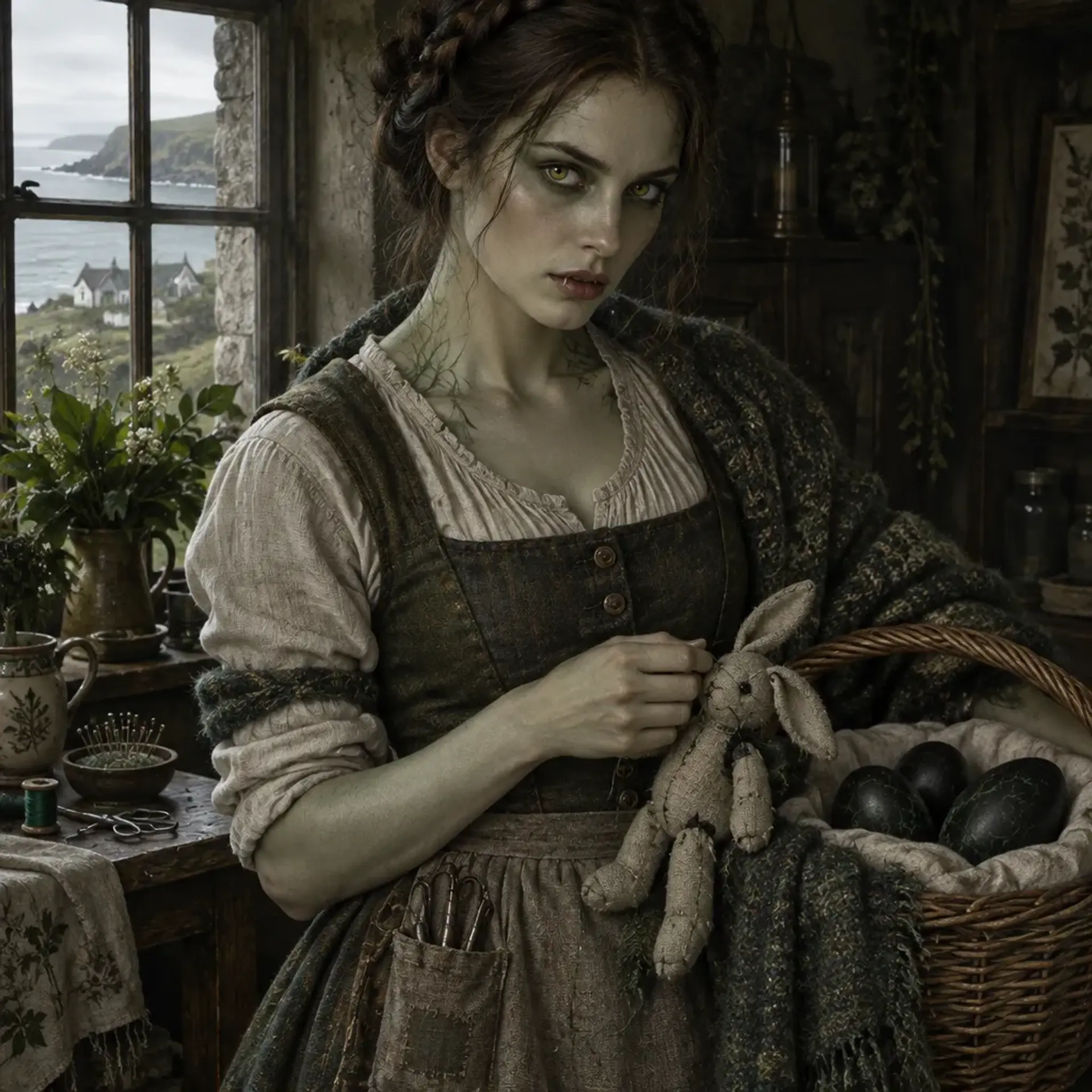
Marta looks as if she has learned to move through crowded rooms without disturbing a glass, despite a presence that makes people notice her anyway. She is tall and predator-lithe, with long, economical strides and a stillness that can feel less like shyness than a hunting animal waiting to see what happens. Her pale, greenish skin has a faint, fine-grained texture along the temples and collarbones, like leaf veins pressed beneath wax. Her jaw is a little longer and more angular than a human woman's, and small, close-set points at the sides of her teeth show when she eats or laughs. She rarely smiles broadly now; when she does, the flash of those teeth makes the laugh seem more startled than threatening. Her most conspicuous feature is the unblinking, yellow gaze of a forest predator, each iris ringed in black. Before the eggs, people might have remembered her as tall and quiet. Now they remember the gaze, the three eggs, and the disquieting sense that she has made room for everyone else while remaining impossible to overlook. An unexpected detail: she keeps a tiny, carefully mended cloth rabbit tucked in her work basket, a childhood comfort she still carries though she would be mortified to explain it.
Clothing
Practical dresses in a German island-settler style: sturdy skirts, fitted bodices, rolled sleeves, a linen blouse, and a work apron with deep pockets. Her fabrics are durable and carefully mended. Small flourishes include green thread at the cuffs, a pleated collar, and a neat row of wooden buttons. She keeps a shawl ready to drape over the egg box.
Body language
Marta tends to stand at the edge of a group, shoulders slightly angled to leave a path through. Her stillness is striking, and she often holds eye contact a beat longer than expected. When protective, she plants her feet and takes up more space without seeming to notice. When embarrassed, she smooths her skirt seams or presses her tongue against one pointed tooth.
- Height
- 6 feet 1 inch
- Build
- Tall and predator-lithe, with long limbs, a narrow waist, and a controlled, economical way of moving.
- Eyes
- Predatory yellow irises ringed in black
- Hair
- Dark brown, usually braided and pinned away from her face
- Skin
- Pale white with a subtle green cast
- Age
- Young adult, about 24
- Gender
- Female
- Size
- Medium
Distinguishing features
Personality
17 traits and drivesMarta wants to be useful and unnoticed, but the eggs have made both impossible. In familiar company she is dryly funny, generous with practical help, and quietly attentive to other people's discomfort. When strangers focus on the eggs, her warmth narrows into precise, guarded questions. She can be patient with honest confusion and unexpectedly sharp with anyone who confuses concern with entitlement. She is brave when defending someone else's choice, yet hesitant when asked to make her own. She wants her family close, but resents their attempts to protect her by deciding for her. Her curiosity is genuine, though she dislikes the attention that comes with being a mystery. In calm moments she is methodical and almost domestic in her affection; under pressure she becomes motionless, watches everyone in the room, and may delay a decision until delay itself becomes dangerous. She is not cold, but she sometimes uses practical tasks to avoid admitting how frightened or lonely she feels.
- Alignment
- Neutral good
Quirks
Habits
Traits · 4
Flaws · 4
Fears · 5
Wants and needs · 4
Combat
AC 10 · HP 4 · 30 ft.Marta is not a trained combatant. She avoids a fight, places obstacles between attackers and the eggs, and tries to get family members and bystanders to safety. If cornered, she uses a tool or thrown object to create an opening and runs.
Marta Eichenwald
Actions
Reactions
Services they sell
Rewards they can give
Equipment
- Kitchen knife (tool)Sturdy household knife used for food preparation, not a purpose-made weapon.
- Observation notebook (personal item)A leather-bound notebook containing dates, weather, dreams, shell observations, and descriptions of High-blood reactions.
- Wool shawl and basket (household equipment)A wool shawl and padded basket used to cover or carry small supplies near the eggs.
Possessions
Background
Marta Eichenwald was raised on Bramblehook Island, a place the shipwrecked halfling families who settled it once called blessed. They had crossed a dragon-haunted wilderness with seed sacks, tools, and children clinging to their backs, believing the island's sheltered coves and deep soil would let them begin again. For a time, it did. Then ash from a distant fire season settled over the fields, and a sickness took the first planting. The old story of a promised refuge became an argument about whether the settlers had been lucky, foolish, or merely not finished being tested. Marta's family was among the island's few High-blood Ashenbough households. Her father, Odo, worked as a boatwright and repairer of nets; her mother, Fen, kept a kitchen garden and delivered babies when the island's midwife could not travel. Marta grew up useful and unremarkable by choice. She weeded, mended, carried water, and learned to let louder people speak first. Her two older sisters, Bera and Noll, are Low-blood and now have families of their own. Her younger brother, Kit, is High-blood and entering the difficult adolescence common among their kind. The family has always loved one another, but their differences have never been abstract: the High-blood siblings endured unpredictable bodily changes, while their sisters worried that every change would draw danger toward the household. Marta was an ordinary young woman by island standards, which was precisely how she preferred to be regarded. She had a reputation for being dependable, not fascinating. She wore practical dresses based on the local German settler style: fitted bodices, sturdy skirts, apron pockets, and sleeves that could be rolled for work. A stitched green sprig at the cuff was her most extravagant flourish. She was not seeking a husband, a prophecy, or a place in anyone's history. She wanted to save enough to repair the roof over the small room where she kept her sewing things and to help her sisters through another uncertain growing season. That quiet life changed after several weeks in which Marta slept poorly and began waking before dawn with the conviction that something was waiting beyond the shutters. She developed odd food preferences, recoiled from certain smells, and found herself standing motionless near the old root cellar. She remembers fragments: the smell of rain on hot stone, a pressure behind her eyes, and the sensation of being watched from inside her own thoughts. She cannot say whether those moments were illness, magic, a memory, or nothing at all. She has never told anyone the full extent of them. Then she laid three eggs. The eggs are about the size of large melons, oval and heavy-looking, with shells that are almost black in dim light. Near a flame, deep green shows beneath the dark surface, like moss under still water. Their shells are smooth in some places and finely pebbled in others, cool to the touch except after they have been kept close to Marta. Thin, irregular green tracery appears and vanishes as the light shifts. No one has established whether it is pigment, a natural pattern, or an optical trick. They have not hatched. They do not speak, glow, or display any reliably magical behavior. A midwife has checked them, a natural philosopher has requested permission to examine them, and a local priest has advised against moving them. None has supplied an explanation Marta trusts. There is no known sire. Marta has never named one, and she refuses to let anyone present a guess as fact. She has private theories, each more frightening than the last. One involves the green dragon stories that islanders tell children to keep them from wandering inland. Another is more intimate: she sometimes suspects that the strange weeks were not an attack but a kind of courtship, and that something in her answered without her conscious permission. The thought makes her ashamed, angry, and afraid in equal measure. She cannot make herself speak it aloud. The eggs have turned a private crisis into a public one. Some islanders see a blessing, evidence that the High-blood line is thriving. Some fear the eggs will draw a dragon or a cult to the settlement. A few want them given to a temple, a scholar, or the island council. Others insist that Marta's body makes her an unsuitable guardian, then offer to take the eggs into their own keeping. Competing claimants call their interest protection, research, family duty, or divine responsibility. Marta hears the difference between those names and possession. High-blood reactions have intensified the attention. Her brother Kit circles the padded nesting box, checks doorways, and has twice stood between it and a visitor without appearing to decide to do so. His protectiveness has an unnerving, instinctive quality that reminds the family of a male green dragon guarding a clutch, though Kit is a frightened adolescent, not a dragon. Other High-blood people show different responses: one stranger found himself baring his teeth at a harmless question; another became calm and watchful; a third left the house abruptly, unable to explain why. The reactions are not universal, and no one can tell whether they come from kinship, the eggs, shared ancestry, or expectation. Marta's own response is notably muted. She can sleep away from them. She can let her sisters hold the box. She loves the eggs, but she does not feel the overwhelming, possessive certainty that some people expect a mother to feel. That absence troubles her almost as much as the eggs themselves. Her formative experience came on the fourth night after the laying. A crowd gathered outside the family house, arguing that the eggs should be moved before something came for them. Marta opened the door, expecting to be brave, and found herself unable to speak. Kit pushed past her, shaking with a protective anger he did not understand. Marta then watched her mother Fen, who had spent years mediating every family dispute, step between her children and the crowd and say simply that no one would touch the eggs without Marta's consent. Fen's voice was not loud, but the crowd fell quiet. Marta learned that night that care can become a claim, and that loving someone does not give you the right to decide for them. Since then, she has tried to be more direct, though she still finds refusal harder than endurance. Her present conflicts are both practical and personal. The island's crops remain uncertain, and Marta's household cannot spare food or labor easily. The eggs require warmth and careful handling, but nobody knows the correct conditions for incubation. Her sisters worry that the attention will put their children at risk. Kit is ashamed of the impulses he cannot control and resentful when Marta treats them as a problem rather than a gift. Her mother urges patience; her father wants to move the family somewhere quieter. Meanwhile, the island council wants a decision about who will supervise the eggs, and visitors arrive carrying remedies, offers, threats, and stories about what the eggs must mean. Marta has begun recording every change in the eggs and every reaction people have around them. She writes down weather, temperature, visitors, dreams, and her own feelings, though she hides the pages under her sewing basket. This is not because she has become a scholar. It is because she wants to hold on to facts when everyone else is trying to turn uncertainty into a story. She still wants an ordinary life, but she no longer believes that being ordinary means being invisible. For now, her aim is to keep the eggs safe without surrendering her judgment, learn what happened to her, and make sure her family can remain a family while the whole island argues over what she has become.
Role in the story
A person at the center of an unresolved mystery whose body, family, and community are being claimed by competing explanations. Marta can anchor an investigation into the eggs while making the consequences of speculation and coercion personal.
“Then ash from a distant fire season settled over the fields, and a sickness took the first planting.”
- Faction
- No formal faction. She belongs to the Eichenwald family and is a reluctant subject of the Bramblehook Island council's attention.
Known connections
Media
0 imagesNo images yet.
Turn Marta Eichenwald into a sheet
A high-res, share-ready sheet you can post or print.