Marta Eichenwald
Marta Eichenwald
At the table
Voice
Marta's voice has a dry rasp at its edges from flour dust and long hours near the bakehouse oven. It carries easily across a workroom without becoming loud. She has a habit of leaving a brief pause before answering personal questions, as if setting down a hot pan first. Her name itself is spoken plainly, without flourish.
She speaks in a practical, lightly island-inflected Common shaped by years of giving kitchen instructions over ovens and household noise. Her consonants are crisp, her sentences usually short, and she often names the concrete thing she means rather than reaching for a grand term. When speaking to children her words loosen and warm. When angry, she does not soften or grow hushed; she speaks more plainly, with a hard stop at the end of each sentence.
Speech patterns
How to play them
Approach Marta as a person first, not as a mystery to solve. Ask before entering the kiln room, explain what you intend to do, and accept that she may decline. She responds well to concrete offers of help, especially protection for her family or quiet time to work. She becomes guarded if people call the eggs a blessing, curse, or community property without asking what she thinks.
Goal
Keep the eggs safe without allowing the settlement to claim ownership of them, and discover what happened during the weeks before they were laid.
Motivation
To preserve her family's ordinary life and protect the eggs without letting fear, religious certainty, or political advantage define them.
Appearance
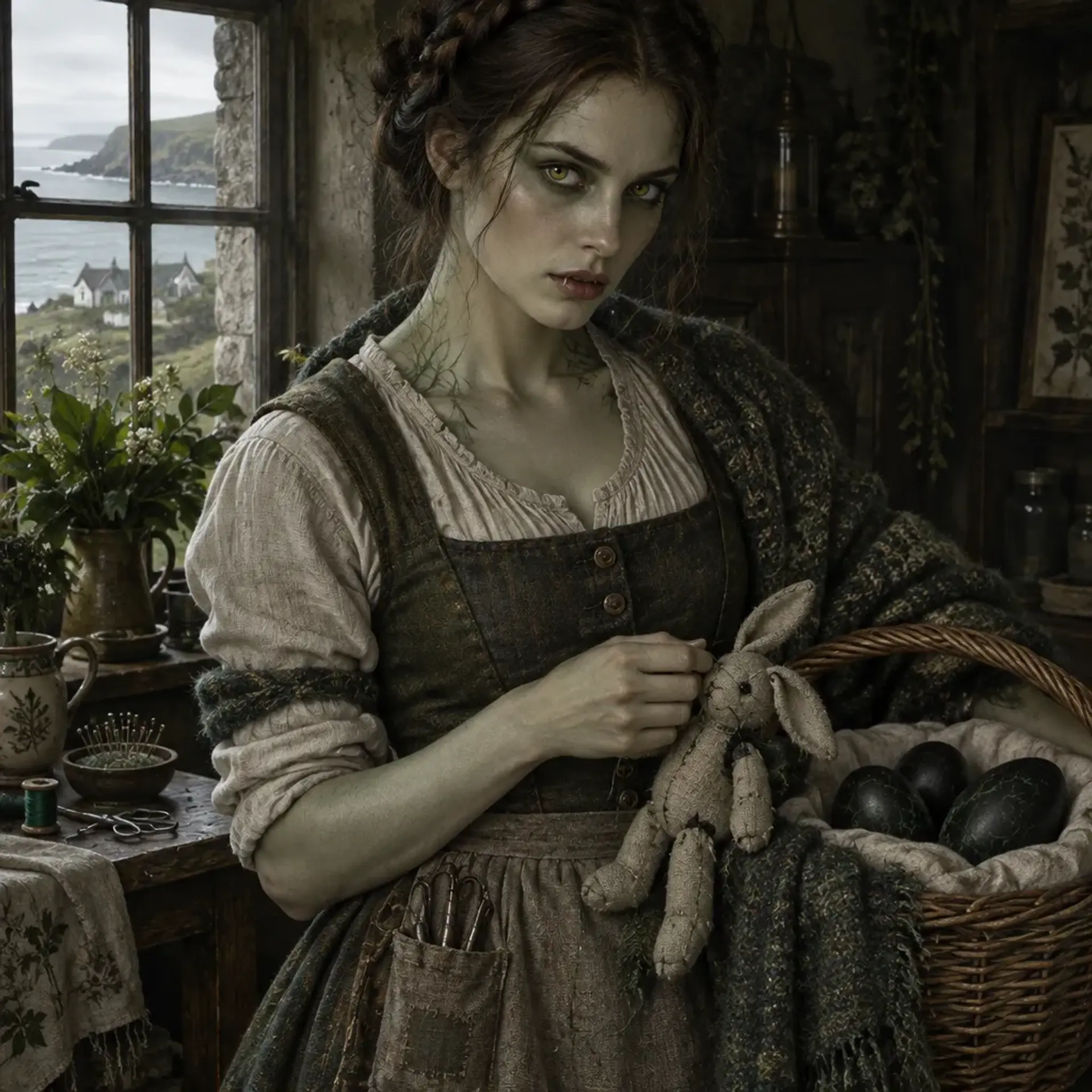
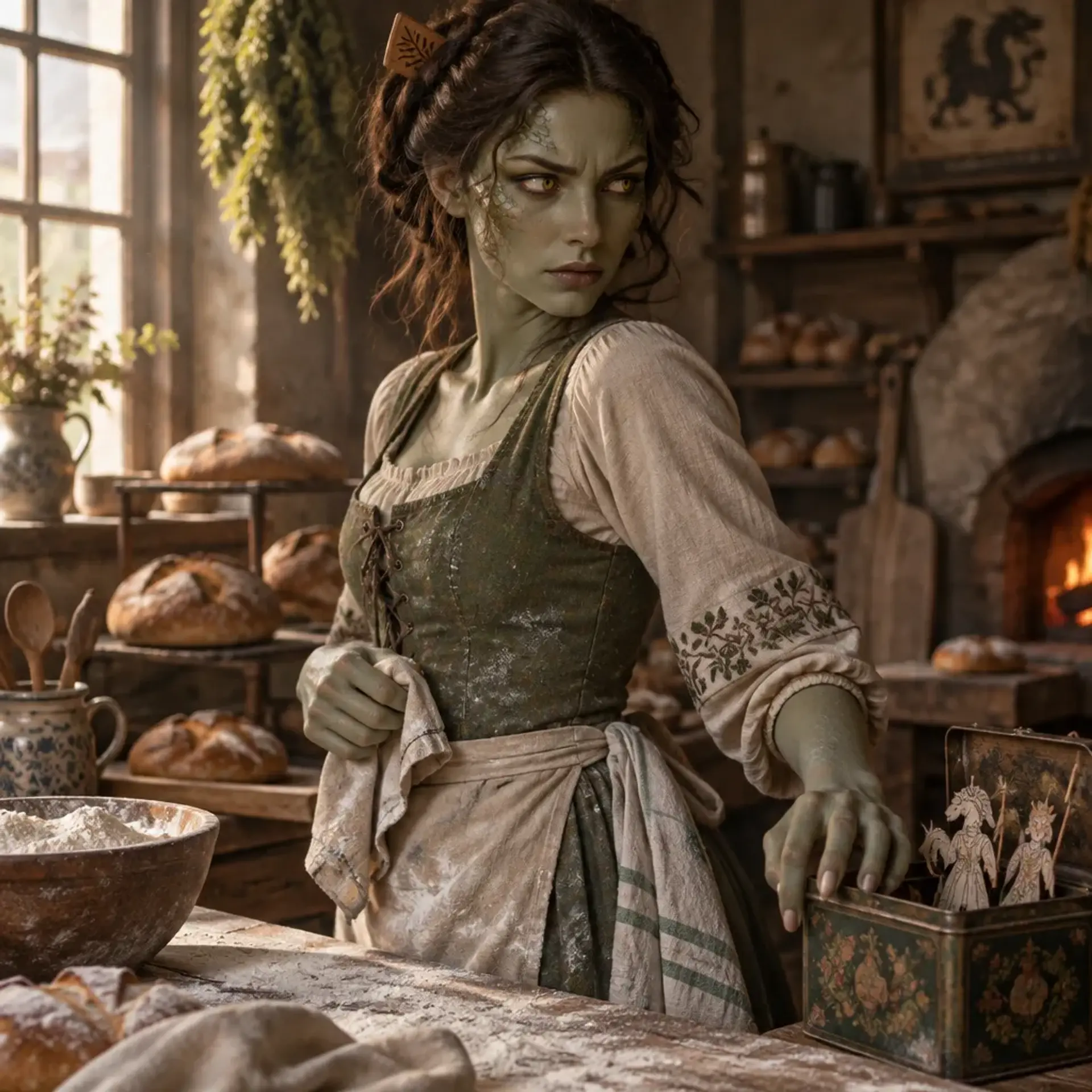
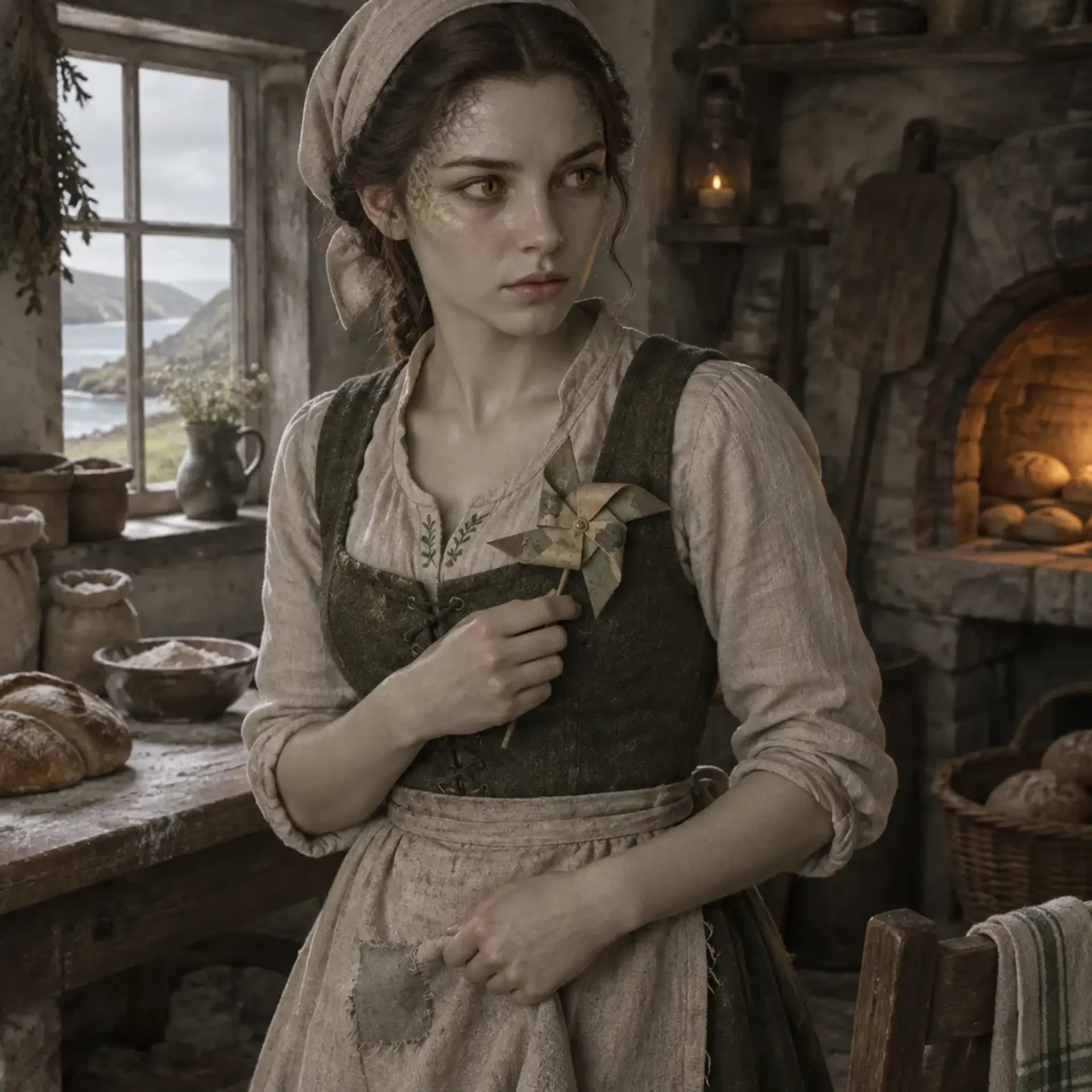
Marta has the alert, economical movement of someone accustomed to carrying water and turning at the sound of a child in trouble. Her pale green-white skin has a faint matte sheen, like river stone dusted with flour, and small, close-set scales stipple her temples and the backs of her shoulders. Her long limbs and narrow waist give her a predator's lithe outline, but her habitual, slightly forward posture makes her seem less imposing than she is. She walks quietly, placing each foot with care, then can pivot with startling speed. Her three eggs have made her famous; she responds to being stared at by checking the nearest door, as if celebrity were a draft she might shut out. The most unexpected thing about her is the little paper windmill she keeps tucked into her bodice, a silly toy she makes for children and repairs rather than replacing.
Clothing
Practical German-style dresses in sturdy linen and wool, with a fitted bodice, full skirt, apron, and sleeves secured above the wrists for work. Her clothes are well-kept but repeatedly altered as her body changes. One small embroidered green sprig at the collar is her only flourish. The left edge of her apron is worn nearly smooth from rubbing the same spot while thinking. Her paper windmill is tucked into the bodice.
Body language
Marta keeps her elbows close and her shoulders slightly forward, not quite hiding herself but making a smaller target. Her eyes move to hands before faces. When alarmed, her fingers press against the worn seam of her bodice. Around family she leans in and touches shoulders; around strangers she leaves a careful arm's length. Her protective instincts show as placement: she quietly puts herself between the eggs and whoever is approaching.
- Height
- 5 feet 8 inches
- Build
- Lithe, long-limbed, and wiry, with a narrow waist and the balanced posture of someone accustomed to carrying trays.
- Eyes
- Draconic yellow with black, slit pupils
- Hair
- Dark brown, usually braided close to her head and pinned beneath a practical kerchief
- Skin
- Pale white-green, with a faint stone-like sheen
- Age
- Young adult, about 23
- Gender
- Female
- Size
- Medium
Distinguishing features
Personality
17 traits and drivesMarta wants to be useful and unnoticed, yet the moment someone vulnerable is cornered she steps forward and accepts the attention she usually hates. In calm company she is matter-of-fact, gently funny, and good at making a visitor feel fed before they feel questioned. When watched, she grows formal and stubborn, answering only what was asked. Fear does not make her meek: it makes her exact. She will admit uncertainty, but resents being told what her uncertainty means. She is tender with children and impatient with adults who use grand language to conceal practical demands. She can be generous with food and time, then fiercely protective of her privacy. She wants her family close, but bristles when they make decisions for her. Marta distrusts spectacle, though she is capable of bluntly confronting a crowd if the eggs or her siblings are threatened. In private, she worries that her wish to return to ordinary work is cowardice; in public, she treats that ordinary life as something worth defending.
- Alignment
- Neutral Good
Quirks
Habits
Traits · 4
Flaws · 4
Fears · 5
Wants and needs · 4
Combat
AC 11 · HP 9 · 30 ft.Marta avoids combat. She tries to get between danger and the eggs or her family, then uses a chair, doorway, or table to delay an attacker while others escape. She throws a stone only to interrupt a pursuer and will surrender rather than risk serious injury. If cornered, she fights with a wooden ladle and tries to break away.
Marta Eichenwald
Actions
Reactions
Services they sell
Rewards they can give
Equipment
- Wooden ladle (improvised weapon)A plain wooden serving ladle, used at the bakehouse and carried when she must cross the settlement after dark.
- Work apron (clothing)A sturdy apron with flour in its seams and a smooth, worn patch at the left edge.
- Paper windmill (personal keepsake)A patched paper toy she makes for children; it is not magical.
- Bakehouse key (tool)A small key to the bakehouse store cupboard, returned after each shift.
Possessions
Background
Marta Eichenwald was born on the island after her parents and a handful of other halfling families crossed a dragon-haunted wilderness in the holds of a wrecked coastal vessel. The settlers called their refuge Ninth Marker, after a survey post they found on the island's ridge. The name was practical, not hopeful. They had been promised good soil, fresh water, and a season without pursuit. They found all three, briefly. Then ash began to fall from the old volcanic heights, and a sickness blackened the roots of their first reliable crop. Marta grew up in the years of recovery, when every household learned to mend, preserve, and share. Her parents, Ansel and Zsuzsa Eichenwald, raised four children in a house built around an old kiln. Marta was the third: younger than her Low-blood sisters, Heda and Sella, and older than her High-blood brother, Vitek. Heda married a careful cooper and has two children; Sella runs a small smokehouse with her partner. Both sisters have families of their own and regard Marta as capable, stubborn, and too practiced at saying she is fine. Vitek is still in the difficult stretch of High-blood adolescence. His scales come and go in uneven patches, his appetite changes by the week, and lately he has taken to watching the family pantry as if it were a territory he must defend. Marta's own adolescence was less dramatic than Vitek's. She developed yellow eyes with black, slit pupils and a dusting of scales, but no wings, claws, or tail. Her parents taught her to cover her eyes with a broad hood when curious strangers came through. She learned bread work and household accounts, and discovered she liked a life whose important events were a repaired roof or a loaf that rose properly. In her early twenties, she was known as reliable rather than remarkable. She liked it that way. The change began with several weeks of strange behavior. Marta woke before dawn and stood outside facing the island's northern cliffs. She forgot simple errands, then remembered details no one had told her, such as which storehouse had damp grain. She grew nauseated at the smell of fish and craved bitter leaves. Sometimes, she said, she could hear a slow tapping beneath the ground. She was embarrassed by these changes and told her family little. Her brother noticed anyway. Vitek began pacing around her chair, carrying food to her without being asked, and glaring at anyone who came too close. His behavior had the watchful, possessive quality of a green dragon guarding a nest. Marta's reactions were far weaker: she felt a pull toward sheltering what was inside her, but the instinct arrived mixed with fear and a fierce wish to be left alone. Then she laid three eggs. It happened in the old kiln room during a storm. Her mother and Sella were present; no one else was admitted until the family had settled Marta and wrapped the eggs in warmed wool. The eggs were larger than a hen's, smooth and faintly mottled, their shells the muted color of green glass seen through ash. They were not visibly moving. They were not obviously magical. A healer examined Marta and found her exhausted but not dying. No one could identify a sire, a process, or even whether the eggs were natural. Marta had no memory of an encounter that could explain them. She cannot say whether they were conceived, planted, or brought forth by some peculiarity of her blood. The news escaped within two days. Some islanders called the event a blessing, proof that the dragon's old gift had become something new. Others feared that a green dragon had marked the family, or that the eggs would hatch into danger. A local healer, Dren Szik, wants to examine them under controlled conditions. A speaker for the settlement's worried families, Borsz, wants the eggs moved to a guarded storehouse. Marta refuses both demands unless she is present. Her sisters support her, though Heda argues for quiet and Sella argues for public witnesses. Her parents are divided between keeping the family together and keeping the island from splitting over their daughter. The competing claims have made Marta's ordinary work nearly impossible. People stop her in the lane to ask what the eggs mean. Visitors bring charms, threats, and gifts. Her employer has kept her place at the communal bakehouse, but she cannot work a shift without someone trying to look through the door. Marta's current problem is not simply identifying the other parent. She must protect the eggs from being treated as property, omen, or weapon while deciding whether she can trust anyone to investigate what happened. She has theories. One is that the eggs are connected to the green dragon whose shadow shaped the settlers' flight and whose influence still lingers in the island's stories. Another is that someone deliberately interfered with her, perhaps through a ritual, a drug, or a hidden visit during her strange weeks. There is also a thought she refuses to complete: that some part of her knew the unknown sire, or knows now, and that naming the possibility would make it real. When pressed, she looks toward Vitek, then away. Her brother's instincts seem to recognize the eggs as a nest. Marta's do not. She cannot tell whether that difference means he is safer, more deeply changed, or simply more honest about what he feels. Marta is trying to keep her family from turning into factions. She wants her sisters' children to play outside without being used as leverage. She wants Vitek to have room to grow without being made into a symbol of what High-blood people might become. She wants the eggs examined, but not taken from her. And, privately, she wants to return to a life where a chipped bowl and a failed loaf are the worst things anyone expects her to explain.
Role in the story
Marta is the human center of a community mystery. The unexplained eggs can draw investigators, opportunists, fearful neighbors, or agents of a dragon, while Marta's family relationships keep the stakes personal. She may become a cautious ally, a protected witness, or the person who refuses to let the party decide what her future means.
“The settlers called their refuge Ninth Marker, after a survey post they found on the island's ridge.”
- Faction
- A member of the close-knit settlement at Ninth Marker, with no formal faction allegiance. Competing island families have tried to claim authority over the eggs.
Known connections
Media
0 imagesNo images yet.
Turn Marta Eichenwald into a sheet
A high-res, share-ready sheet you can post or print.