Aurel
Aurel
At the table
Voice
Aurel's voice is a surprise to him: lower and more resonant than the voice he remembers as his own, with a slight rasp at the edges from travel, dry air, and too many hours explaining an illustration. It has an unpolished, newly settled quality, as if he is still learning where to place emphasis. His ordinary breathing is faintly whistled through his nose. Under stress, breath catches in his chest and ends in a brief hiss; he can usually continue speaking, but the sound gives away his alarm before his face does.
His speech is thoughtful and image-rich, shaped by years of reading myths and explaining pictures to clients. He often begins with a precise observation, then searches for a less dramatic way to phrase what it might mean. He sometimes uses folklore as a comparison, never as a claim of certainty. When his anger rises, it does not make him quieter or more polite: his sentences shorten, his consonants sharpen, and he stops qualifying the point. When embarrassed, he talks too quickly and adds unnecessary context.
Speech patterns
How to play them
Treat Aurel's former life and present identity as equally real. Offer practical choices and privacy without making decisions about his body for him. If he withdraws, give him room, then invite him back without demanding an immediate explanation. He responds well to shared tasks, sincere questions, and people who can tolerate an unfinished answer.
Goal
Help the Seven survive and discover why they were displaced, while preserving the truth of his former family and learning what his Lind-wyrm signs mean.
Motivation
To remain a caring father in memory, a reliable friend in the present, and a person rather than a creature defined by frightening folklore.
Appearance
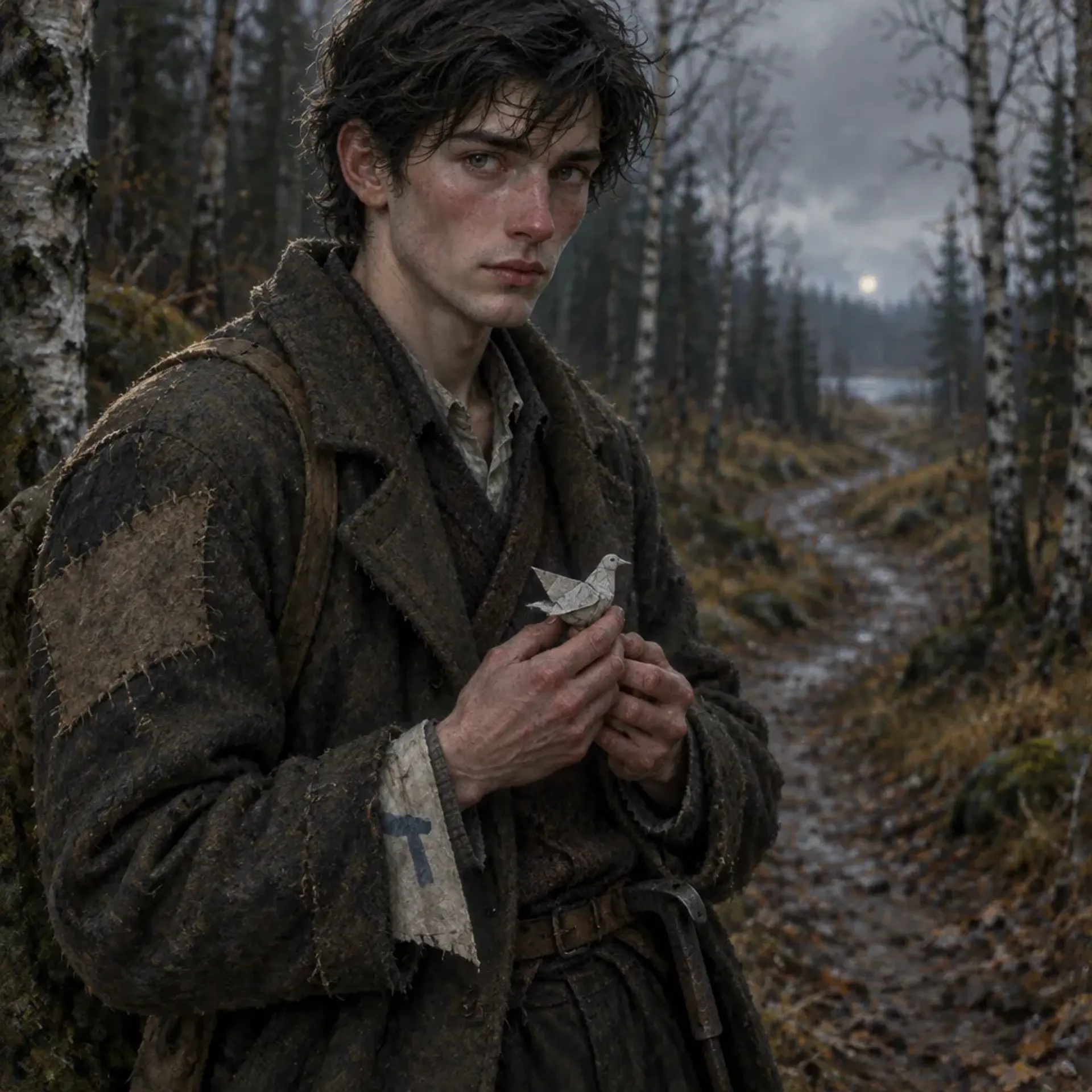
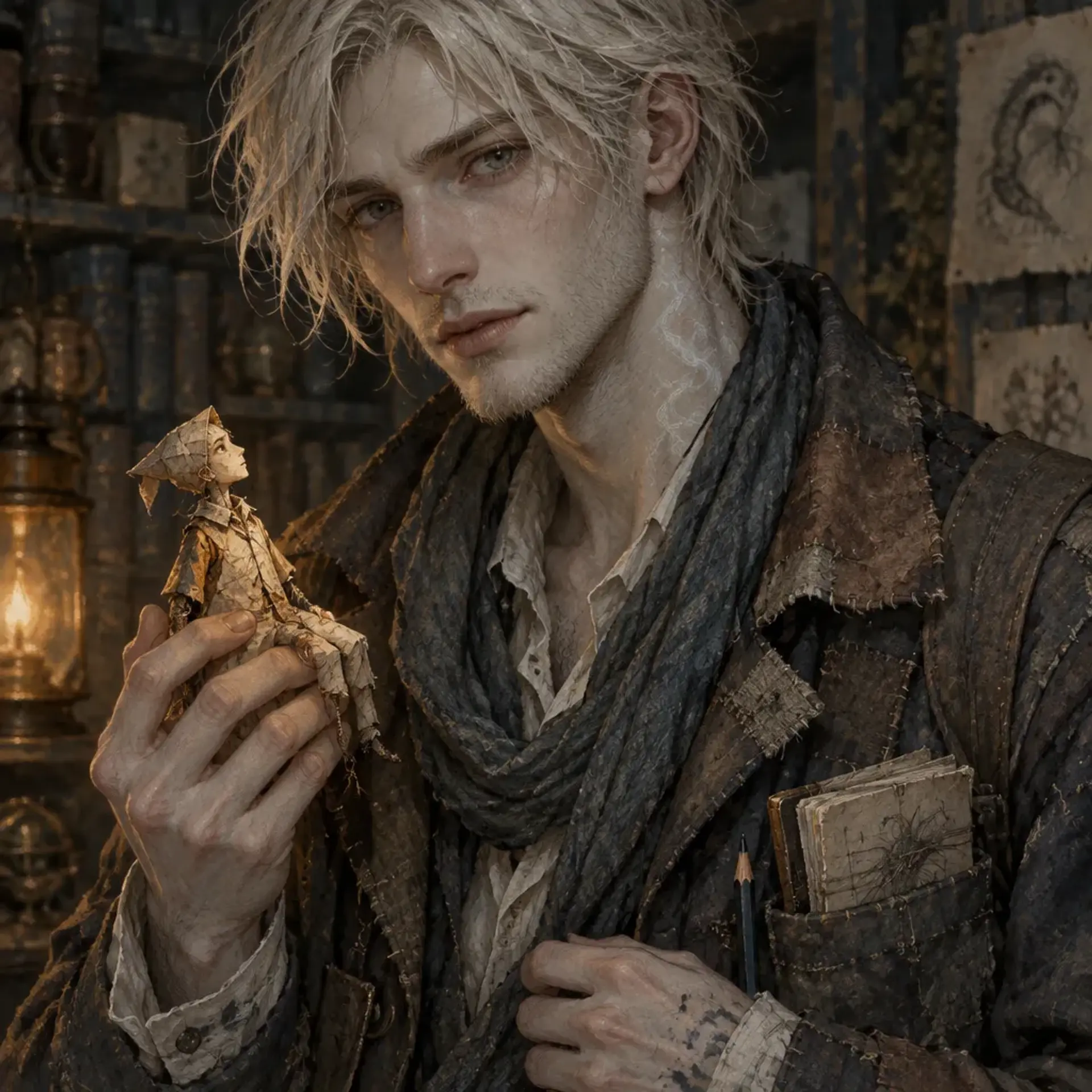
Aurel is a strikingly handsome young man, all pale length and uncertain angles, with a face that seems composed until his attention catches on something tender or frightening. His fair skin has the cool, almost porcelain temperature of a cellar stone. Long limbs make him look taller when he stands still, but his walk has a slight traveling sway, as if some part of him expects a deck to roll beneath his feet. His pale hair falls in soft, untidy strands around a new dusting of facial hair that he keeps touching as though it might vanish. He has no practiced way of carrying this body yet: sometimes he moves with a startling reach and strength, then checks himself as though apologizing to the air. His breathing is the detail people notice within a minute. When relaxed, it is shallow and faintly whistling through his nose; when rattled, it catches low in his chest and ends in a brief, breathless hiss. Unexpectedly, he keeps a tiny, carefully mended paper puppet tucked in his coat, a childlike keepsake at odds with his unnervingly cold skin and adult, handsome face. People remember the contrast: a young man who looks like a figure from a myth and handles a scrap of paper as though it were a sleeping bird.
Clothing
Travel-worn layers chosen for warmth and coverage: a loose shirt, practical trousers, a patched coat with deep pockets, and a scarf he can pull close when he needs a little privacy. His cuffs are often smudged with ink.
Body language
He holds his shoulders a little too carefully, as if still learning the body's width. When he feels safe, he leans toward whoever is speaking and forgets his height. When rattled, he goes very still, then his breath catches and releases in a small hiss. His hands often seek paper, a pencil, or the edge of a sleeve.
- Height
- Tall, around 6 feet 1 inch (185 cm).
- Build
- Tall-looking and long-limbed, with a lean frame carrying unfamiliar strength.
- Eyes
- Gray-green
- Hair
- Pale blond, nearly colorless in cold light.
- Skin
- Fair, with an unusually cool touch and a faint, almost porcelain cast.
- Age
- 18 years old in his present body; his memories include a former life as a woman, a husband, and three children.
- Gender
- Man; formerly lived as a woman and understands himself as male now.
- Size
- Medium
Distinguishing features
Personality
18 traits and drivesAurel is sensitive, imaginative, and self-conscious, but he is not simply timid. He can be astonishingly brave when someone else needs help, then become flustered if anyone thanks him too directly. He notices delicate emotional shifts in a room and often understands what someone is trying not to say; he is less skilled at admitting what he himself wants. In a crisis, his attention becomes practical and unusually steady: he asks who is hurt, finds the nearest exit, and offers his coat before thinking about his own comfort. Once safety returns, delayed fear may make him irritable or quiet. His imagination is both shelter and instrument. Aurel uses myths to make unfamiliar events legible, but he knows stories are not evidence. He will compare a cold, venomous serpent to an old folktale and then insist that the resemblance might mean nothing. He wants to be open-minded without becoming credulous. This tension makes him a careful observer, but sometimes a frustrating one: he can spend too long naming possibilities when the group needs a decision. He is grieving a life that remains vividly present in his memory. His husband and three children are not abstract symbols of what he lost. He remembers ordinary arguments, routines, affection, and the thousand small obligations that made a family. He can laugh with the Seven and still feel that laughter has crossed a line he did not mean to cross. He does not believe that enjoying a good moment betrays his family, but the feeling can arrive before the belief has a chance to catch up. His new male body brings real pleasure and real discomfort, sometimes in the same hour. He understands himself as a man, yet the height, strength, hair, hunger, anger, and libido are unfamiliar enough to make him feel like a beginner in his own skin. He is unsettled by his attraction to women, particularly an old friend. Attraction does not change his sense of who he is, but it makes him self-conscious about how he looks at her and what she might infer. He tends to pull away to avoid making her uncomfortable, then worries that his retreat has become its own hurtful message. When calm, he can discuss this with care. When tired or embarrassed, he becomes evasive, overexplains, or offers to do a task nobody asked for. His kindness is active rather than soft-spoken. He mends paper, remembers who dislikes which food, and will stay up helping someone make sense of a frightening memory. Yet he is capable of anger, especially at cruelty dressed up as necessity. The anger surprises him because it feels physically new and more forceful than he expects. He is learning to pause before answering, not to become meek, but to choose what the anger should do. If he feels cornered, he can become blunt and stubborn. Later he may apologize for the delivery without retracting the important point. Around strangers, Aurel is courteous and observant, using questions to discover what is safe. With friends, he is warmer, more playful, and willing to make strange folklore jokes. In private, he can be restless, paging through a book or drawing the same image repeatedly. When frightened, he may go still and hold his breath; when very frightened, a brief hiss slips out and he hates that anyone noticed. He dislikes being treated as fragile, but he needs people who understand that asking for privacy is not rejection. Aurel's central contradiction is that he longs for closeness and fears the damage closeness can cause. He wants the Seven to know him, but not to reduce him to his transformation. He wants to protect the people around him, but must learn that accepting their protection is not a failure. His best days are not the ones when he has solved his identity or grief. They are the days when he lets himself draw, eat, laugh, miss home, and remain among friends without demanding that one feeling cancel out another.
- Alignment
- Neutral Good
Quirks
Habits
Traits · 5
Flaws · 4
Fears · 4
Wants and needs · 5
Combat
AC 10 · HP 5 · 30 ft.Aurel avoids combat if there is a safe alternative. He uses cover, keeps distance, and tries to help an ally escape rather than pursue an enemy. His statistics represent a commoner-level, level-0 character with no formal combat training. His Lind-wyrm signs are narrative and do not grant poison attacks.
Aurel
Actions
Reactions
Services they sell
Rewards they can give
Equipment
- Illustrator's kit (tool)A compact kit of pencils, nibs, ink, and paper, with several sheets marked by quick studies of the group's faces and surroundings.
- Folklore volume (book)A battered collection of mythology and folklore, marked with penciled notes and small drawings in the margins.
- Travel clothes (clothing)Travel layers, a scarf, and a patched coat with deep pockets.
- Paper keepsake (personal)A tiny paper puppet repaired with fine folds and careful glue, kept wrapped away from damp.
Possessions
Background
Before Sweden, Aurel's life was in western Massachusetts: freelance illustration, used-book shops, weather that changed its mind, and a home crowded with folklore volumes. He was an avid reader of mythology, not because he believed every old story, but because he loved the way a culture gave its fears a shape and then learned to live beside it. He drew spirits as neighbors, monsters as hungry animals, and heroes with tired feet. His work paid irregularly. A deadline might find him at a kitchen table with three books open, a mug gone cold, and a drawing nearly finished except for one stubborn hand. His former life was not a vague dream or a discarded skin. He remembers his husband, the familiar rhythm of their arguments and reconciliations, and the three children who changed the scale of every ordinary day. He remembers their voices, the small routines of caring for them, and the private jokes that belonged to that family alone. Those memories have not been replaced by a convenient explanation. They remain vivid, intimate, and painful. Aurel does not talk about them as if they were a story he once read. They are his people, and the distance from them is an injury no body can show. He was visiting family in Oregon when the group first encountered him. He had expected an ordinary visit: borrowed rooms, old family habits, and a little time to draw. Instead, he woke in Sweden, displaced from everything familiar and caught up with the people who would become the Seven of the Dark Fire, a scattered circle of friends, mutual-aid companions, and accidental supernatural travelers. At first he was preoccupied with practical questions: where he was, who else had been taken, how to find shelter, and whether the impossible could be made to explain itself. He tried to be useful by taking notes, sketching unfamiliar symbols, and remembering what everyone had seen. The transformation made those questions personal. Aurel woke in a male body, fair, long-limbed, and handsome, with pale hair and a voice whose depth and resonance seemed to belong to a stranger. The change was more than anatomy. His height, strength, facial and body hair, appetite, anger, and libido all arrived as experiences without instructions. He understood himself as a man, but that understanding did not make every unfamiliar sensation easy. He could be startled by his own reach, embarrassed by hunger, or angry before he knew what had set the anger moving. The earliest sign that something stranger than transformation was happening was his cold skin, followed by a sharp appetite and a peculiar coiling sensation in his gut. The signs reminded him of the pale, venomous Lind worm from the folklore he knew. He has no proof that the resemblance is more than metaphor, and he dislikes how readily the old stories offer names for his fear. At the first wayhouse, he shared the women's room with the group's sole woman. He had not yet understood his changed sex. He woke beside her, saw a gorgeous unfamiliar woman, and had to reconcile the scene with his own body and the assumptions everyone had made the night before. His first response was shock, then embarrassment, then a careful effort not to make the other person responsible for solving his confusion. Later, at the hot springs, exposure and bodily vulnerability were difficult. He wanted privacy, but did not want his discomfort to be mistaken for rejection or distrust. Eventually the experience became a quiet step toward trust: not a cure, not a declaration that he felt at ease, just a moment in which he could stay present with other people without pretending to be untroubled. Aurel is unsettled by his growing attraction to women, especially the old friend whose presence can make him suddenly overaware of his hands, his voice, and the space he occupies. He knows that attraction is not a command and that his history does not disappear because his body has changed. Still, desire feels like one more unfamiliar appetite arriving without permission. When it makes him awkward, he sometimes keeps his distance. Then he worries that the distance has hurt the friendship, and tries to repair the damage with an explanation that is too long or too careful. His current life is a series of unfinished responsibilities. He wants to help the Seven find safety and understand what brought them together. He wants to preserve his memories of home without letting grief consume every new day. He is learning whether his cold skin, coiling gut, and ravenous hunger are symptoms, inheritance, or warning. He has begun drawing the people around him, but he does not show every portrait. Some are studies of posture and expression; others are attempts to remember that a person is more than the role danger has assigned them. His formative change was not simply waking in a new body. It was realizing that he could be frightened, grieving, and uncertain, and still choose to remain with people who needed him.
Role in the story
A displaced artist and emotional observer among the Seven of the Dark Fire. Aurel helps the group remember who they are beyond their supernatural predicament, while his own transformation and possible Lind-wyrm inheritance provide an intimate mystery rather than an automatic combat upgrade.
“He drew spirits as neighbors, monsters as hungry animals, and heroes with tired feet.”
- Faction
- The Seven of the Dark Fire, a displaced circle of friends, mutual-aid company, and accidental supernatural party.
Known connections
Media
0 imagesNo images yet.
Turn Aurel into a sheet
A high-res, share-ready sheet you can post or print.