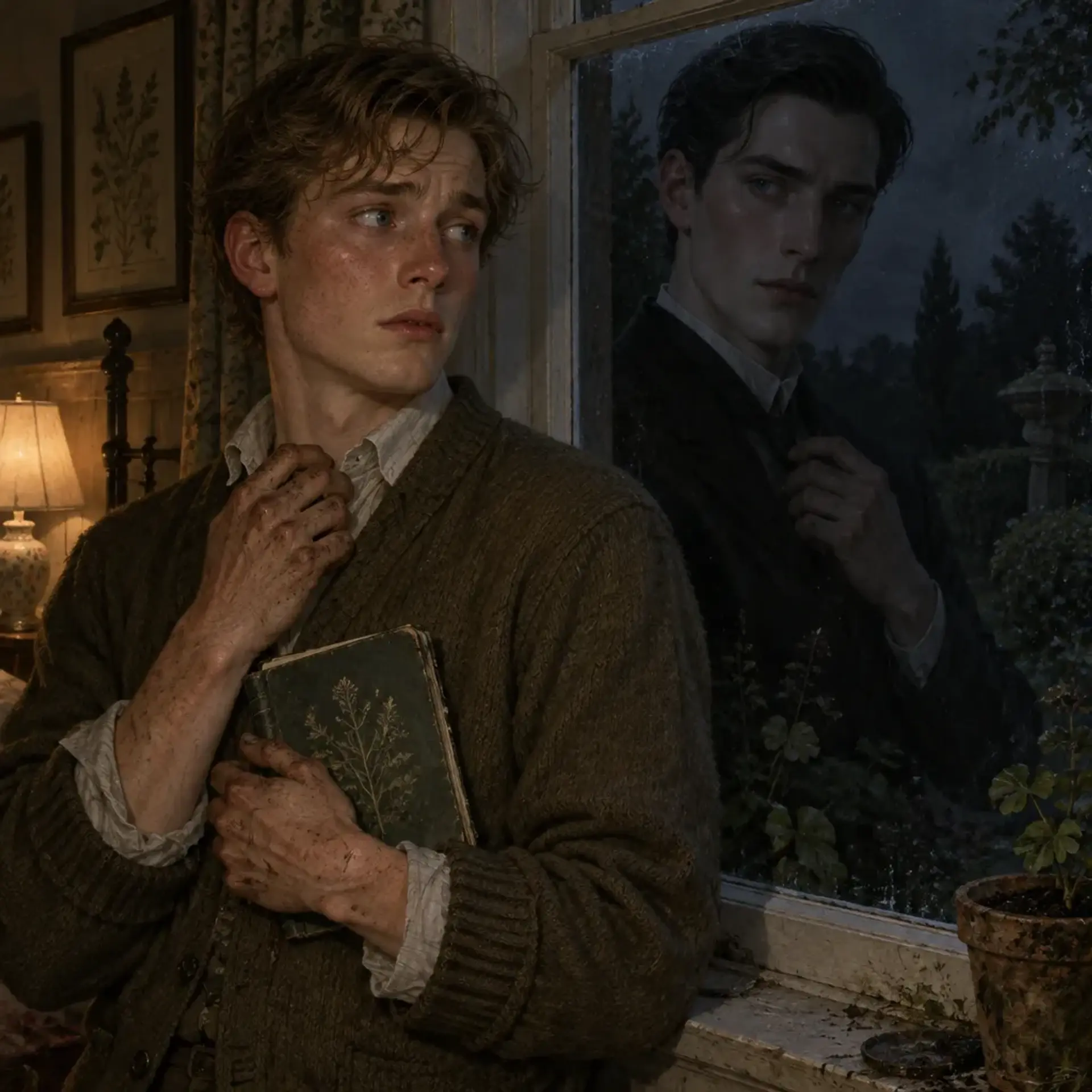
William Windon
William Windon
At the table
“She notices what is neglected.”
Voice
William speaks with a young man's clear, slightly breathless voice, the sound of someone accustomed to outdoor work and conversation at close range rather than speeches. When tired, he catches on consonants and starts again. The reflection's voice comes through the same body but has a deeper, older texture, with dry edges and careful enunciation. It sounds as if it learned politeness from another century and sarcasm from watching William's neighbors. Neither voice becomes quiet or polite simply because it is angry; anger makes William speak faster, while the reflection becomes more exact.
William's speech is local and plain, shaped by family life, estate work, and the need to explain himself without sounding fanciful. He tends to answer carefully when discussing the heart, then rushes his words if he thinks he is being disbelieved. The reflection uses William's mouth but sounds like an older generation: deeper, more clipped, and formally assured, with an accent that does not quite belong to William. Its comments often arrive as dry asides, precise corrections, or observations framed through weather, tides, and forge work. The name William is spoken in William's ordinary voice; the reflection has not supplied a separate name.
Speech patterns
How to play them
Approach William with patience and directness. Ask before looking into mirrors with him, and do not treat the reflection as a joke after it has acted independently. He responds best to practical help, honest questions, and respect for his fear of another collapse. If the reflection speaks, address it plainly without assuming it is a ghost, a demon, or William pretending. Do not force William to choose between himself and the stranger in public. Adaline, Elizabeth, and his friends are emotional pressure points, so threats toward them may prompt the reflection to intervene.
Goal
Find the missing heart, locate Abraham Gorff despite his move to Canada, and learn whether the reflection can be understood without allowing it to take over William's life.
Motivation
William wants a future as a botanist, ordinary affection with Adaline, and the right to decide what happens to his own body. The reflection wants to understand its surroundings, recover something of its past, and remain close to the life it has found, though it may not understand what William must lose for that to happen.
Appearance
William Windon is a young Wiltshire man with a sturdy gardener's frame, brown-spotted fair skin, and dark blond hair that will not lie flat for long. His blue eyes keep returning to windows, polished kettles, and other people’s spectacles, not because he is vain but because he is checking who is looking back. He stands as if trying not to take up room, then unconsciously blocks a doorway when the reflection takes interest in a conversation. His hands have the roughened pads and fine scratches of estate work, with soil often caught at the nail edges. The surprising detail is that he has an almost fussy, old-fashioned care for his collars and cuffs, despite the mud on his boots and the practical clothes of a gardener. In mirrors, dark water, or glass, his face is replaced by a different young man: long-faced and handsome by a severe English standard, with neatly combed short black hair trimmed at the sides, moonlit blue eyes, and an expression that seems to have judged the room before entering it. The reflection's features are structurally unlike William's, not an altered version of his face. When it moves, its gestures are a fraction too deliberate, as though it is trying to remember how a living person occupies a body.
Clothing
Practical work clothes suited to an estate gardener: sturdy trousers, boots that carry traces of soil, plain shirts, and a serviceable jacket. He tries to keep his cuffs and collar neat. During bed rest he wears ordinary indoor clothes and often has a cardigan within reach. The reflection disapproves of rumpled collars and will sometimes straighten William's posture or clothing without asking.
Body language
William keeps his elbows close and gives other people room, but often plants himself in a doorway as if unconsciously guarding it. He rubs soil from his nails when worried and touches his collar when embarrassed. The reflection's posture is more upright and proprietorial: chin level, shoulders squared, eyes tracking the person with the most authority in the room. When it takes over, William's habitual fidgets stop abruptly, which is usually the first visible warning.
- Height
- Not specified; an ordinary young adult man, with no exceptional height.
- Build
- Sturdy and work-hardened, with the callused hands and practical strength of a gardener, currently weakened by recovery and bed rest.
- Eyes
- William's eyes are blue. The reflection's are a different, cool blue, like moonlight over a freshwater pond.
- Hair
- William's hair is dark blond, usually untidy after work. The reflection's hair is short, black, carefully combed back, and trimmed at the sides.
- Skin
- Fair skin with brown freckles and spots, often reddened from outdoor work.
- Age
- Young adult
- Gender
- Male
- Size
- Human, ordinary adult size
Distinguishing features
Personality
23 traits and drivesWilliam is proud of his work and quietly ambitious, but becomes self-conscious when people treat his botanical studies as a childish hobby. He wants to be kind, especially to family and people who are embarrassed, yet he can become defensive when he feels watched or patronized. He is more patient with plants than with people because plants do not demand that he explain himself. In company he tries to be ordinary and agreeable; alone, he argues aloud with the reflection and can be surprisingly sharp. Fear makes him practical at first, then stubborn: he will try to find a safe explanation until the evidence makes that impossible, after which he may fix on one course of action too fiercely. The reflection is not a second personality invented to suit William's needs. It has its own preferences, pride, embarrassment, curiosity, and dislikes. It enjoys films and books, particularly accounts of history and exploration, and becomes physically eager when it encounters something it finds compelling. It takes grooming and social form seriously. It can be witty, attentive, and even apologetic, but its dry humor may cut across a boundary it does not recognize. It has a tendency to treat people as examples of custom or conduct rather than as individuals, especially when it is trying to understand modern life. It dislikes Ronald White with disproportionate intensity and is fascinated by Elizabeth's questions and Adaline's presence. When frightened by the paranormal, it is not brave or commanding: it tries to get away, sometimes using William's body before William agrees. The two pull against one another. William wants privacy and ordinary independence; the reflection wants conversation, movement, and access to the world through the body it shares. William is protective of his family but resents being scolded for the reflection's remarks. The reflection occasionally restrains William from saying something it regards as improper, yet it can itself say cruel things without hesitation. William is jealous of its interest in Adaline, while also curious about the tenderness or embarrassment it sometimes reveals. Neither is always honest with the other. William hides plans to search for the heart; the reflection withholds memories because it does not know how to explain them, or because it fears what William will do with the answer. Their best conversations happen at bedtime, when William is exhausted and the reflection is less concerned with appearing composed. Their worst happen in front of other people, when William cannot tell whether a sentence is his until it has already left his mouth.
- Alignment
- Not meaningfully represented in the supplied Secret Histories rules context; William is compassionate but prickly, while the reflection's ethics are old, incomplete, and difficult to read.
Quirks
Habits
Traits · 6
Flaws · 5
Fears · 6
Wants and needs · 6
Combat
HP 1William is not a trained combatant and would rather leave a dangerous situation than fight. He uses distance, obstacles, and a gardener's practical understanding of tools and terrain to get away. If cornered, he may shove or swing a nearby tool. The reflection can briefly impose coordinated, forceful movements during extreme stress, but this is unreliable and can trigger a frightening collapse or flashback. These are custom narrative features, not claims about canonical Secret Histories combat rules.
William Windon
Actions
Reactions
Services they sell
Rewards they can give
Equipment
- Estate gardening tools (work equipment)Practical gardening implement, useful for work and potentially dangerous if grabbed in a struggle. William is not trained to fight with it.
- Field notebook (personal item)A notebook containing plant observations, questions about Abraham Gorff, and fragments of the reflection's descriptions of its past.
- Hand lamp (personal item)A small light kept close at night after the episode in the hall with Elizabeth.
- Heart of England (missing uncanny object)The supposedly fossilized heart is missing. It is not currently in William's possession.
Possessions
Background
William Windon was born in Wiltshire, into a family whose roots in the county stretch back far enough that Hector, his historian father, can make an evening feel like a lecture about the people who came before them. William grew up among hedges, lanes, kitchen gardens, and the quiet hierarchies of estate work. He learned plants by handling them: the difference between a root that gives under the trowel and one that snaps, the smell of bruised stems, the way rain changes the colour of soil. He works as a gardener on a local estate and is training, as best he can, to become a botanist. He is proud of this ambition but often embarrassed by the way his family discusses it as though it were a harmless hobby rather than a life he is trying to build. The trouble came to him by way of an object that had already passed through several frightened hands. Bartholomew Golden, an amateur arcanist, had arrived at Hush House carrying something he called the Heart of England. He had wrapped it in newspaper and offered it as payment for entry. It looked like a human heart carved out of Dover cliff rock, with barnacles and sea grass grown over its hunched, uneven shape. It was supposedly fossilized, but the claim had the quality of a boast made to cover uncertainty. Bartholomew was never allowed near Brancrug again. The heart was thrown into the sea, and returned to shore in an undignified state, wet with salt, water, and black ooze. Under the stone it had become a red-pink colour, as if something lit or bled beneath the surface. Abraham Gorff, a young man from London, found it and took it home to Wiltshire. The object repelled him, but he could not stop studying it. He showed it to neighbors; in their company it seemed dead, just a disagreeable stone. When he took it to a Hampshire shore and dropped it in water, it turned pink again. Abraham decided the heart was special and belonged to him. He did not keep it from others merely out of greed. He came to believe that the object disliked company. As weeks went by, voices sounded in his house, doors moved, and footsteps crossed halls and stairs when no one was there. Abraham understood that the heart was beating and weeping salt water. The hauntings and the object’s distress became more than he could live with. He sold it to a seventeen-year-old local boy, one of the people who had seen it appear dead in the presence of visitors. That boy was William. At first he was delighted with the strange trinket. Its shape made it an excellent story, and he liked having a curiosity no one else could claim. Then he began to feel its beat inside his own chest, in time with his heart, and sometimes after his own pulse had slowed. After a spell of tasting ocean, blood, and soil in his mouth, he decided the thing needed to be broken. He brought a hammer to it. The blow did not break the stone. Pain went through him instead, sharp and immediate, and he fell to the ground groaning. Blood came from his mouth. For a fraction of a moment, he saw something twitching like muscle beneath the stone. Then his body gave out. His mother, Clare, found him and later told him his heart had stopped. William recovered, but not without fear. He took the heart to a hollow log and left it there. Days later it looked cold, clean, and pristine, despite the heavy hammer blow. When he returned, it was gone. He did not know whether someone had taken it, whether it had moved, or whether he had simply failed to find it. He began to notice that mirrors did not show his face. The stranger in the glass was a young man his age, long-faced, handsome, short black hair combed and slicked back, trimmed at the sides, blue eyes with the cool look of moonlight over a pond. He held himself to an English standard of neatness and formality that William found both impressive and irritating. William became cautious while grooming, watching the glass to see whether the stranger would mimic him. At first the stranger only annoyed him. Its movements jerked against William's, as though it wanted to turn toward something outside the frame. Its expression grew stern while William was still making a face at himself. Then, during William's bedtime routine, the stranger spoke through William's own mouth: “Well, it's not often you use that one.” It sounded older than William, with a deeper voice and an accent from a generation that had passed. The stranger seemed surprised that it had spoken aloud. William was more surprised still. He tried to ignore it. The reflection did not let itself be ignored for long. It criticized William's hair, his clothes, and his manners. When William neglected to shave, it reminded him to do it tomorrow, then later that day, then again when he passed a darkened window. His friends Tommy DeHare, John Mollask, and Ryan O'Leary came to visit. William had wanted a normal afternoon and was already self-conscious about being on bed rest. The reflection watched them arrive through the front room glass. At first it seemed to be making its usual private observations, but when Tommy leaned toward the window to inspect something in the garden, the stranger moved independently of William. It turned its head and fixed its blue eyes on him. John noticed the mismatch first. Ryan joked about it, thinking William was making a face. Then the reflected stranger smiled when William did not. It spoke through William's mouth without his permission, answering a question no one had asked in the clipped, dry manner of a person who considered the visitors badly arranged. William felt the words form in his throat but could not stop them. His friends stopped laughing. Tommy stepped back from the glass; the reflection's attention followed him. The visit became a jumble of forced explanations and strained attempts at ordinary conversation. William's friends left worried, and William was left with the humiliating knowledge that the stranger could react to people even when it had no reflective surface through which to do so. His family learned in pieces. William's father, Hector, can talk at length about history but has a habit of dismissing country people as silly when he is trying to sound worldly. The reflection once replied with a cutting remark about Hector, and William was punished for the insult as though it were his own. His sister Elizabeth is younger and persistent, often asking William what he thinks of a boy she likes, whether a dress looks nice, or whether she is being improper. The reflection finds her “interesting,” which is not an answer William trusts. It watches her with a focused curiosity, comments on her choices as though they were evidence of some larger custom, and sometimes tells William to answer her properly when he is about to be rude. At other times it makes a sly remark about the boy she likes, or calls one of her questions a “small courtship petition.” William has to decide whether to translate the reflection's strange formality or pretend it was only his own thought. Elizabeth has begun to suspect that the stranger is not merely a delusion, though she does not yet know what it is. A neighbor's child once ran into William with a toy wagon and made a girl cry while apologizing. The reflection responded with a slur against the Welsh neighbor's child. William will not repeat the word. His parents made him muck out the neighbor's stables as a consequence, and the reflection considered the punishment a poor exchange: useful labor for an unforgivable insult. William disagreed with the judgment but not the punishment. He is particularly wary of the reflection's casual certainty about what is proper. It seems to have inherited manners and prejudices from a world William cannot place, and it can be cruel before it understands the modern consequences of its words. William's cousin Ronald White calls himself a modern man and enjoys explaining how much less provincial he is than the rest of the family. The reflection dislikes him intensely. Its comments range from mild observations about Ronald's clothes to precise, venomous remarks about his self-importance. William does not know whether the dislike comes from Ronald's manner, a memory the stranger has not shared, or simple territorial jealousy over anyone who speaks to William as if he were foolish. Adaline, William's girlfriend, has auburn hair and soft brown eyes. The first time the reflection saw her, it became unmistakably interested. William had never imagined his most difficult romantic rival would be the thing behind his own eyes. At first the reflection watched her with the absorbed attention of a person studying an unfamiliar flower. Then it began making observations about her that were far too intimate for someone who had just met her. It noticed her voice, how she held a cup, what made her laugh, and whether she looked at William or at the window. It sometimes praises her in a tone that makes the compliment sound like an acquisition. It has tried to guide William's posture before she arrives and has once made him hold a door open with a rigid formality he found mortifying. William is jealous, alarmed, and also ashamed of feeling jealous of a presence that shares his body. The reflection insists it wants to speak with Adaline, not simply take William's place, but it has yet to prove it understands the difference. The reflection's history comes in fragments during the quietest parts of the day, especially William's bedtime ritual or the moments before sleep. It says it has siblings and a father, but describes them through sea conditions, weather, and forge work, as though people were pressures in the air or processes in a workshop. It has referred to a dark wood, a pond, salt, and iron heat. William once dreamed he was the reflection, watching a young man beside a pond in wild woods. The dream left him cold and unsettled. On another night he woke shivering, went into the hall with a small light, and spoke to Elizabeth. The voice and accent that came out of him were not his. Elizabeth stared at him as if she had found a stranger in the family home. William remembers the shame more clearly than the words. The reflection enjoys books and films, especially when they show history, exploration, or people going where they should not. William's body has sometimes made eager, involuntary movements while it watches. It has a startling grasp of historical details, but explains them as if describing a change in the weather or a piece of work at a forge. War films are different. When one came on television, William lost control of his body. The reflection reacted as if it had been thrown into a battle it had survived before. William's body stiffened, fought, and tried to get away. His parents thought he had suffered another heart attack until he began struggling. Elizabeth changed the channel, wide-eyed and frightened. Later, in bed, the voice through William's mouth mumbled an apology. The reflection offered a memory in return, not as a full explanation but as consolation: a sensory fragment of fear, noise, metal, and the certainty that the dead were not the only things to dread. Since then it has tried to explain itself more often, though it remains unable to tell a clean story. Bathing is awkward. The stranger appears in the water instead of William, and both of them have enough English prudishness to find the situation uncomfortable. Sometimes the reflection takes the lead in washing William when embarrassment makes him freeze, narrating the process with sarcastic comments about his body and his attempts to avoid looking at the water. William once felt it blush through him, a sudden heat in his face that did not belong to his own embarrassment. This is one of the few times he has wondered if the stranger can be genuinely ashamed. William is on bed rest after the heart stoppage and has been trying to fill the days with books, plant catalogues, notes, and careful conversations. He is desperate to find the heart again, locate Abraham Gorff, and understand what the reflection is. He has learned that Abraham moved to Canada, making the one living person who might know the most difficult to reach. The heart is no longer in the hollow log. William's searching has become a quiet obsession. He fears that finding the heart will make things worse, but fears even more that its absence means it is moving toward him by some route he cannot see. His current problem is not simply an uncanny reflection. It is the possibility that the stranger has a life, family, memories, and desires of its own, and that William's body may be the only home it has left.
Role in the story
A living mystery and emotionally grounded witness to an uncanny bond. William can lead characters toward the history of the Heart of England, Abraham Gorff, and Hush House while forcing them to reckon with the reflection as a person rather than a simple haunting. He is also a vulnerable ally whose family, romantic life, and botanical ambitions continue beyond the investigation.
“William grew up among hedges, lanes, kitchen gardens, and the quiet hierarchies of estate work.”
- Faction
- No known formal affiliation. William belongs to his family and the local estate's working community; his connection to Hush House is indirect, through the heart's earlier history.
Known connections
Media
0 imagesNo images yet.
Turn William Windon into a sheet
A high-res, share-ready sheet you can post or print.