Tomasz Wójcik
Tomasz Wójcik
At the table
Voice
A newly deepened voice with a slightly rough edge, as if shaped by cold air and days spent giving instructions across wind. It catches on certain words when he is tired, not from a lack of confidence but from still getting used to hearing himself speak.
He speaks with careful, compact phrasing shaped by engineering work: define the problem, name the risk, suggest the fix. Technical words slip out when he is anxious. He sometimes pauses before speaking, as if checking whether a sentence fits the voice he now hears from his own body.
Speech patterns
How to play them
Approach Tomasz with a concrete problem, a map, or an offer of shared work. He responds better to honest uncertainty than to praise. Do not press him to explain his body or his feelings in front of the fellowship. If trust grows, he will talk plainly about the past, but rarely without first finishing the task in front of him.
Goal
Find a route and a stable refuge where the Seven Marks can survive the season without depending on one person's judgment.
Motivation
To make survival depend on good planning and shared effort rather than on anyone being fearless. He wants to become comfortable in his changed body without treating it as either a betrayal or an excuse.
Appearance
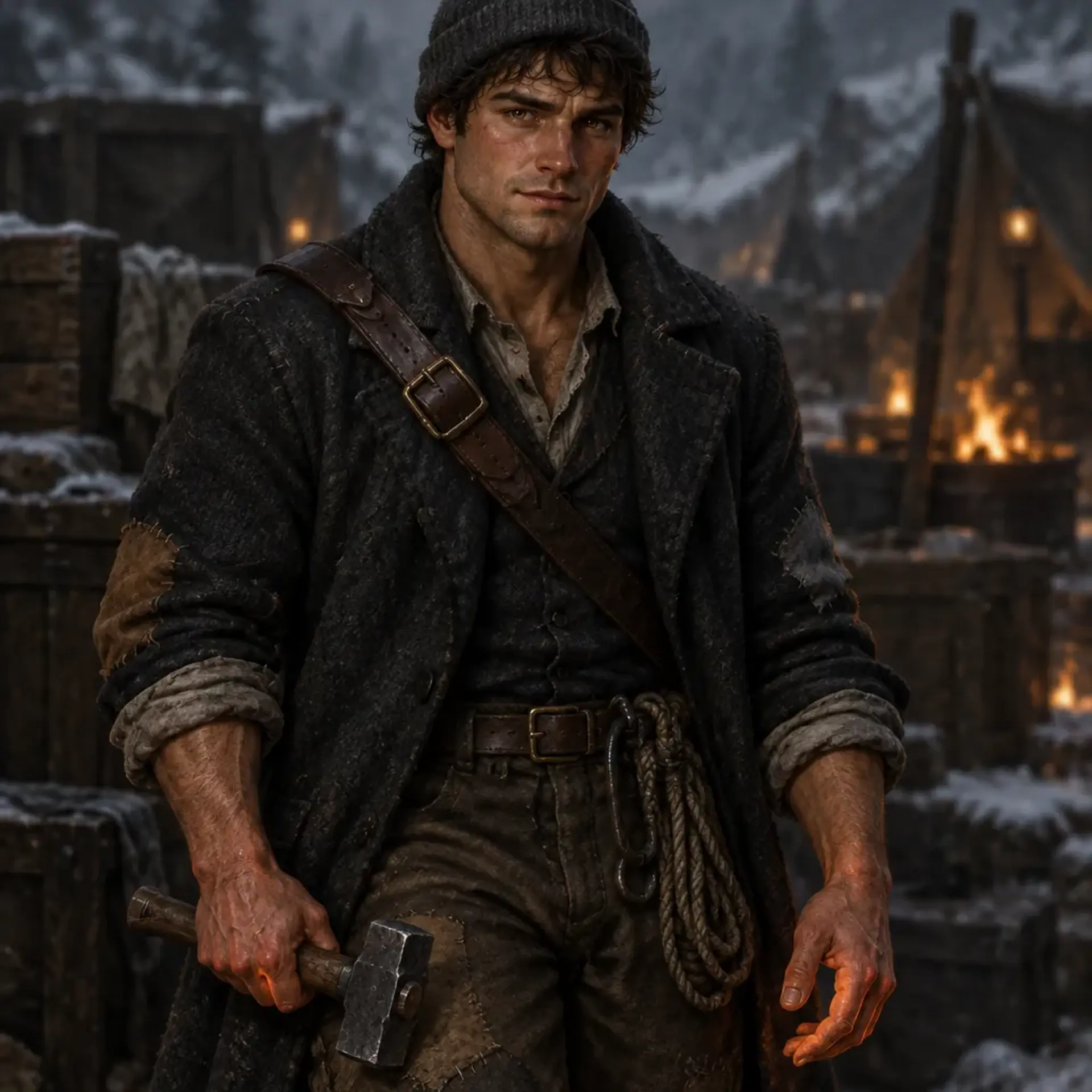
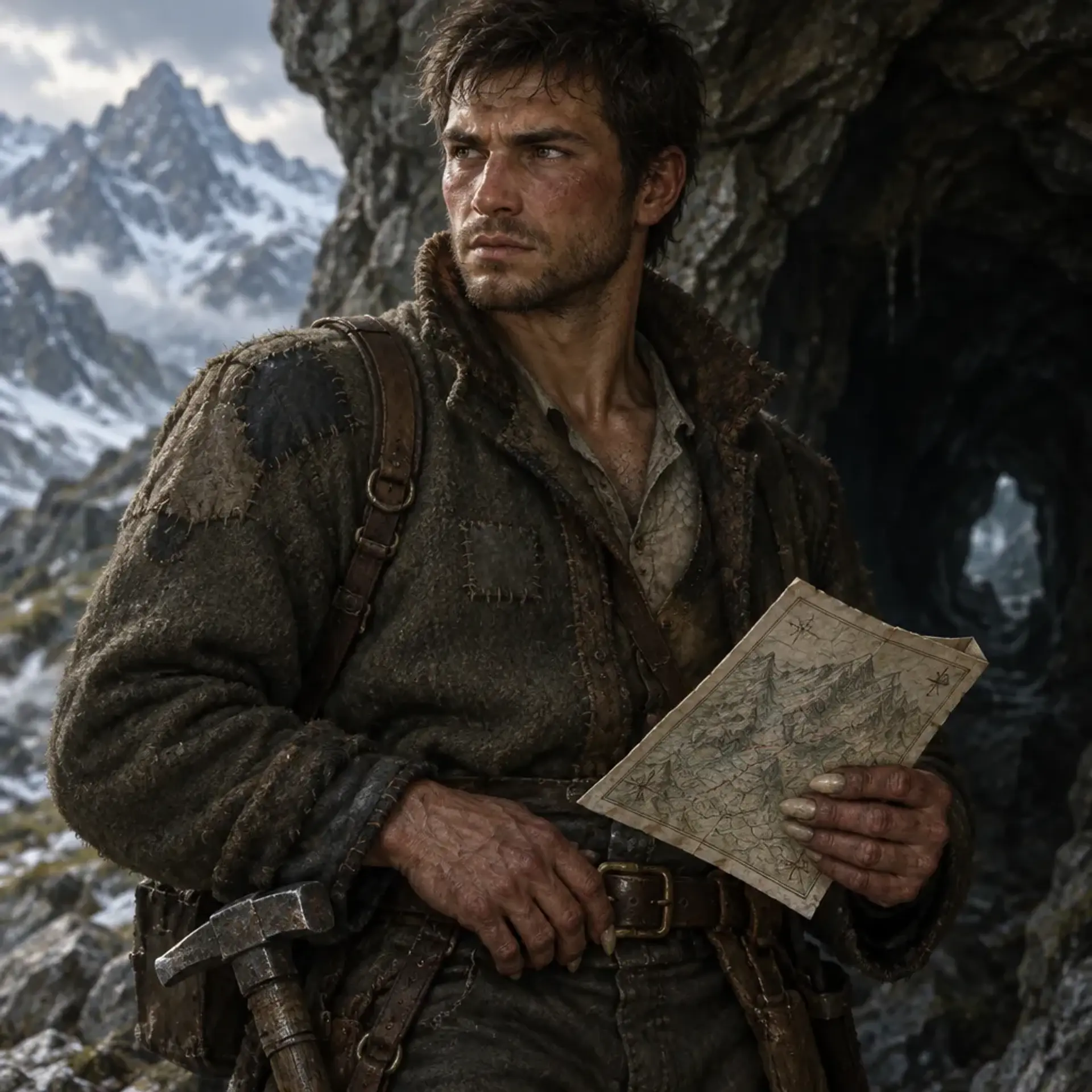
A broad-shouldered young man with the stillness of someone measuring a wall before leaning on it. His new jaw is shadowed by patchy dark stubble, and his nails have grown thick and horn-hard at the tips. Fine, matte scales lie close to his skin along his lower ribs, usually hidden. He moves carefully in open terrain but threads narrow caves with an ease that surprises him. Within a minute, most people notice the folded route map tucked under his belt: its lower corner is worn nearly through from his thumb rubbing it whenever he has to make a decision.
Clothing
A patched wool coat, work trousers, and boots suited to wet rock. The coat hangs awkwardly at the shoulders and has been let out with mismatched thread. His belt and route-map pocket are carefully maintained, while the rest of his clothes show improvised repairs. He keeps a small shaving blade wrapped in cloth.
Body language
He tests floors with his heel, watches the line where walls meet ceilings, and unconsciously angles his shoulders toward narrow openings. When frustrated, his jaw sets and his hands flex as if searching for a tool. Around Anja, he becomes overly attentive to practical details, then catches himself and makes a point of giving her space.
- Height
- About 178 cm (5 ft. 10 in.).
- Build
- Broad-shouldered and compactly strong, with a new body's appetite and physical confidence still outpacing his sense of familiarity with it.
- Eyes
- Hazel brown, often narrowed as he judges distance or slope.
- Hair
- Dark brown, kept short with uneven self-trims.
- Skin
- Light olive, weathered red across the nose and cheeks from alpine wind.
- Age
- About eighteen in his current body; his former body was an adult woman's, and the displacement left him with memories of that life intact.
- Gender
- Man; before displacement, Tomasz had been a woman.
- Size
- Medium
Distinguishing features
Personality
14 traits and drivesTomasz is methodical but not unfeeling: he may spend ten minutes checking a roof beam, then give away his own food without discussing it. In calm moments he is dryly funny and likes having a plan; under pressure he becomes blunt, controlling, and intensely protective. He is embarrassed by the anger and libido that arrived with his changed body, but treats that embarrassment as a reason to be responsible, not as proof that his feelings are false.
- Alignment
- Neutral Good
Quirks
Habits
Traits · 4
Flaws · 3
Fears · 3
Wants and needs · 4
Combat
AC 12 · HP 8 · 30 ft.Avoids fair fights. He puts sturdy objects between danger and the group, chooses ground with dependable footing, and uses his hammer only when someone is threatened or escape is blocked. He tries to create a route out before committing to a fight.
Tomasz Wójcik
Actions
Reactions
Services they sell
Rewards they can give
Equipment
- Builder's hammer (tool and improvised weapon)A short-handled tool with a battered head, used for construction and, if necessary, defense.
- Route map (navigation)Folded and repeatedly annotated; the lower corner is worn thin from his thumb.
- Repair kit (tools)Cord, wedges, a small pry tool, and scraps of marked cloth for temporary repairs and route signs.
- Utility knife and shaving blade (tool)A plain, serviceable blade he uses for food and shaving, wrapped carefully when not in use.
Possessions
Background
Tomasz Wójcik used to believe that every structure told the truth eventually. A beam might look sound, a wall might stand straight, and a report might claim the foundations were adequate, but time and weight would expose whatever had been missed. He trusted measurements not because they made him fearless, but because they gave fear something useful to do. As a civil engineer, he learned to check the load, inspect the joints, and ask what would happen if the worst plausible thing happened at the worst possible moment. Then the world changed, and none of his old calculations helped him understand why he had woken in the Swiss Alps. The mountains were beautiful in the way a deep river was beautiful: indifferent to whether anyone admired it. Tomasz found himself on the French-speaking side of the range, far from his old routines and the colleagues whose names he still sometimes rehearsed in his head. He had a different body, young and male, with broader shoulders, greater strength, and a voice that sounded like someone else had borrowed his throat. His reflection was familiar only in fragments. He knew the shape of his own attention, the habits of his hands, the way he frowned when doing arithmetic. The rest felt like a set of tools issued to him without instructions. At first, he tried to make a list. Find water. Find shelter. Learn the paths. Work out whether the change was temporary. Do not waste food. The list helped, though it did not explain the hunger. Appetite came on with a force he had never known, sharp enough to make his concentration stutter. He began carrying small portions whenever he could, not because he enjoyed eating constantly but because he had learned that an empty stomach could become an emergency before he noticed it. The other changes were harder to file under practical concerns. His voice dropped. Stubble appeared, then returned with stubborn regularity. Shaving became a private daily negotiation, a task he performed carefully because routine was one of the few things that still seemed to belong to him. He also found himself dealing with flashes of anger and desire that arrived with no warning and no familiar context. They embarrassed him. That embarrassment did not convince him that the feelings were false, only that he needed to take responsibility for how he acted on them. He watched himself closely, especially when tired or frightened, and tried not to confuse an impulse with permission. The fellowship that gathered around him became known as the Seven Marks. Its members had been displaced too, each carrying their own bewilderment, losses, and ways of surviving. Tomasz was not naturally eager to become anyone's leader. He liked plans, but he had never mistaken a plan for a commandment. Still, he could read a slope, judge whether a ledge would hold, and notice when a shelter's roof was carrying more snow than its supports could bear. People began asking him where they should go and whether a crossing was safe. When he did not know, he said so. When he thought they were about to do something dangerous, he said that too, usually in fewer words than they wanted. His place among them was decided during a storm. Snow had collected on an overhang above the fellowship's shelter, and Tomasz heard a crack that sounded wrong. He looked up, saw the timber support bowing, and understood that there was barely time to move everyone clear. He braced himself against the failing support and ordered the others to get out. The wood shifted against his shoulder. Snow and broken stone came down in a white rush. He held on long enough for the others to escape, though afterward his arms shook so hard he could barely undo his coat. No one thanked him in quite the same way after that. They watched him as if he had become something larger than a frightened man making a calculation. Tomasz disliked the attention, but he did not pretend the event meant nothing. Fear had been useful. It had told him the danger was real, and responsibility had given him something to do with it. Since then, he has taken the fellowship's safety personally, sometimes too personally. Under pressure, his manner grows blunt and controlling. He will tell people to move, stop, or hand over a pack, and leave the explanation for later. In calmer moments he can admit that this is not always the best way to be heard. His engineering instincts have become the basis of his work for the Seven Marks. He checks beams, tests snow bridges, studies the angle of a hillside, and plans routes with alternates in case weather or injury closes the first choice. He keeps track of stores and tries to make sure the most vulnerable people are not carrying the heaviest loads. He is methodical enough to spend ten minutes examining a roof joint, then quietly give away part of his own meal without making a speech about generosity. When someone asks why he did it, he may answer that the food was getting in the way of his calculations. His humor is dry, and it tends to appear when everyone else is too tired to laugh. There is another problem he has not yet found a way to measure. Tomasz has begun to suspect that his new body carries a Tatzelwurm heritage. His nails harden when danger is close, becoming more like claws than they should be. Tight passages and dark caves draw his attention with a pull that feels instinctive, almost comforting. At times, scales have appeared along his body. He has not shown them to everyone. He is not sure whether secrecy is caution, shame, or simply the need to understand what is happening before the fellowship has to react to it. He refuses to let curiosity make him careless. If he is changing further, he wants to know what that means before it puts anyone at risk. Anja has become a different kind of uncertainty. Tomasz is growing fond of her, and the feeling is real enough to trouble him. He cannot separate it neatly from the unfamiliar appetites and emotions that came with his changed body, so he will not ask her to settle the question for him. He keeps his affection quiet, tries not to turn protectiveness into a claim over her choices, and pays attention when she speaks instead of assuming he knows what she needs. It is not a perfect method. It is, at least, a method he can live with. The life he had before remains distant: the worksite, the familiar streets, the colleagues who knew how he took his coffee. He does not know whether he will ever return to them, or whether the person who returns could explain the mountains and the scales. For now, the problems nearest to hand are simpler and more urgent. The Seven Marks need food, shelter, and safe passages. Their next route must account for weather, exhaustion, and the possibility that the map is wrong. Tomasz can work with those questions. He checks the knots, counts the provisions, and studies the stone above them. Then he makes a plan, knowing full well the mountain has not agreed to follow it.
Role in the story
A practical guide and uneasy protector whose careful route planning can save the fellowship, while his hidden cave discovery and evolving sense of self create difficult choices.
“He trusted measurements not because they made him fearless, but because they gave fear something useful to do.”
- Faction
- The Seven Marks, a displaced survival fellowship. Tomasz is its builder and route planner, not its formal leader.
Known connections
Media
0 imagesNo images yet.
Turn Tomasz Wójcik into a sheet
A high-res, share-ready sheet you can post or print.