Oswin Hirst
Oswin Hirst
At the table
Voice
His voice is clear and youthful, with a little rasp from cold air and years of calling across fields. Its rhythm carries a practical farmer's habit of ending statements decisively, though older memories sometimes make him pause as if listening for the rest of a sentence. In the name Oswin Hirst, the hard consonants sound especially crisp. When the hound nature presses close, his breath gains a low, rough edge and his words come with fewer pauses.
Oswin speaks in an even, work-shaped manner, with the plain phrasing of a Yorkshire farmer and the measured pauses of someone choosing words across a language of memory. He uses concrete comparisons drawn from sheep, weather, tools, and roads. The old Dales cadence surfaces when he is tired, but his oldest words are fragmentary and sometimes arrive in the wrong context. He does not become softer or more courteous when angry: anger makes him blunt, direct, and startlingly still.
Speech patterns
How to play them
Approach him through practical concerns: livestock, weather, household repairs, or a need to protect someone vulnerable. Offer honesty rather than threats. If asked about his age or iron aversion, he deflects; if William is threatened, the gentleness can vanish in an instant. The three-point hit-point field is a custom storage shorthand for his three narrative wound states, not a canonical Other statistic.
Goal
Keep Mary and William safe while preserving their ordinary family life, and learn whether William can inherit his nature without inheriting its loneliness.
Motivation
Love for Mary and William, longing for a stable home, and a buried desire to roam again without pretending that the Dales' strange inhabitants are merely stories.
Appearance
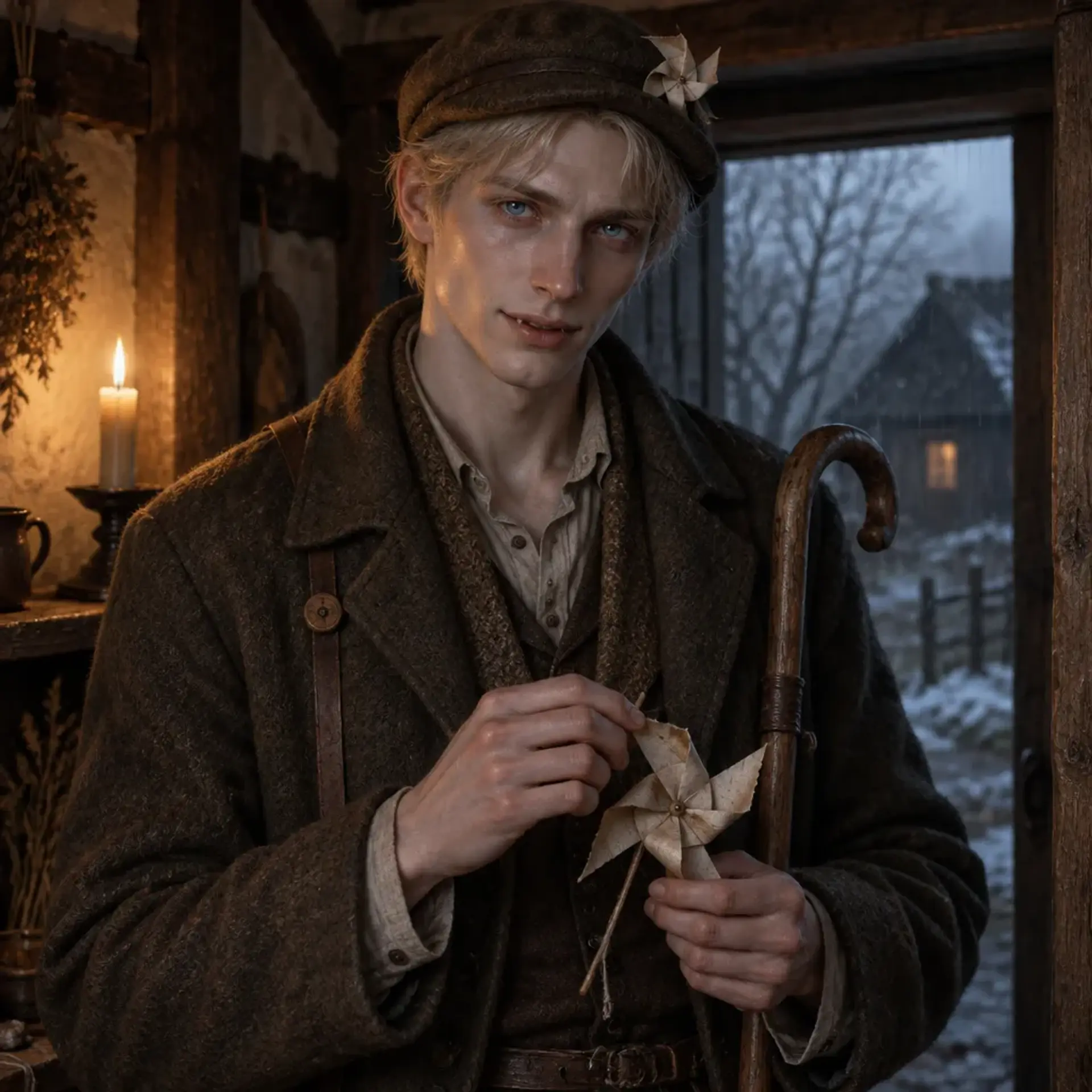
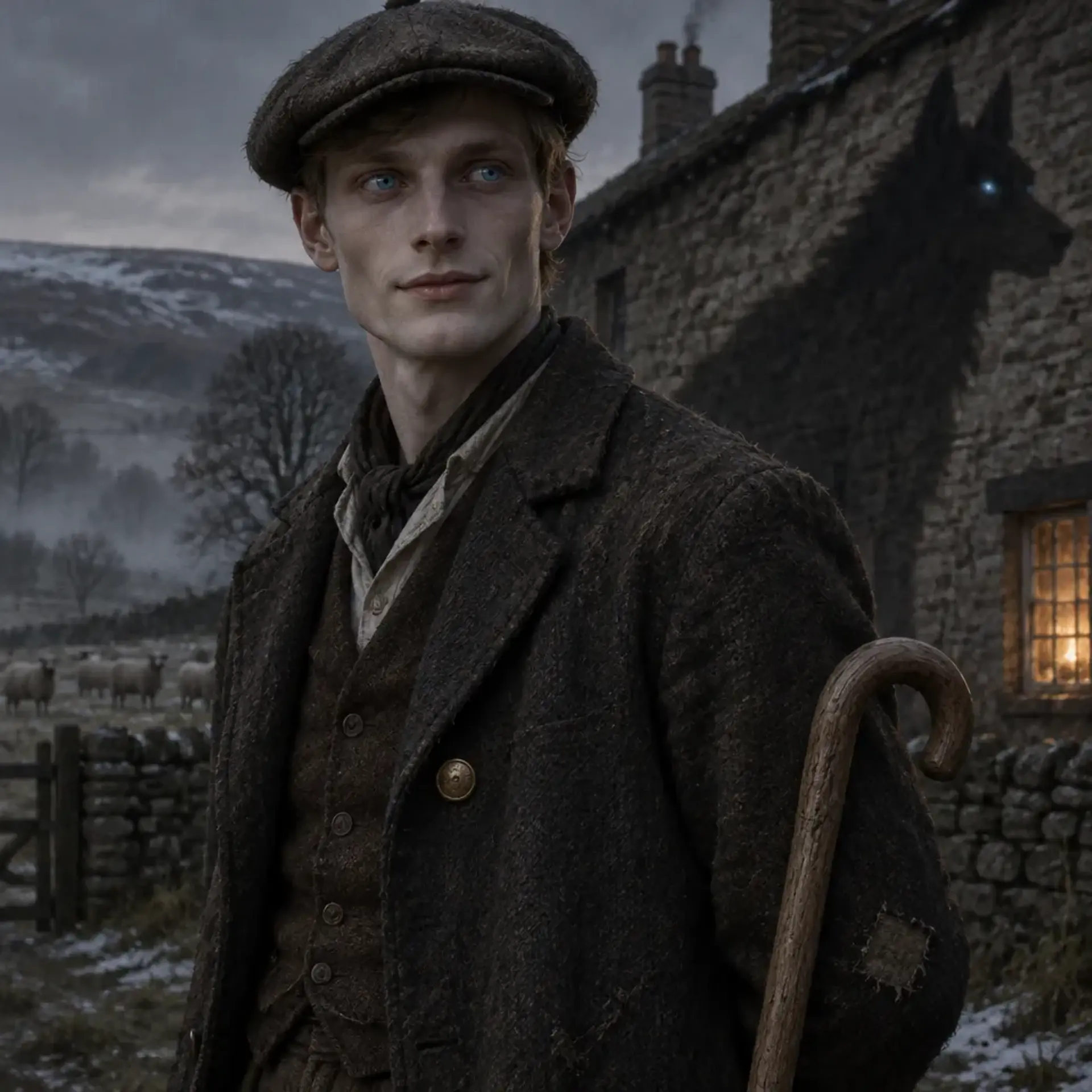
Oswin stands six feet tall, pale and straight-backed, with a face that Mary remembers as youthful and that has scarcely changed since their courtship. His fair hair falls in a blunt, tidy line beneath a common flat cap; his blue eyes catch light with an unnerving, almost furnace-bright clarity. At a glance he looks like a handsome farm lad who has somehow walked out of an old portrait. Up close, his skin has the faint, cool smoothness of wax kept from sunlight, and his movements are careful until they are suddenly too swift, as if he has skipped the intervening motion. His broad, work-worn hands are rough at the palms and knuckles, but he keeps the nails meticulously clean, a small fastidiousness unexpected in a sheep farmer. His coat is well made for his station, but its cuffs are repeatedly darned in thread of slightly different shades; he polishes one brass button until it shines while allowing the rest to dull. He leaves the impression of a kindly young man whose shadow sometimes belongs to something much larger.
Clothing
A fine but lived-in wool coat, plain waistcoat, work trousers, sturdy boots, and the common flat cap of the district. His cuffs are visibly darned in mismatched thread; one brass button is polished obsessively while the others are dull. He chooses wooden or bone-handled tools when possible and keeps iron buckles and fittings from touching his skin.
Body language
In company, Oswin stands with the relaxed balance of a farm worker, hands often folded behind his back. He watches people with direct, gentle attention, but at strange sounds his head turns first and the rest of him follows a beat later. During seasonal agitation he paces the edges of a room rather than crossing its center. His smile can arrive too quickly and stay too long.
- Height
- 6 ft (183 cm)
- Build
- Tall and lean, with the durable, rope-strong frame of a working sheep farmer.
- Eyes
- Bright, burning blue
- Hair
- Pale blond, straight, kept neat beneath a flat cap
- Skin
- Pale, with a cool, smooth cast that seems unchanged by age.
- Age
- Appears about seventeen; claims to be a young adult. In truth he was born in the Danelaw era, many centuries ago, and has lost track of his own years.
- Gender
- Male
- Size
- Medium in human form; large in black hound or bear form, as a custom descriptive measure.
Distinguishing features
Personality
20 traits and drivesOswin is kind in the deliberate, practical way of someone who has learned that affection is shown by returning, mending, and staying. He gives Mary and William his time even when the changing season makes every dark hour feel crowded. Yet his gentleness sits beside an alien composure: he can hear that a child is frightened and answer with perfect tenderness, then describe a death omen as though discussing a frost. He is not cruel or secretly eager to frighten people. Rather, his instincts classify some things as natural that humans experience as dreadful. He is practical and shrewd in matters of land, animals, food, and bargaining. He knows how to make a fine house from careful decisions and how to stretch a bad season without making the household feel poor. In conversation about ordinary life, he is observant and unshowy. He listens before speaking, notices who has not eaten, and makes a point of being present on a day off. He can be stubborn about accepting help, however, because dependence makes him feel exposed. He prefers to repair a problem quietly rather than explain why it matters. With Mary he is affectionate but evasive. He wants her to be unafraid of darkness and fae, and he reaches for Christian teaching and new scientific ideas because he hopes they can give her a stable account of the world. He does not mock her fear. He does, however, conceal the most important evidence that would explain it. His instinct is to withhold frightening facts until he can make them harmless, a protective habit that has begun to resemble deception. Mary remembers his youthful face and notices that it has not changed. Oswin can tell she is watching him, but he avoids naming the subject because he fears that speaking plainly will make the marriage impossible to preserve. With William, he is softer and more patient than the village expects a father to be. He makes time for him, accepts the child's slow pace, and tries to see the distant spells as a way William is listening rather than as a defect. But Oswin is also afraid of what the boy may become. That fear can make him overprotective, and once, when William's anger put Mary at risk, Oswin's own hound nature broke through. He regrets the transformation more than he regrets stopping the immediate danger. William's reaching hand and small “Da?” unsettled him: the boy accepted the monstrous face without understanding its meaning. Oswin cannot decide whether that response comforts him or warns him. Thomas Pickles draws out Oswin's guarded, calculating side. Oswin recognizes Thomas's suspicion but does not know that Mary has already confided in her father. He avoids direct confrontation, preferring to keep the household's needs beyond Thomas's reach. He can be generous when Thomas acts as a grandfather and quietly watchful when Thomas asks questions. Oswin does not naturally think in terms of human schemes; he has spent too long among beings whose bargains are explicit and whose motives can be stranger than greed. He may therefore underestimate how deliberately Thomas wants to use what he learns. The seasons pull different selves to the surface. As nights grow dimmer and colder, Oswin's warmth becomes effortful. He sleeps poorly, checks the yard, and listens for chains or the calls of dogs. He remains gentle, but his attention is divided between his family and whatever seems to be moving beyond the threshold. Around Mayday, the dividing line reverses. He can become startlingly delighted, eager for music, ribbons, crowds, and the turning dance. His pleasure is genuine, but too intense and too old for the occasion. The Maypole feels to him like a familiar summons, even though he has no clear memory of why. On All Saints' Eve and Halloween, his blood rises in a sharper way. He is alert, restless, and drawn toward graveyards, funeral routes, lonely lanes, and the invisible company of the dead. He knows that this frightens others and tries to stay near his family, but the effort is not always enough to make him seem ordinary. Christmas brings the opposite. Oswin becomes calm and domestic, able to sit beside the fire without scanning the windows. He likes the household's repeated rituals: food laid out, a toy repaired, Mary close by, William safe in the room. This steadiness matters to him because it suggests that he can belong to a human life, not merely imitate one. He does not explain why Christmas settles him. He only knows that the season leaves him less divided. Oswin sometimes longs for the roving days. He misses the freedom of roads, the lack of expectations, and the strange company that accepted him without asking him to explain his face. He does not want to abandon Mary or William. The longing embarrasses him because it coexists with real devotion. He can be content at home and still feel a road calling through the winter dark. He knows how to care for a family; he is less certain how to be one person, continuously, across centuries. His deepest conflict is between a human wish for a settled, safe home and an inhuman understanding of what safety means. He believes he is protecting his family by concealing the truth and controlling exposure to danger. Yet his lies leave Mary alone with her suspicions, and his instincts make William's difference seem both familiar and frightening. He is most trustworthy when he speaks about what he wants, and least trustworthy when he insists that nothing unusual is happening. Under pressure he will protect his family first, even if the form that protection takes reveals the very monster he hoped they would never see.
- Alignment
- Protective and compassionate in daily life, yet governed by an alien, perilous sense of what is ordinary.
Quirks
Habits
Traits · 5
Flaws · 5
Fears · 5
Wants and needs · 5
Combat
HP 3 · Ordinary human pace when untransformed; custom narrative advantage for sudden bursts in Barguest form. No canonical movement value is asserted.Oswin avoids fights and tries to put himself between danger and his family. He uses ordinary tools only when cornered. If someone threatens William or Mary, he may change into the black hound and drive the attacker toward an escape route. He does not willingly cross flowing water in that form, and iron can interrupt his confidence. These are custom narrative mechanics for an unspecified Other ruleset, not imported statistics.
Oswin Hirst
Actions
Reactions
Services they sell
Rewards they can give
Equipment
- Shepherd's crook (farm tool)Useful for ordinary livestock work. He handles the wooden shaft confidently and avoids the iron head when he can.
- Small belt knife (tool)Kept to show how an ordinary farmer might defend his household. He dislikes the iron fittings and rarely carries it.
- Work coat (clothing)A wool coat with repaired cuffs and one polished brass button, both familiar signs of his careful domestic life.
- Household reading (personal item)A plain Bible and a small collection of printed scientific notes. He uses both to reassure Mary, not to prove that the supernatural is false.
Possessions
Background
Oswin Hirst was born in the Yorkshire Dales during the age of the Danelaw, the child of a human woman violated by Viking raiders. His mother raised him in poverty and taught him ordinary things: how to mend a sleeve, distinguish weather by the smell of the wind, and bring a frightened lamb close without grabbing it. He remembers her as a tired, warm presence, though the details of her face have blurred with time. She died slowly, after a long illness, when Oswin was still a child by the measure he then understood. Her death was his first encounter with the Dales' hidden inhabitants. At her bedside, he heard chains dragging outside a shuttered room and saw a black dog standing where no dog could fit. He believed it was an omen for her death, not a reflection of himself. Afterward Oswin wandered between human settlements and places where the ordinary map seemed to fold: limestone gullies, old tracks, abandoned boundary stones, and winter lanes that returned him to places he had not set out for. He met wraiths, fair folk, devils, and other things that the villagers had names for but little agreement about. He was, for a long time, simply a lonely boy who found that these beings spoke to him as though he belonged among them. They did not explain what he was. Their customs felt normal to him, while human fear seemed excessive. A stranger's sudden death could strike him as a matter of seasonal balance; a bargain made with a nameless presence could seem no stranger than borrowing a plough. His change into a Barghest changeling was not a single transformation he remembers. It came by degrees: an impossible escape from a winter pursuit, a night lost in a gill with no footprints on the way out, a dream of running on four legs that left his palms muddy. He could sometimes hear chains where no chains were present. He began to notice that iron hurt him, that flowing water stopped him in certain shapes, and that dogs would howl when he passed a funeral. Only after years of noticing his own reactions did he suspect that he was a changeling, and later still did he understand the Barghest nature of it. Even that knowledge is incomplete. His memory ebbs and fades, especially around the oldest years; what remains is less a chronology than a trail of places, faces, and recurring seasonal dread. Oswin spent centuries on the move. He travelled the Dales and beyond, sometimes as a young man, sometimes as a black hound with burning eyes, sometimes as a headless figure glimpsed crossing a lane. He remembers adventures in fragments: a night escorting a terrified family through weather that had no stars; an argument with a spirit that insisted a dead village was still inhabited; a spring when he followed a funeral procession and every dog in the district joined its howl. He occasionally tells Mary a piece of these roving years as though recounting a harmless journey. He does not always recognize that the story is frightening. In time, the wandering tired him. He wanted a hearth, a field with boundaries, and people who would expect him at supper. He settled into sheep farming and built a fine house for a man of his class through patience, shrewd bargains, and a knack for making himself useful. The place is comfortable, not grand: sound stone, a good roof, a large kitchen, and enough land to keep the household secure. He wears the local flat cap and works with care, learning the rhythms of sheep and weather as if they could anchor him. He has made a life that is ordinary by intention, even when his idea of ordinary is not always human. Mary Pickles became Mary Hirst after they married. She is blonde, blue-eyed, and more observant than Oswin gives her credit for. He loves her with a tenderness that is steady and practical: he mends what she needs mended, listens to her worries, and sets aside time for her and their child even when a day off coincides with a season that keeps him awake. He wants Mary to stop fearing darkness and the fae. He reaches for the Church's Christian doctrine and the new sciences as they develop, hoping both can give her firm explanations and a sense of safety. Yet he sometimes speaks of the supernatural as if it were a weather system, not a danger. Their son William was born with thick black hair, though both parents are fair, and the same vivid blue eyes as Oswin. The locals call him Black William or Blackby. William is slow to meet some expectations for his age, cries easily, has fits of anger, and can go distant as if listening to something beyond the room. Oswin sees these signs as evidence of the child's mixed human and hellish fae inheritance, but he has not told Mary. Mary, meanwhile, suspects that William is the Barguest's spawn. She keeps iron scissors near herself and an iron thimble by the child, watching Oswin and William especially when the seasons turn. She has told her father, Thomas Pickles, about her fear. Oswin does not know she has done so. Mary has suffered pregnancies that did not reach term, and one small, sickly infant died soon after birth. The grief sits between the couple without being fully spoken. Oswin is not sure whether his nature is responsible, but he fears it is. He has never been able to promise Mary a healthy, living heir, and he knows she sees the pattern. Thomas is suspicious of his son-in-law, noting that Oswin never seems to age and avoids iron. Thomas hopes to use what he learns about Oswin's secrets to benefit himself and his family. Mary’s brothers Hugh and Edward remain part of the household's wider life, though their loyalties and suspicions differ. One Mayday, Oswin went with Hugh to the village's Maypole gathering. The bright ribbons and turning dance should have been ordinary country festivity. Instead, the season surged through Oswin. He joined the circling with an unnatural delight, smiling too broadly and moving as though the music were a pursuit he had waited centuries to resume. When Hugh stumbled, Oswin caught him with impossible speed and laughed at the alarm on his face. He recovered enough to walk home beside him, but Hugh has never forgotten the look in his eyes. Oswin calls it a happy day; Hugh remembers it as the day he saw something old wearing his friend's face. On Halloween, after the death of Alice Pickles, Oswin was left alone with Edmund to mourn her. The house was cold, the evenings dim, and the sense of the dead pressing near. Oswin tried to comfort Edmund with plain words and a carefully banked fire. As night deepened, his blood rose with the season: he paced, listened at doors, and reacted to every distant dog as though summoned. He did not leave Edmund, and that mattered. Yet Edmund saw Oswin stop mid-sentence, head angled toward an empty passage, while the sound of unseen chains crossed the yard. Oswin said nothing about it until morning. At Christmas, by contrast, Oswin is calm. One Christmas he spent the whole day at home with Mary and William, turning his attention to small domestic tasks: keeping the fire fed, helping William shape a rough wooden toy, and sitting with Mary after supper. Snow muffled the lanes. Oswin did not pace or watch the windows, and his eyes seemed almost wholly human. Mary remembers it as a rare peaceful day. Oswin remembers it as proof that a life can be held together by simple routines, even if the season's meaning is not the same for him. A more recent iron incident came when a sheep snagged a leg in a gate and Oswin reached through to free it. A loose iron fitting scraped his palm. The skin blistered at once; he jerked back so violently that the gate slammed and the sheep bolted. He hid his hand beneath a rag and claimed a tool had pinched him. Mary saw the mark and did not believe him. He has avoided that gate since, repairing it only with a wooden wedge and asking another farmer to handle its ironwork. Once, while William was in a rage and clawing at Mary, Oswin's restraint failed. His face lengthened, his jaw opened too wide, and a heavy black hound's shadow filled the kitchen wall. He seized William by the back of his clothes and lifted him clear of Mary, teeth bared but not touching the boy. William stopped crying and stared at him. Then he reached out and touched Oswin's muzzle, saying, “Da?” Oswin returned to human form in terror at what he had done. William clung to him afterward, but Mary saw the transformation. She has never forgotten it. As the colder, dimmer seasons arrive, Oswin's sleep breaks into short stretches. He checks the stable, walks the boundary, and hears chains in wind that other people call branches. The longer nights make him attentive to thresholds and funeral bells. Around Mayday he grows bright, eager, and dangerously receptive to music, dancing, and invitations from strangers. All Saints' Day and Halloween raise his blood in a different way: alertness, appetite for movement, and a pull toward graves, old roads, and the company of the dead. Christmas quiets him. He does not understand these shifts as a choice; they arrive like weather in his body. Oswin's current problem is not simply hiding his nature. He wants to protect Mary and William without turning their home into a prison, and he wants to keep Thomas from discovering enough to exploit him. He longs for his roving days sometimes, not because he wants to abandon his family, but because wandering was the last time he did not have to pretend to understand human fear. His love makes him try. His alien instincts keep proving that trying is not the same as being safe.
Role in the story
A loving husband and father whose hidden nature makes the family both vulnerable and dangerous. Oswin can be an ally, a source of local folklore, or the center of a domestic folk-horror mystery about inherited monstrosity, trust, and what it means to protect someone.
“He remembers her as a tired, warm presence, though the details of her face have blurred with time.”
- Faction
- No formal faction. He belongs to the Hirst household and to the unsettled, half-remembered world of the Yorkshire Dales' wraiths, fae, and devils.
Known connections
Media
0 imagesNo images yet.
Turn Oswin Hirst into a sheet
A high-res, share-ready sheet you can post or print.