William Windon
William Windon
At the table
Voice
A work-roughened, slightly breathy voice that belongs to William until it doesn't. Wilt's delivery is older in its cadence, clipped and dry, with the accent of Wiltshire made heavier. William's breathing grows shallow when the heart-stoppage memory returns; Wilt can force a sentence through the same breath with unsettling control.
William's ordinary speech is a straightforward, warm Wiltshire English, with the occasional hesitation of someone choosing a careful word. Wilt's words come through his mouth in a thicker, older-sounding Wiltshire accent, with unusually formal phrasing and dry timing. The voice has a slight rasp from garden work and cold nights. When rattled, William's breath catches high in his chest, while Wilt's consonants become clipped and firm. A sentence may begin in William's voice and finish in Wilt's. The name Wilt, when spoken, has a short, dry sound.
Speech patterns
How to play them
Approach him as a frightened young man rather than a monster or puzzle. Give him time to answer, do not crowd mirrors or windows, and speak plainly. Clare's patient company helps. Hector's interrogation makes him evasive. Respect William's concern for his family while acknowledging that Wilt is also present and can hear.
Goal
Understand what the returned heart has bound together, keep the Windon house closed to the coastal siblings, and find a way to see Adaline and his friends without endangering them.
Motivation
William wants the people he loves safe and wants his ordinary life back. Wilt wants shelter from his searching siblings, a place among the living, and the freedom to explore a world of strange machines, books, and customs. Neither has yet accepted how much those desires overlap.
Appearance
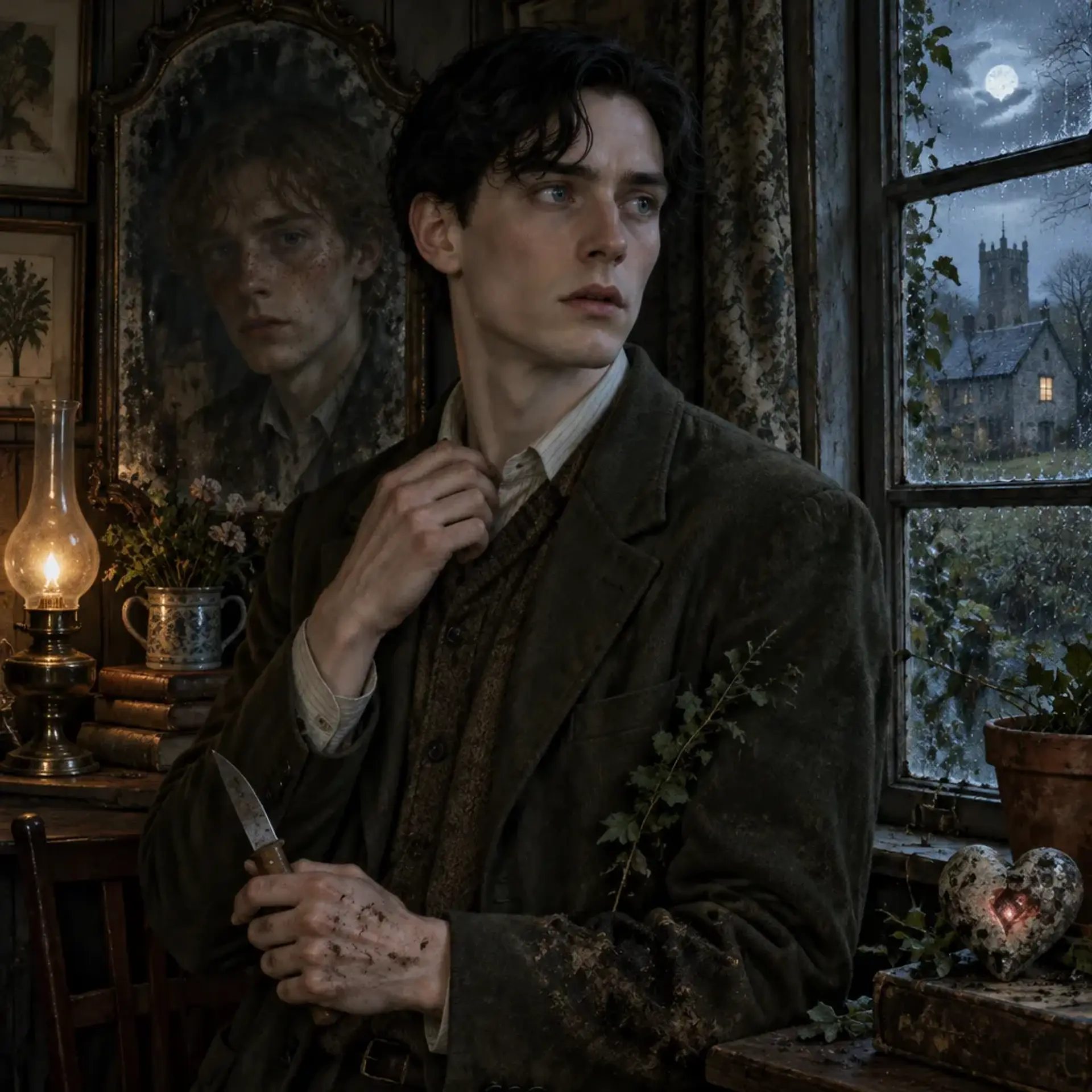
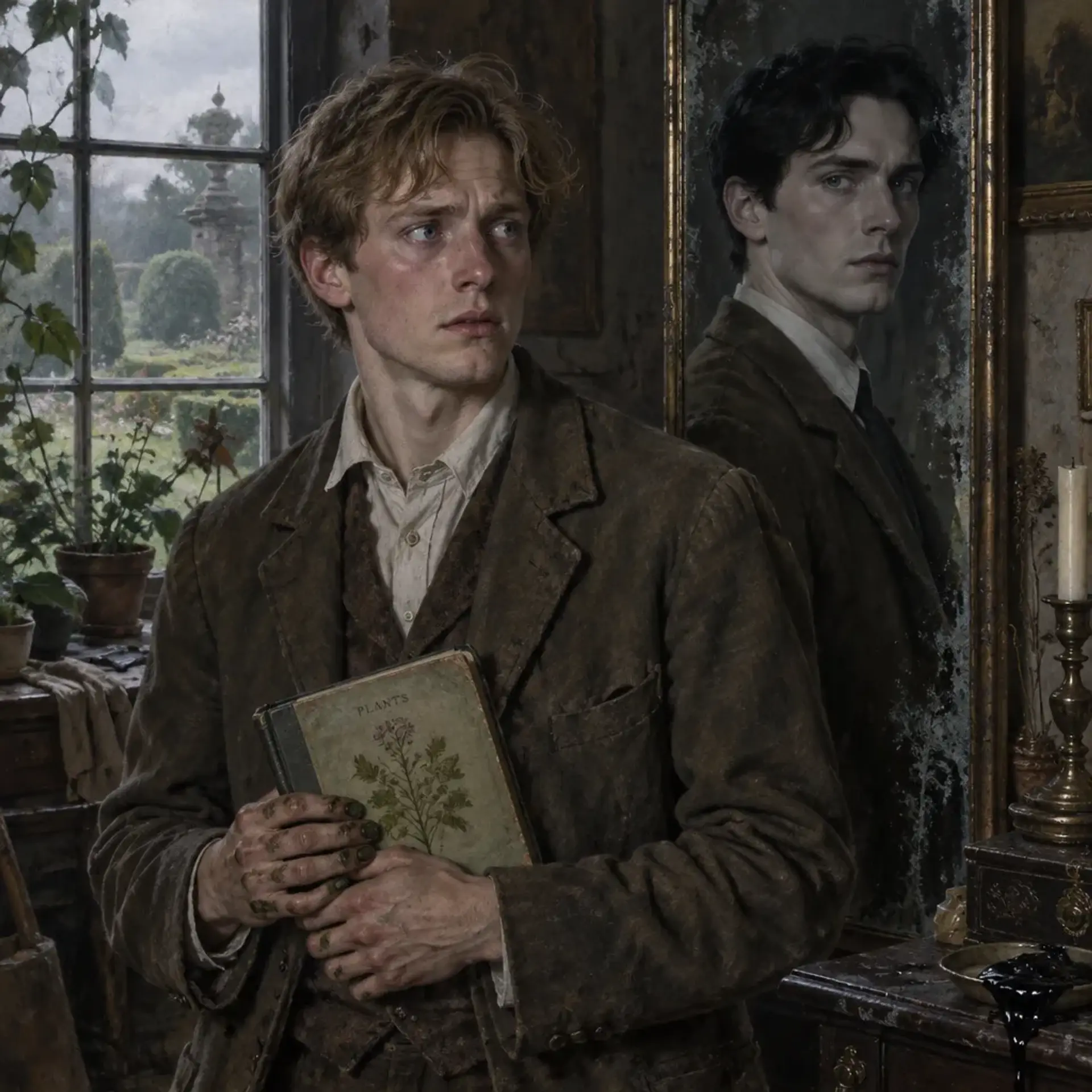
William Windon is an average-height young Englishman with a gardener's wiry strength, a slightly soft face, and the guarded, attentive look of someone still recovering from illness. His hands are often faintly green at the nail beds from stems and soil. His clothes are practical and carefully mended: a jacket that sits a little poorly at the shoulders, work trousers polished at the knees, and one over-cared-for shirt kept crisp for visits. His dark-blond hair is usually rumpled unless he has just groomed it. In glass, water, and polished metal, the stranger called Wilt appears instead: a little taller, black-haired, blue-eyed, long-faced, handsome by a severe and old-fashioned standard, with a more polished short haircut and an aloof expression. Wilt always wears the clothes William is wearing, but seems to inhabit them with more formal certainty. The difference is immediate and unnerving, not a simple resemblance. William moves with a gardener's measured economy; Wilt's movements are more exact, sometimes a fraction too decisive for William's body. Unexpected detail: despite his botanical ambitions, William is unexpectedly delighted by modern televisions, cars, and electrical gadgets, and will pause mid-conversation to study how one works.
Clothing
Mended work clothes, a practical jacket, and a shirt he keeps unusually neat. Wilt prefers a crisp collar, carefully arranged hair, and proper clothes for tea. Both appearances wear the same garments.
Body language
William's shoulders settle when he gardens and tighten when Hector questions him. He rubs his sternum when the old heartbeat memory returns. Wilt's influence brings a poised stillness, a straightened collar, and precise, old-fashioned gestures. When the coastal presence is near, the body goes rigid and listens toward closed doors.
- Height
- William is average height for a young man of his period; Wilt appears taller by several inches.
- Build
- Wiry, lightly muscled from garden work, with some lingering weakness after a heart stoppage
- Eyes
- William: blue. Wilt: clear blue, like moonlight on a freshwater pond.
- Hair
- William: dark blond, often rumpled. Wilt: black, neatly cut and more carefully arranged.
- Skin
- Fair, often ruddy from outdoor work; sometimes pale and cold after a night troubled by the sea
- Age
- Young adult; William and Wilt both appear about eighteen
- Gender
- Male
- Size
- Medium
Distinguishing features
Personality
18 traits and drivesWilliam is tender-hearted without being meek. He notices discomfort in other people and often tries to soften it, but he can be stubborn when someone treats his family as foolish. He would rather work quietly among plants than argue about status, yet he is not indifferent to being underestimated. Wilt's influence makes him more exacting and less patient with sloppy manners, but it does not erase William's affection or sensitivity. In calm moments, the two can bicker with an intimacy that is almost comic. Wilt teases him about grooming and clothes; William answers with irritation, then asks questions about Wilt's family. Around Clare, the shared presence is gentler and more willing to listen. Around Hector, William grows guarded and Wilt grows cutting, especially when Hector talks down to country people. With Elizabeth, he is easily flustered, while Wilt may answer her questions with a dry, inappropriate observation. In public, William tries to perform normality. At home, he can be curious, funny, or unexpectedly delighted by a television or motorcar. When the coastal siblings draw near, both selves become fearful and defensive. William's fear is personal: he does not want to lose himself. Wilt's is older and more alien: he fears being found, exposed, or called back into a place he cannot describe. The Christmas change has made their emotional lives difficult to separate. He may mourn William's lost job with William's sadness, then suddenly insist on an old rule of tea with Wilt's certainty. Neither is simply pretending. Their disagreements are real, but so is their growing attachment.
Quirks
Habits
Traits · 5
Flaws · 4
Fears · 4
Wants and needs · 5
Combat
HP 5Not a trained combatant. Avoids violence, tries to escape or barricade a route, and uses nearby garden tools only when cornered. Under supernatural pressure, Wilt may seize bodily control unpredictably. Do not treat the custom features as a reliable combat build.
William Windon
Actions
Reactions
Services they sell
Rewards they can give
Equipment
- Garden shears (tool)A gardener's practical tool; not carried as a weapon unless he is cornered.
- Botany notebook (personal)A battered notebook holding plant observations and copied fragments from Hector's occult papers.
- Hidden knife (weapon)A concealed knife that Wilt once stole and hid in William's coat.
Possessions
Background
William Windon was born in Wiltshire into a family whose roots in the county reach back several generations. He grew up among fields, hedges, weathered stone, and the quiet social rules of a household that was never quite as ordinary as it looked. He was a warm, sensitive boy, more studious than his father thought useful and more careful with other people's feelings than his schoolmates expected. His father, Hector, is a historian: intelligent, politically liberal, impatient with class deference, and privately involved in an occult circle. Hector grew up under the shadow of his own father, a fierce veteran remembered by the family as Bobby. Hector has spent much of his life resisting the rigid systems Bobby represented. He wants William to become an intellectual in his own image, and his disappointment when William chose practical gardening and botany has often come out as dismissive teasing rather than honest conversation. William's mother, Clare, is steady and affectionate. She has a way of making care feel ordinary: tea, a book, a passage from the Bible, or a walk among the garden beds. William's sister Elizabeth is sharper and more curious. She enjoys finding the turns of phrase that make her brother flustered, but her teasing has lately given way to attentive worry. Her boyfriend, Romy Brock, is an artist who plays rock and roll on the guitar. He is still unaware of the full danger in the Windon house, though he follows Elizabeth into strange plans because she makes them seem like adventures. William's friends Tommy DeHare, John Mollask, and Ryan O'Leary knew him before his illness and have seen enough oddness to worry, though none has the whole story. His girlfriend, Adaline, with auburn hair and soft brown eyes, is now a source of longing and dread: William wants to see her, but fears that she will meet someone who looks like him and speaks with another presence behind his eyes. The trouble began with a stone that was not quite a stone. Years earlier, the amateur alchemist Bartholomew Golden brought a heart-shaped object to the Hush House as payment for entry. He called it the Heart of England, and claimed it could bring servants from man's shadow, from chalk cliffs and borderlands, laborers born of the land rather than human. It resembled a piece of Dover chalk cut into a human heart, crusted with barnacles and sea grass. Golden was never permitted near Brancrug again. The object was thrown out to sea and returned to shore, wet with salt and black ooze, its stony surface faintly red-pink beneath the crust, as if blood or a small light had returned. Abraham Groff, a young Londoner, found it and took it home to Wiltshire. In his possession it beat beneath his coat after a train journey. It seemed to die when displayed to visitors, then revive when brought to the Hampshire shore and dipped in water. Abraham came to believe that it disliked guests. Sounds, moving doors, and footsteps gathered in his house. Eventually he sold the object to William, one of the people who had seen it before it went still. William was proud of his strange purchase until its heartbeat seemed to echo inside his own chest. After tasting the sea, blood, and soil in his mouth, he struck the stone with a hammer. The pain arrived in his chest as if the blow had landed on his heart. He fell, groaning, and saw a twitch of muscle beneath the stone's surface. His own heart stopped. Clare found him and brought him back. William abandoned the object in a hollow log; it looked pristine there days later, unaffected by his hammer. Then the reflection began. At first it was simply not William. It showed a long-faced young man with black hair, pond-blue eyes, and a stern expression. It moved oddly, then began to move with purpose of its own. One morning it spoke through William's mouth: "Well, it's not often you use that one." Its accent belonged to an older generation, its wit dry, its manners exacting. It criticized William's grooming, clothes, and neighbors, sometimes stopping him from speaking when it judged his words improper. It had an unsettling knowledge of history, which it described as weather, forge-work, or the feel of a place. It also seemed to have opinions about William's sister, Adaline, and the people around them. Its interest in Adaline became uncomfortably competitive. When William watched a war film, Wilt seized control in a violent episode that reminded the family of shell shock. Hector restrained his son. Afterward, Wilt apologized in a mumble and offered a memory as consolation, though neither William nor the family understood what they had witnessed. Other experiences were stranger but gentler. The reflection loved books and television, became fascinated by cars and electronics, and once drank the whisky and bourbon Hector had left for William's health. That night it argued, teased, sang, and laughed with William as if they were drinking together in a pub. Its delight in alcohol was the first time William sensed that Wilt could blush with embarrassment as well as sneer. The borrowed heart has never been recovered. Abraham has moved to Canada, and William has searched for him without success. Hector understands that the object was unnatural, but has not told the family about his occult circle. He is increasingly suspicious of William's private investigations and late-night movements, and his guilt makes him alternate between watchfulness and clumsy offers of chores. He cannot tell whether William resents him, whether the strange presence has altered his son, or whether his own occult interests helped open a door. The first truly dangerous night came when William woke cold and unable to move. Wilt told him, in a thick Wiltshire accent, that his sister was outside looking for him. William heard words bleeding through the walls and felt his body roll silently from the bed and crawl beneath it. He fought for control and managed to ask, "The bloody hell, your siblings?" Wilt admitted that she was trying to draw him out. In the dark, he told William to be quiet and insisted they would talk in the morning. William sensed the tension in Wilt ease. Moonlight filled the room and the shadows shifted like tides across the floor. He did not know when he fell asleep. At dawn he woke under the bed and pushed himself toward the bathroom mirror. Wilt's face remained there. William touched his own cheek and felt his own skin again. Wilt said, "See, you're fine now," with a plaintive gesture that seemed almost an apology. Outside the house, William found saltwater, damp grass, and black ooze. Wilt wanted him to stop looking. William forced himself to search the grounds anyway. He has since learned that there is at least one sibling, a female presence that seeks Wilt, and that there are "more." The house has possible points of entry: a damaged old study window hidden behind a bookcase, sealed by Hector, and a bricked cellar that predates Hector's ownership. Salt air sometimes seeps in, carrying the smell of blood or meadow grass. William and Wilt now cooperate in silence to keep the house from being entered. Their uneasy partnership has changed through the months of William's recovery. Clare set regular times for them to garden together, reading while William worked and preparing tea and snacks. William returned to the estate's garden work after five months. Wilt mellowed somewhat with routine, but retained his old rules for tea, grooming, and manners. He steals food, cigarettes, cigars, and occasionally weapons, hiding them in William's room. A bottle of apple juice under the bed turned out to contain alcohol. He has also hidden a knife in William's coat. Elizabeth has noticed William talking to himself and now watches from a mixture of curiosity and concern. She calls his condition "brain damage," partly to provoke him and partly because she has no better explanation. She has learned that a particular kind of question can coax Wilt into answering. Once Wilt insulted a Welsh neighbor's child with a slur after the child accidentally collided with William and made a girl cry. The insult is not repeated here. William was made to muck out the neighbor's stables. Hector reprimanded him after Wilt made a cutting remark about him, and the incident sharpened the distance between father and son. The last great change happened three months after the night under the bed, on the night before Christmas. William's old face seemed to strip away. He woke to find Wilt's face in the mirror and no longer felt a clear boundary between the two. His memories, habits, emotions, and loyalties had become mixed. Sometimes he thinks of himself as William; sometimes as Wilt; sometimes he cannot tell which name belongs to the thought he is having. The change is not a neat possession and neither name explains all of him. The being is not a human soul or a ghost in any ordinary sense. It is a changeling-like presence of Wiltshire, a local thing with an existence that has never before become tangible in this way, now anchored to William by the heart. It has principles of Scale and Nectar, with Forge as a major solar aspect and Moon as a minor lunar aspect; Scale and Nectar are subverted through one another. These are the family's working occult description, not a complete account of the being. Its human connection has made it legible to the household, while the boundary between William and Wilt continues to erode. Wilt's face is slowly becoming the body's face. William has lost his job because his family cannot safely let him appear in public as a changed young man. The Windons hide him at home and tell outsiders he is recovering. William takes the loss badly. He longs to see Adaline and his friends, though he cannot say whether he wants them to meet William, Wilt, or the confused person who now carries both. The family reacts in distinct ways. Clare protects him with practical affection and refuses to treat him as a monster. Elizabeth is frightened but attentive, increasingly careful not to corner him, and fiercely unwilling to abandon her brother. Romy follows her lead without fully understanding the risk. Hector watches the doors, the sealed study window, and his son's changing manner. His inquiries have grown more methodical. He compares William's phrases against old family records, listens for unfamiliar accents, and checks whether the room has been disturbed. He is not sure whether his occult circle could help or would make matters worse. He knows that whatever suppression or restraint has held the situation back will eventually come knocking. William, or Wilt, has begun to haunt his own home in Wilt's face. He avoids windows when the coastal siblings are near, moves softly through hallways, and visits the study to read Hector's hidden occult writings. He looks for clues without waking the family. He closes doors, checks the old window, and listens to the bricked cellar. This is not a comfortable arrangement, but it is a means to an end: learn what is coming before the house is breached. He is not wholly safe at home, but he can remain there for now. Clare's care, Elizabeth's vigilance, and Hector's guilt make the family a fragile shelter. Hector's suspicion could rupture that shelter, while the coming coastal presence may make concealment impossible. William's love and sensitivity remain, but Wilt's formality and sharpness surface more often. Their shared life is becoming real even as its beginning remains hidden from them.
Role in the story
A vulnerable, evolving mystery and potential ally. William and Wilt can point the characters toward the Heart of England, Hector's occult papers, and the coastal siblings, while their family's fragile safety gives the mystery an immediate human cost.
“He grew up among fields, hedges, weathered stone, and the quiet social rules of a household that was never quite as ordinary as it looked.”
- Faction
- No known formal faction. Hector belongs to a private occult circle, but its name and full nature are unknown to the family.
Known connections
Media
0 imagesNo images yet.
Turn William Windon into a sheet
A high-res, share-ready sheet you can post or print.