Skip to content
CreatePricing

Oruven Dalan

Human · Fighter, Battle Master · Level 20

Oruven Dalan

Retired commander, occasional instructor, and keeper of the Seventh Company's names
AC20
HP204/204
Init
STR
DEX
CON
INT
WIS
CHA
ConditionsNone

At the table

Voice

A weathered, chest-supported speaking voice with a faint rasp at the edges, shaped by years of shouting orders outdoors and speaking through dust. He articulates carefully, as though names deserve to be heard correctly. When amused, a warm, breathy chuckle breaks through the discipline.

His words have the dry, even pace of someone used to being heard over wind and frightened people. He favors short instructions when danger is near and more winding, image-rich sentences when he is remembering the dead. He rarely raises his voice; instead, he makes each consonant land cleanly, like a boot on a wooden bridge.

Speech patterns

Uses direct questions to bring a conversation back to what can actually be done.
Speaks of the dead by name rather than calling them casualties.
When speaking to frightened people, gives them one small task they can complete immediately.
Turns to plain, almost unadorned imagery when discussing duty, grief, or leadership.

How to play them

Treat Oruven as a careful listener who dislikes being made into a symbol. He responds warmly to practical honesty and to people who protect others without needing praise. He becomes guarded if asked to endorse the court's war or repeat the official story of the siege. If the party earns his trust, he offers useful connections and admits that he is still trying to decide whether to correct the record publicly.

Goal

Prevent the court from using his name to justify a new war, and repair his relationship with Ilyan without asking her to forgive him on his schedule.

Motivation

To protect people from being spent as symbols, and to leave behind an honest account of the Seventh Company's last stand.

Secret · GM only

Appearance

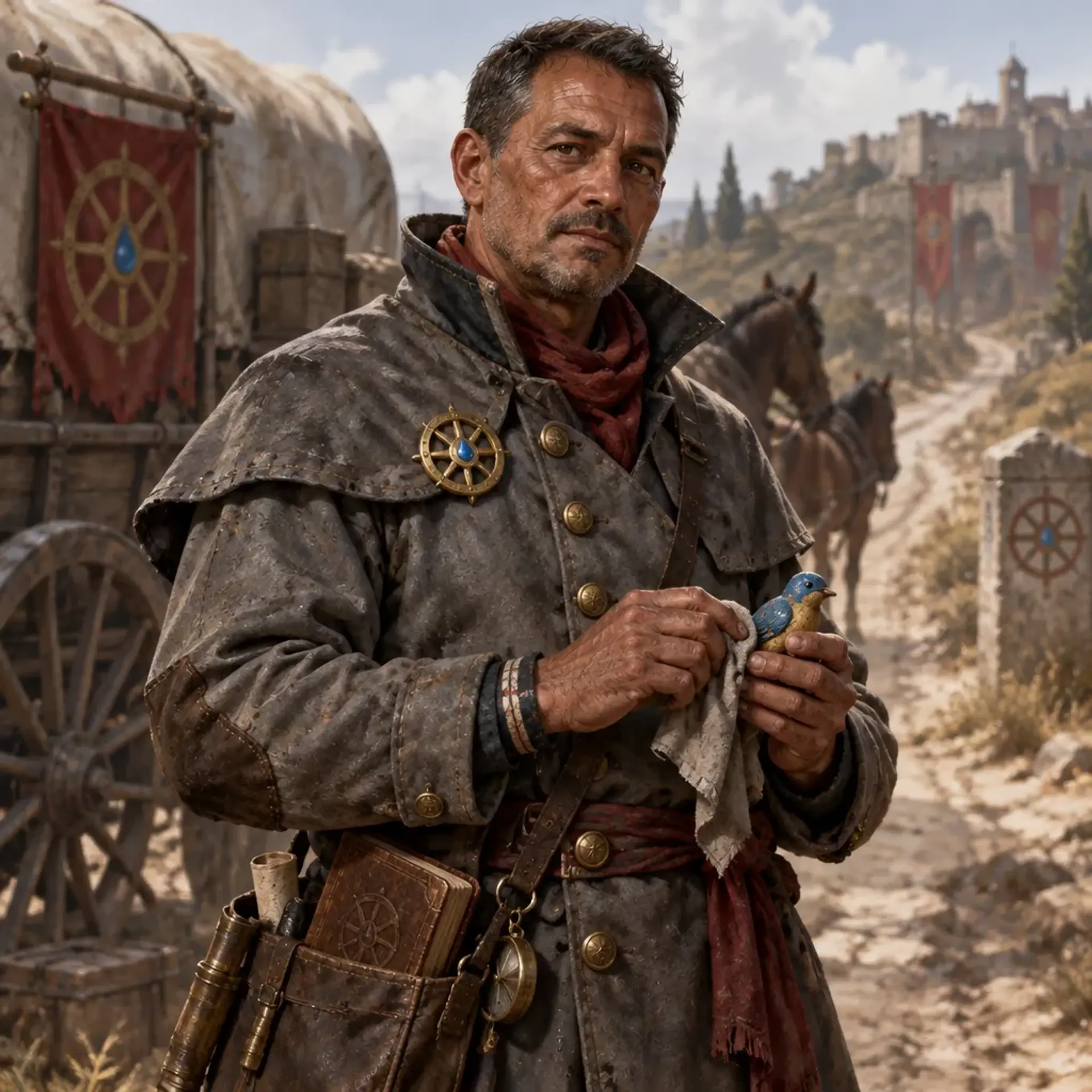
Oruven is a broad, weathered man who seems to occupy a little more space than his frame ought to allow. He stands with his feet planted as if every floor might become a battlefield, yet makes room for others with deliberate care. His skin is deeply lined and sun-browned, his silver hair cut short and brushed forward, and his beard kept close enough not to catch on armor straps. His movements are economical, not frail: a slow turn of the head can make a busy room feel suddenly arranged around him. The unexpected detail is a tiny, perfectly folded paper bird tucked into the leather tie at his sword's grip, renewed whenever the old one tears.

Clothing

Blue-gray plate armor, carefully maintained but dulled by years of use, over a quilted buff coat. He wears a faded red strip of cloth inside his left cuff, a remnant of his first company, and a plain wool cloak patched at the hem.

Body language

He takes up space without leaning on anyone, shoulders squared and hands still. In a conversation, he angles his body so that a younger or more anxious speaker has the center of attention. When doubtful, his thumb rubs the worn notch in his sword grip; when convinced, he becomes completely motionless.

Height
6 feet 1 inch
Build
Broad-shouldered and sturdy, with the compact strength of a veteran who has kept training long after retirement
Eyes
Dark hazel, with amber flecks
Hair
Silver-gray, cut close and brushed forward
Skin
Sun-browned bronze with a ruddy undertone and deep weather lines
Age
Seventy-eight
Gender
Male
Size
Medium

Distinguishing features

His broad stance and steady attention make people unconsciously leave him a clear space in crowded rooms.
The leather sword grip is polished smooth except for one deep thumb-notch worn into its center.
A folded paper bird is almost always tucked beneath the grip's leather tie.
His armor bears no grand heraldry, only tiny stamped names inside the breastplate.

Personality

14 traits and drives

Oruven is measured and patient with frightened people, but brisk with those who mistake rank for wisdom. He can be unexpectedly funny over a meal, then severe when someone treats a life as an acceptable cost. He wants others to make their own choices, yet fear makes him reach for command. In private grief he writes; in public anger he gets more direct, not less.

Alignment
Lawful good, with a practical streak that sometimes resembles lawful neutral

Quirks

Folds any scrap of paper handed to him into a small bird, even receipts and threatening letters.
Before entering a crowded room, he counts the exits under his breath, then deliberately leaves the easiest one unobstructed.
He taps the worn notch on his sword grip exactly three times before giving an order he knows someone will hate.
He saves the crusts from his bread to feed birds, but insists it is because they are useful scouts.
He corrects memorial lists when people use ranks instead of names.

Habits

When a room grows tense, he positions himself between the most frightened person and the nearest exit.
He asks who will be harmed by a plan before he asks whether it will succeed.
He remembers the names of enlisted people and forgets the titles of nobles on purpose.
After a difficult decision, he writes a line on scrap paper, folds it into a bird, and does not explain why.

Traits · 4

He offers practical help before reassurance, though he notices when someone needs the reverse.
He distrusts grand speeches but remembers every plain promise.
He is protective of young people and resents being thanked for it.
He can laugh at himself over small failures, but not at the suffering of people under his command.

Flaws · 3

He assumes responsibility for decisions that belong to other people.
He can be controlling when frightened, dressing his worry up as discipline.
He has trouble accepting that a worthy cause may require him to step aside.

Fears · 3

That his daughter will remember him only as a man who gave orders instead of listening.
That his reputation will be used to make a needless war sound honorable.
That he has mistaken stubbornness for courage in the final years of his life.

Wants and needs · 4

He wants the court to stop using his name as a warrant for war.
He needs to trust Ilyan with the truth instead of deciding what she can bear.
He wants the old soldiers remembered as people, not as proof in an argument.
He needs help finding a safe way to release the dispatches.

Combat

AC 20 · HP 204 · 30 ft.

Oruven begins by assessing the enemy's leader and the nearest threat to an ally. He uses Goading Attack or Menacing Attack to draw pressure away from vulnerable companions, then positions himself to block routes rather than chase fleeing foes. He saves Action Surge for a decisive turn, uses Parry or Riposte to punish reckless attackers, and spends superiority dice freely if doing so prevents an ally from falling. He prefers capture or surrender when practical, but will not hesitate to finish a dangerous foe who threatens civilians.

Oruven Dalan

Medium humanoid (human), lawful good, with a practical streak that sometimes resembles lawful neutral
Armor Class20
Hit Points204
Speed30 ft.
Level20
STR
DEX
CON
INT
WIS
CHA
Saving ThrowsStrengthDexterityConstitutionIntelligenceWisdomCharisma
SkillsAthleticsInsightIntimidationPerceptionPersuasionSurvival
SensesPassive Perception 16
Languages
Common,
Dwarvish
Fighter 20, Battle Master archetype. Proficiency bonus +6. Four attacks when taking the Attack action.
Second Wind, 1/short rest. regain hit points as a bonus action.
Action Surge, 2/short rest. take one additional action on his turn.
Indomitable, 3/long rest. reroll a failed saving throw and use the new result.
Extra Ability Score Improvements. his exceptional physical and social abilities reflect a lifetime of hard training.
Battle Master maneuvers, save DC 19. Commander's Strike, Disarming Attack, Goading Attack, Maneuvering Attack, Menacing Attack, Parry, Precision Attack, Rally, Riposte, and Trip Attack. He has 6 superiority dice, each a d12, regained on a short or long rest.
Custom feature, The Soldier's Measure. once per turn when Oruven hits a creature with a weapon attack, he can move that creature 5 feet to an unoccupied space, provided it is no more than one size larger than he is.
Custom feature, Poet's Pause. once per short rest, Oruven can spend a bonus action to speak a brief, personal line to up to three creatures within 30 feet who can hear him. Each ally gains 10 temporary hit points; each hostile creature must succeed on a Wisdom saving throw or have disadvantage on its next attack roll before the end of its next turn.
Custom feature, Crown Without a Throne. while Oruven is conscious, allies within 10 feet of him have advantage on saving throws against being frightened.

Actions

Multiattack. Oruven makes four attacks with his old campaign sword, or two attacks with his longbow.
Old Campaign Sword. Melee Weapon Attack: to hit, reach 5 ft., one target. Hit: 12 () slashing damage, or 13 () slashing damage if used with two hands. Once per turn, he can expend a superiority die to add damage and apply a maneuver.
Longbow. Ranged Weapon Attack: to hit, range 150/600 ft., one target. Hit: 8 () piercing damage. Oruven does not use the bow if an ally is within 5 feet of his target.
Commander's Strike. Oruven barks a precise order at one ally within 30 feet who can hear him. That ally may use its reaction to make one weapon attack, adding damage on a hit. Oruven expends a superiority die when he uses this action.
Second Wind. Oruven uses Second Wind, regaining hit points.
Action Surge. Oruven uses Action Surge to take one additional action on his turn.
Poet's Pause. Oruven delivers a short, pointed verse, using Poet's Pause. Up to three allies within 30 feet gain 10 temporary hit points, and each hostile creature in range must make the feature's Wisdom saving throw.

Reactions

Parry and Riposte. When a creature Oruven can see hits him with a melee attack, he expends a superiority die and reduces the damage by . If the attacker is within reach, he may make one melee weapon attack against it as part of the same reaction.
Shielding Maneuver. When a creature Oruven can see makes an attack against an ally within 5 feet of him, he can use a superiority die to impose disadvantage on that attack roll. If the attack misses, he may move the ally 5 feet to an unoccupied space without provoking opportunity attacks.
Indomitable. When Oruven fails a saving throw, he can use Indomitable to reroll it. He must use the new result.

Legendary Actions

Measured Step. Oruven moves up to half his speed without provoking opportunity attacks from one creature he can see.
Sword Cut. Oruven makes one Old Campaign Sword attack.
Hold the Line (costs 2 actions). Oruven chooses one ally within 30 feet who can hear him. That ally may use its reaction to move up to half its speed without provoking opportunity attacks.

Services they sell

Weapons instruction and tactical coaching
Planning an evacuation, defense, or disciplined retreat
An introduction to former soldiers and battlefield physicians
Honest counsel on command, duty, and the cost of public reputation

Rewards they can give

A letter of introduction to Yema, who can provide skilled medical care and battlefield knowledge.
A practical lesson in leadership, including training with a weapon or help planning a retreat.
A copy of the Seventh Company's roll, with the names of the dead and missing.
If the party earns his trust, access to the sealed dispatches that expose the court's role in the siege.

Equipment

  • The Old Campaign Sword (weapon)A well-balanced +1 longsword with a nicked guard and a grip worn smooth at one precise thumb-notch. The magical bonus is a custom item property.
  • Veteran's Plate (armor)A finely made suit of plate armor, repaired repeatedly and kept in excellent working order. Its +1 enhancement is a custom item property.
  • Longbow (weapon)A longbow with a plain horn nock, carried for practical use rather than display.
  • Roll of the Unreturned (personal item)A narrow notebook containing names, dates, and unfinished lines for those who did not come home.
  • Paper and ink (personal item)A small bundle of scrap paper cut into bird shapes, along with a writing kit.

Possessions

The Old Campaign Sword
Veteran's Plate
Longbow and a quiver of arrows
Roll of the Unreturned
A writing kit and folded scraps for paper birds
The original dispatches from the siege, sealed in oilcloth

Background

Oruven grew up the second son of a ferry keeper, learning to read weather, faces, and current before he could read a map. At nineteen, he enlisted in a border company and discovered that soldiers obeyed more readily when someone remembered their names. He rose through the ranks by keeping his word and bringing people home, not by winning courtly favor. At forty-three, during the siege of Aven's Ditch, his company was ordered to hold a breached causeway until reinforcements arrived. The order was impossible. Oruven instead led a retreat through the flooded sluice, carrying a wounded standard-bearer on his back and abandoning the banner. The survivors lived, but the court called him a coward and the standard became a national relic. That night changed his idea of honor: he would no longer sacrifice the living to preserve a symbol. He later served as a commander, then a negotiator, and finally a reluctant mentor to young officers. He writes short verses for the names of the dead, though he claims they are only lists with rhythm. His old companion Yema, now a physician, still challenges his habit of treating every quarrel as a crisis of command. His estranged daughter Ilyan runs a small printing shop and refuses to let him turn her life into another campaign to be managed. Recently, the court has asked Oruven to return and publicly endorse a new war. He suspects the request is a trap designed to rehabilitate the old story of the abandoned banner.

Role in the story

A powerful retired soldier whose reputation could legitimize a war or expose the truth behind an old betrayal. He can be a mentor, a political obstacle, or a source of dangerous evidence, depending on whether the party respects the people behind his legend.

“At nineteen, he enlisted in a border company and discovered that soldiers obeyed more readily when someone remembered their names.”
From their background
Faction
Former commander of the Seventh Company. He has no current official post and refuses to join the court's campaign committee.

Known connections

Yema, a physician and former battlefield companion, sends him blunt letters about his health and his habit of refusing help.
Ilyan, his adult daughter and a printer, is proud of his service but resents his instinct to make choices for her.
Varo, a former standard-bearer who survived the siege, now teaches recruits and still believes Oruven should have saved the banner.
The soldiers of the old Seventh Company remember Oruven as the commander who knew their names and shared the blame.
Major secret · GM only
Minor secrets · GM only

Media

0 images

No images yet.

Visual sheet

Turn Oruven Dalan into a sheet

A high-res, share-ready sheet you can post or print.