Gunther
Gunther
At the table
Voice
His voice carries a dry, papery rasp, as if years of damp air and old dust have worn its edges. It is shaped by German speech, military drilling, and long stretches spent talking to no one. He often begins formally, then wanders into an explanation and forgets the formality. The name 'Gunther' comes out with a hard opening and a brief, blunt finish; he says it as if checking that it still belongs to him.
Gunther speaks in German-accented English with a Mecklenburg regional accent he calls simply 'local.' His consonants are firm and sometimes over-enunciated, as though he learned speech from formal military commands and old books. He pauses to search for modern words, then substitutes an exact but outdated phrase. When relaxed, he speaks in long, branching arguments. Under pressure, his sentences shorten into clipped observations and remembered commands.
Speech patterns
How to play them
Approach him without crowding him, acknowledge the questions he asks, and offer practical instruction rather than grand promises. He responds well to patient explanations and to people who admit uncertainty. Do not treat his theories as either obvious nonsense or proven truth. A useful opening is to ask what he thinks the computer should do, then let him explain. If challenged about his past, give him room to answer in fragments; pressure tends to produce withdrawal or a defensive lecture.
Goal
Find a mentor who can teach him to use modern technology and help him understand whether his unusual relationship to Byelobog is real.
Motivation
To make a coherent account of his existence without surrendering his judgment to the clan, a sire, or a single grand theory.
Appearance
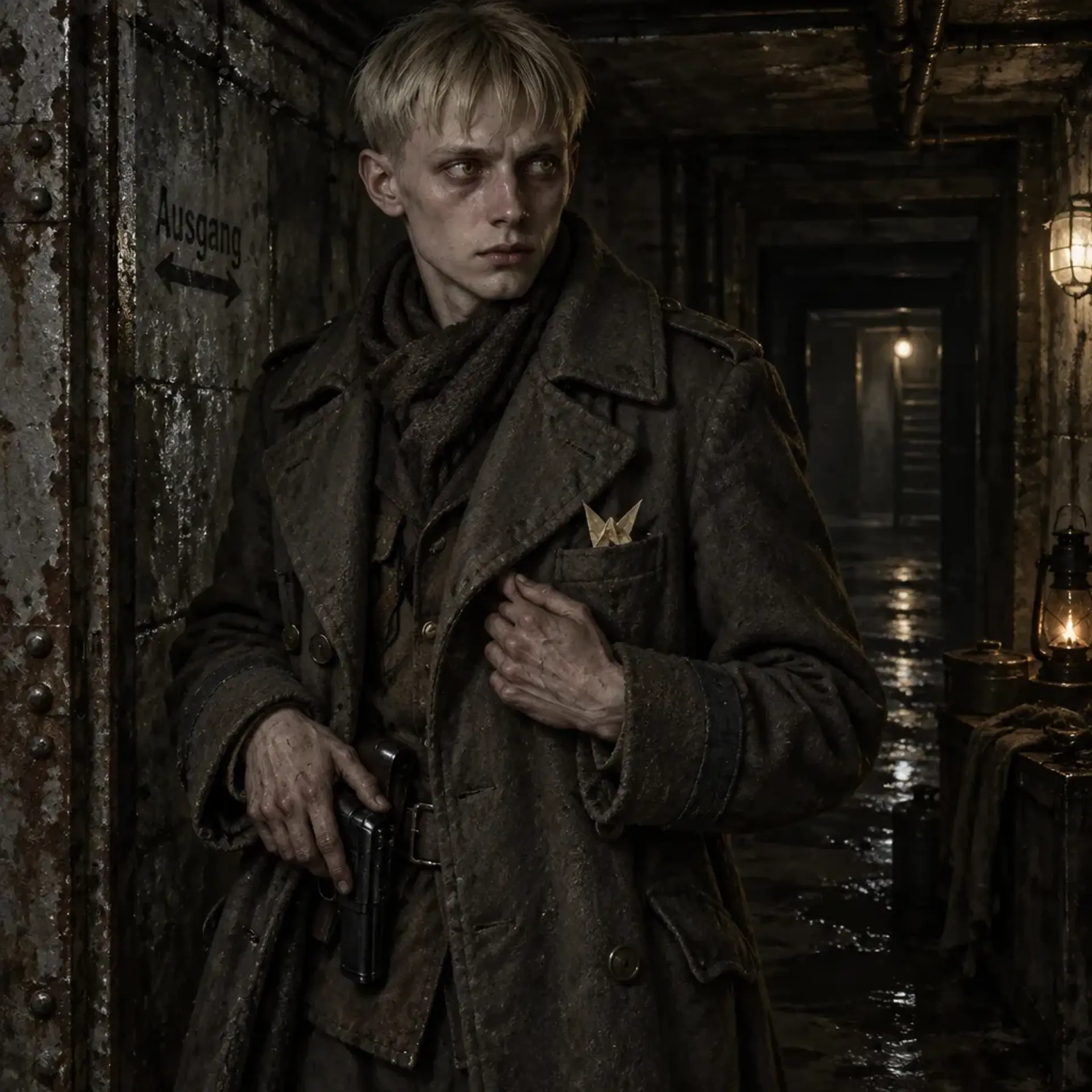
Gunther looks like a pale, underfed teenager who has dressed himself from the memory of an older soldier. Before feeding, his skin has the flat, waxy pallor of paper kept in a damp cellar; after feeding, a faint rose-brown warmth creeps into his cheeks and the bridges of his ears. His pale blond hair is cut bluntly around his temples, with an uneven fringe he trims using a knife. His yellow eyes seem clouded by old tobacco smoke until he has fed, when they become sharp and reflective. He holds his shoulders square but puts his weight on the balls of his feet, as if waiting for an order to move through a trench. He walks with a careful, heel-light tread that makes the floorboards complain only after he has passed. His hands are often stained with earth and bunker grease. Unexpectedly, he wears a tiny, neatly folded paper crane tucked into the breast pocket of his military coat, a private attempt at making something beautiful from discarded paper.
Clothing
A German military greatcoat from the Second World War, carefully stripped of every insignia and repaired with mismatched thread. Beneath it he wears plain, old-fashioned clothes chosen for warmth and concealment. His boots are scuffed but meticulously cleaned, and he sometimes wraps his collar in a dark scarf against the damp.
Body language
He holds himself at attention when uncertain, but his weight remains forward on the balls of his feet. His eyes track hands and exits. When he is trying to appear harmless, he keeps both hands visible; when he is embarrassed, he folds paper or picks at the edge of a cuff. He rarely sits with his back to a door.
- Height
- Approximately 5 feet 6 inches (168 cm).
- Build
- Lean and wiry, with the compact, coiled posture of someone who has spent too long waiting in cramped shelters. His apparent youth makes his rigid military bearing feel especially incongruous.
- Eyes
- Yellow, smoky and dull when hungry; sharper and more reflective after feeding.
- Hair
- Pale blond, bluntly cut with an uneven fringe.
- Skin
- Deathly pale with a waxy, damp-cellar cast before feeding; faintly warmer and more human-looking afterward.
- Age
- Appears about 16; actual age is unknown. He remembers the First World War and served in the Second World War, but his precise undead age is unclear.
- Gender
- Male
- Size
- Human-sized
Distinguishing features
Personality
19 traits and drivesGunther is a person of sharp contradictions, and the contradictions are not a performance. He can be patient with a broken device for hours, yet lose his temper when a stranger moves an object in his bunker. He is skeptical of explanations offered by established vampires, especially the claim that all Kindred history can be made tidy by tracing it to one ancestral source. At the same time, he is willing to entertain theories far stranger than the ones he rejects. He sees this as intellectual honesty: if the evidence is incomplete, why should an old story receive special respect? Others may see it as a defense against the possibility that he has no evidence at all. When alone, Gunther is methodical. He cleans the pistol, checks the dry path through the bunker, and arranges his possessions with the care of a soldier preparing for inspection. His routines give him a sense of continuity. He has not decided whether he keeps them because he values order or because he fears what will happen if he stops. He is capable of long, quiet concentration, especially when examining soil, old paper, or a machine he does not understand. In these moments he seems almost calm. A small disturbance can break that calm: a sudden splash in the flooded passage, a door closing behind him, or someone touching the coat. Then his attention becomes narrow and tactical. Among strangers, Gunther is guarded but not naturally cruel. He watches what people do with their hands, how quickly they answer questions, and whether they treat him as a child because of his face. He dislikes being patronized, though he may initially respond with brittle politeness rather than anger. If someone offers him useful knowledge without demanding obedience, he can become unexpectedly earnest. He asks questions with the urgency of a person who believes that a missing piece of information might explain his whole existence. He will listen closely, then test what he has heard against an improvised theory of his own. With company he trusts, he talks too much. His ideas arrive in chains: the customs of burial, the physiology of blood, the design of a console, the story of Cain, and the habits of ants may all become part of the same argument. He is fond of Norse pagan material, but more drawn to its austerity and its acceptance of harsh consequences than to any claim of religious certainty. He is also attracted to severe political doctrines because they appear to him to reveal the same uncomfortable truth: humans and vampires alike are shaped by appetite, fear, hierarchy, and the stories they use to justify obedience. He may admire a doctrine's discipline without accepting its cruelty, then find himself defending its cruelty because someone has called him naive. He is still learning to tell conviction from provocation. His guilt over deserting in the First World War has made duty a painful subject. He calls his retreat dishonorable, yet remembers the people he might have died beside as frightened and exhausted rather than heroic symbols. He cannot reconcile the two views. He dislikes officers and elders who speak as if obedience guarantees virtue, but he also distrusts his own refusal to obey. He can be surprisingly sympathetic toward frightened people who run from danger, then condemn himself for the same choice. This makes him protective in practical, unsentimental ways: he may show someone the safest exit while insisting that he is doing it only because a dead body would create trouble. He is not comfortable with the Tzimisce expectation that power should be displayed through mastery of flesh. He does not use Vicissitude, and he feels exposed when clan members ask why. His own experiments with soil and burial are both a source of pride and a source of fear. He calls the practice grave-listening, but privately suspects that it might be Byelobog acting through him. If another vampire praises the ability as proof that he is exceptional, he tends to become suspicious. If they dismiss it, he becomes argumentative. He is trying to build an identity without knowing whether the material he is building with belongs to him. Gunther's hunger changes his social presence. When fed, his yellow eyes sharpen, his cheeks gain a trace of warmth, and curiosity makes him almost boyish. He may ask an awkwardly personal question, offer to share some scrap of lore, or become absorbed in a conversation about machines. When hungry, he grows still and formal. He stops volunteering theories, monitors the room, and sees even ordinary human warmth as something he could take. He works to avoid feeding on people he knows, but his principles are not an unlimited shield against hunger. If forced into a choice between a familiar person's safety and his own survival, he may falter long enough to make the situation worse. He wants a mentor, but his ideal mentor is almost impossible to satisfy: knowledgeable but not condescending, honest but not cruel, willing to teach without making him a dependent, and unafraid of the possibility that his nature is unusual. He will test any candidate with small questions, then wait to see whether the answers are patient. He is more likely to trust someone who admits they do not know than someone who claims complete authority. His need for instruction is genuine, as is his fear of being owned by the person who provides it. The paper crane in his pocket shows the part of him he rarely explains. He folds it from scraps associated with the dead, carefully smoothing the creases and hiding the finished shape beneath his coat. He does not think of the cranes as memorials. He says they are practice, though he never explains what he is practicing. The act is one of the few times he makes something without trying to classify it. It gives him a small, private tenderness that conflicts with his attraction to severe systems and his military posture. Gunther is neither secretly gentle nor secretly monstrous. He is a person trying to make a life from fragments, with no guarantee that the fragments are even his.
- Alignment
- Not applicable as a D&D-style alignment. He is a remorseful deserter with a taste for harsh doctrines, yet capable of gentleness toward the frightened and curious.
Quirks
Habits
Traits · 5
Flaws · 5
Fears · 4
Wants and needs · 5
Combat
HP 0 · Use the chronicle's standard movement rules for a vampire with Dexterity 3; no separate speed value is provided in this system.Gunther prefers concealment, hard cover, and an escape route. He uses the pistol at range, fires only when he believes the shot will matter, and retreats into narrow passages where a pursuer cannot easily surround him. If cornered, he grapples or strikes to create an opening rather than fighting to the death. He will exploit darkness and unfamiliar terrain, but avoids prolonged combat when hungry or outnumbered.
Gunther
Actions
Reactions
Services they sell
Rewards they can give
Equipment
- Battered service pistol (weapon)An old German service pistol retained from his wartime years. Its exact model and condition are not established; use the chronicle's normal firearm rules.
- Unmarked greatcoat (clothing)A German military greatcoat with all insignia removed, carefully patched and maintained.
- Computer and game console (personal effects)An old computer and a game console, both taken from victims. He has not figured out how to use them and is looking for a trustworthy teacher.
- Theory notebook (personal effects)A small notebook of speculative theories, fragments of Norse pagan material, and sketches of the bunker. Some pages are written in cramped, almost illegible German.
Possessions
Background
Wilhelm remembers no human childhood, no family table, no schoolroom, and no name spoken by a living parent. His first memory is the taste of burial cloth between his teeth. He was clawing upward through cold earth, choking on soil, and trying to breathe though he no longer needed breath. The grave was in Mecklenburg, beneath a churchyard whose stones had sunk into wet grass. He emerged with a mouth full of linen and dirt, a body that looked about sixteen, and no explanation for why the dead ground seemed more familiar than the sky. He took the name Wilhelm from a half-rotted military tag found in the grave, though he later began using Gunther because it sounded, to him, like a name that could belong to a living man. Even he is not consistent about which name he answers to. His earliest nights were guided by hunger, cold, and an instinctive aversion to people who looked directly at him. He learned to sleep in culverts and root cellars, and to follow the scent of blood without understanding why it made the world briefly vivid. The first time he fed from a living person, he was horrified by the ease with which the victim's fear became his own relief. He developed a private theory that he had not been reborn as a vampire in the familiar sense, but as a Nachzehrer, a grave-haunting dead thing that fastened itself to the living. He has no proof. He keeps the theory because it makes his condition feel less like an inheritance and more like a problem with a shape he can study. At some point during the First World War, he joined the German army as a shock trooper. How he entered the records, found equipment, and endured daylight remains murky even to him; he does not give a reliable chronology. He remembers mud packed into his cuffs, the percussion of artillery in his teeth, and a night assault where he deserted rather than advance into a position he believed would slaughter his squad. He survived, while others did not. For years he told himself that leaving was the only sane act available. Eventually the memory hardened into shame. He regards desertion as dishonorable, but cannot make himself believe that the alternative would have been noble. He keeps the contradiction alive like a sore tooth, returning to it whenever someone speaks of duty as if it were simple. During the Second World War he served again, in a role he refuses to specify. He will mention a pistol, a winter march, and a coat stripped of every insignia, then abruptly change the subject. The coat is now his most carefully maintained possession. He brushes its seams, repairs its lining, and will not let anyone attach a badge to it. He says that symbols make men imagine they know who is giving orders. The hidden truth is less abstract: he remembers taking part in something terrible, and he fears that a person who learns what it was will decide that he is not merely strange but irredeemable. Gunther is a Tzimisce, though he has never fit comfortably among the clan. He does not practice Vicissitude as other Tzimisce expect, and he has no visible fangs. Whether his body has been altered, whether some curse or unusual feeding pattern is involved, or whether the stories about his supposed sire are simply wrong is unresolved. Vampires whisper that he is Byelobog's childe, perhaps the last, and that Byelobog is not merely his sire but an invasive intelligence living through him, like a parasitic fungus commandeering an insect. Gunther neither confirms nor denies this consistently. He remembers no Embrace, no sire's face, and no instruction in clan custom. He does sometimes wake with mud under his nails after sleeping in a sealed room. Rather than Vicissitude, he experiments with a custom, earth-focused practice he calls grave-listening. He presses his palm into soil or masonry dust and describes it as learning what the ground remembers. He has not established whether this is Koldunic sorcery, a warped Discipline, a habit mistaken for magic, or something his blood has made possible. He is careful to say that his version is not the same as anyone else's school. A few Tzimisce find this irritating; others find it dangerous. Gunther is less interested in being accepted than in discovering whether he is a person, a weapon, or a habitat for something else. Today he lives in a partly flooded Second World War bunker in Mecklenburg. The bunker smells of rust, stagnant water, and old lime. He has made a dry sleeping platform above the waterline, marked his safe paths with chalk, and arranged scavenged objects according to a system he refuses to explain. Among them are an old computer and a game console taken from victims. He has not understood how to operate either device. He regards them as evidence of a new human age whose logic he has missed, and wants a mentor who will teach him without treating him like a fool or a specimen. He is suspicious of anyone too eager to help. His nights have become increasingly crowded by problems. A local Kindred has noticed the bunker and may want it cleared or claimed. A mortal who searches for a missing relative has started asking questions near the site. Gunther has not decided whether to mislead them, scare them away, or offer them something useful. He also needs blood, but dislikes hunting people he has spoken to, which narrows his choices and makes him vulnerable. He studies scraps of Norse pagan writing and is attracted to austere, unforgiving ideologies because they suggest that living and undead are not opposites: both are bodies serving appetites, loyalties, and systems larger than themselves. He argues against the Cainite account of vampire origins, not because he has a proven alternative, but because he believes any theory that claims one ancient ancestor explains everything is too comfortable. Sometimes he offers his own theories: that vampires are ecological consequences of burial customs, that blood is a memory-bearing medium, or that the dead are a society humans keep feeding without knowing. He may believe any one of these for an evening, then abandon it when a better question appears. Gunther wants a teacher, a stable explanation of himself, and a way to atone for the deaths attached to his human service. He cannot decide which desire matters most. His best chance of becoming more than a frightening rumor may be the relationships he has not yet learned how to maintain: a cautious contact among local Kindred, a mortal who might teach him about machines, and anyone willing to ask what he remembers without demanding a confession in exchange. He has a life beyond the bunker, but he has not yet learned that being invited into one is different from taking shelter in it.
Role in the story
A dangerous but approachable outsider whose need for instruction and identity can draw the characters into Kindred politics, wartime secrets, and the mystery of Byelobog. He can be a reluctant source of local knowledge, a potential ally, or a tragic figure whose search for certainty makes him vulnerable to manipulation.
“His first memory is the taste of burial cloth between his teeth.”
- Faction
- Clan Tzimisce. His standing within the clan is uncertain and uncomfortable. He is not securely aligned with a sect; any assumed allegiance should be established by the chronicle.
Known connections
Media
0 imagesNo images yet.
Turn Gunther into a sheet
A high-res, share-ready sheet you can post or print.