William Windon
William Windon
At the table
Voice
William's voice has the soft breath and slight catch of someone recovering from illness, with a natural local rhythm that becomes more assured when he talks about plants. He often takes a short intake before speaking, then starts too quickly and has to correct himself. The reflection uses his throat but sounds older and more deliberate, with crisp consonants and a measured cadence. Its voice does not become louder when angry; instead, it cuts in before William has finished and chooses words with unnerving precision.
William speaks in a contemporary local English voice, with an easy, slightly breathy delivery that can turn halting when he discusses his health. He often draws a breath before answering, as though checking that the words are really his. The reflection uses the same mouth but carries an older, deeper-sounding weight and an accent that seems to belong to an earlier generation. It articulates carefully, makes dry observations without raising its voice, and can abruptly speak in an unfamiliar cadence during a takeover.
Speech patterns
How to play them
Approach William gently and speak to him as a person rather than as a supernatural curiosity. Ask permission before examining mirrors, windows, or his symptoms. Give him time to explain what happened. The reflection responds better to direct, concrete questions than to demands for its complete history. Do not assume it is a ghost or fae, and do not assume its fear of those things is proof that they are involved.
Goal
Find Abraham Gorff or another trace of the Heart of England, understand the reflection's identity, and recover enough to train as a botanist without surrendering his body.
Motivation
William wants to return to an ordinary life, keep his family safe, and understand the thing sharing his body. The reflection wants to recover its memories and pursue whatever it recognizes in Adaline, the sea, and its fragmentary family history.
Appearance
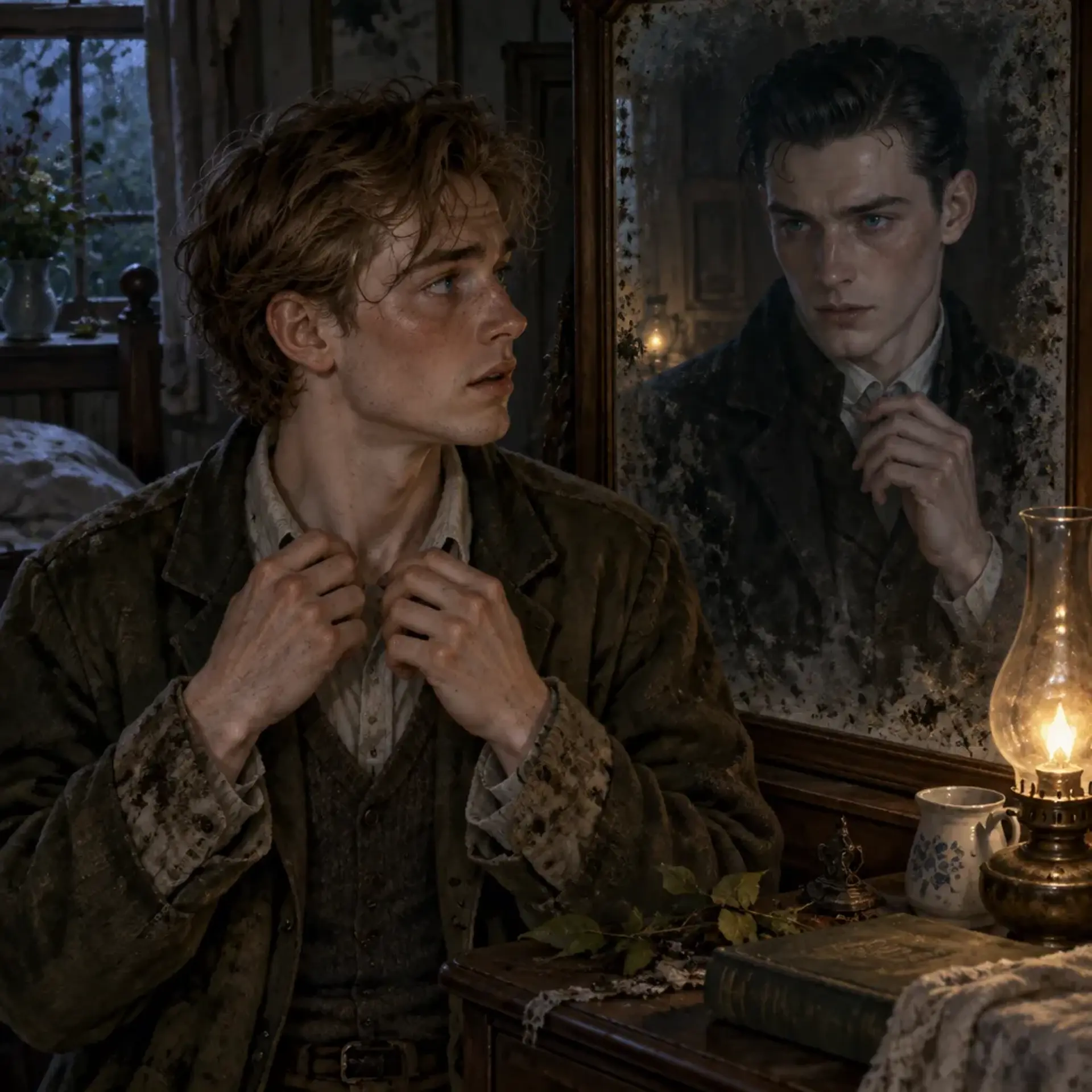
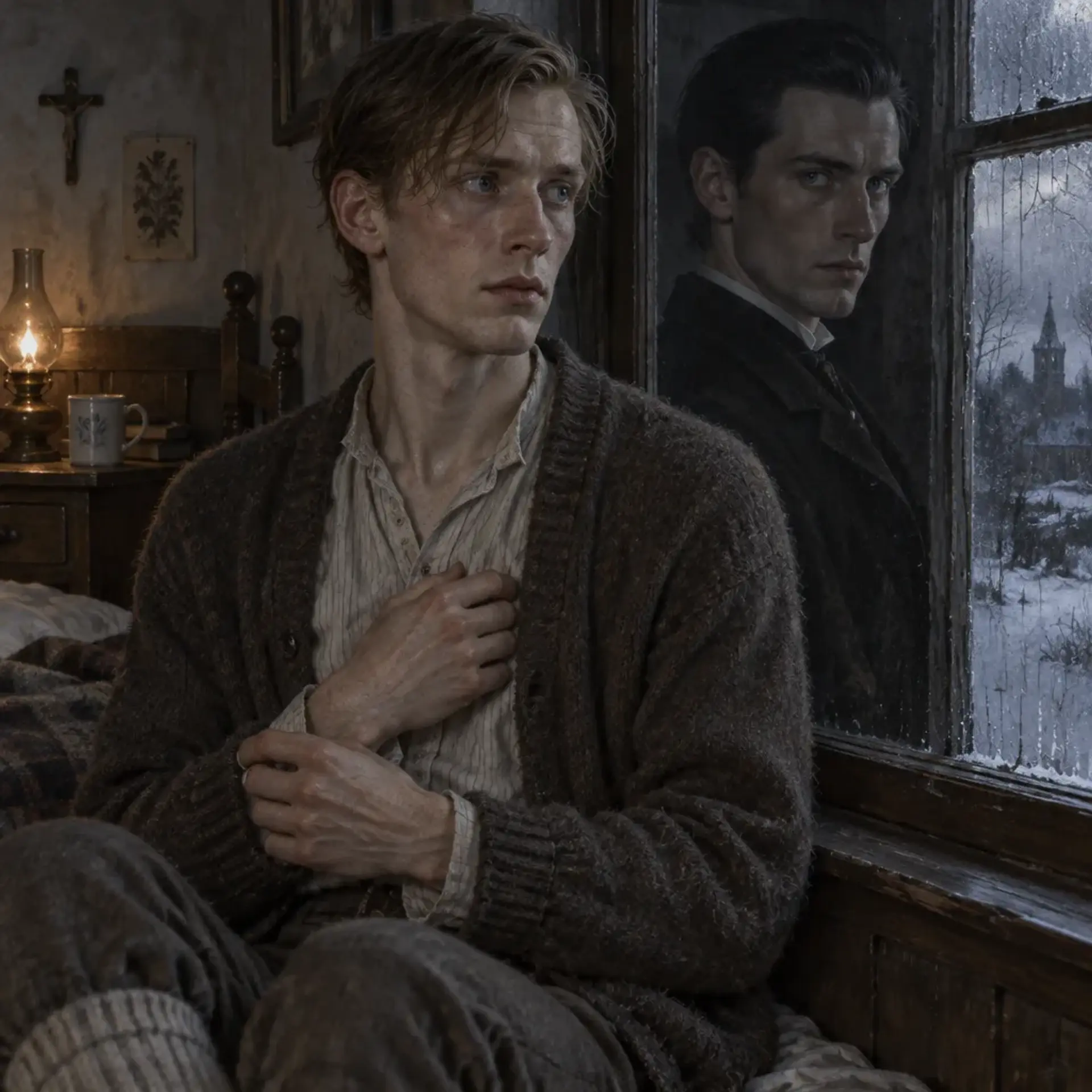
William Windon is a young Wiltshire man with a long, freckled face, brown-spotted fair skin, dark-blond hair, and clear blue eyes. He has the wiry, slightly underfed look of someone who spent his days walking estate grounds before his heart stopped. Since his illness, his movements have become cautious: he tests his balance before standing, holds a hand against his chest when cold, and walks with a gardener's careful attention to uneven ground. His hair is usually brushed into place, though bed rest has left it stubbornly flattened on one side. His clothes are practical and recently looser on him: work shirts, worn trousers, thick socks, and a cardigan or dressing gown when the house is cold. He looks like an ordinary local lad until a reflective surface catches him. There the face is not William's: it is longer and more formally handsome, with short, black hair combed slickly back and trimmed close at the sides, moonlit blue eyes, a stern mouth, and a posture that seems trained by an older, stricter household. The difference is not a trick of expression or lighting. The reflected stranger has different bones. When the reflection takes over, William's shoulders settle, his chin lifts, and the body seems to move with an old-fashioned economy that does not belong to him. The unexpected detail is that William, despite being a country gardener, habitually checks the hems and cuffs of his clothes as though preparing for a formal portrait; the reflection's fussy influence has made the habit seem almost ceremonial.
Clothing
Practical gardening clothes, worn shirts, work trousers, sturdy shoes, and warm layers. While on bed rest he wears loose home clothes and thick socks. The reflection prefers tidy collars, properly arranged cuffs, and hair combed neatly back.
Body language
William folds inward when watched and tries to make his hands look occupied. He touches his chest, checks his cuffs, and shifts his weight carefully after standing. The reflection makes the same body seem unfamiliar: shoulders back, chin level, motions clipped and economical. During a takeover, William's body may turn toward a reflection before he has chosen to look.
- Height
- Average height
- Build
- Wiry and lightly built, with the lingering weakness of someone recovering from a serious cardiac episode.
- Eyes
- Blue
- Hair
- Dark blond
- Skin
- Fair, with brown freckles and spots
- Age
- Young adult
- Gender
- Male
- Size
- Human
Distinguishing features
Personality
19 traits and drivesWilliam is observant and kind, but embarrassment can make him evasive. He is proud of his work and dislikes being treated as helpless, yet he quietly welcomes Clare's care when his heart or balance frightens him. With friends he tries to be funny and ordinary; with family he is more likely to snap, then regret it. He wants to believe the reflection is a problem he can solve with patience and research, but its invasions of his body make him furious and afraid. The reflection is not simply cruel. It is curious, vain about appearance, and capable of apology, but it appraises people in a way that makes affection feel like possession. It can be attentive to Elizabeth's questions one moment and cutting about her choices the next. It seems to like films and books, becomes physically eager when it encounters something it enjoys, and is fascinated by places it has never seen. Its fear of ghosts and fae can overwhelm its pride. It wants conversation and offers fragments about itself, but when William asks for a coherent account it becomes evasive or describes history as weather, salt, or forge work.
- Alignment
- Not applicable as a canonical Secret Histories statistic. In ordinary terms, William tries to be decent and fair; the reflection is governed by private loyalties and sharp judgments.
Quirks
Habits
Traits · 5
Flaws · 4
Fears · 5
Wants and needs · 5
Combat
HP 1William is not a trained fighter and avoids violence. If cornered, he tries to escape, put a table or door between himself and danger, or call for help. The reflection may briefly seize control during a frightening threat, but its response is driven by panic and memory rather than a practiced tactic. Treat such episodes as a custom narrative complication, not a canonical Secret Histories combat mechanic.
William Windon
Actions
Reactions
Services they sell
Rewards they can give
Equipment
- Gardening trowel (tool)A practical tool from his gardening work. William keeps it out of reach while recovering and does not regard it as a weapon.
- Hand lamp (personal item)A small bedside light used when he wakes cold or disoriented at night.
- Recovery notebook (personal item)A notebook where William records the reflection's words, symptoms, dreams, and any clues about Abraham Gorff or the missing heart.
Possessions
Background
William Windon was born in Wiltshire, into a family that had been local for generations. His father, Hector, works as a historian and has a habit of treating the county as a footnote to larger events. His mother, Clare, is practical and attentive, the person who notices whether the kettle has boiled and whether someone has eaten. His younger sister Elizabeth is lively, curious, and forever bringing him questions about boys she likes, clothes that look nice, and whether he is being rude again. William has always liked the living world more than arguments about it. He works as a gardener on a nearby estate and hopes to train as a botanist. He can spend a morning quietly pleased by a seedling and an afternoon embarrassed by the attention that pleasure draws. The trouble began with a stone that should never have reached him. Bartholomew Golden, an amateur arcanist, had brought a strange object to the Hush House as a gift and payment for entry. In newspaper wrappings, he called it the Heart of England. It looked like a human heart carved from the chalky rock of the Dover cliffs, with barnacles and strands of sea grass clinging to its uneven surface. Those who saw it described it as ugly, damp, and oddly sad. It was thrown into the sea. Later, it returned to shore, slick with salt water and black ooze, and a red-pink hue seemed to glow under the stone's surface. Bartholomew was never again permitted near Brancrug. Abraham Gorff, a young man from London, found the object and took it home to Wiltshire. At first he treated it as a curious rock. It had the social life of an awkward guest: in the company of neighbors it appeared to die, cold and dull, but alone with Abraham it could beat beneath his coat. When he carried it to a Hampshire shore and put it in water, its color returned. Abraham concluded that it was special and that it preferred him. He was not merely greedy about it. He came to believe the stone disliked company, and he began keeping it from other people's eyes. His house filled with sounds: voices without speakers, footsteps on stairs, doors shifting open, and the sensation of someone present just beyond the room. The heart wept salt and water. Abraham found the haunting unbearable and sold it to a local seventeen-year-old, William, one of the people who had once seen the stone among Abraham's visitors. William was proud of his purchase. He imagined an odd keepsake, perhaps a bit of local mystery, and showed it off. Then he began to feel its beat in his chest, in time with his own. Sometimes he thought he stood taller after tasting the sea, blood, or soil in his mouth. The sensation repulsed him. He decided that a rock could be broken, brought a hammer to it, and struck. The pain did not seem to come from his hand. It opened in his chest, sharp and absolute. William dropped to the ground, groaning and weeping, and heard blood in a voice that did not sound like his. For a fraction of a second he saw muscle twitch beneath the stone. Then the movement stopped, and his own body seemed to stop with it. William woke with Clare's hands on his face. His heart had stopped. His family called for help, and the episode was treated as a medical emergency. The frightening fact that he survived did not make the memory less real. Days later, still shaken, he left the heart in a hollow log. It looked cold and pristine, despite the blow. When he returned, it was gone. He searched the log, the nearby ground, and every place he could imagine someone putting it. He never found it. For a while, William thought the worst was over. Then his reflection began to be wrong. At first it was only a different face in the mirror: a long-faced young man his own age, handsome in a formal, English way, with neatly slicked black hair and blue eyes like moonlight over a freshwater pond. The stranger looked stern and maintained himself with a care William did not share. William became cautious while grooming, checking the mirror as if he might catch it making some mistake. He tried to dismiss it as illness, stress, or a remembered face from somewhere else. The figure did not fade. It began to lag behind him, then to jerk toward movements William had not made. Sometimes the reflected mouth held a severe line while William himself was smiling. Sometimes the stranger seemed to look past William, as though the mirror showed a room with its own business. The first words came during William's bedtime routine. William had spoken aloud to himself, an idle remark about how he did not often use a particular comb. The reflection's mouth moved with his and answered, in William's voice but not William's accent: “Well, it's not often you use that one.” The voice sounded older than William's, with the measured habits of another generation and a deeper, more deliberate weight. The remark was so mundane that William could not convince himself he had imagined it. The reflection paused after speaking, apparently as surprised by the exchange as William was. The reflection's comments grew. It criticised how William combed his hair, what he wore, and the state of his room. It made dry observations about people passing the window and seemed especially willing to be rude when it thought no one else could hear. It sometimes stopped William from speaking when it thought his words improper, though William could still feel the impulse to continue. A cutting remark about Hector followed Hector's complaint that country people were silly. William was blamed for the insult and got into trouble, unable to explain that his own mouth had made a judgment he had not chosen. Another time, after a neighbor's child accidentally ran into William with a toy wagon and made a girl cry while apologizing, the reflection used a slur about the Welsh neighbor's child. William was made to muck out the neighbor's stables. The reflection did not understand why the punishment belonged to William, or at least refused to admit that it did. William's friends Tommy DeHare, John Mollask, and Ryan O'Leary visited while he was recovering. Their visit was supposed to be ordinary company. William was delighted to see them and embarrassed by the attention paid to his illness. The reflection made itself known in the most socially disastrous way possible. It spoke through William while he was looking toward a pane of glass, then reacted to the boys as though they were present in the reflection's own room. It could move William's expression and posture without waiting for him. The boys saw a face that did not look like William's, and heard William's body speak with a voice and manner that were not his. William tried to explain that he was unwell. The reflection made a dry remark about the explanation, then seemed interested in the visitors, watching them with a stern, appraising look. Tommy tried to joke. John watched William with concern. Ryan kept close to the door. Their visit ended with all three understanding that this was not a performance. William felt relieved that someone else had witnessed it, and sick with shame that the witness had been his closest friends. The reflection has opinions of its own, though they do not always resemble a living person's opinions. It describes a father and siblings as if it were talking about weather, tides, or a particular kind of forge work. Its references imply a family somewhere beyond William's life, but the details are incomplete and inconsistent. It speaks of people it calls its father and siblings without the ordinary warmth or grief William expects. The reflection is also afraid of ghosts and fae. It avoids the paranormal with a fear that makes no sense beside its own existence. When William suggests asking a medium or seeking a supernatural explanation, the reflection resists, changes the subject, or tries to prevent him from going. It will tolerate mirrors more readily than spirits. It has developed a particular interest in Elizabeth. When she pesters William about a boy she likes, or asks whether a dress or ribbon looks nice, the reflection often calls her “interesting.” It means this as an observation, but the word lands like an appraisal. The reflection dislikes being treated as an amusing nuisance and yet pays close attention to Elizabeth's moods and questions. It occasionally corrects William's manners around her, then makes an unnecessarily cutting comment about the boy she likes. William has learned to interrupt it before his sister can hear. Elizabeth, for her part, has noticed that he sometimes looks at her as though he is listening to a second conversation. She teases him about it, then watches him more carefully when he goes pale. William's girlfriend, Adaline, has become a different sort of conflict. She has auburn hair and soft brown eyes, and William finds her pleasing to look at in a way that makes him self-conscious. When the reflection first saw her, its interest sharpened. It did not merely approve of her appearance; it wanted her attention. It began commenting on her when William was getting ready to see her, calling her lovely in a tone that made the compliment sound possessive. It tried to improve William's hair and clothes, then made remarks about how Adaline deserved better conversation. It sometimes moved his eyes to follow her in a window before William could look away. William is frightened by the possibility that the reflection might use his body to approach her. The reflection seems to regard Adaline as a person it might court, despite being bound to William's body and despite Adaline's relationship being with William. William has never had a more humiliating rival: himself, wearing his face and borrowing his mouth. A bad night made the danger more obvious. William woke shivering and went into the hall with a small light. Elizabeth saw him and spoke to him. He answered in a different voice and accent. He was cold in a way that seemed to belong to someone else, and he did not remember choosing the words. On another occasion he woke feeling better, then went to the study to warm himself by the private fireplace. He fell asleep on the lounge. Hector found him there, looking strangely comfortable and strangely cold. William dreamed of salt, forges, and a dark wood. The reflection later described the dream as if it were a place it had known, not a dream it had borrowed. The worst episode came while the family watched a war film on television. The reflection reacted to the sounds of battle with sudden terror and fury. William lost control of his body as if he were experiencing a remembered shell shock: he fought, ducked, struck out, and seemed unable to recognize the room. His parents feared his heart had stopped again. Elizabeth changed the channel, wide-eyed and frightened. When the scene ended, William was exhausted and ashamed. At bedtime the reflection used his mouth to mumble an apology. It offered a fragment of memory in consolation: forge noise, a smell of wet leaves, the taste of salt, and the feeling of being trapped under a dark sky. It did not explain enough to make the episode safe, but it was the first time it tried to make amends. William is now on bed rest after the heart stoppage and the later episodes. He spends his days searching for information about Abraham Gorff, the missing stone, and a way to understand the reflected stranger without inviting a ghost or fae into his home. He has learned Abraham moved to Canada, which makes him feel that his best lead has slipped beyond reach. William's practical goal is to resume his work and training as a botanist. His urgent goal is to find the Heart of England before the reflection becomes able to live through him without restraint. The reflection has its own purpose, but it explains that purpose in sensations rather than a plan. It wants to remember its family, to know why it was left in stone, and perhaps to reach something it associates with the sea and the dark wood. Neither William nor the reflection knows whether these desires can coexist.
Role in the story
A sympathetic, unsettling witness to an object that has vanished but not released its influence. William can lead investigators toward Abraham Gorff, the Hush House, the Heart of England, and the reflection's buried past. He is also a domestic horror character whose most urgent conflicts involve family, friendship, recovery, and the frightening possibility of losing ownership of his own face and body.
“His father, Hector, works as a historian and has a habit of treating the county as a footnote to larger events.”
- Faction
- No known faction affiliation. William is a local gardener and aspiring botanist. His connection to the Hush House is indirect, through the Heart of England.
Known connections
Media
0 imagesNo images yet.
Turn William Windon into a sheet
A high-res, share-ready sheet you can post or print.