William Windon
William Windon
At the table
Voice
William's normal voice is youthful and serviceable, with a little breathlessness after exertion since his heart stopped. The reflection uses the same vocal instrument but imposes an older, deeper cadence, as if William's throat were recalling a speaker it has never met. William's gardening work gives him plain terms for soil, roots, rot, and weather; the reflection turns historical knowledge into descriptions of tide, pressure, heat, and forge work.
William speaks in a contemporary local English manner, earnest and direct, with a gardener's practical vocabulary. When tired, he trails off rather than dramatizing his fear. The reflection uses William's mouth but sounds like an older generation: deeper, more formal, clipped, and dry. Its voice feels physically wrong because the mouth moves with William's face while the accent and cadence belong to someone else. When the reflection is frightened, its wit disappears and the voice becomes urgent.
Speech patterns
How to play them
Approach William gently and give him time to explain. Do not assume the reflection is merely a symptom or that it is harmless. Ask before involving his family or friends. If the reflection appears, address William as a person while recognizing that another will may be listening. Avoid sudden threats, forced separation, or testing the heart with violence.
Goal
Find Abraham Gorff or the fossil-heart, learn what the reflection is and what it wants, and regain enough control to return to gardening and botanist training.
Motivation
William wants an ordinary future in which he can work with plants, see Adaline, and trust his own face. The reflection wants experiences, movement, and some route back to its unknown family; it is curious about the world but terrified of ghosts and fae.
Appearance
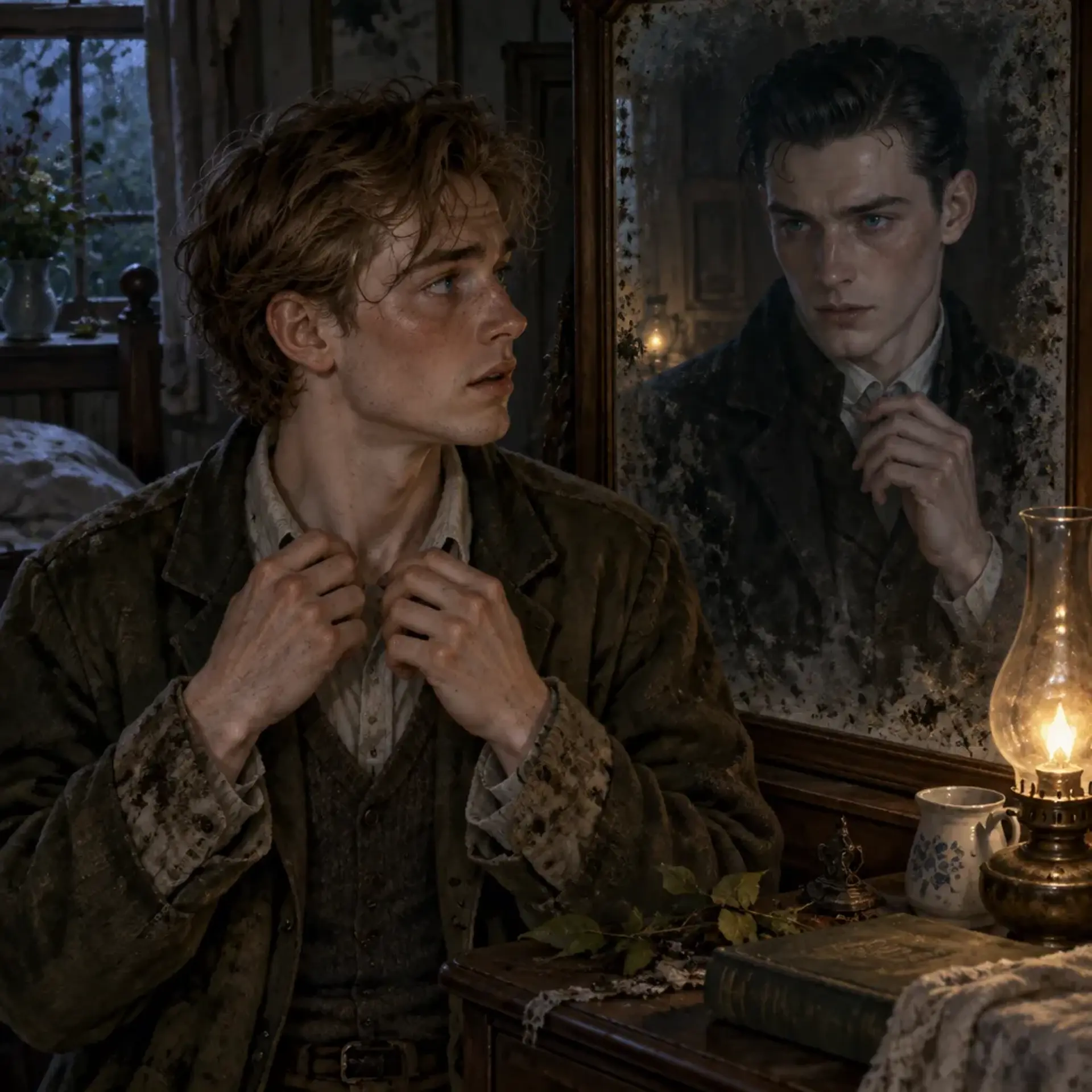
William is a country-bred young man with a gardener's attentive way of looking: he notices leaf damage, damp hems, and the direction a person has walked through grass. He is neither imposing nor particularly slight, but lately he moves as though testing whether the floor and his own heart will keep their promises. His dark-blond hair has a wind-tossed texture, and he repeatedly tries to make it sit neatly. Brown spots freckle his face. His blue eyes look clear when rested and startled when he is not. He smells faintly of turned soil, bruised green stems, and the medicinal soap his mother uses while nursing him. He seems unaware that the garden smell follows him indoors. The most unsettling thing about him is his reflection: long-faced, handsome in a severe, carefully groomed way, with slicked-back short black hair, trimmed sides, and blue eyes like moonlight on a still pond. The face is structurally unlike William's, not a distorted version of it. The reflection holds itself with an old-fashioned stiffness and sometimes moves a fraction before William does.
Clothing
Practical country clothes suited to garden work: sturdy trousers, a shirt with a softened collar, and work layers that can take soil and rain. He tries to dress neatly when Adaline may visit. The reflection has strong opinions about his hair, collars, and anything it considers ill-chosen.
Body language
William fidgets with cuffs and hair when anxious, then catches himself and holds very still. He walks with a gardener's care around fragile things, but after a cold spell his steps can become measured and unfamiliar. When the reflection takes an interest, his head turns toward the object first and the rest of him follows. Its expression settles into a stern, composed mask that does not match William's open, worried face.
- Height
- Unspecified; ordinary height for a young adult man
- Build
- Average young-man's build, currently weakened by recovery and bed rest; accustomed to outdoor work rather than fighting.
- Eyes
- Blue
- Hair
- Dark blond
- Skin
- Fair skin with brown spots and freckles
- Age
- Young adult; exact age unspecified
- Gender
- Male
- Size
- Not applicable as a verified Secret Histories combat category; human adult
Distinguishing features
Personality
19 traits and drivesWilliam is attentive and good-hearted, but not naturally brave in the theatrical sense. He will keep a frightened person company and then lie awake replaying a careless remark. He likes practical explanations, especially those rooted in plants and work, yet he is now living with an event he cannot explain. Around his family he tries to be dependable, sometimes becoming brisk because he does not want them to see how scared he is. With friends he wants to joke as before, but can overcompensate with cheerfulness. With Adaline he is tender and easily flustered, while also hiding the most important fact about his life. The reflection is not simply William's dark side. It has its own likes, dislikes, fears, and curiosity. It can be funny in a cutting, almost clinical way, and sometimes appears to enjoy provoking William. It may also show genuine concern, though its idea of concern can mean preventing a sentence, taking control of a movement, or making an unwelcome judgment aloud. It is fascinated by books and films and by the ordinary permissions William takes for granted. The reflection's interest in William's family is observant but unsettling: Elizabeth is “interesting,” Hector invites sharp criticism, and Clare's care is noticed without being described in familiar emotional language. William wants the reflection to be a person if that would make it less frightening, but resents it when it treats his body as shared property. He is curious about its knowledge and resentful of its control. The reflection wants William's access to the world but does not seem to understand why William considers that access private. They can feel affection, fear, and anger in the same moment without agreeing about what those feelings mean.
- Alignment
- Not applicable as a Secret Histories rule. Personally protective and earnest, with the reflection's colder judgments complicating his choices.
Quirks
Habits
Traits · 5
Flaws · 4
Fears · 4
Wants and needs · 6
Combat
HP 0William is not a trained combatant and avoids violence. He seeks an exit, cover, or help, especially because injury may provoke the heart's connection. The reflection may briefly seize initiative to flee or protect the body, but its priorities are not reliably William's. No formal combat statistics are asserted as canonical Secret Histories mechanics.
William Windon
Actions
Rewards they can give
Equipment
- Hand lamp (practical equipment)A small light used on nighttime trips through the house.
- Gardener's tools (work equipment)Gardening tools used in his work and training; none is carried as a weapon.
- Recovery arrangements (personal)A bed-rest routine and household supervision imposed after his cardiac episode.
Possessions
Background
William Windon was born in Wiltshire, into a family whose habits seemed to him as permanent as the chalk beneath the fields. His father, Hector, is a historian, fond of dates, sources, and making broad pronouncements about the people who live beyond his books. His mother, Clare, is practical and watchful. His younger sister, Elizabeth, has lately taken to bringing him questions about boys, clothes, and what counts as good manners, as if his being home more often has made him an available authority. William has never thought of himself as a person with a destined part in anything. He works as a gardener on an estate and is trying to train as a botanist. He likes names for plants because names imply that somebody has looked closely enough to distinguish one living thing from another. The object that altered his life began far from William. At the Hush House, a visitor named Bartholomew Golden presented a purported fossilized living heart, calling it “The Heart of England.” He had wrapped it in newspaper and offered it as payment for entry. The thing resembled a human heart carved from Dover cliff rock, rough and mineral, with barnacles and sea grass clinging to it. Golden was never allowed near Brancrug again. The heart was cast into the sea. It returned to shore, apparently dead, weeping salt water and black ooze. Beneath its stony shell, however, a red-pink hue had returned, as though something inside had remembered blood. A young Londoner named Abraham Gorff found it and carried it home to Wiltshire. At first he studied it, repelled and fascinated. He showed it to neighbors. In company, the heart seemed to die: it became inert, cold, and rocklike. Alone, or brought to a shore in Hampshire and put in water, it blushed red-pink and beat. Abraham came to believe it disliked guests. He stopped showing it around, not because he wanted to hoard a valuable object, but because the heart appeared to recoil from attention. Meanwhile, his house developed its own disturbances: voices without speakers, doors moving, footsteps on stairs and in empty halls. Abraham understood that the pulse belonged to the heart, not to any ordinary stone. The burden frightened him. He sold it to a seventeen-year-old local lad, William, one of the people who had seen the object when it had gone dead. William was proud of his strange possession. Then its rhythm began to answer his own. He felt the beat under his coat as if his chest had acquired a second, more deliberate heart. After a spell of tasting the sea, blood, and soil in his mouth, he became convinced that a stone ought to be breakable. He took a hammer to it. The blow did not break the heart. Pain shot through William's chest, sharp enough to fold him to the ground. He groaned, tasted blood, and saw the stone twitch: for an instant its surface seemed to part around a muscle that convulsed violently. Then William's own body gave out. Clare found him. His heart had stopped. He woke with his mother's hands on his face and the knowledge that his life had become conditional. The medical scare kept him under watch and eventually confined him to bed rest. Days later, frightened by the heart and unsure what else to do, he left it in a hollow log. When he checked, it was cold and pristine, as though the hammer had never touched it. It is no longer there. William cannot tell whether somebody took it, whether it moved, or whether it was never as safely abandoned as he hoped. The first sign of what remained was a mirror that did not show William. In it stood a young man his age, long-faced, handsome, stern, and much more carefully groomed. The reflected stranger had short black hair slicked back and trimmed at the sides, and blue eyes unlike William's in their stillness. William began checking mirrors while shaving and washing, afraid the image would change while he was looking away. At first it merely irritated him. Its expression could turn stern when William was relaxed; its movements jerked as if it wanted to go somewhere else. William told himself that illness, fear, and poor sleep could make a person imagine things. One night, during his ordinary bedtime routine, William watched the reflection move its mouth with his. The voice that came out was William's, but not his accent or age. “Well, it’s not often you use that one,” it said, commenting on his grooming. The stranger paused after speaking, as though surprised that it had been heard. Its voice sounded older than William's and deeper, with the confidence of a person accustomed to having a room listen. After that, windows and dark glass became dangerous. The stranger appeared in them where William's face should have been. It started changing things in his room while he slept, though William could never prove what had moved. The reflection began to speak more often at bedtime, when William was tired and the house was quiet. It spoke of a father and siblings, but not as a person might describe a family. They came to it as weather, tides, the smell of a forge, or a feeling recalled in the wrong order. William dreamed once that he was the reflection, watching a young man by a pond in wild woods. He woke with no useful explanation, only the certainty that the stranger had a past of its own. It has emotions and opinions, even when it describes them strangely. It likes certain books and films; William's body will sometimes lean forward in excitement before he has decided what he thinks. It enjoys exploring and sneaking into places where neither of them has permission to go. Its knowledge of history is unsettlingly specific, but it frames historical events as changes in weather or work at a forge. The reflection's comments about William's appearance started as little corrections: the parting is crooked, the collar is absurd, the hair has been handled too much. It has opinions about clothes and about what a person should say. Sometimes it stops William from speaking, especially when it considers his words improper. It has also made dry, sarcastic remarks about family and neighbors when it thought nobody else could hear. One such remark about Hector followed Hector's dismissal of country people as silly. Hector was offended, and William was blamed. Another time, a neighbor's child accidentally ran a toy wagon into William. The girl apologized and began to cry. The reflection, judging her by a standard William did not share, used a slur about her Welsh family. William was made to muck out the neighbor's stables as a consequence. He still feels shame about the remark, though it was not quite his and not quite something he could stop. Elizabeth gets the reflection's particular attention. It calls her “interesting,” a word it uses as if she were a specimen in a cabinet, and listens to her chatter about boys and pretty things with an attention that makes William uncomfortable. It sometimes offers comments on her manners that are too perceptive to be kind and too old-fashioned to sound like an ordinary brother's teasing. William tries to steer the conversation away before she notices that his face has gone still. He is protective of Elizabeth, but the reflection's detached curiosity makes him wonder whether it sees her as family, a puzzle, or something else entirely. William's friends from school, Tommy DeHare, John Mollask, and Ryan O'Leary, visited while he was recovering. He wanted the visit to be ordinary. He had missed their jokes and wanted to prove he was still himself. At first he managed it, though he was tired and self-conscious. The reflection watched from a dark window and began to comment through William's mouth when the others thought he was alone. Then it moved William's expression into a look he did not intend, answered a question with a dry observation in the older voice, and seemed to react physically to the visitors. William could feel his own face and hands making motions that did not begin with his choices. His friends saw enough to realize that his oddness was not simply a bad mood. He tried to explain the mirror, but the explanation sounded worse aloud. The visit ended with anxious questions, strained jokes, and William afraid that his closest friends would either tell the adults or stop coming. He has not decided which possibility frightens him more. Adaline, William's girlfriend, is another source of conflict. She has auburn hair and soft brown eyes, and William finds her pleasing to look at in a way that is personal rather than abstract. When the reflection first saw her, its interest became unmistakable. It wanted her. William had never imagined that his hardest competition for a girl's attention would be himself. The reflection's interest is not a simple imitation of William's affection. It watches her, appraises her, and seems to enjoy the fact that she can make William flustered. It has made comments about her appearance and about what William ought to say to her, sometimes with the air of giving advice and sometimes as if it were testing how far it can intrude. William tries not to let it speak to Adaline, but he cannot promise that he can always stop it. He wants her to know him without making her responsible for the frightening thing attached to him. The cold episodes have deepened the problem. William once woke shivering and went into the hall with a small light. When he spoke to Elizabeth, his voice and accent were not his own. Another night he felt unexpectedly better, but cold, and went to the study seeking warmth from a private fireplace. He fell asleep on the lounge. Hector found him there and looked at him strangely. William remembers a dream of salt, forges, and dark woods, but not the words he may have said. The reflection avoids the supernatural even as it is itself inexplicable. It fears ghosts and fae, a fear William finds difficult to reconcile with its courage in other matters. Its fear is not theatrical. When it senses something uncanny, it can become rigid and desperate to withdraw, leaving William with the impression of a creature that recognizes a predator. The worst loss of control came when a war movie played on the television. The reflection reacted sharply. William's body seized up into a terror and panic that did not feel like his own, as if an old wound had been touched by a sound or image. He lost control of his movements and could not make sense of the scene. His parents thought he was having another heart attack. Elizabeth changed the channel when he went to bed. Through William's mouth, the reflection mumbled an apology. Since then, it has wanted to see more things, including films and books William might have avoided. It seems to understand that experiences can be gathered, and it has become hungry for them. Now William is stuck between bed rest and a life he wants to resume. He searches for Abraham Gorff, only to learn that Abraham has moved to Canada. He wants to find the heart, understand the stranger, and return to the estate garden without his own reflection deciding where his body goes. He also wants his family and friends safe from the words and impulses that emerge through him. The stranger wants to see the world, to learn what it has forgotten, and to find its own lost family. Neither is certain whether the heart created their bond, revealed it, or merely gave it a way into William's life.
Role in the story
A vulnerable witness and potential ally whose body has become the meeting place of a missing occult object and an independent reflection. His family, friends, and girlfriend offer emotional stakes, while his search for Abraham Gorff and the heart can draw the characters toward the mystery.
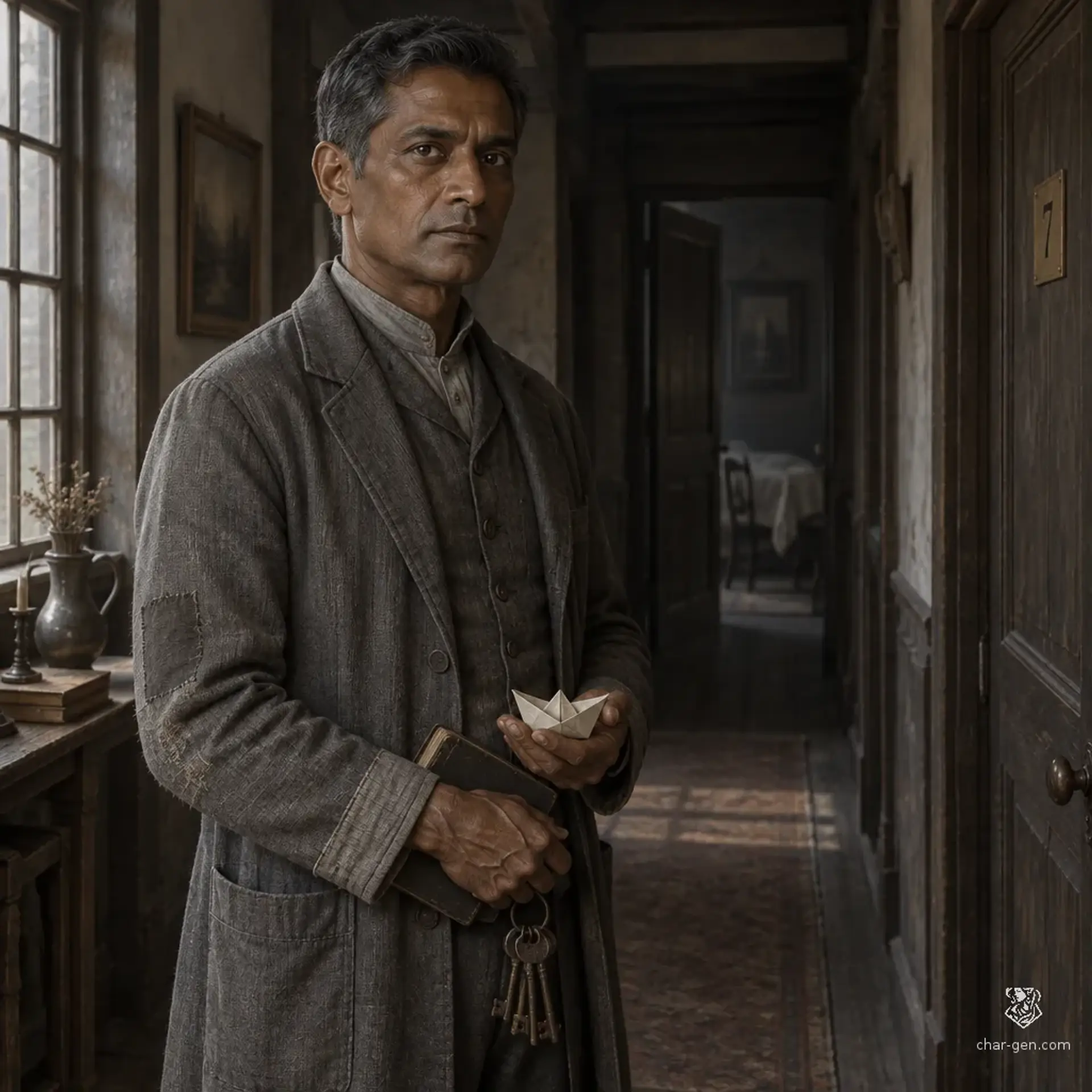
“His father, Hector, is a historian, fond of dates, sources, and making broad pronouncements about the people who live beyond his books.”
- Faction
- None known. The Hush House and Brancrug are connected to the heart's earlier history, not to William's membership in any organization.
Known connections
Media
0 imagesNo images yet.
Turn William Windon into a sheet
A high-res, share-ready sheet you can post or print.