Eber Waldner
Eber Waldner
At the table
Voice
A dry, lightly rasping voice with occasional wet clicks on hard consonants. His careful diction comes from workshop concentration and from learning to answer worried family members without letting every question become an examination. His words are quick and clever when he is deflecting attention, but steady and direct when someone is at risk.
His voice has a dry rasp from a throat still adapting to its changed anatomy, with a faint wet click at the back of certain consonants. He speaks at a measured pace, shaped by years of listening for tiny mechanical faults and by the habit of choosing words carefully around anxious relatives. His humor is precise and understated. When angry, his words become more plainly direct, not quieter or gentler.
Speech patterns
How to play them
Begin with practical conversation about the party's equipment or a repair. Eber responds well to people who respect his competence and do not stare at his eating or wings. He will offer useful help in exchange for information, materials, or a favor that benefits his family. If pressed about his body, answer with blunt humor or carefully phrased questions. Earn his trust by treating him as a craftsman and brother, not as a curiosity.
Goal
Build an adjustable sleeping frame and a more private, comfortable way to manage his unusual digestion, while protecting his family from anyone seeking to exploit the Marshwake's draconic inheritance.
Motivation
To remain recognizably part of the Waldner family while deciding for himself what his inherited draconic body means.
Appearance
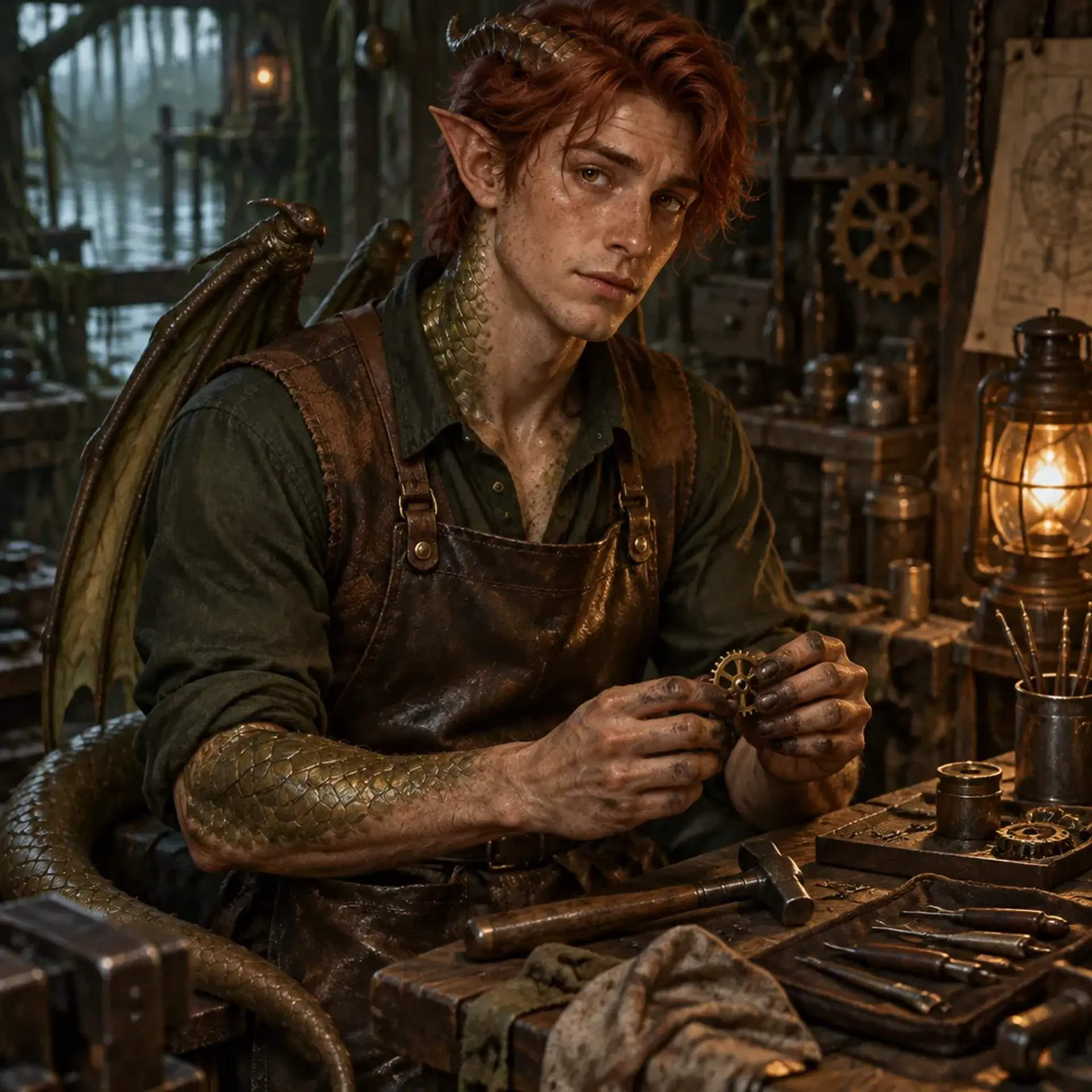
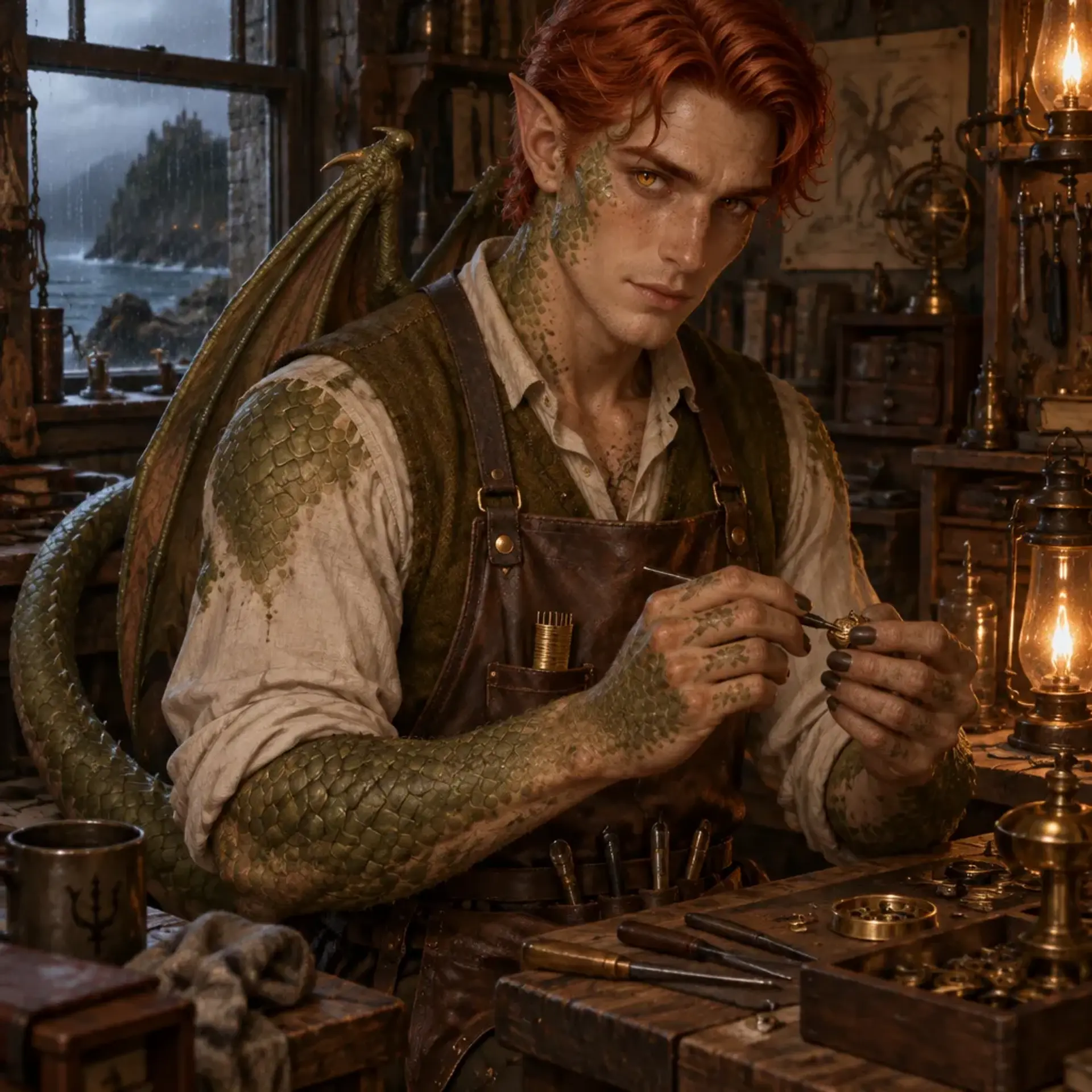
Eber is a young man built on a scale his family never expected to accommodate: five feet ten inches tall, long-limbed, and visibly stronger than his compact parents. Olive-green scales overlap his fair, freckled skin in irregular patches, finer along his cheeks and throat and thicker across his shoulders, forearms, and spine. Their surface is supple rather than armor-hard, with a faint wet sheen after rain. His red hair is stubbornly familiar, a bright family inheritance he keeps trimmed with workshop shears. His amber eyes have narrow, draconic pupils that catch light like polished resin. Pointed ears and a long, expressive tail make his attempts to pass as an ordinary halfling futile. His folded wings sit close to his back; when he turns, their thin membranes flex and briefly show darker green veins. He walks with a careful, measured sway to keep his tail clear of furniture, but can move with startling speed when startled. His hands are broad and callused from tools, with bluntly filed claws and black grease caught at the scale edges. The unexpected detail is his painstakingly neat hair: each morning he parts it with a tiny brass comb and pins it in place, even when the rest of him is dusted with filings. He leaves an impression of contained force, as if a workshop door has learned to speak politely.
Clothing
He wears sturdy craftsman's clothes influenced by the Marshwake's Germanic work traditions: a moss-brown wool vest, linen shirt, leather apron, and reinforced trousers. The clothes are altered at the shoulders and back for his wings, but the stitching is plainly visible and the sleeves never quite sit right over his scales. He keeps one small brass comb in a fitted pocket and repairs its case obsessively.
Body language
Eber angles his wings and tail away from people in tight rooms, careful not to knock anything over. He braces small objects against his broad palm and turns them with neat, practiced movements. His eyes linger on shiny objects, though he tries to disguise the interest as inspection. When embarrassed about eating, his jaw tightens and his gaze fixes on the tabletop.
- Height
- 5 feet 10 inches
- Build
- Tall for his family, lean and long-limbed, with a powerful back and shoulders shaped by wings and workshop labor.
- Eyes
- Molten amber with narrow draconic pupils; formerly dark brown
- Hair
- Red
- Skin
- Fair skin with olive-green scales and subtle green undertones
- Age
- 19
- Gender
- Male
- Size
- Medium
Distinguishing features
Personality
17 traits and drivesEber is clever and guarded, but not cold. He can turn a question aside with a polished quip, then spend an hour quietly fixing the problem behind it. He wants the comfort of his family's closeness and resents how their care can make him feel like a patient instead of a brother. Around strangers, he is observant, courteous, and difficult to read; around children, he becomes unexpectedly patient and lets them inspect his harmless tools. When he is embarrassed, especially about eating, he grows formal and exact. When someone is in danger, that careful distance breaks: he becomes direct, quick, and surprisingly forceful. He admires Rodrick's confidence but dislikes his arrogance, envies Yonda's ease with people but resists her advice, and trusts Ignatz more than he can comfortably say. Eber would rather make a useful device than ask for comfort, yet he treasures the small signs that his family still makes room for him.
- Alignment
- Neutral Good, though his guarded manner can make him seem indifferent until someone is in danger.
Quirks
Habits
Traits · 4
Flaws · 4
Fears · 4
Wants and needs · 5
Combat
AC 15 · HP 17 · 30 ft.Eber prefers cover, a clear retreat route, and a chance to assess an opponent before committing. He uses Faerie Fire to expose hidden threats, then supports allies with Cure Wounds or a well-placed crossbow bolt. He avoids grappling and does not rely on his wings for flight. If cornered, he uses Draconic Bearing to make an opening and withdraws rather than pursuing a frightened foe.
Eber Waldner
Spells
Actions
Reactions
Services they sell
Rewards they can give
Equipment
- Light crossbow (weapon)A sturdy crossbow with a fitted stock and a small brass sight he made himself.
- Light hammer (weapon)A compact hammer balanced for his large hands, also used for ordinary workshop repairs.
- Workshop apron (tools and clothing)A leather apron with reinforced seams, tool loops, and a hidden pocket for polished digestion stones.
- Artificer's tools (tools)A set of tinker's tools, smith's tools, and watch-repair instruments inherited and adapted from his family.
- Craftsman's clothing (clothing)A family-made vest and reinforced work clothes altered to accommodate his wings and tail.
Possessions
Background
Eber Waldner was born the youngest of Trogi and Wilma Waldner's eight children, in a household where every cupboard had a purpose and every spare nail was saved. The Waldners are of Stout halfling descent, craftsmen and gardeners whose lives have long revolved around their workshop, chickens, fishing nets, and the warm press of a crowded family table. Eber arrived with red hair like the family expected, and dark brown eyes that made his mother say he looked thoughtful even when he was only hungry. As a child, he was smaller than most of his siblings, quick to sit beside Wilma in the garden and content to watch Trogi mend a hinge rather than take a turn at the noisy bench. He learned to sort screws by size before he could properly use a file. He collected bright scraps: a polished washer, a lost button, the glint of a fishhook. His parents teased him about the habit, then quietly set aside the prettiest pieces for him. The family had already learned to live with the island's strange inheritance. The Marshwake were castaways who had survived a dragon-haunted wilderness by accepting the blood of a wounded green dragon. Generations later, the legacy remained uneven. Most of Eber's older siblings were Low-blood, close to their halfling forebears. His brother Rodrick and brother Ignatz were among the High-blood, their bodies changing in adolescence. Eber saw what that meant before it happened to him: a sudden growth spurt, strange appetites, scales that spread, unfamiliar strength, and the shame of being watched while one's own body became a public question. He promised himself, privately, that if it came to him, he would endure it without frightening Wilma. At fifteen, his eyes changed first. Their brown darkened, then broke into molten amber around narrow pupils. His ears lengthened to points, green scales appeared beneath his hair and along his shoulders, and pain woke him at night as his bones and back stretched. His red hair stayed, as if it were a small stubborn message from the family he still belonged to. Wings budded along his back, strong but too small to lift him. His tail grew quickly enough that he knocked over a stool while trying to stand at the supper table. That evening, his brothers made space for him, but the old kitchen seemed to shrink around him. The family made him a bed in the dining room, since the bedrooms and beds were too small. Eber hated needing the change more than he hated the cramped mattress. The worst change concerned eating. His teeth sharpened and shifted, no longer suited to chewing. The first time he tried to bite a crust, pain flashed through his jaw and he could not make himself swallow. Wilma wanted to summon every healer on the island; Trogi sat beside him and kept his voice steady, though his hands shook. Ignatz stayed close, offering clumsy practical help and refusing to leave when Eber snapped at him. A healer confirmed that Eber could swallow small pieces and that his body had developed a gizzard-like organ, but could offer no painless cure. Eber learned to cut food into careful morsels. He also began swallowing smooth stones to help grind what he ate, an unpleasant practice that left him sore and embarrassed. It gave his family another reason to watch his meals. They meant it as care. He experienced it as a reminder that he could no longer eat as they did. The transformation altered more than his body. He was now taller than every Low-blood sibling, stronger than he wanted to be, and distant from the easy warmth that had once meant being shoulder to shoulder with his parents. At family meals, he sat apart so his wings and tail would not catch anyone. He could not share a bite from a common loaf or eat quickly alongside his nieces and nephews. He sometimes slipped away rather than endure the loving, anxious attention. He resented that reflex, and resented himself for resenting it. Work gave him something he could control. Trogi put small repairs in front of him: a clock spring, a bent latch, the hinge of a chicken coop. Eber had patience for tiny mechanisms and an instinct for finding the part that did not fit. His hands, once nimble little hands among many in the shop, became powerful and clumsy by comparison. He adapted by making finer tools with longer grips and by learning to brace work against his body. He began studying the family watch repairs with Kasper, who taught him how to listen for a mechanism's fault. Eber found comfort in the notion that a device could be taken apart, understood, and made useful again. He was not alone in learning how to live with the changes. Ignatz, two years older, had once killed a chicken with his bare hands during a sudden hunting urge and had retreated into the workshop afterward, shaken by himself. He understood Eber's fear of being watched as a creature rather than a brother. Rodrick, older and larger, was less gentle. He teased Eber about his careful eating and called him too proud to ask for help. Rodrick thought bluntness was honesty, and he did stop when Eber's anger became real. Eber nevertheless remembered each remark. The brothers share work, arguments, and a strained affection that neither is good at naming. The older siblings built lives that Eber admires from a distance. Windle, the eldest, works in the shop and is expected to inherit it; his stoicism hides a fear that his children, Otto and Anika, might undergo the same changes. Karl works among gears and tools, but his marriage to Leanora is rocky, and their household carries the unresolved complication of Ragni, a child whose parentage is not simple. Yonda, the only sister, is generous and beautiful, with five children and an instinct for drawing people together; she repeatedly urges Eber to be more social. Alder keeps part-time guard work and spends too much time at merrymaking, while his High-blood son Black Alder visits with stories of the wider island. Kasper repairs watches, keeps chickens and tends the garden with his wife and daughters Wonda and Ilse. Eber loves all of them, but each family gathering makes him aware of the life he no longer fits into neatly. His parents' worry is practical as well as tender. High-blood children need more food, room, clothing, and beds than the old household was built to provide. Trogi says he wants to retire, then returns to the workbench whenever a hinge squeaks. He secretly wants a beard after admiring one on another craftsman. Wilma is clever and warm, happiest among her garden beds or tending the chickens, and she can butcher a bird without hesitation but goes faint at the thought of violence directed at her children. She and Trogi fish together at a local stream. Eber notices how often they bring home an extra catch and pretend it was simply a lucky day. Now Eber works in the family shop as an apprentice artificer, though the title is his own way of understanding what he does. He repairs, adapts, and invents simple devices, borrowing methods from the artificers he has met rather than claiming a formal tradition he has not completed. His current project is a compact, adjustable sleeping frame that could give the High-blood members of the family a proper bed without forcing the Low-blood household to surrender its remaining space. A more private project is a set of small, smooth, polished stones fitted into a washable case, so his digestion need not be discussed at every meal. A crisis is growing beyond the workshop. The island's wet forests and rich fishing grounds are changing, and draconic-tainted wilderness presses close to the settlements. Some neighbors see the High-blood as proof that the Marshwake are being remade for someone else's purpose. Eber has begun noticing that strangers ask unusually pointed questions about his family's changes and about the old dragon whose blood founded their people. He does not know whether those questions come from healers, scholars, or people hoping to control the Marshwake. His caution has become a habit: he listens first, answers carefully, and keeps every useful scrap of information. He wants to protect his family without treating them like fragile things, and to prove that a body changed by inheritance can still belong to the person living in it.
Role in the story
A young family craftsman and potential ally who embodies the Marshwake's struggle to preserve halfling fellowship while adapting to a draconic inheritance. Eber can provide repairs, local knowledge, and a personal connection to the community. His suspicion about the hidden stones can draw the party toward a mystery in the island's tainted wilderness.
“Eber arrived with red hair like the family expected, and dark brown eyes that made his mother say he looked thoughtful even when he was only hungry.”
- Faction
- The Waldner family workshop and the Marshwake community. He is not formally part of a guild or political faction.
Known connections
Media
0 imagesNo images yet.
Turn Eber Waldner into a sheet
A high-res, share-ready sheet you can post or print.