Eber Waldner
Eber Waldner
At the table
Voice
His voice has a faint rasp from years of dust, oil, and talking over the workshop's clatter. It catches slightly on certain consonants because of his altered teeth, though he has learned to speak clearly. The result is dry and textured, with the brisk rhythm of a person used to giving instructions over tools striking a bench. His name, Eber, comes out with an unexpectedly off-beat stress.
Eber speaks in the measured, exact cadence of someone accustomed to explaining why a mechanism fails. His phrasing is clever without being flowery, and he often compares people or promises to tools that need adjustment. When comfortable, his humor comes out dry and quick. When cornered, he becomes precise rather than loud, asking pointed questions and correcting careless assumptions. He avoids discussing food while eating.
Speech patterns
How to play them
Approach Eber through a concrete problem, especially a broken tool or an impractical room. Give him time to decide whether to discuss his body; he responds poorly to being handled, pitied, or treated as a curiosity. Respectful questions and honest offers of help earn trust more quickly than praise.
Goal
Develop practical adaptations and trustworthy records that help high-blood Marshwake live safely, while finding a way to build an independent life without abandoning his family.
Motivation
To turn the changes he cannot control into knowledge and useful work, and to remain part of a family whose ways of living no longer fit his body.
Appearance
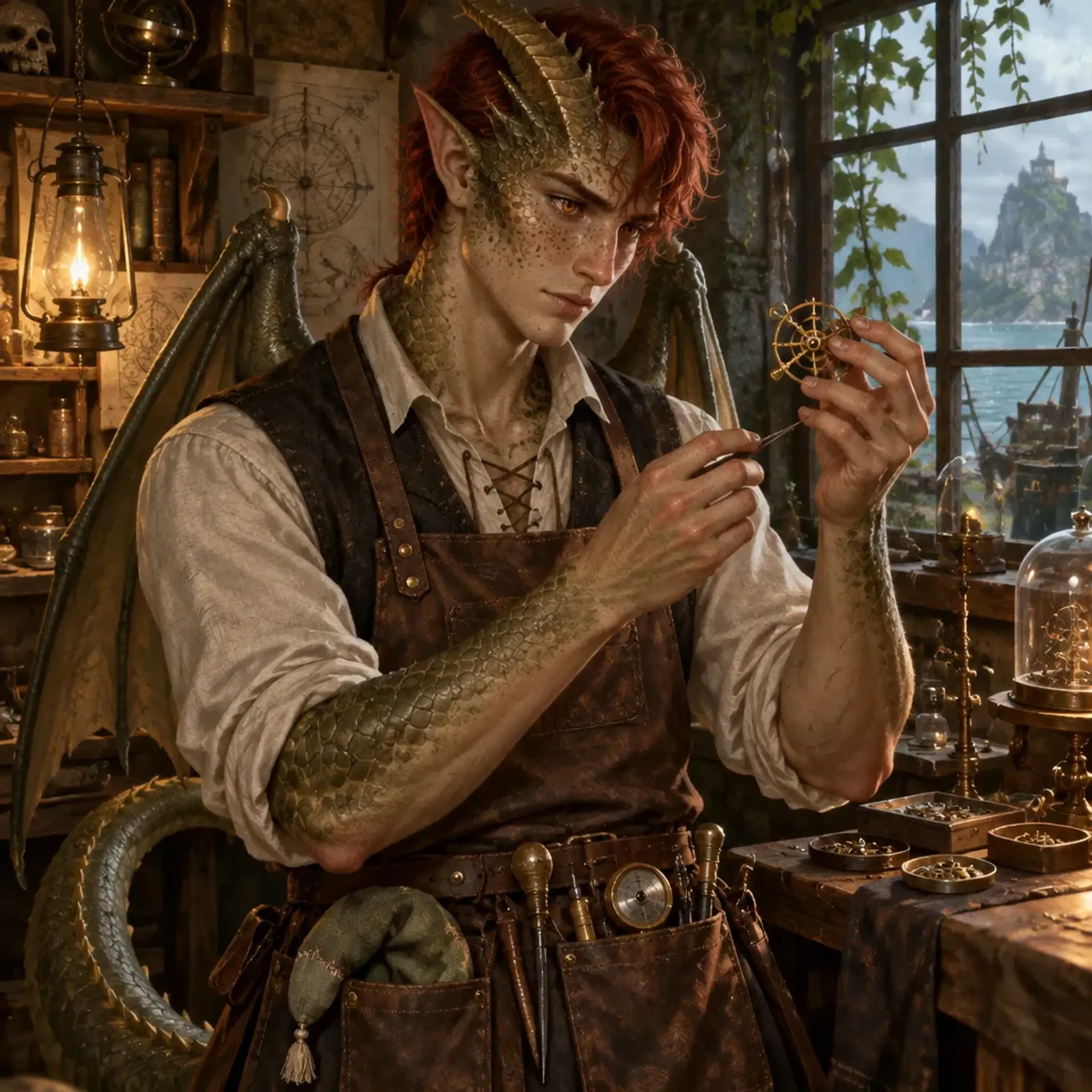
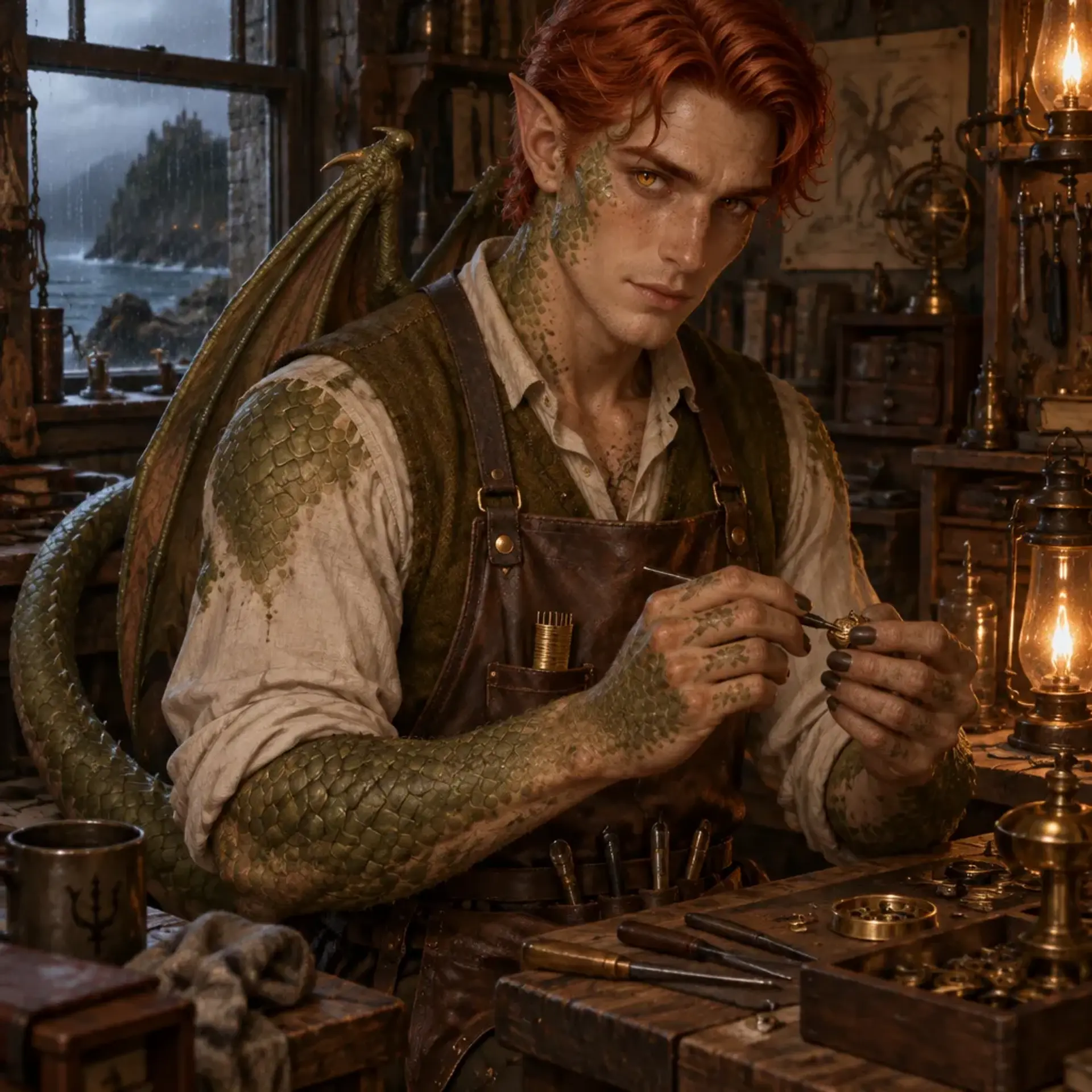
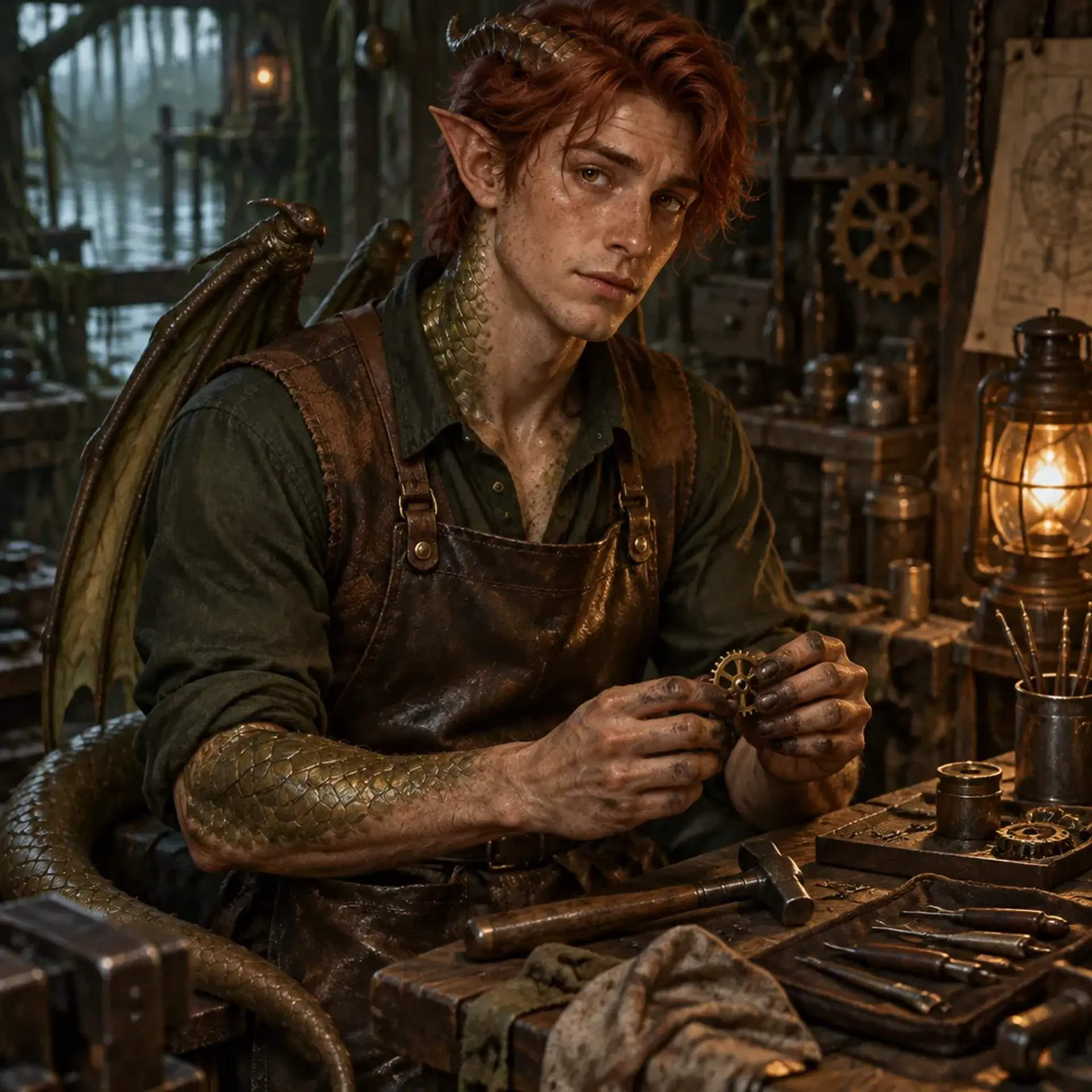
Eber is an unmistakably young man made too large for the compact world his family built around him. He stands 5 feet 10 inches, with fair, freckled skin broken by olive-green scales that lie close and flexible across his throat, shoulders, ribs, and forearms. Their edges catch light like damp leaves. Red hair, once his most noticeable feature, sticks up in uneven tufts around two small, swept-back ridges. His amber eyes are mottled with darker rings and hold a patient, measuring look that can feel more like an appraisal than a greeting. A long tail balances his stride; folded wings sit tightly against his back, their membranes dappled green and brown. His teeth are strong but narrow and pointed, useless for grinding food. He moves with careful economy, ducking beneath doorframes and angling himself sideways through spaces designed for halflings. Within a minute, people notice the rows of tiny tool cuts and dark grease lodged in his callused fingertips, and that his carefully patched shirt is always buttoned around an extra-deep chest.
Clothing
German-influenced craftsman's clothes adapted from halfling patterns: a dark green linen shirt, patched brown waistcoat, broad leather apron, sturdy trousers, and boots reinforced at the toes. The waistcoat's shoulders have been let out twice, and the apron is exceptionally well cared for, polished with oil and repaired with careful, nearly invisible stitches. His sleeves are rolled high to keep them clear of grease and his scales.
Body language
He angles his shoulders to protect his folded wings in tight rooms and keeps his tail tucked close around stools or chair legs. When he feels safe, the tail loosens and moves with his attention. He handles small objects with a craftsperson's concentration, but draws his hands back if someone reaches toward his mouth or scales without asking.
- Height
- 5 feet 10 inches
- Build
- Tall and lean for a Marshwake, with a strong back, long limbs, and a tail that helps him balance. His wings are powerful but not built for sustained flight.
- Eyes
- Draconic amber with dark mottling; formerly dark brown
- Hair
- Red
- Skin
- Fair skin with olive-green scales
- Age
- 19
- Gender
- Male
- Size
- Medium
Distinguishing features
Personality
17 traits and drivesEber is thoughtful and observant, but he is not naturally serene. He can spend an hour patiently aligning the teeth of a damaged gear, then snap at a sibling who asks whether he is eating enough. With strangers, he uses clever phrasing and an almost formal distance to keep control of the conversation. With family, that distance thins: he is more easily embarrassed, more easily hurt, and more likely to make a joke that lands too sharply. He wants to be treated as capable, yet resents how often he must prove it. He dislikes pity, but remembers every practical kindness. He loves the close, noisy warmth of his parents' table and also finds it painful to sit there with food he cannot eat the old way. He is curious about his draconic inheritance and disturbed by it in equal measure. He can admire a beautiful piece of craftsmanship without wanting to own it, but has a fondness for bright, well-made objects that he will deny if teased. In a calm mood, he listens carefully and offers unexpectedly generous help. Under pressure, he becomes cool, exact, and argumentative, turning feelings into problems he can take apart. When frightened, he tries to become indispensable; when lonely, he insists that he prefers working alone.
- Alignment
- Neutral Good
Quirks
Habits
Traits · 5
Flaws · 4
Fears · 4
Wants and needs · 4
Combat
AC 15 · HP 17 · 30 feetEber avoids a fair fight. He uses cover, keeps distance with a thrown awl, and tries to disable a weapon or create an opening with a spell before closing in with his tool-hammer. He retreats if an ally is hurt or if his family is threatened, and uses Marshwake Menace only to interrupt an immediate danger. His folded wings can help him manage a short drop or gap, but do not grant flight.
Eber Waldner
Spells
Actions
Reactions
Services they sell
Rewards they can give
Equipment
- Workshop leather armor (armor)Sturdy leather armor fitted around his wings and tail; it is reinforced with overlapping leather panels.
- Fitted shield (armor)A small shield made from layered wood and metal, built to sit clear of his folded wing joints.
- Tool-hammer (weapon and artisan's tool)A compact steel-tipped hammer used for delicate work and, if necessary, self-defense.
- Tinkerer's tools (artisan's tools)A leather roll containing miniature files, pliers, a screwdriver, a hand drill, and fine wire.
- Gizzard stones (personal item)A small pouch of smooth stones chosen for size and shape; he keeps them out of sight during meals.
- Workshop notebook (personal item)A folded notebook of sketches for adjustable furniture, food-cutting tools, and observations about high-blood changes.
Possessions
Background
Eber Waldner was born the youngest of eight children in a Stout-halfling family of makers, repairers, gardeners, and keepers of more chickens than anyone could reasonably need. His father, Trogi, has spent most of his life at the family workshop, insisting he is about to retire while taking every difficult repair back onto his own bench. His mother, Wilma, keeps the garden and poultry in better order than the workshop, and can calm a quarrel with a look. She is tenderhearted about violence, though she has no hesitation when it comes to preparing fish or chickens for supper. The Waldners are Marshwake, descendants of castaways who survived a dragon-haunted wilderness by accepting the blood of a wounded green dragon. In their family, that inheritance appears unevenly. Most Waldners remain recognizably halfling; some grow into the taller, more conspicuously draconic high-blood form. Eber's red hair was there from childhood, and the family joked that it was a sign of something grand. His eyes were ordinary dark brown. He spent his early years under the workbench, learning to sort screws by touch and listen for the different complaints of a clock that needed oil, a hinge that needed reshaping, or a parent who needed help but would not ask. He was good with small mechanisms. He was also good at finding excuses to stay close to the dinner table long after the meal, listening to the crowded, affectionate arguments of his family. His adolescence began as a fever and a deep ache beneath his ribs. Then his teeth changed, his skin roughened into scales, and his body grew with disconcerting speed. His ears sharpened, a tail emerged, and folded wings stretched painfully across his back. His dark brown eyes turned amber, and his appetite became a source of fear. He could no longer chew. His first attempts to eat the family's ordinary meals ended in choking, pain, and frantic calls for help. He learned to cut food into tiny pieces and swallow it carefully. Small smooth stones, which his body could pass later, eased the grinding process in a second stomach. The adjustment works, but it hurts. He hides the worst of it because he has already watched his mother go pale with worry. The formative moment came one night when Wilma found him alone in the pantry, sweating and frightened after trying to eat a piece of bread as he used to. She did not scold him or tell him it would be fine. She sat on the floor beside him, cut the bread into small pieces, and waited while he managed them one at a time. Eber remembers that night less as a rescue than as the first time he understood that love could not make his body go back. Since then, he has tried to let his family help without letting them see how much help he needs. The family workshop has not been built for high-blood bodies. Eber sleeps in the dining hall, where the benches are too short and the ceiling beam catches his wing joints when he turns in his sleep. Clothes are hard to find, and the family keeps letting out seams in garments already borrowed from someone else. Trogi worries about lumber, bedding, food, and whether the children are safe. Wilma worries about all of that and tries to disguise it by sending Eber home with bundles of herbs. Eber's small, private resentment is not directed at them. It is directed at the fact that their warmth often reaches him through a practical solution rather than a familiar embrace: a new cot, a bigger coat, another plate of food cut into careful pieces. His siblings have become a second, unruly household. Windle, the eldest, is already a father to Otto and baby Anika, works at the shop, and is expected to take it over. He meets Eber's changes with stoicism, but fears his own children may become high-blood. Karl works with gears and tools and lives in a strained marriage with Leanora, a sailor descended from dragon hunters Wilks and Nailia. Their household includes Hansel and Ragni, whose pale coloring and unusual eyes have caused more than one uncomfortable question. Yonda, Eber's only sister, is generous and beloved, with five children of her own; she gently urges Eber to spend time with people instead of tools. Her sons Hans and Birke show signs that may mark them as high-blood. Alder, a part-time guard who is often occupied by merriment, has a high-blood son, Black Alder, who visits with adventure stories. Kasper repairs watches, tends the garden, and keeps chickens with his wife and daughters Wonda and Ilse. Rodrick, twenty-one, is a high-blood with auburn hair, yellow eyes, reddish-tipped green scales, and a predator's build. He is blunt, arrogant, and fond of teasing Eber about his eating. He insists he means no harm, which is not the same as being harmless. His sorcery gives him a platform for boasting, and Eber's dislike of the performance has made their relationship a recurring contest of sharp remarks. Rodrick usually stops when Eber's anger becomes unmistakable. Ignatz, twenty, is Eber's closest brother and the one who stood beside him through the worst of his transformation. Ignatz's own draconic instincts frightened him when he deliberately killed a chicken with his bare hands. Ashamed, he has kept to the workshop, where a precise task gives his hands something safe to do. Eber has taken up the artificer's craft as a way to make the world fit bodies that were never considered when it was built. He repairs tools, watches, locks, and kitchen fittings, and experiments with adjustable benches, broad door hinges, and a hand-cranked food chopper that makes meals safer for him. He has begun recording the changing bodies of high-blood Marshwake, carefully and with consent, hoping to distinguish ordinary inherited variation from something that needs a healer's attention. He does not yet know whether his interest is compassion, fear, or the wish to be the person who understands what is happening. His current problem is practical and political. The family has been asked to help supply repairs for a settlement whose neighbors are increasingly uneasy about the high-blood generation. Eber suspects someone is collecting accounts of the changes, but cannot tell whether the interest comes from responsible healers, frightened officials, or people who want to use the Marshwake as a resource. His own notes contain details about his painful digestion, unusual growth, and the first signs of changes in his nieces and nephews. He keeps those pages hidden even from the family. He wants a life of his own, a room with a bed that fits, and the freedom to choose when to be touched or helped. He also wants to stay near the people whose ordinary halfling life he can no longer share in the ordinary way. For now, he keeps working at the bench, building small useful things and pretending that every bright object he saves is only valuable because it can be repaired.
Role in the story
A young craftsperson and potential ally who can repair equipment, offer insight into the Marshwake, and embody the personal cost of a community's changing inheritance. His family ties can draw the party into questions of healing, privacy, prejudice, and who gets to define what the Marshwake are becoming.
“His mother, Wilma, keeps the garden and poultry in better order than the workshop, and can calm a quarrel with a look.”
- Faction
- The Waldner family and the Marshwake community. He has no formal guild affiliation.
Known connections
Media
0 imagesNo images yet.
Turn Eber Waldner into a sheet
A high-res, share-ready sheet you can post or print.