Eber Waldner
Eber Waldner
At the table
Voice
His voice has a lightly rasped edge from years of workshop dust and the strain of a throat adapting alongside his jaw. He articulates carefully, with a faint breathy catch after long explanations. He does not boom to command attention; he uses a measured, dry delivery that makes a cutting joke land harder than a shout. When concentrating on a repair, his words come faster and his breath catches on technical details.
Eber uses short, carefully chosen sentences, often with a dry twist at the end. He asks practical questions before offering opinions and refers to people by what they are doing rather than by grand titles. When discussing mechanisms, his explanations become quick and exact. When discussing family, he pauses over names and avoids exaggeration. His wit can be clever without being warm, especially when he feels watched.
Speech patterns
How to play them
Approach him as a capable young craftsperson, not as a medical puzzle. Give him room to answer personal questions in his own time, and show interest in his work without pretending his difficulties are trivial. He responds well to practical collaboration and honest offers. Family is a tender subject: he will defend them fiercely, but may bristle if outsiders describe them as helpless or backward.
Goal
Develop practical workshop designs and food-preparation tools that let High-blood Marshwake live safely and comfortably without making their families choose between their needs.
Motivation
To make his changing body and crowded family life more manageable without letting fear or pity define him; to repay the care his family gave him by making their home work for everyone.
Appearance
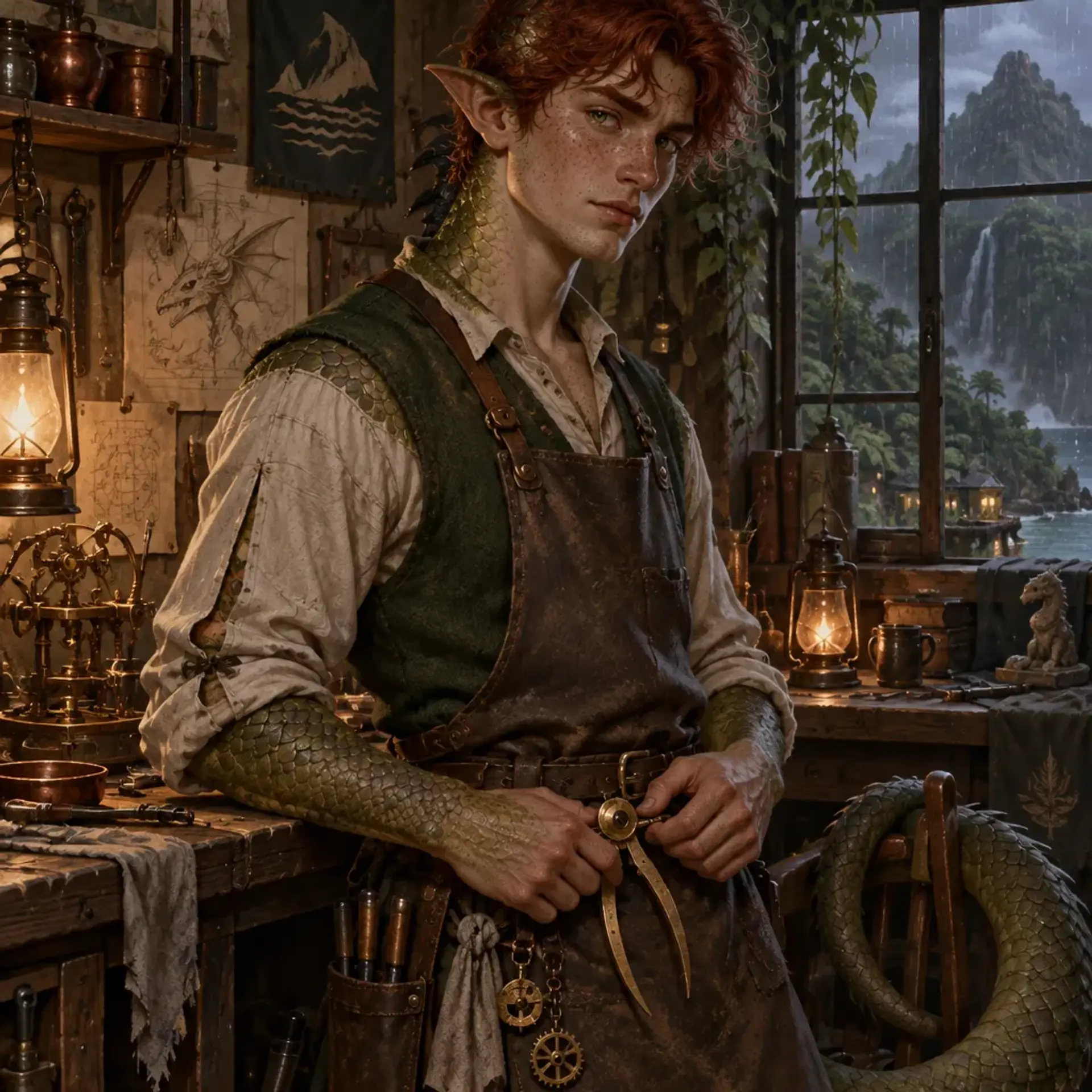
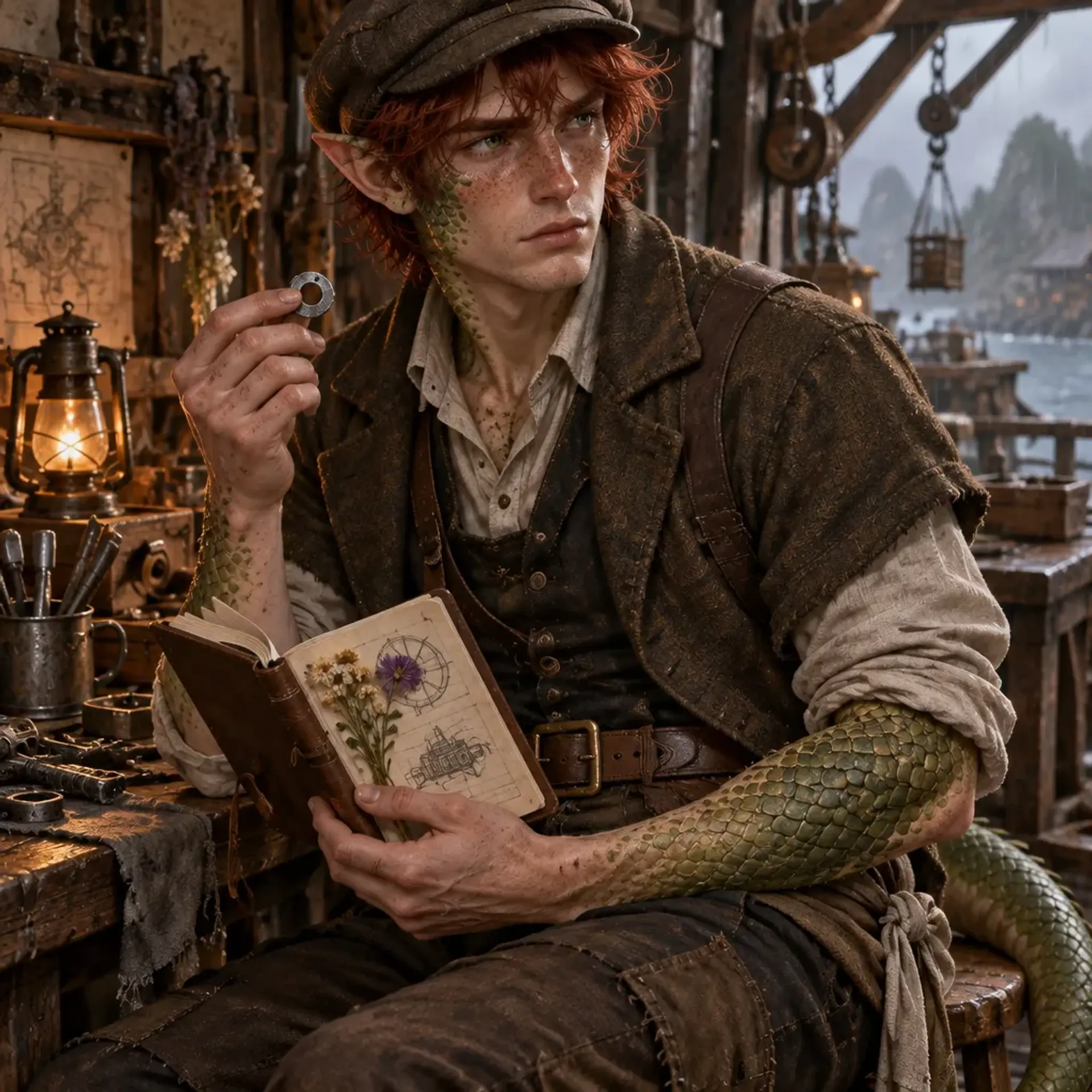
Eber is a young man whose first impression is a collision of family resemblance and unmistakable difference. At five feet ten inches, he stands a head above his stout halfling parents and most of the workshop's doorframes. His fair, freckled face and unruly red hair still look like his family's, but olive-green scales overlap his shoulders, ribs, forearms, and the sides of his jaw. They are flexible and finely textured, like wet leaves with a faint pebbled sheen, paling toward his hands. His long, narrow face ends in a jaw built for swallowing rather than chewing; green-dragon teeth show in a closed-lipped smile, neither brittle nor suited to grinding food. He has pointed ears, a long expressive tail, and strong wings folded close to his back. Their dappled green surfaces have a soft, leathery look, and the joints protrude awkwardly through clothes cut for smaller bodies. His amber eyes are mottled with darker rings and hold on a person a little too long, as though he is weighing what they know. He moves with a careful, sinuous economy, folding his wings to pass between crowded benches and using his tail as a quiet counterweight. His unexpected detail is that he keeps a tiny, neatly polished brass bird pinned inside his work vest, a sentimental toy he repairs whenever its hinge squeaks. People remember his shining eyes, his conspicuous wings, and the strange, restrained way he eats.
Clothing
He wears sturdy craftsman's clothes with strong Germanic workwear influences: a dark wool vest over a linen shirt, reinforced trousers, broad leather suspenders, and boots built for wet volcanic ground. The cut is always an imperfect compromise between halfling-made clothes and his larger frame. Seams are let out, hems are patched, and a single brass clasp is polished obsessively. Slits in the vest accommodate his wings, though the fabric pulls when he spreads them.
Body language
His wings fold tightly when he feels scrutinized, but loosen when he is comfortable. His tail betrays his attention, turning toward a new sound or curling around a stool rung. He watches faces steadily, tilts his head when listening, and keeps his hands occupied with a tool or small bright object when a conversation becomes personal.
- Height
- 5 feet 10 inches
- Build
- Tall and lean, with wiry strength in his shoulders and back from workshop labor; his wings and tail make ordinary furniture and doorways awkward.
- Eyes
- Draconic amber, mottled with dark rings
- Hair
- Red, tousled and usually flattened under a work cap
- Skin
- Fair beneath olive-green scales; freckles cross his nose and cheeks
- Age
- 19
- Gender
- Male
- Size
- Medium
Distinguishing features
Personality
20 traits and drivesEber wants closeness and resents being fussed over, often in the same breath. He misses the easy intimacy of being small enough to squeeze between his parents at the table, yet bristles when anyone assumes that because he is their youngest he must be managed. He is protective of his family, but his affection usually arrives as a repaired hinge, a sharpened tool, or a dry remark that gives someone room to save face. He can sound aloof when he is actually anxious, and he can seem proud when he is trying not to look ashamed. In the workshop, Eber is patient, methodical, and quietly competitive with a stubborn mechanism. He likes problems that can be taken apart and understood. He will spend an hour adjusting a watch escapement, then pretend he has not noticed that the customer has been waiting. When a device works, he does not boast; he turns it over in his hands as if checking for a hidden flaw. He is most relaxed when his hands are busy and another person is nearby without demanding conversation. With family, his moods shift. He is warmer with Ignatz, who stood by him during the worst of his adolescent changes, and he will make room for Ignatz's uncertainty without making him explain it. He loves Yonda's children but dislikes being urged into sociability as though it were a simple choice. He appreciates her kindness and sometimes answers it with teasing, especially when she tries to introduce him to new friends. Rodrick brings out a sharper, less generous side. Eber is quick with a pointed reply and slower to admit that the old jokes hurt more than he lets on. He is protective of Windle's children and can grow unexpectedly stern when adults talk about them as though their future has already been decided. Among strangers, he listens before he speaks. He uses clever questions to find out what a person wants and whether they view the Marshwake as neighbors or as a phenomenon. He dislikes being stared at while eating, and his reserve turns to clipped hostility if someone makes his jaw or stomach a spectacle. If the other person is genuinely curious and respectful, he can become an unexpectedly generous explainer, discussing scales, tools, and adaptation with exacting detail. He does not believe every question is an insult; he simply wants the right to choose what he answers. Eber's fondness for shiny things is part comfort, part instinct, and part craftsperson's eye. He notices a polished buckle in a crowd and remembers where a missing washer belongs. He can be sentimental about objects while pretending to be practical. His hidden brass bird is the clearest example: he calls it a toy when asked, but keeps it cleaner than his own tools. He can part with a useful thing easily and a meaningless bright thing with surprising difficulty. He dislikes violence, though he is not helpless. Fear for family can make him brave before he has time to consider consequences. He does not seek to dominate a room, but his fixed gaze and the shape of his wings can make his silence feel threatening. If angered, he becomes more direct rather than more polite or quiet. He will name the specific harm, hold eye contact, and wait to see whether the other person can admit it. He is slow to forgive someone who treats his body as a joke, but capable of changing his mind when an apology is sincere and followed by different behavior. His deepest conflict is that he wants to be treated as independent while still wanting the comfort of being cared for. He envies the ordinary ease his Low-blood parents have with food, clothes, and shared rooms, and then feels guilty for envying them. He wants to leave the island and see how other people solve problems, but fears that leaving would feel like abandoning a family already stretched thin. He wants the Marshwake to have a future of their own, not one dictated by the green dragon whose blood changed their ancestors, but he has no simple theory about what that future should be. At his best, Eber is observant, inventive, loyal, and capable of making a frightened person feel less alone without smothering them. At his worst, he withdraws, hoards his worries, and uses intelligence as armor. He is not naturally charming, but he can be funny when he trusts someone. He is not naturally trusting, but he keeps showing up for people. He will deny that he needs a place at the family table, then quietly fix the loose leg on his mother's chair so it will hold his weight.
- Alignment
- Neutral Good, though his guardedness can make him seem indifferent
Quirks
Habits
Traits · 5
Flaws · 5
Fears · 5
Wants and needs · 5
Combat
AC 15 · HP 17 · 30 ft.; custom wings allow controlled gliding, not flightEber prefers cover, distance, and a prepared escape route. He uses fire bolt from behind a bench or crate, then changes position rather than trading blows. He casts faerie fire to expose concealed threats and cure wounds to keep an ally standing. If cornered, he uses his wrench, wings to glide away from a drop, or his once-per-rest menace to create an opening. He avoids frightening or harming opponents when a distraction, negotiation, or retreat will work.
Eber Waldner
Spells
Actions
Reactions
Services they sell
Rewards they can give
Equipment
- Artificer's tools (tool)A compact set of smith's and tinker's tools, including pliers, small files, punches, a hammer, wire, and measuring calipers.
- Workshop wrench (weapon)A sturdy, well-used workshop wrench carried as a practical tool and improvised weapon.
- Light crossbow (weapon)A light crossbow with a reinforced stock and a handful of bolts.
- Reinforced workwear (armor)A reinforced leather vest and work clothes adapted with wing slits; not magical armor.
- Digestive stones (personal item)A pouch of small smooth stones, carried for his painful altered digestion.
Possessions
Background
Eber Waldner was born the youngest of Trogi and Wilma Waldner's eight children, in a house built for Stout halflings and a family that measures love by how many hands turn up when a roof leaks. Trogi, a Low-blood craftsman with black hair gone grey and green eyes, spent his days among tools and customers in the family workshop. Wilma, warm, sharp-minded, and happier with her garden and chickens than the noise of the benches, kept the household fed and everyone informed. Their children grew up sharing meals, beds, chores, and the certainty that no one had to face trouble alone. Eber's first years fit that pattern. He was small, red-haired, freckled, curious about bright scraps of metal, and forever following his older brothers through the workshop. His parents had seven other children to worry over, but they made room for the youngest in every conversation and at every meal. His siblings made that childhood vivid in different ways. Windle, the oldest, is a balding Low-blood with hazel eyes, a steady temperament, a spouse, and two young children. He works in the workshop and is expected to inherit it. He rarely says he is frightened that his own children might become High-blood, but Eber sees it in the way Windle checks them for scales. Karl, another Low-blood, loves gears and tools. His marriage to Leanora, a rough sailor descended from the famed dragon hunter Wilks and the heroine Nailia, is rocky; Karl has one son, though two children are part of his household. Yonda, their only sister, is a blond, hazel-eyed social butterfly with five children. She is kind to Eber and includes him, yet gently urges him to seek company rather than retreat into work. Alder, a green-eyed Low-blood guard with a taste for merriment, has a High-blood son, Black Alder, whose pale green scales and amber serpent eyes make him a cousin Eber recognizes as kin in a way he cannot always explain. Kasper, a Low-blood watch repairer and garden hand, is content with his wife and two daughters, and has never wanted a large family. Rodrick, twenty-one, is a taller, more predatory High-blood with auburn hair, yellow eyes, reddish-tipped green scales, and sorcery from his dragon inheritance. He can be blunt to the point of cruelty. He used to tease Eber about his eating, insisting he was only being honest, until Eber's anger made it clear that honesty could hurt. Rodrick still works in the shop, carries heavy loads, and helps with the chickens, while looking for a life beyond the family business. Ignatz, twenty, is Eber's closest brother: a High-blood with ashy blond hair, draconic green eyes, fair skin, grey-green scales that are growing more vivid, claws, and a flexible tail. When Ignatz's instincts overtook him and he killed a chicken with his bare hands, he was horrified. He retreated to the workshop, where Eber stayed beside him without pretending the incident had not happened. The change in Eber began in adolescence. His body lengthened, scales spread, wings grew strong, and his ears and tail altered the shape of the life he had known. The worst change was his jaw. His teeth could puncture and tear, but the muscles and fit of his mouth no longer worked for chewing. A meal he had once shared with his family became a source of pain and embarrassment. He learned to cut food into small pieces, swallow carefully, or take food down whole. Small stones seem to help his altered digestion, though they cause discomfort and are not a cure. He hates needing them, especially at the family table, where his parents still put out familiar dishes and try not to watch him struggle. The event that changed his relationship with his body came during a storm-season dinner. A swallowed mouthful caught painfully; Eber panicked, and his family surged around him. Wilma went pale at the sight of his distress, while Trogi tried to stay calm and keep everyone from crowding him. Ignatz remained close, uncertain but present. Eber recovered, but afterward he realized that every meal could turn his loved ones into frightened caretakers. He started taking his food to the workshop and staying late, telling himself he preferred quiet. The real reason was that he could not bear to see his mother flinch or his father pretend not to worry. He was not the only one in the house to change. High-blood children need more food, larger clothes, sturdier beds, and space their grandparents' home was never built to provide. Eber is too tall for many of the old benches and too strong for some delicate tools, but he still cannot share his parents' ordinary food without adapting it. The family has made do: extended sleeping pallets in the kitchen and dining area, patched clothes, a crowded workshop, and careful portions. Trogi says he wants to retire, then takes on another repair job. Wilma tends chickens and gardens, and she and Trogi still go fishing together at the nearby stream. Their love makes Eber grateful and guilty at once. He sees the strain on them and resents that his body appears to add another need to their already crowded household. The Waldners belong to the Marshwake, a young people descended from castaways who survived a dragon-haunted wilderness by accepting the blood of a wounded green dragon. The inheritance is not a neat gift or a curse with a single explanation. Some Marshwake remain close to their halfling ancestors, while others grow taller, scaled, clawed, or otherwise changed. The islands themselves are wet, beautiful, and dangerous, with volcanic ground, rich fishing waters, hot springs, and forests that seem to be changing alongside their people. Eber's family has reason to fear what comes next: there are not enough clothes, beds, food, or answers for every child who develops High-blood traits. Eber found a way to be useful where he could. As a boy, he watched Trogi repair hinges and gauges, then began taking apart broken mechanisms that other people had given up on. He has an artificer's gift for seeing how a small part controls a whole device. He can make a latch catch, a watch tick, or a hinge stop complaining. At level two, his work is still practical and modest, but his tools are becoming extensions of his thoughts. He experiments with a small alchemical apparatus and keeps spells prepared for repair, protection, and clever improvisation. The family workshop is not an escape from family so much as a place where he can give something back without having to explain his body. His fascination with shiny objects is not simply dragonlike greed. A polished washer, bright pin, or piece of glass gives him a steady point of focus when his body feels unfamiliar. He collects small things, cleans them, and sometimes repairs them before returning them to their owners. His most treasured object is a tiny brass bird, an old toy with a loose hinge. He keeps it hidden in his vest and fixes it whenever it squeaks. It reminds him that a thing can be changed, awkward, and still worth caring for. Now Eber is caught between two ways of belonging. He loves the warmth of his family's close quarters, but he is too large to disappear into it. He wants independence, but he notices how quickly Wilma's eyes follow his wings when he turns toward the door. He longs to be treated as an adult, yet resents being made into a warning about what might happen to Windle's or Yonda's children. He is clever enough to cloak hurt in a dry remark, and distant enough that people may mistake his reserve for arrogance. Beneath it, he wants the same ordinary things his parents wanted for him: useful work, a safe home, shared jokes, and a place at the table that does not depend on pretending he has not changed. His immediate troubles are practical. He wants to design a sleeping platform and workbench that fit the growing High-blood bodies without forcing the family to spend money they do not have. He also wants a reliable way to prepare food he can swallow without pain. He does not want to become a healer's specimen or a cautionary tale, though he would accept help from someone who sees a person rather than a curiosity. Rodrick's teasing still stings, and Eber has not decided whether to seek an honest reconciliation or simply keep his distance. Ignatz needs a brother who will not judge his frightening instincts. Windle needs reassurance that the children are not doomed to repeat Eber's experience. And Trogi, who says he wants to retire, needs someone to tell him that a workshop can continue without his hands on every tool. Eber's life is still unfolding. He may become a maker who gives the Marshwake practical ways to live with their changing bodies, or he may leave the island to find better materials and knowledge. He does not know whether the dragon blood is making the Marshwake into something new, or whether the islands are simply asking them to adapt. He is afraid that the answer will be decided by people who care more about the inheritance than about the children carrying it. For now, he keeps repairing watches, shaping scrap into useful fittings, and bringing the family small polished objects as if they were proof that beauty can survive being remade.
Role in the story
A young craftsperson whose personal struggle makes the Marshwake's changing inheritance immediate and human. Eber can be a practical ally, a source of insight about the island's families, or the center of a conflict over whether High-blood people are being helped, studied, or quietly reshaped by forces beyond their control.
“Trogi, a Low-blood craftsman with black hair gone grey and green eyes, spent his days among tools and customers in the family workshop.”
- Faction
- The Waldner family and the Marshwake community of their volcanic archipelago; he has no formal faction membership.
Known connections
Media
0 imagesNo images yet.
Turn Eber Waldner into a sheet
A high-res, share-ready sheet you can post or print.