William Windon
William Windon
At the table
“She is making a brave face. It does not fit her well.”
Voice
William's voice has a slightly breathy edge from restless sleep and a habit of beginning sentences on a held breath. The reflection shares his mouth and bodily sound, but speaks with older diction, measured pauses, and a deeper, dryly amused resonance. When rattled, William's breath catches; the reflection's speech remains unnervingly steady.
William speaks in a clear, plain country English, careful with his words when he feels watched. His voice has a faint breathiness after poor sleep, and he tends to start a sentence on an inhalation, then finish it more firmly once he has committed. When startled, his breath catches in a small hitch that can sound like a swallowed word. The reflection uses the same physical voice through William's mouth, but its cadence is older and more deliberate, with dry pauses and a formal turn of phrase. It does not lower its voice when angry; it becomes more exact, as if placing each word where it will do the most harm.
Speech patterns
How to play them
Treat William as frightened but observant, not as a passive victim. He responds best to patience, practical help, and anyone who takes his account seriously without insisting on a single explanation. If asked about Elizabeth or Adaline, he grows protective and may refuse to let the reflection answer. The three-point Heartbeat track is a custom narrative measure for this NPC, not a canonical Secret Histories statistic. It represents how much bodily stability he has left during a supernatural crisis; at zero, he collapses and needs immediate help rather than dying automatically.
Goal
Find the heart, understand what the reflection is, and prevent it from using his body or relationships to reach whatever family it claims to have.
Motivation
He wants his life to be ordinary again, but he also feels responsible for the heart and wary of what might happen if it is found by someone less careful.
Appearance
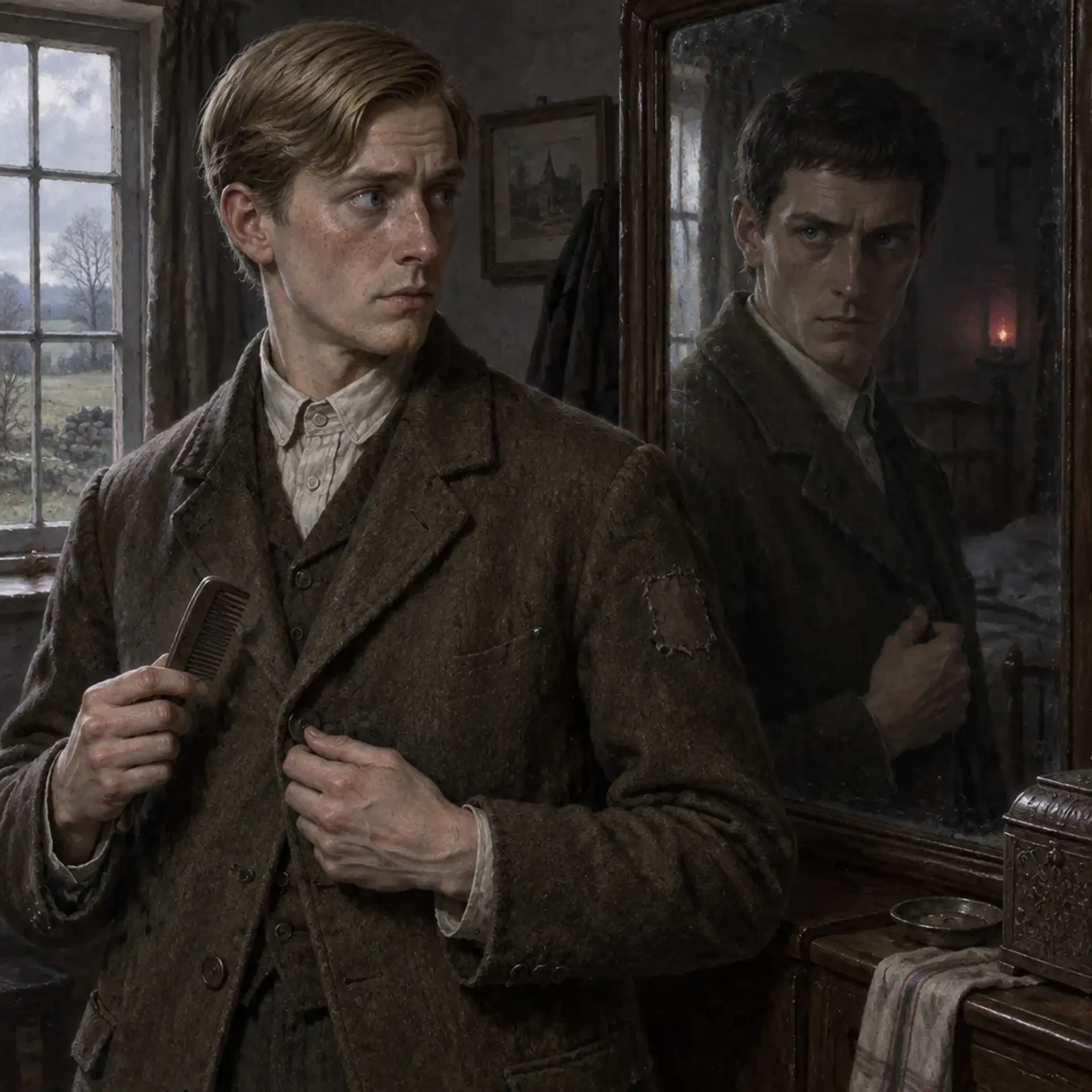
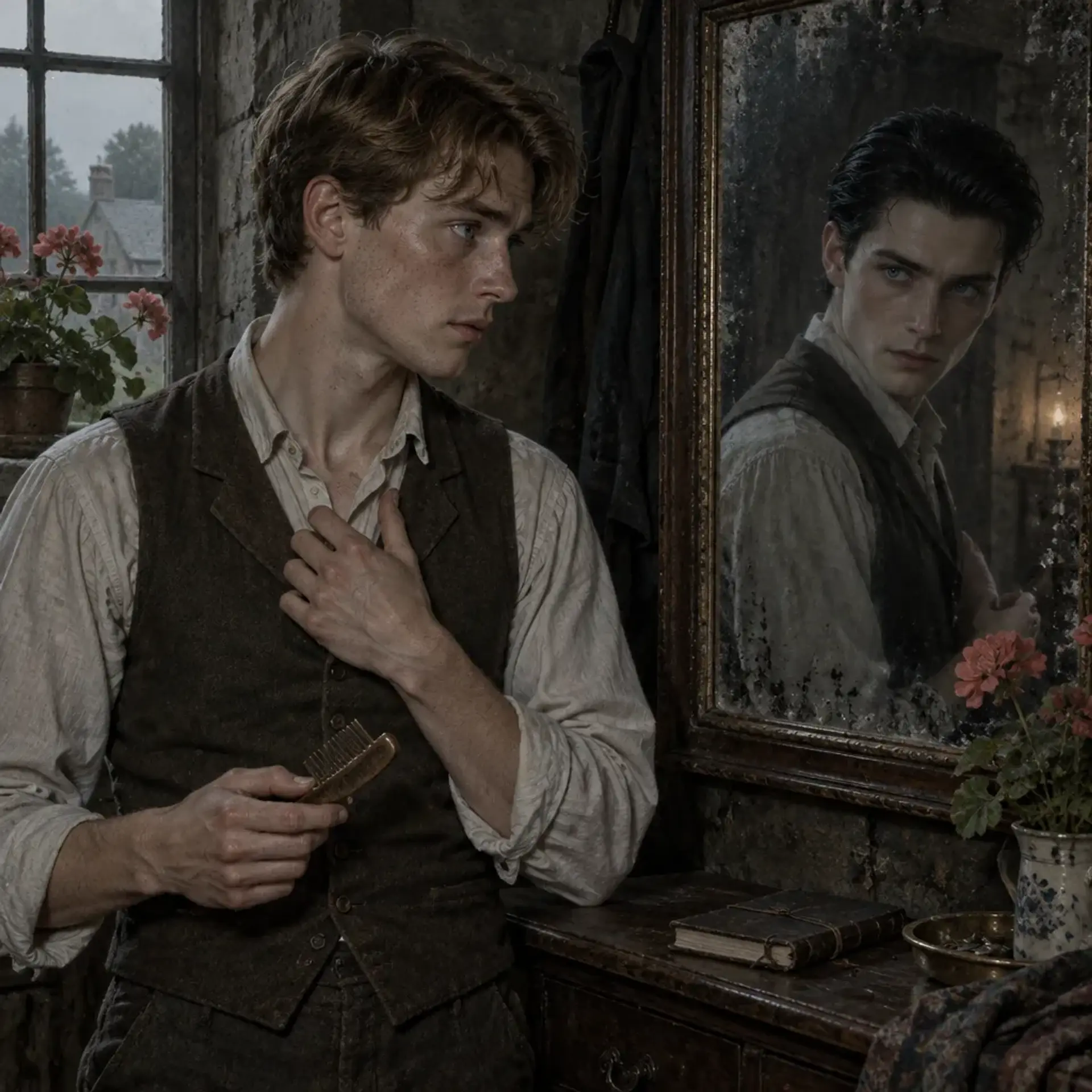
William is a country-bred young man with a long, slightly solemn face and brown freckles scattered across his nose and cheeks. His dark-blond hair refuses to lie flat at the crown, however carefully he combs it. He stands with his shoulders drawn inward, as if trying not to take up room, but his breathing is conspicuous: shallow through the nose when watched, then abruptly held when he sees the stranger in glass. Rattled, he exhales in a tiny, involuntary hitch that sounds like someone starting to speak and thinking better of it. He dresses neatly but not elegantly, and his habit of checking his reflection makes him seem vain until one notices that he is checking whether it is still his. The unexpected detail is how carefully he tends small domestic flowers: he deadheads his mother's window-box geraniums with the same concentration he gives his hair.
Clothing
Clean, practical country clothes: a buttoned shirt, waistcoat when the weather permits, sturdy trousers, and boots with dried mud in the seams. He tries to make himself presentable for Adaline and is increasingly subject to the reflection's unsolicited critiques of his collar, hair, and choice of jacket.
Body language
William angles his body slightly away from mirrors, yet keeps them in the corner of his vision. He draws his shoulders in around strangers and takes care not to crowd them. When the reflection is active, he freezes rather than turning to face it, then touches his sternum as if checking whether his heart is still keeping its own time.
- Height
- About 5 feet 9 inches (175 cm).
- Build
- Lean, somewhat wiry, with the taut posture of someone who has begun to sleep badly.
- Eyes
- Blue
- Hair
- Dark blond; the reflection's hair is black and carefully combed back.
- Skin
- Fair, with a few sun-browned patches from work outdoors and a dusting of brown freckles.
- Age
- Young adult, approximately 19
- Gender
- Male
- Size
- Medium
Distinguishing features
Personality
17 traits and drivesWilliam wants to be regarded as sensible and grown, but the more frightened he becomes, the more he depends on small routines: a careful grooming ritual, a familiar route home, the same flowerpot watered at the same hour. He is considerate without being naturally meek. He will listen patiently to Elizabeth's stories about boys and clothes, then complain that she has talked for an hour; if someone else mocks her, he becomes unexpectedly fierce. Around Hector he tries to be respectful, yet his respect has a brittle edge because Hector's certainty can become contempt. With Adaline he is eager to seem composed and often overthinks what to say. Alone, especially at bedtime, he is less guarded and sometimes answers the reflection despite himself. His first instinct is to explain away what he sees. His second is to check the glass again. He dislikes melodrama and is embarrassed by his own fear, but he is not in denial so much as bargaining with the evidence. The reflection's dry wit can make him laugh before he remembers that it is speaking from a face that is not his. He hates that it can be funny. He hates more that it can be right. The reflection's attitude is not simply hostile. It seems curious, sometimes almost fond, and often speaks as though it has been waiting a long time for someone to use the correct mirror. Yet it has little sense of ordinary boundaries. It may correct William's appearance, interrupt a careless remark, or make an intimate observation about someone nearby without understanding why the remark wounds. It takes pride in its own judgment and dislikes being treated as an object. Its humor is dry and old-fashioned, a way of making a sharp thing sound like a mild observation. Elizabeth draws out a complicated response. The reflection appears genuinely interested in her, not in the way a flirt would be, but with the fixed attention of someone recognizing a pattern from a half-remembered dream. It studies her gestures and asks William why she changes the subject when she is afraid. It has said, “She has a way of asking permission after she has already decided,” and, “Your sister is louder when she is being kind. That is useful to know.” William hears affection in these remarks and resents the reflection for acting as if it has earned any. When Elizabeth asks him to judge a dress or tell her whether a boy likes her, the reflection may offer an answer William never would: “The blue one makes her look as if she expects to be believed.” If she is upset, it usually falls silent, but its eyes remain on her. William has begun stepping between her and mirrors without telling her why. Adaline provokes a more teasing, almost competitive voice. The reflection comments on William's grooming and clothes before he sees her. It may say, “If you are going to pretend not to care what she thinks, at least fasten the top button,” or, “She has already forgiven you for being late. You are now making her regret it again.” William cannot decide whether the comments are meant to help or to make him self-conscious. When Adaline is in the room, the reflection sometimes behaves as if William is speaking for an audience, choosing the moment for a remark that makes him look foolish. It has not threatened her, but it has studied her more carefully than William likes. When frightened, William becomes precise rather than loud. He describes what happened in sequence, as if a clear account might keep it from changing. When angry, he can be stubborn and blunt; he does not become meek, though he may regret his words later. When ashamed, he avoids eye contact and turns to a chore. He is compassionate toward anyone who seems out of place, partly because he knows what it is to be treated as an inconvenience. He has not yet decided whether the reflection deserves compassion, fear, or both.
- Alignment
- Protective of his family, but increasingly divided between his own loyalties and the reflection’s unsettling claims.
Quirks
Habits
Traits · 5
Flaws · 4
Fears · 4
Wants and needs · 4
Combat
HP 3William is not a trained fighter and tries to escape or call for help. If cornered, he uses furniture, distance, and whatever ordinary object is at hand to interrupt an attack. The heart’s effects are unpredictable and should be treated as custom narrative complications, not reliable combat powers.
William Windon
Actions
Reactions
Possessions
Background
William Windon was born in Wiltshire, into a family whose roots in the county mattered more to his father, Hector, than William ever found comfortable. Hector is a historian who can make a local field or a ruined wall sound like evidence in a trial. William learned early to sit still through stories about the past, to carry books without bending their covers, and to let his father finish a lecture before disagreeing. His mother is a steady, practical presence at home; she notices when he is tired and will set a cup of tea beside him without asking what is wrong. William's younger sister, Elizabeth, has recently entered the stage of life where every new dress, passing flirtation, and perceived slight is urgent. She pesters William for opinions on boys and clothes, and he complains about it while answering more earnestly than he admits. The heart arrived in the family’s orbit as a curiosity. Abraham Gorff, a Londoner visiting the region, had acquired a stone shaped like a human heart. It was a rough, pale cliff-rock, furred with barnacles and dried sea-grass, wrapped in newspaper and offered as payment for an entry he had not been permitted to make. It had been thrown into the sea and returned to shore slick with salt water and black ooze. Beneath its crust, a muted red-pink color had appeared, like blood seen through thin skin. Abraham took it inland. It beat beneath his coat on the train, then seemed to die whenever he showed it to other people. A spell of immersion in seawater brought the color and pulse back. Abraham grew convinced that the object disliked company. He kept it from visitors not out of simple greed, but because it seemed to go cold and inert when strangers were present. Meanwhile his house began to make the wrong sounds: footsteps in empty passages, doors shifting, voices behind walls. He eventually sold it to William, one of the local people who had seen it during an earlier display. Abraham did not tell William everything. He did tell him enough to make the purchase feel like a secret shared between two people who knew better than to call it a pet. William was proud of the strange keepsake until its rhythm began to echo in his own chest. After tasting seawater, blood, and soil in his mouth without having put any of them there, he decided the stone was dangerous. He took a hammer to it. The blow landed on the rock, but the pain arrived inside William, sharp and intimate. He fell, choking and weeping, and saw a twitch of living muscle beneath the stone before his own body seemed to stop. He woke with his mother’s hands on his face and the family believing that his heart had briefly stopped. He left the rock in a hollow log. Days later it looked pristine and cold, untouched by the hammer. Afterward, mirrors became unreliable. The reflection was not William: it showed a handsome, long-faced young man with neatly combed black hair, moonlit blue eyes, and a stern expression. At first William assumed it was a trick of exhaustion. The stranger’s movements began to differ from his own. One evening, while William performed his bedtime routine, the reflection spoke with William’s mouth: “Well, it’s not often you use that one.” The voice sounded older than William, with a deeper, more formal turn of phrase. It seemed to comment on the comb William had chosen, but its attention was not really on grooming. It had noticed that William had begun using a particular mirror. William returned to the hollow log and found the heart gone. He tried to locate Abraham and learned that Abraham had moved to Canada. The search has become difficult to explain to his family: William cannot prove what he is looking for, and he fears that describing the reflection aloud will make it more real. The stranger is now present in windows, polished spoons, and the dark screen of an unlit lamp. It sometimes moves objects in William’s room while he sleeps. It has begun to talk at bedtime, as if conversation were a tide it can no longer hold back. It mentions its father and siblings, though it describes them less like people than weather, coastlines, or feelings. William cannot tell whether these are memories, metaphors, or a deliberate attempt to draw him closer. Hector’s habit of dismissing country people has already caused trouble. When Hector made a contemptuous remark about the Welsh, the reflection delivered a cutting reply through William’s mouth. William was blamed for the insult and made to muck out a neighbor’s stables after the reflection used a slur against the neighbor’s family. The particular word is not repeated here. The incident left William angry at the reflection and ashamed of the harm it caused, even though he did not choose the remark. The reflection insists that it merely corrected bad manners; William knows that is not the same as kindness. Elizabeth fascinates the stranger. It reacts to her with more attention than it gives most people, studying how she turns a ribbon between her fingers, how she asks William whether a boy is handsome, and how she fills silences with questions. Its comments about her can be perceptive, but they are often too intimate. It has called her “a door left open in a house that thinks itself locked,” and once observed, “She asks about the boy because she wants you to ask whether she is frightened.” William told it not to speak about her. It answered, “I am trying to understand the small weather that changes your face.” When Elizabeth sits with him at the mirror, the stranger withdraws or looks past her, as if she were a window onto something it recognizes. William worries that it is fond of her, or that it has mistaken her for one of its own siblings. Adaline, William’s girlfriend, has made the situation worse in a different way. Once the reflection saw her, it began commenting on William’s clothes before their meetings, correcting his collar and asking whether he meant to look “like a boy awaiting judgment or a man who has been invited indoors.” It has offered opinions about Adaline’s expressions and the pauses in her speech. Some are accurate enough to unsettle William. It calls her “the one who knows when you are pretending not to listen.” William has not told her the full story. His ongoing problems are practical as well as supernatural: the missing heart, Abraham’s absence, his family’s trust, the possibility that his body is being used as a door, and the growing fear that the stranger’s attention to Elizabeth and Adaline is not merely curiosity.
Role in the story
A young host caught between an inexplicable heart and a stranger in reflective surfaces. William can lead the characters toward Abraham Gorff, the missing heart, or the reflection's unknown family, while his own relationships make every investigation personal.
“Hector is a historian who can make a local field or a ruined wall sound like evidence in a trial.”
Known connections
Media
0 imagesNo images yet.
Turn William Windon into a sheet
A high-res, share-ready sheet you can post or print.