William Windon
William Windon
At the table
“s not the point”
Voice
William's voice comes from a young man who has spent years trying to sound reasonable around a father who likes facts and a sibling who knows how to tease him. It is clear but not especially forceful, with a slight catch when he must describe the moment his heart stopped. He speaks faster when nervous and carefully resets his phrasing when he thinks he has sounded foolish. The reflection's voice has more weight in the same mouth, with an older cadence and a dry edge, as if it has spent a long time judging how people speak. It does not sing or murmur. It delivers remarks as though stating an obvious fact, which makes its most personal comments feel especially intrusive.
William's own voice is youthful and carefully controlled, with the local Wiltshire sound of someone used to speaking plainly at home and minding his manners in company. He sometimes rushes when describing the heart, then slows down to correct himself. He tends to soften claims with phrases such as "I know how it sounds" and "I am not saying it was alive, exactly." The reflection uses his mouth but sounds older than him, deeper and more measured, with an accent that suggests a generation before William's. Its comments are dry, pointed, and often domestic rather than grand. When angry, William does not become gentle or whisper; his speech becomes clipped and he stops qualifying what he says.
Speech patterns
How to play them
Begin with ordinary questions about the heart, Abraham, and what the stranger has said. William is more likely to trust someone who takes his account seriously without immediately calling him mad. Do not make him disclose everything at once. He may show a visitor the reflection only if he believes they can help and Elizabeth is not in immediate earshot. If the visitor mocks him, he becomes defensive. If they threaten Elizabeth or try to break the heart, he may act rashly.
Goal
Find Abraham Gorff or another informed witness, recover the fossilized heart if it can be found, and learn how to stop the reflection from taking more of his life.
Motivation
William wants his face, privacy, and ordinary family life back. He also feels a grudging responsibility toward the stranger because it speaks as if it has a family and has not yet physically harmed him.
Appearance
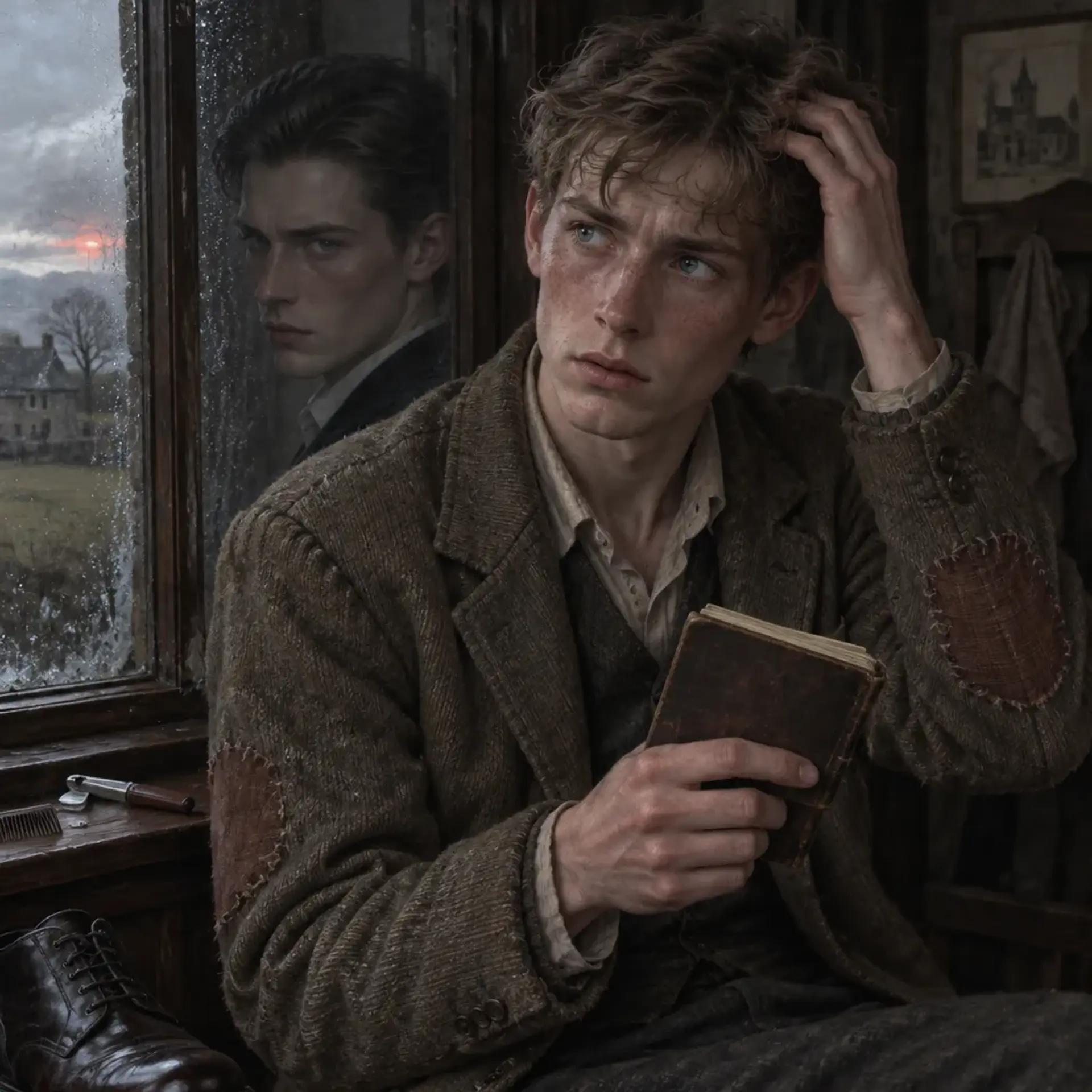
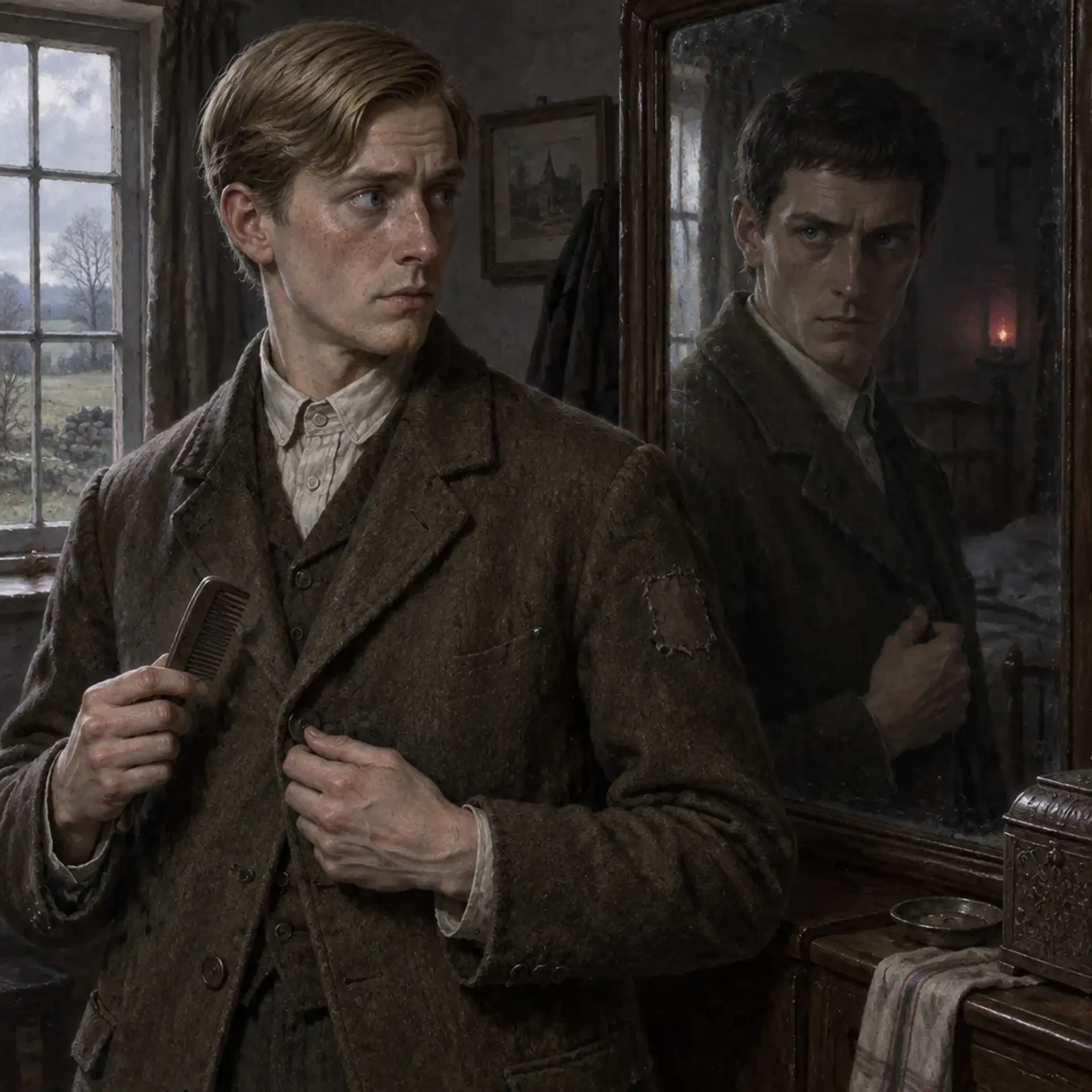
William is a local young man with a long, earnest face, blue eyes, and a scattering of brown spots across his skin. His dark-blond hair is brushed into a careful side part, then combed back so thoroughly that it lies in tidy, slightly shining ridges. He is not tall, though he carries himself as if he expects to be measured against someone taller. His movements are quick and ordinary until a reflective surface catches his attention: then his shoulders lock, his chin turns by cautious degrees, and he watches the glass without appearing to. His clothes are practical country wear, usually a little too carefully arranged for stable work. The cuffs and elbows have been mended with thread that almost, but not quite, matches. He keeps one polished button on his coat conspicuously bright. The unexpected detail is his meticulous grooming: even after mucking out a stable, he will stop to straighten his collar and smooth his part with a pocket comb. He leaves the impression of a decent, self-conscious young man trying to look composed while listening for something behind him.
Clothing
A clean but frequently mended country coat, plain shirt, sturdy trousers, and work boots. His collar is often too carefully arranged for the state of the rest of his clothes. He carries a pocket comb and fusses over a single polished coat button.
Body language
William holds his shoulders a little too square and keeps his hands busy with cuffs, buttons, or his comb. He glances at reflective surfaces without turning his head fully. When the reflection speaks, his expression often tightens before his lips move, as if he is bracing for an interruption. With Elizabeth he tries to look exasperated, but his attention keeps returning to her. When angry, he rubs his thumb along a coat seam and becomes unnaturally still.
- Height
- Average for a young man of his place and time
- Build
- Lean, young, and lightly built, with the wiry strength of someone accustomed to ordinary country chores rather than formal training.
- Eyes
- Blue
- Hair
- Dark blond; the stranger in his reflection has short, dark hair combed back.
- Skin
- Fair skin with scattered brown spots
- Age
- Young adult, approximately 17
- Gender
- Male
- Size
- Medium
Distinguishing features
Personality
20 traits and drivesWilliam wants to be considered sensible, grown, and properly mannered. He is also frightened enough to watch windows and mirrors as if they might answer him. In company he is restrained and tries to appear agreeable; alone, especially at bedtime, he argues with the reflection in quick, frustrated whispers. He can be proud of the heart as a possession one moment and deeply ashamed of it the next. His instinct is to protect Elizabeth, but he sometimes resents her teasing because it exposes how badly he is coping. He has learned to be patient with Hector's lectures, yet the reflection's blunt retorts have given voice to William's own buried irritation. He is not naturally cruel, but he can be sharp when frightened or embarrassed. He wants the stranger to explain itself and simultaneously fears that asking will invite it closer. Around the reflection he is watchful and argumentative; around his family he performs normality; around strangers he tries to judge whether they are curious, useful, or dangerous.
- Alignment
- Not applicable as a canonical Secret Histories statistic; William is protective, easily embarrassed, and capable of sharp retaliation.
Quirks
Habits
Traits · 5
Flaws · 5
Fears · 5
Wants and needs · 5
Combat
HP 10William is not a combatant by profession and has no established combat training. He avoids a fight, seeks an exit, and tries to put furniture or a door between himself and danger. If cornered, he may use an improvised object or shove past an attacker. The reflection's influence is disturbing but not a reliable weapon. Use the chosen Secret Histories procedures rather than importing D&D combat statistics.
William Windon
Actions
Reactions
Services they sell
Rewards they can give
Equipment
- Pocket comb (personal item)A small, well-used comb that William checks and cleans with fussy care.
- Mended country coat (clothing)A practical coat with uneven mending and one conspicuously polished button.
- Fossilized heart (absent relic)The fossilized heart is missing at present. It resembles a sea-worn stone carved in a human heart's shape, with barnacles and sea grass once attached; beneath the stone it can become red-pink and apparently alive.
Possessions
Background
William Windon was born in Wiltshire into a family whose roots in the county reach back through enough generations that his father, Hector, treats local history as a kind of inheritance. William grew up among familiar lanes, farm work, church notices, practical neighbors, and the unspoken expectation that a young man should know how to be useful without making a spectacle of himself. He has one sibling, Elizabeth, who is close enough to tease him and perceptive enough to notice when he is pretending not to be frightened. Their father is a historian. Hector can turn an ordinary family conversation into a lecture about the past, and he sometimes speaks dismissively of country people outside his own circle. William has learned to swallow irritation rather than challenge him in front of others. The heart entered William's life as an object, not a person. A London amateur named Abraham Gorff had taken a peculiar stone from a visitor associated with the Hush House. It had been described as a fossilized living heart forged of heart and scale. At first glance it looked like a chunk of Dover cliff carved into a crude human heart, barnacles and sea grass clinging to its surface. It had been thrown into the sea and washed back onto shore, wet with salt and black ooze. Under the grey exterior, a red-pink hue had appeared, like a glow or a trace of returning blood. Abraham carried the thing home to Wiltshire. He studied it, showed it to neighbors, and learned that in company it could seem dead. Alone with it, or after contact with seawater, its strange signs returned. Abraham did not keep it simply out of greed. He became convinced that the heart disliked visitors. His house grew increasingly troubled: voices in rooms where nobody stood, doors shifting, footsteps on halls and stairs. Eventually Abraham got rid of the heart, selling it to William, then seventeen. William had been among the people who saw the object when Abraham showed it around, and he took possession of it with the pride of someone who believed he had acquired an unusual keepsake. At first, the stone was cold and inert. Then William felt a beat in his chest that seemed to answer its own rhythm. After tasting the ocean, blood, and soil in his mouth without having put any of them there, he decided the heart had to be broken. He brought a hammer to it. The blow did not crack the stone. Instead, pain struck through his chest so sharply that he dropped to the ground, weeping and groaning in a voice that did not sound like his. He spat blood. For one fraction of a moment he saw muscle twitching inside the heart, then his body gave out. William woke with his mother's hands on his face. She told him his heart had stopped. He never forgot the words, or the sensation of being called back into his own body by somebody else's fear. Days later he hid the heart in a hollow log, intending never to touch it again. When he checked, it looked cold and pristine despite the hammer blow. Then he began to see someone else in his reflection. The stranger's reflected face was long, handsome by the standards William knows, and stern. It had short, dark, carefully combed-back hair and blue eyes like moonlight on a freshwater pond. At first it merely copied William badly, with a small delay or a jerk toward an unintended movement. William tried to dismiss it as fear, exhaustion, or the aftermath of the collapse. He kept up his grooming routine because abandoning it would mean admitting that the reflected face mattered. One night, while William was preparing for bed, the reflection moved with a will of its own. It said, using William's mouth, "Well, it's not often you use that one." The voice seemed older than William's and deeper, with an accent that did not belong to him. The remark was not a threat. That made it worse. It sounded like someone who had been watching for a long time and had decided William's choice of comb was worth commenting on. William returned to the hollow log, but the heart was gone. He has searched for Abraham Gorff and learned that Abraham moved to Canada. The more he looks, the less he trusts what he sees. Windows and mirrors increasingly show the stranger rather than William. The reflection can move while he sleeps, leaving small alterations in his room: an item turned toward the glass, a comb put precisely where William would not leave it, or a chair shifted so that its back faces the window. It does not appear to have a body outside reflective surfaces, and William cannot prove whether it is doing these things or whether his memory is failing. The stranger speaks most often during William's bedtime routine or while he lies awake. It comments on William's clothes, the way he parts his hair, and the manners he tries to maintain. It has opinions about what William eats and which things smell pleasant. It has also started speaking of its own family. Its father and siblings are described as though they were weather, tides, or feelings, not living people. It once offered the number forty-eight as the number of its siblings, then stopped as if it had given all the explanation it could. William cannot tell whether this is a hint, a boast, a fragment of memory, or an attempt at conversation. The reflection has already caused trouble. When Hector complained about how silly country people are, it put a cutting remark into William's mouth. William was the one who got reprimanded. In another incident, a neighbor's child ran into him with a toy wagon. The girl apologized and began to cry. The reflection made a slur about the Welsh neighbor. William will not repeat the word. He was made to muck out the neighbor's stables afterward, and the punishment was humiliating enough that he still feels angry with the reflection as well as himself. Elizabeth is the person William most wants to protect from this. She pesters him about the boy she likes, asks whether certain things look nice, and points out his lapses in manners. The reflection reacts to her with an odd, inconsistent interest. It sometimes answers her questions through William with an unexpectedly sharp, almost teasing observation. It may tell William that Elizabeth's new ribbon suits her, then sneer when she tries to arrange his collar. When she speaks about the boy she likes, it listens more intently than William does and may make a dry, unnerving comment about the boy's posture, hands, or family. It does not openly threaten her. It has, however, told William that she has a "good way of looking at a door before entering," as if noticing a quality in her it recognizes. William fears the reflection may be using Elizabeth to learn how ordinary affection works. William's present problem is practical and frightening. He wants the heart back, or wants someone who understands it to tell him how to sever the connection. He must keep living at home, avoid alarming his mother, and conceal the reflection from Hector, who would try to classify it before he believed it. He also needs to keep Elizabeth from becoming a target or an accomplice. The reflection, meanwhile, seems to want company and a way to describe its family. William has not decided whether its remarks are evidence of a trapped person, a predator, or an intelligence too alien to fit either description. He is trying to find Abraham Gorff, understand the heart, and keep his own face from disappearing entirely.
Role in the story
A frightened witness and potential ally whose reflection may be an independent presence connected to a missing living relic. William can lead characters toward Abraham Gorff, the Hush House connection, or the mystery of the heart's origin. His family ties create immediate stakes, especially his relationship with Elizabeth.
“He has one sibling, Elizabeth, who is close enough to tease him and perceptive enough to notice when he is pretending not to be frightened.”
- Faction
- No known faction. The heart's earlier connection to the Hush House is unverified and should not be treated as proof of membership or allegiance.
Known connections
Media
0 imagesNo images yet.
Turn William Windon into a sheet
A high-res, share-ready sheet you can post or print.