Wulfgar
Wulfgar
At the table
Voice
His voice is a little rough at the edges, shaped by years of speaking over work noise and outdoor weather. It has the grounded, matter-of-fact rhythm of someone used to giving instructions across a site. He clips practical statements short, then lets jokes tumble out with an abrupt burst of breath. When heat rises in him, his words catch on dry breaths and he swallows between phrases, more like a man fighting a fever than lowering his voice.
Plain, direct, and full of practical comparisons. He explains risk as if describing a construction failure, uses short questions to orient himself, and reaches for humor when emotions grow difficult. His teasing can be sharp without being cruel by intent, which does not stop it from hurting. When speaking of his family, he grows specific and careful, recalling ordinary details rather than grand declarations.
Speech patterns
How to play them
Meet Wulfgar through practical work: ask him to assess a road, brace a roof, or plan a safe crossing. He responds warmly to people who share food and responsibilities. If he jokes at someone's expense, have him notice the consequence through a clear reaction from the target; he may initially defend himself, but a direct, calm challenge can get through. Treat his longing for family as sincere, not as a convenient way to manipulate him.
Goal
Find a way to return to his wife and children while helping the Seven survive long enough to choose their own futures.
Motivation
To keep his memories of home intact, protect the people stranded beside him, and prove that an inherited hunger does not decide what kind of person he is.
Appearance
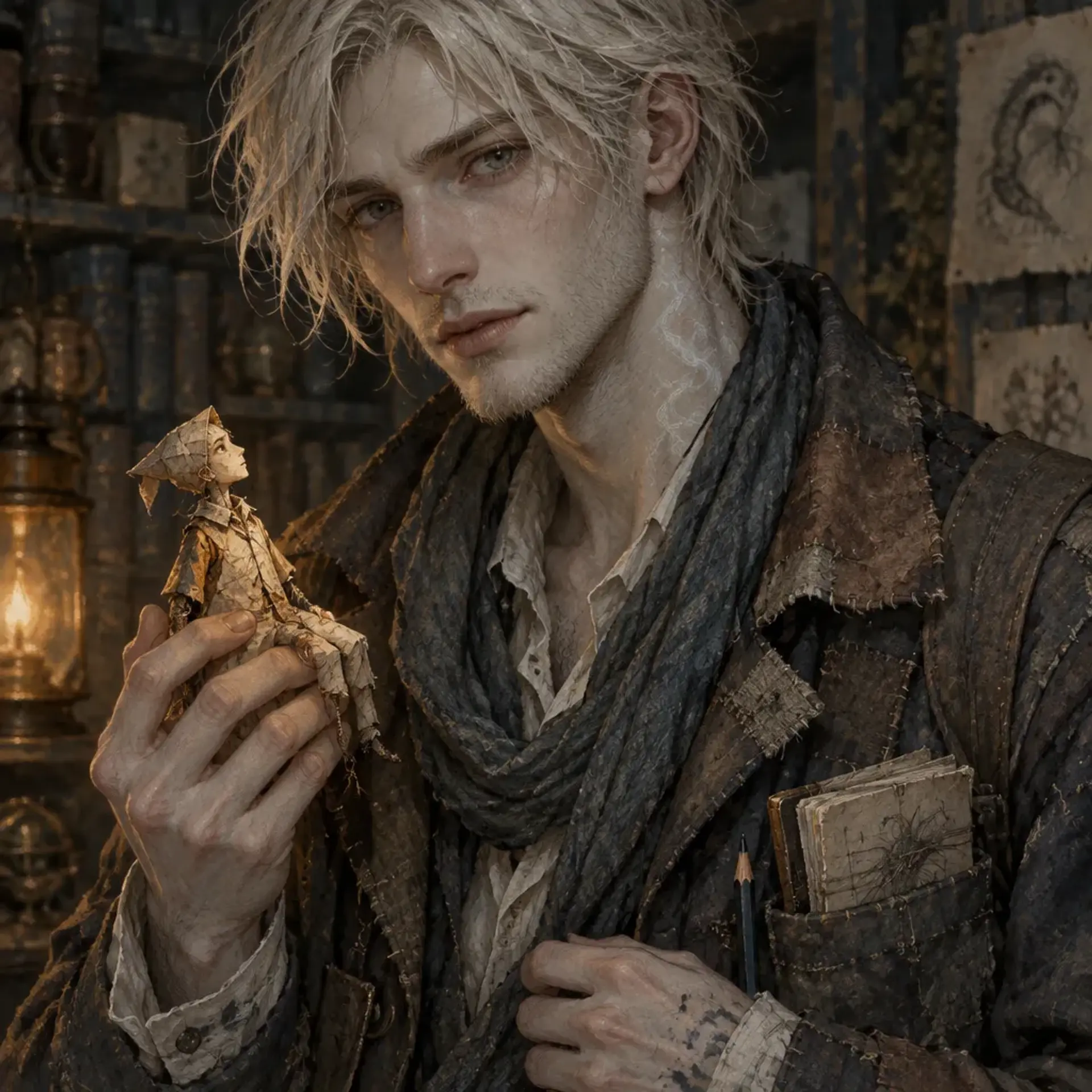
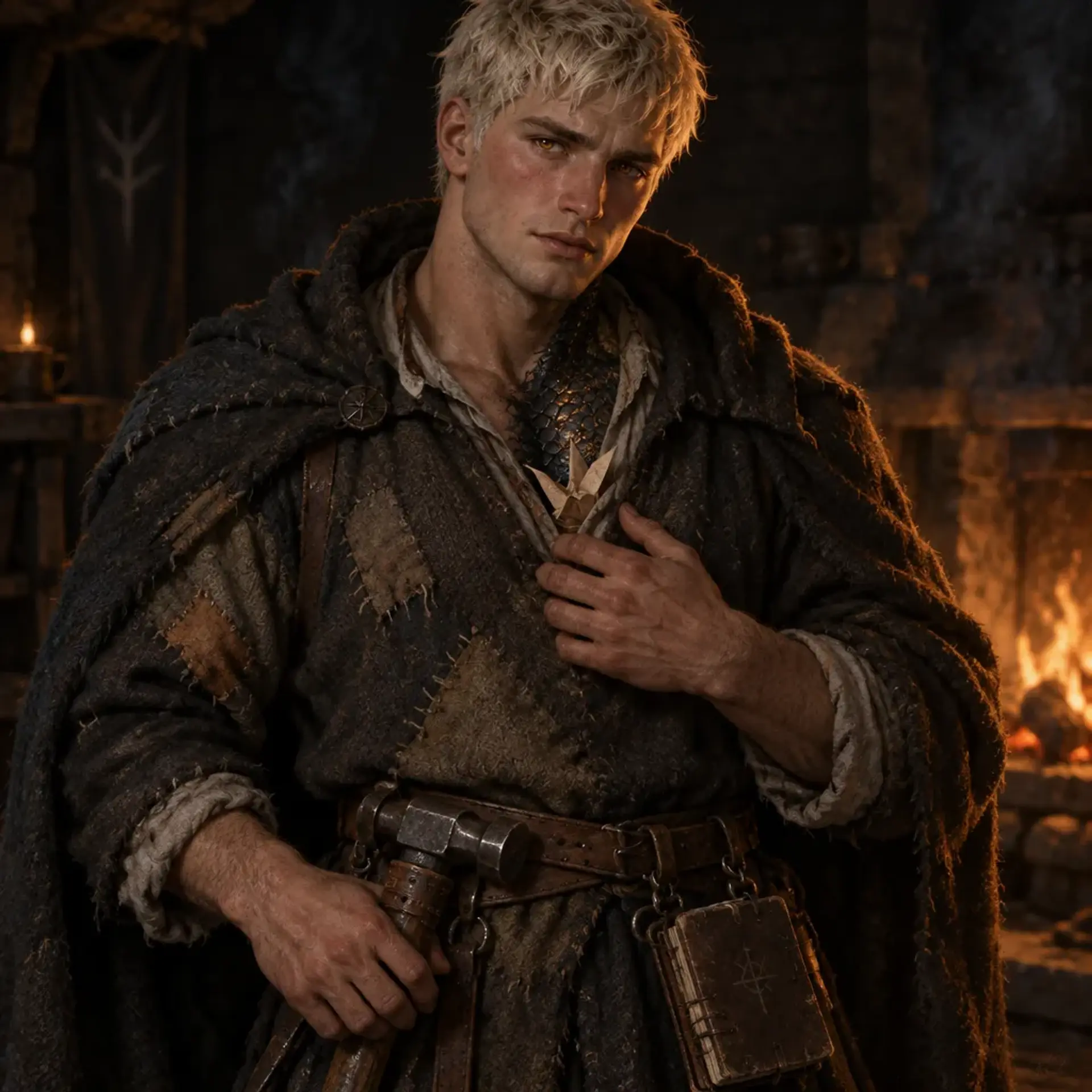
Wulfgar is tall enough to make a crowded room feel smaller, broad through the shoulders and built like someone who has hauled surveying gear up muddy slopes. His pale hair is thick, nearly white-blond, and clipped unevenly with a knife; he keeps pushing it back as if it were a safety helmet brim. His bright amber eyes hold a fixed, measuring focus. In ordinary light he looks like a handsome, imposing young traveler. Beside a hearth, a black pattern appears beneath the skin at his collar and ribs: overlapping scales, glossy as wet pitch, spreading and fading with his pulse. He plants his feet as though testing ground for stability, takes up more room than he realizes, and gives the impression of a man who expects a structure to fail unless he checks it himself. An unexpected detail: he keeps a tiny, carefully folded paper crane tucked into his shirt, made from a scrap of a printed highway map.
Clothing
A borrowed wool tunic, patched trousers, a weather-darkened cloak, and sturdy boots chosen for walking rather than appearance. He has reinforced the tunic's seams himself and carries a leather belt with practical loops for tools. Nothing matches, but everything is arranged to stay out of the way.
Body language
Wulfgar stands with his weight balanced and his feet placed as if the floor might shift. He leans into conversations, occupying space without noticing, and points with a broad thumb rather than a finger. When embarrassed, he rubs his sternum where the scale-mark forms. His amusement arrives visibly in a lifted cheek and a sudden snort; concern makes him busy his hands with straps, knots, or tools.
- Height
- 6 feet 4 inches (193 cm).
- Build
- Tall, broad-shouldered, and powerfully built, with the functional strength of a laborer rather than a trained soldier.
- Eyes
- Bright amber, with a reflective gleam in firelight.
- Hair
- Pale blond, almost white.
- Skin
- Fair, with a faint warmth at the throat and chest during a heat surge.
- Age
- 18; he remembers an adult life in another world, though his present body and the local calendar make his age difficult to explain.
- Gender
- Male; formerly male and still male, as specified.
- Size
- Medium
Distinguishing features
Personality
17 traits and drivesWulfgar is blunt, observant, and often genuinely funny. He notices the practical details other people miss: a roof beam beginning to bow, a companion favoring one leg, a valuable clasp hidden under a sleeve. His humor makes him easy company when the danger is distant, and he likes seeing people loosen up. But he can mistake a laugh for proof that everyone is all right. When two members of the Seven became newly male, he found their awkwardness funny and teased them, sometimes failing to see that their distress was serious. He can be generous with labor and ungenerous with patience. In a crisis, his jokes stop and his old engineer's mind takes over: he checks loads, routes, water, and exits. When grief or shame catches him off guard, he becomes louder and more sarcastic, then later tries to make amends through some practical kindness. He misses his wife and children with a tenderness he rarely shows in public, and he is frightened by the warmth and hoard-hunger in his blood. He wants to be the dependable person he remembers being, yet resents that the new world keeps asking him to prove it.
- Alignment
- Neutral Good, with a practical streak that can look selfish when survival is at stake.
Quirks
Habits
Traits · 4
Flaws · 4
Fears · 4
Wants and needs · 5
Combat
AC 11 · HP 7 · 30 ft.Wulfgar is a level-0 novice, not a trained combatant. He looks for cover, keeps companions behind him, and uses a hammer or nearby object only when cornered. He tries to break line of sight and escape rather than trade blows. A heat surge makes him panic before it makes him dangerous; he has no reliable fire attack.
Wulfgar
Actions
Reactions
Services they sell
Rewards they can give
Equipment
- Work hammer (tool)A heavy, blunt-ended tool that serves as a modest weapon and a reminder of his former work.
- Field notebook (personal item)A small notebook filled with rough maps, measurements, remembered names, and sketches of bridges.
- Map-paper crane (keepsake)A folded paper crane made from a fragment of a printed map from his old life.
- Travel clothes (clothing)A patched wool cloak and sturdy walking boots suitable for cold, wet travel.
Possessions
Background
Before the mountains, Wulfgar was a civil engineer from Tennessee who had gone back to Oregon for work. He understood roads as promises: someone had measured the slope, tested the soil, and decided that strangers ought to be able to cross. His old life was full of unremarkable particulars he now clings to fiercely: his wife, their two children, friends who knew which jokes he repeated, and the small routines of work. He remembers their voices with painful clarity. He does not know whether time has passed for them, whether he can return, or whether the life he remembers belongs to a world that still exists. The transition left no explanation. He woke near the Harz Mountains in Saxon lands, cold, confused, and alone, wearing unfamiliar clothes that fit his powerful new body. He had no map he could read, no phone, and no sensible account of how an American engineer had arrived in another age or world. At first he treated the ordeal like a disaster site. He checked himself for injuries, searched the ground for belongings, and tried to identify the nearest road. The nearest road was a muddy track, the landmarks were wrong, and his own reflection showed a young man with pale hair and bright, unsettling eyes. His first days were a chain of small, humiliating lessons. He could not make himself understood. He was too conspicuous to travel unnoticed and too ignorant of local custom to ask for help without blundering. A feverish heat began to roll through him at night. The first time it struck, he thought he was dying. His skin grew hot from within, his ribs seemed to glow with pain, and the black scales beneath his skin showed in the flame of a cooking fire. He tried to smother the fire, then sat shaking in the dark until the worst passed. Soon after, he caught himself staring at a merchant's bright clasp with an unreasonable, hungry fixation. He did not steal it. He did, however, have to walk away twice. In time he found other displaced people, the circle that came to call itself the Seven of the Dark Fire. They were not an army or a formal order. They were a mutual-aid company formed from people who shared the impossible fact of having been pulled out of familiar lives and set down in a world with different rules. They traded translation, shelter, food, and information. Wulfgar's engineering habits proved useful: he could judge a sagging roof, plan a drainage ditch, and explain why a bridge needed a better footing. He began sketching routes and simple structures on scraps of paper, turning unfamiliar ground into problems that could be measured. The group gave him somewhere to be useful, but not a cure for missing home. He talks about his wife and children more readily than he talks about the fear that he may never see them again. He tries to keep their names and habits vivid, recalling what each child liked to eat, what his wife would have said about a foolish plan, and which friend would have called him out for acting tough. Those memories are both anchor and wound. When the others suffer, he can be generous with food and labor; when their distress touches his own, he sometimes snaps into jokes and pretends that pain is a thing they can all outwork. Wulfgar's worst misjudgment has been with two members of the company who have recently become male. Their awkwardness and confusion have struck his humor as an opening for teasing, and he has laughed at them when they needed patience. He tells himself that laughter is a way to make a strange situation bearable. He has not always noticed when it makes someone feel alone. The habit is not malice, but that distinction offers little comfort to the people on the receiving end. His friends have begun to make him face the difference between sharing a joke and making a person into one. His present troubles are practical and supernatural at once. The Seven need reliable shelter, safe routes, and a way to earn enough food without becoming someone's property. Wulfgar wants to find a path home, but every rumor of a crossing or a powerful dragon pulls his attention in two directions. His own bloodline feels like an unwelcome inheritance from a pitch-black Firedrake, an ever-burning creature whose greed is said to be as relentless as its heat. Wulfgar has no proof that the dragon knows he exists. He does know the heat is worsening, and bright treasure increasingly feels like a solution to a need he cannot name. He has made a private promise not to let the new world turn him into a stranger to the people he remembers. He is not sure what keeping that promise means. It may mean finding a way home; it may mean surviving long enough to help the Seven; it may mean admitting that the people around him matter even when they cannot replace the family he lost. For now, he measures bridges, checks the others' supplies, and tries to make his jokes land gently. His life beyond the party is already underway, and its hardest construction project is the person he is becoming.
Role in the story
A displaced engineer with the beginnings of a dangerous draconic inheritance. Wulfgar can help the party solve travel and shelter problems while creating interpersonal tension through humor that sometimes lands cruelly. His family memories provide an emotional stake in finding a way home; his emerging Firedrake traits create a slower, uncertain threat.
“He understood roads as promises: someone had measured the slope, tested the soil, and decided that strangers ought to be able to cross.”
- Faction
- The Seven of the Dark Fire, a displaced circle of friends and mutual-aid company, not a formal military faction.
Known connections
Media
0 imagesNo images yet.
Turn Wulfgar into a sheet
A high-res, share-ready sheet you can post or print.