Gunther
Gunther
At the table
Voice
A dry, slightly rasping voice shaped by Mecklenburg German, military habits, and years spent in damp underground spaces. In German his local accent is immediately recognizable to people from the region. In English he sounds deliberate and somewhat bookish, with firm consonants and pauses where he searches for the exact term. Curiosity makes him speak faster; shame makes him stop rather than soften his voice.
His German carries the clipped regional sound of Mecklenburg, with consonants shaped by a lifetime of speaking through cold air, dust, and damp cloth. In English he uses short, carefully assembled phrases and puts stress on practical nouns. His voice has a dry rasp, as if his throat still remembers soil; when he has been feeding, the rasp is less pronounced. He does not sing or whisper for effect. Anger makes his sentences more exact and his consonants harder, while genuine curiosity brings a stumbling rush of questions.
Speech patterns
How to play them
Begin with practical questions and give him time to assess whether the conversation is safe. Do not mock the shroud, his ignorance of modern technology, or his wartime remorse. A sincere request for his opinion can earn an unexpectedly long and candid discussion. If asked about the Second World War, accept a refusal; pressing him makes him withdraw. Demonstrate patience with a device or offer a concrete lesson to earn his trust.
Goal
Find a trustworthy mentor to teach him how to use the computer and game console, while discovering whether his connection to Byelobog is real.
Motivation
To make his existence mean something beyond hunger and survival, and to find a form of kinship that does not require obedience.
Appearance
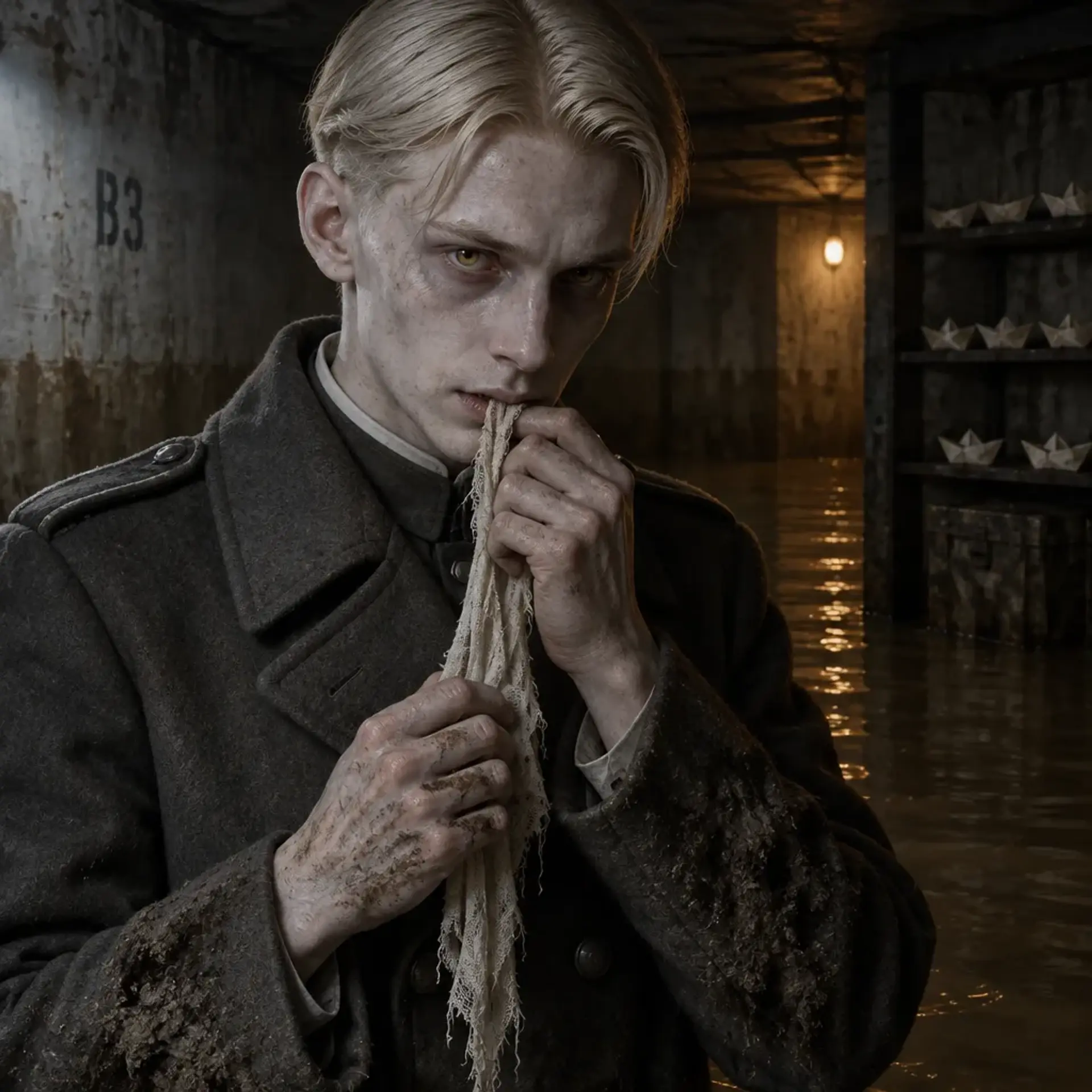
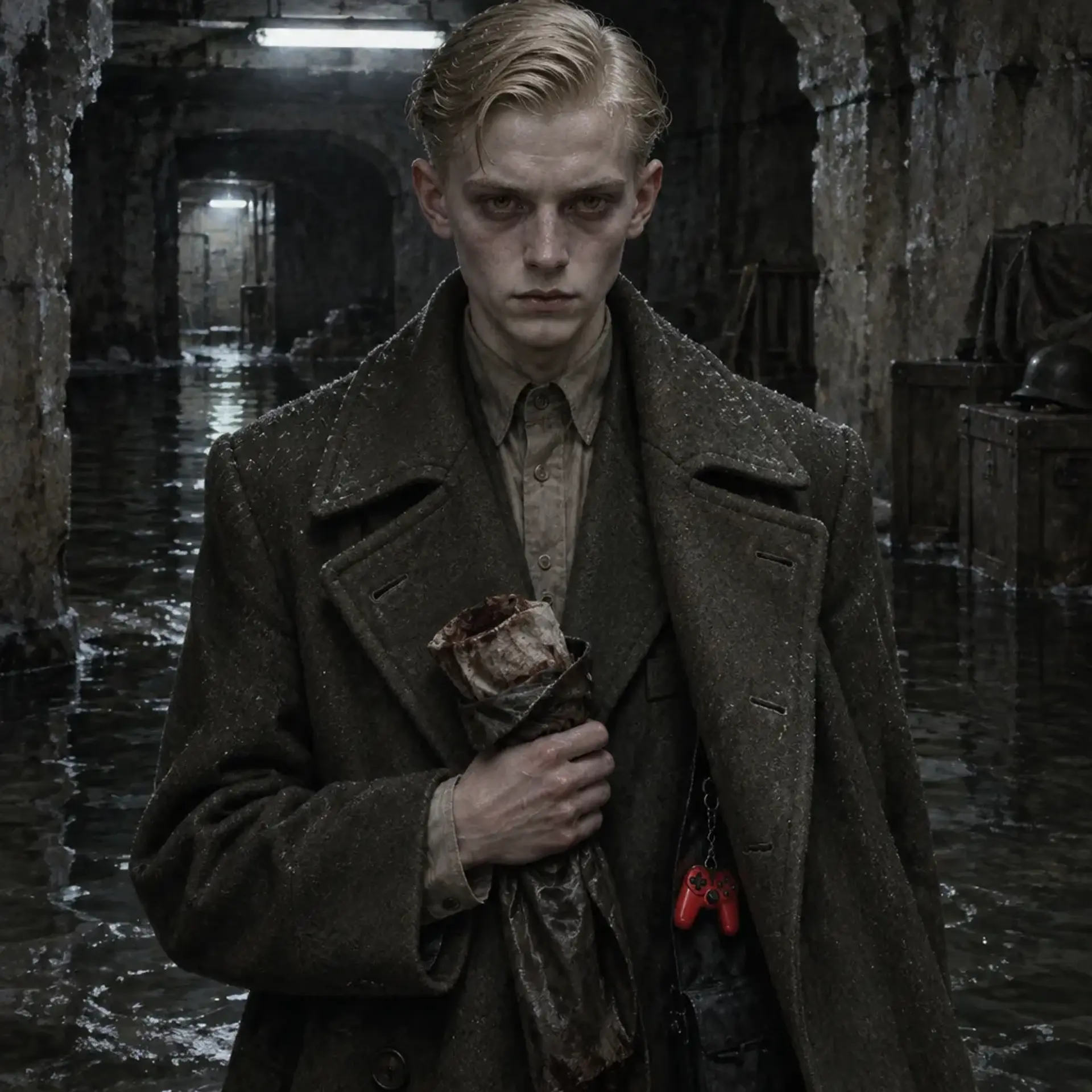
Wilhelm looks like a pale adolescent who has tried to dress himself into an older, stricter life. His face is narrow and carefully shaved, his pale-blond hair combed into precise ridges, and his skin has the matte, faintly waxed look of a candle left in a cold room. Before feeding he is deathly white, his eyes a muddy, exhausted yellow; afterward a little color seeps through and the yellow brightens, though it never looks quite human. His military coat hangs straight and overlong, its insignia removed so meticulously that pale stitch-holes remain. He keeps his cuffs clean and his buttons aligned even in a flooded bunker. His unexpected detail is a small, brightly colored plastic game-controller charm tied to his coat lining, which he handles with almost ceremonial care. He stands as if expecting inspection, but when waiting he puts nearly all his weight on his heels and keeps his toes lifted, like someone testing whether the floor is truly solid. He smells of wet limestone, turned soil, old wool, and a faint sour trace of blood. He knows the smell and insists it is merely the bunker.
Clothing
A carefully brushed German military coat with every insignia removed, dark trousers, repaired boots, and a plain shirt kept buttoned to the throat. A strip of burial shroud is wrapped in oilcloth inside the coat. A bright plastic game-controller charm is tied to the lining.
Body language
He stands stiffly, shoulders squared as if for inspection, but waits with his weight on his heels and toes slightly lifted. He watches people’s mouths when they speak, then glances toward the floor as if testing whether their words have made the ground change. In conversation he fingers the shroud through an inside pocket. When frightened, he aligns nearby objects into straight rows.
- Height
- About 170 cm (5 ft 7 in).
- Build
- Lean and compact, with narrow shoulders and a soldier’s economical posture. His movements are measured rather than graceful; he can become startlingly fast when something threatens his space.
- Eyes
- Dull yellow when hungry, brighter after feeding.
- Hair
- Pale blond, combed into precise ridges.
- Skin
- Cold, wax-pale white before feeding, with faintly gray undertones; slight color returns after feeding. Fine white flakes occasionally shed from his skin.
- Age
- Appears about 16; actual age and mortal birth date unknown. He remembers serving in both world wars, but his account of the years between is incomplete.
- Gender
- Male
- Size
- Medium
Distinguishing features
Personality
18 traits and drivesWilhelm’s personality is built around a contradiction he cannot resolve: he distrusts authority, yet he longs for rules firm enough to tell him what a good person is. He deserted the German army near the end of the First World War because its repeated failures made its promises of honor feel hollow. He still experiences that decision as a moral failure. He can explain, lucidly, why obedience is not the same as virtue; then, when shame overtakes him, he will judge himself by precisely the harsh standard he rejects in others. This makes him severe without making him consistently cruel. He is more likely to condemn himself than a frightened stranger, but can become unexpectedly hard on anyone who appears to enjoy power over the weak. In company, he is guarded at first. He studies posture, exits, hands, and the floor, as though a person’s stability might be judged by how they stand on the earth. He answers direct questions directly if he believes they are asked in good faith. If he senses mockery, he becomes clipped and literal, often withdrawing rather than retaliating. The exception is ideological conversation. Give him an attentive listener and he may become voluble, building theories about origins, folk belief, death, and the limitations of the Cainite story. He is not trying to win a debate so much as to prove that uncertainty can be faced without submitting to the first explanation offered. Unfortunately, he does not always notice when his listener has stopped enjoying the discussion. His friends call him an ideological idiot; the phrase annoys him because it is often accurate. He is meticulous about small, controllable things. He brushes his coat, keeps its buttons aligned, and arranges his possessions in a deliberate order. This grooming does not come from vanity. It is a private refusal to become as chaotic as the wars and ruins through which he has passed. His bunker may be flooded, his history inaccessible, and his body strange, but his collar can still be straight. When he is calm, this discipline makes him seem older than his face. When he is frightened, it becomes compulsive: he straightens objects, checks latches, and tests the floor with his heel. His manner changes sharply depending on the subject. Talk of modern machines brings out a shy, almost boyish curiosity. He is embarrassed by his ignorance but not by the devices themselves; he will ask careful questions about the game console and computer if he trusts the person answering. He wants a mentor, not a servant, and can become surprisingly patient when someone teaches him without condescension. Talk of his missing memories makes him evasive. He does not like being treated as a mystery to solve, especially by people who assume that a dramatic supernatural origin will be more interesting than the life he has made since. Talk of either world war can produce silence, dry practical remarks, or a sudden effort to change the subject. He does not become softer when angry. He becomes more exact, using brief sentences and naming consequences as if preparing a report. Wilhelm is fascinated by harsh ideologies because they seem to expose the common ground between humans and the undead: both survive, both fear, both invent stories to justify what they do. He sometimes mistakes severity for honesty. In his better moments he recognizes that cruelty can be as self-serving as sentimentality. In his worse moments he treats suffering as evidence of seriousness and takes needless hardship upon himself. He is not a preacher, despite the bluntness of some of his arguments. His interest in Norse paganism is personal and eclectic, not an organized religious identity. He likes stories in which a person’s worth is tested, but is uneasy with the implication that the defeated deserved to lose. He is capable of affection but poorly equipped to display it. With Friedrich, he allows long pauses and does not demand that the wraith explain the need to borrow a face. He shows loyalty by keeping the bunker open, sharing blood when he can, and remembering small preferences. With the informal fellowship he will complain that they are not truly a family, then put himself in danger to help one of them. He dislikes the language of found family because he thinks it makes loyalty sound easy and chosen; to him, loyalty is proved through repeated inconvenience. He nevertheless wants belonging badly enough to keep returning to people who call him annoying. His humor is dry, often misjudged, and sometimes deliberately provocative. Taking the changeling Gunther’s name was a petty act dressed up as a philosophical experiment. Wilhelm knows that, though he would rather argue about the nature of names than admit he wanted to get a reaction. He can be tender toward fragile objects and callous toward his own comfort. The small controller charm is handled as carefully as a relic. The shroud is chewed and soaked in blood, yet he will not let anyone else touch it. At heart, Wilhelm is not looking for a grand revelation that will excuse him. He wants evidence, a teacher, a place where his presence is not merely tolerated, and a way to remember without being ruled by what he remembers. He may be kind, suspicious, stubborn, and lonely in the same conversation. The more he trusts someone, the less polished his certainty becomes; he starts to say “I think” where he would once have said “I know.”
- Alignment
- Not applicable as a formal Vampire: The Masquerade statistic. Morally severe, remorseful about desertion, and capable of tenderness he distrusts.
Quirks
Habits
Traits · 5
Flaws · 5
Fears · 4
Wants and needs · 4
Combat
HP 7 · Use the movement rules of the chosen Vampire: The Masquerade edition; no universal speed statistic is assigned.Avoids a fair fight. He uses the bunker’s tight passages, water, and prepared patches of soil to split opponents or obstruct pursuit. He fires his pistol only when escape or protecting an ally requires it. If forced into close combat, he bites and grapples with unnerving persistence. He retreats rather than risk frenzy or expose his unusual nature.
Gunther
Actions
Reactions
Services they sell
Rewards they can give
Equipment
- Unmarked service pistol (weapon)An old German military pistol with uncertain service history. Use the selected edition’s rules for the specific weapon; he conserves ammunition.
- Insignia-less coat (clothing)A German military coat stripped of all insignia, carefully maintained despite the damp.
- Burial shroud (keepsake)A blood- and soil-stained strip from the burial shroud he remembers chewing through.
- Computer and game console (salvaged technology)An old computer and game console taken from victims. He cannot operate either and is looking for someone patient enough to teach him.
Possessions
Background
Wilhelm remembers no human childhood, no family name, no first language, and no moment of death. His first memory is pressure: a burial shroud in his mouth, packed earth against his face, and the discovery that he could chew. He clawed upward through a grave, not knowing whether he had been buried alive or had simply begun existence there. A strip of the shroud came with him. He has kept it ever since, soaking it in blood and soil and worrying it between his teeth when thought becomes difficult. He calls himself a Nachzehrer, a name he treats as a personal truth rather than a category other people can correct. The name Wilhelm came later, and Gunther later still. He took Gunther from a changeling who already bore it, partly as a provocation and partly because he wanted to see whether a name could be stolen as easily as a face. The changeling, also called Gunther, has never forgiven him. Wilhelm calls the theft an experiment in identity; he knows perfectly well it was also an unkind joke. He believes Byelobog, the elusive and feared Tzimisce, made him. He has no proof. The possibility is supported by a handful of terrible coincidences: the white flakes that sometimes lift from his skin, his uncanny fixation on soil, and the rumors that Byelobog’s influence could mark territory through shed skin. Wilhelm does not know whether the flakes are a sign, a disease, or something his mind has made meaningful because the alternative is having no origin at all. Other Tzimisce find him unsettling. He does not practice Vicissitude, has no known aptitude for it, and lacks the expected confidence of someone who thinks the body is a medium to be mastered. He chews at the dead, a habit that has encouraged rumors that Byelobog’s skin, or some other influence, grows through him like a parasite. Wilhelm has no fangs that anyone can see. He has never sired a childe, and whether he can do so is unknown. His first life that he can narrate began in the First World War. He served as a German shock trooper, though he cannot explain how he came to the front or what name he used then. The war gave him a structure he could understand: orders, mud, hunger, fear, and the terrible relief of being told what to do. Near its end he deserted. The German army’s repeated failures had made loyalty feel less like honor than a machine grinding people into waste, but that judgment did not make his escape brave. He remembers leaving men behind and has never forgiven himself. He speaks of desertion as a stain, not a liberation. He also served during the Second World War. He will not say what his exact job was, and his silence is not theatrical. He shuts down when pressed, as if the words have been filed somewhere he cannot safely open. He kept a German military coat and pistol, but removed every insignia from the coat. The missing marks left neat ghosts in the cloth. Whatever happened during those years, he emerged with an even deeper distrust of institutions that promise order while demanding obedience. Afterward he spent long stretches alone, moving through ruined places and abandoned structures. He developed a private practice he calls Koldunic Sorcery, though it is not a claim to a documented German tradition. His rites join scraps of local folk belief, practical observation of earth and weather, and his own compulsive experiments. He is fond of Norse paganism at a distance, especially the harsh idea that survival and worth are proved through struggle. That idea comforts him because it makes humans and the undead seem less separate. He argues against the Cainite origin story when he finds a willing listener, not because he has a better theory, but because he thinks a single ancestral explanation is too neat for a world this broken. His alternatives tend to be elaborate, contradictory, and occasionally absurd. His home is a partly flooded Second World War bunker in Mecklenburg. The water is cold and shallow in some passages, waist-deep in others, and the air smells of wet stone. Wilhelm has made a sleeping place above the waterline, arranged his few possessions with military neatness, and salvaged an old computer and a game console from victims. He cannot operate either. He is seeking a mentor who can teach him without treating his ignorance as a joke, but he has not yet decided what would count as the right person. He wants to understand the devices, and also suspects that learning them might offer a way into a century that has continued without him. The closest thing he has to family is a loose, uncomfortable fellowship of outsiders: werewolves, mages, changelings, wraiths, and others who do not fit easily elsewhere. They call one another family when it suits them, then dismiss the idea of found family as sentimental when challenged. Wilhelm is regarded as an ideological idiot and a nuisance, but he keeps returning. His closest friend is Friedrich, a wraith from Brandenburg who must borrow or steal a living face to be seen. Friedrich’s stiff manners recall old Junker nobility and Prussian officers; he and Wilhelm seem roughly the same age, though both have gaps where memory should be. They share silences more comfortably than explanations. Klaus, a hostile Ronin Get of Fenris or perhaps a skin-dancer, insists Wilhelm stay out of Bavarian lands permanently. Wilhelm does not know whether Klaus’s threat is political, personal, or protective. He also has a fraught acquaintance with the changeling Gunther, whose stolen name remains a running grievance. At present, Wilhelm is trying to keep the bunker habitable, make sense of his two machines, and decide whether his origin is a mystery worth solving or a story he has mistaken for evidence. The old shroud remains close to his mouth whenever the earth above him shifts.
Role in the story
A disturbing but potentially loyal occultist whose uncertain origin connects local Tzimisce mysteries to the lost presence of Byelobog. He can offer shelter, obscure lore, and uneasy access to a supernatural fellowship, while his shame and unusual feeding behavior create social and ethical complications.
“His first memory is pressure: a burial shroud in his mouth, packed earth against his face, and the discovery that he could chew.”
- Faction
- Tzimisce by clan; an uneasy member of an informal fellowship of supernatural outsiders. He claims no formal sect allegiance.
Known connections
Media
0 imagesNo images yet.
Turn Gunther into a sheet
A high-res, share-ready sheet you can post or print.