Eber Waldner
Eber Waldner
At the table
Voice
His voice has a slight rasp, shaped by workshop dust, long hours speaking over tools, and a jaw that has changed how he articulates certain sounds. He speaks from the chest when he has something practical to say, but personal subjects often come out clipped and carefully formed. His laugh is brief and usually closed-mouthed, more a breath through the nose than a full, open sound.
Eber speaks in practical, measured sentences, with a craftsman's habit of naming materials, sizes, and likely failure points. He pauses to choose exact words when the subject is personal, then can sound abrupt when he has decided that further explanation will only invite pity. His humor is dry and usually delivered without changing expression. He avoids lingering on his swallowing, but if asked respectfully, describes it in precise physical terms.
Speech patterns
How to play them
Treat Eber as a capable young craftsman, not a medical curiosity. Give him room to choose where he sits and do not comment on every bite of food. He responds well to practical questions, honest uncertainty, and offers of useful work. If players show interest in his devices or ask what he wants rather than what is wrong with him, he becomes more open. He withdraws when people crowd him, touch his tail without permission, or make jokes about his eating.
Goal
Develop a safe, comfortable device and eating routine that reduces his swallowing pain, then help the family adapt its workshop and home to the high-blood children without making them feel like burdens.
Motivation
Eber wants to be useful without being treated as a problem to solve. His love for the Waldner family is real, but it competes with a need to find a place where his size, changed appetite, and solitude do not make him an exception.
Appearance
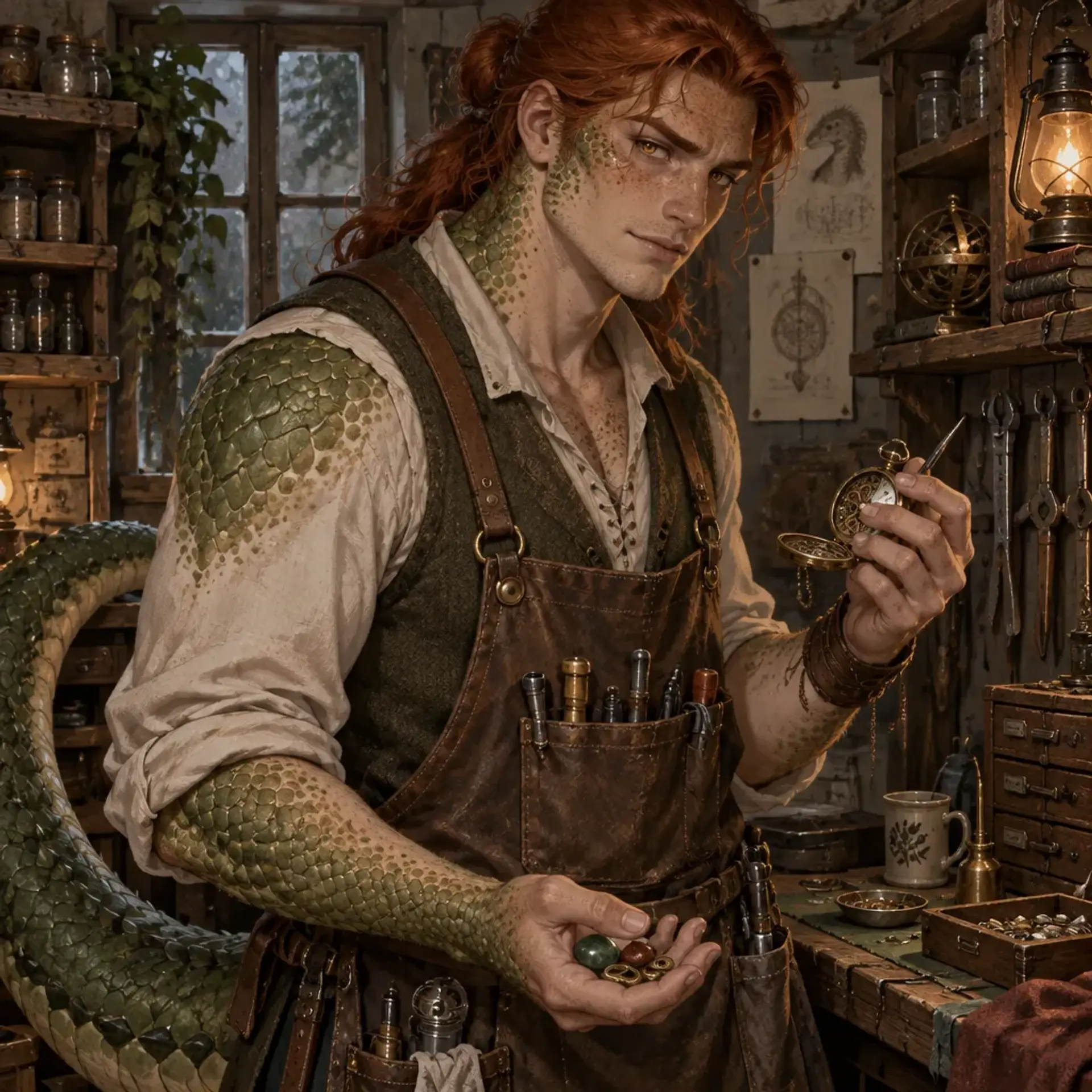
Eber is a young man who looks as if a halfling childhood has been stretched abruptly into something built for a different life. At 5 feet 10 inches, he stands a head above most of his stout halfling relatives, and he has learned to turn sideways in cramped doorways before he remembers that he no longer needs to. His fair skin is dusted with red freckles across the bridge of his nose and shoulders, but much of it is overlaid by olive-green scales. The scales lie in uneven, flexible patches, fine and close like damp leaves along his throat and ribs, larger and darker over his shoulders, forearms, and the length of his tail. His red hair is thick, unruly, and still unmistakably the same hair he had as a child, though he now ties it back with a strip of leather when working. His eyes, once dark brown, have become molten amber with narrow, predatory pupils. His pointed ears angle toward small noises even when he pretends not to listen. Eber's jaw moves with a restricted, careful rhythm. His green-dragon teeth are strong but poorly suited to chewing, so he cuts food into small pieces and swallows it with a pebble or metal fragment that he can feel settle painfully in his second stomach. He has a long, muscular tail that makes a soft scraping sound against chair legs and tool chests. He moves with cautious precision through the workshop, but in open spaces he takes up room without meaning to: tail behind him, elbows wide, gaze measuring exits. The impression he leaves is of a craftsman trying not to look like a hunting animal, and of a young man still waiting for his family to tell him he belongs.
Clothing
He wears practical craftsman's clothes with strong Germanic influences: a laced linen shirt, wool waistcoat, suspenders, sturdy trousers, and a leather apron with deep pockets. He has lengthened and patched much of it himself to accommodate his tail and shoulders. His boots are broad and soft-soled, and his sleeves are often rolled up to keep them clear of oil and filings.
Body language
Eber angles his shoulders away from people in narrow spaces and keeps his tail curled close to his legs, though it betrays his mood by tapping or dragging. He examines objects while listening and tends to face a speaker only after deciding they are being sincere. When anxious, he holds his jaw still and presses the tip of his tongue against one pointed tooth. His movements around tools are exact; around family, they are careful in a way that can look like distance.
- Height
- 5 feet 10 inches
- Build
- Tall and broad-shouldered for a former halfling, with a lean, flexible torso and a strong tail. His strength is practical rather than showy, built by carrying supplies and working at the family shop.
- Eyes
- Molten amber with narrow, draconic pupils; dark brown before adolescence.
- Hair
- Red, thick and usually tied back with a leather strip.
- Skin
- Fair skin with red freckles, overlaid by olive-green scales that deepen to dark green across his shoulders and forearms.
- Age
- 19
- Gender
- Male
- Size
- Medium
Distinguishing features
Personality
18 traits and drivesEber wants closeness but often behaves as though he has already decided people will misunderstand him. At home, he is protective, observant, and more sentimental than he admits; in public, he tends to become self-contained and hard to approach. He can spend an hour repairing a tiny hinge for someone he loves, then answer a sincere question with a defensive shrug because the question feels too much like pity. He dislikes being fussed over, yet notices immediately when his mother has quietly changed a meal to make it easier for him. He resents the difference between his body and his parents' bodies, but is fiercely proud of the family craft that shaped his hands and mind. His cleverness is patient when applied to mechanisms and less patient when applied to people. A watch can be opened, examined, and put back together; a family's fear does not offer a clean set of screws. When calm, Eber is dryly funny, thoughtful, and generous with advice. When embarrassed, he retreats into practical details. When angry, he becomes exact and blunt, naming the hurt rather than raising his voice. He is not cruel, but can make a quiet remark land harder than he intended. Rodrick's teasing about his eating is a reliable way to provoke him, especially when other people are present. Eber knows that Rodrick often thinks he is merely being honest, but that knowledge does not make the words harmless. Around Ignatz, he is more willing to admit fear. Their shared nights in the kitchen formed a bond without requiring either brother to explain what was happening. Eber can joke with him about cramped beds and strange appetites, but watches for signs that Ignatz's hunting impulse is returning. Around Yonda, he softens, even when her advice to be more social irritates him. He trusts her kindness and dislikes the way it sometimes turns into encouragement to behave as if nothing is difficult. With Wilma, he accepts practical care until it begins to feel like surveillance. With Trogi, he is most comfortable working in silence, where affection can be expressed through a well-made tool or a chair reinforced without comment. Eber is proud of what his body can do: carry heavy loads, move through wet woodland, and notice small sounds. He dislikes that these abilities arrived alongside pain, unfamiliar impulses, and the sense that he has become too large for the shape of his old life. He does not want to become a dragon, nor does he want to deny his Marshwake heritage. He wants the freedom to decide what it means. He saves shiny objects, partly from a new draconic fascination and partly because they are beautiful in a simple, undeniable way. He knows this habit looks like a dragon's hoard, and sometimes leans into the joke. Other times he hides the collection because he fears that people will see a symptom where he sees comfort. His solitude is not a lack of affection. Eber loves the crowded kitchen, family arguments, and the familiar sounds of the workshop, but he can only bear them for so long before he needs quiet. In a new group, he studies people before joining in. He notices who gives orders, who gets interrupted, who avoids looking at whom, and who seems to be hungry or tired. This makes him perceptive, but it also makes him suspicious. He is slow to trust people who offer grand reassurances or praise his resilience. He responds better to someone who admits they do not know what his life is like and asks what would help. When he feels safe, he can be unexpectedly playful. He will take apart a useless object just to see how it was made, leave a small polished washer as a gift, or make a harmless magical effect that imitates a sound from the workshop. He enjoys being clever but dislikes being called a prodigy. He is still nineteen, still the baby of the family in the eyes of his parents, and still trying to work out whether independence means leaving or simply being allowed to choose. In a crisis, his attention narrows and his feelings become manageable because there is something clear to do. Once danger passes, the feelings return. His contradictions are not a pose: he wants his family's protection and resents needing it; he misses halfling meals he can no longer eat; he wants to be seen, but not stared at; he wants to leave, but keeps finding reasons to stay.
- Alignment
- Neutral Good
Quirks
Habits
Traits · 4
Flaws · 5
Fears · 5
Wants and needs · 4
Combat
AC 16 · HP 17 · 30 ft.Eber avoids a stand-up fight. He uses cover, distance, and prepared tools, fires his crossbow from behind sturdier allies, and uses spells such as Faerie Fire or Grease to disrupt enemies rather than pursue them. If threatened at close range, he uses his hammer to make space and retreats. He saves Marshwake Menace for an attacker who corners him or threatens his family. He does not have a breath weapon or dragon-scale immunity.
Eber Waldner
Spells
Actions
Reactions
Services they sell
Rewards they can give
Equipment
- Padded-head workshop hammer (simple melee weapon)A sturdy workshop hammer with a wrapped grip, used as a tool first and a weapon only when necessary.
- Light crossbow (simple ranged weapon)A compact crossbow with a reinforced stock and a simple sight Eber adjusted himself.
- Tail-adjusted scale mail (armor)A patched suit of scale mail adapted with flexible gaps around his tail and shoulders. The scales are ordinary armor, not his natural scales.
- Artisan's tools (tools)A small kit of files, punches, pliers, wire, and tiny screwdrivers, with extra pieces wrapped in cloth to keep them from rattling.
- Gizzard stones (personal medical necessity)A belt pouch of smooth pebbles and carefully rounded metal scraps used to help grind swallowed food. They are not ammunition or treasure to him.
- Repaired pocket watch (personal possession)A pocket watch with a cracked enamel cover, repaired repeatedly and kept because it was his first ambitious repair.
- Shiny collection (personal possession)A fistful of bright sea glass, polished washers, and odd metal fragments that catch the light.
Possessions
Background
Eber Waldner was born the eighth and youngest child of Trogi and Wilma Waldner, into a house where there was almost always someone talking, someone repairing something, and someone being told to mind the chickens. The Waldners are of stout halfling descent and have made their lives through practical skill, stubborn affection, and a family workshop that never quite closes. Trogi, black-haired and now greying, is the family patriarch in the quiet sense: a patient hand at a tool, a calm voice at a crowded table, and a man who says he means to retire while still finding reasons to be in the shop before dawn. Wilma, with whitening-blond hair and hazel eyes, is the matriarch. She is warm, clever, and most at ease among her garden beds and chickens. She can butcher a bird or fish without hesitation, though she would rather Trogi do it, and the sight of a fight can make her faint with worry. As the youngest, Eber was passed between siblings, cousins, and parents with the comfortable certainty that there would always be a lap, a spare bed, or a place at the table. His eldest brother Windle, a low-blood Marshwake with hazel eyes and thinning brown hair, was already becoming a steady second adult in the workshop. Windle has a family of his own now: his son Otto, with brown hair and hazel eyes, and his cheerful baby daughter Anika. He works toward inheriting the workshop and carries a fear he rarely names: that Otto or Anika might someday change as Eber did. Karl, the next oldest, loves tools and gears and works alongside the family. His marriage to Leanora, a rough sailor descended from the dragon hunter Wilks and the halfling heroine Nailia, is rocky and often interrupted by her absences at sea. Karl and Leanora have a son, Hansel, and Leanora also has a child named Ragni, whose pale purplish skin, white hair, and milky blue eyes have made the family's complicated ties more visible than anyone would like. Yonda, Eber's only sister, is a beautiful, kind social butterfly with a wide circle of friends and five children. She has always treated Eber gently, but she cannot resist urging him to join in more often. Her sons Hans, blond with vivid green eyes, and Birke, whose hazel eyes turn yellow in certain light, have begun to show signs that trouble the family. Her daughters Willow, Trude, and Liesel have their own distinct temperaments and appearances, and Yonda watches them all with the fierce attentiveness of a mother who knows that family history does not always announce what it plans to do. Alder, green-eyed and black-haired, is a low-blood who serves part time as a town guard, though merriment frequently steals his attention. His son, Black Alder, is a high-blood cousin with amber serpent eyes and green scales on pale skin. He visits often and talks of adventures, making him one of the few people who can describe Eber's body without treating it as a family emergency. Kasper, brown-haired and brown-eyed, works as a clerk and watch repairer in the shop, then tends the chickens and garden. He and his wife are content with two daughters, Wonda and Ilse, who trail one another through the garden. The family had already learned that Marshwake blood could emerge differently in each generation. Their people were castaways who survived a dragon-haunted wilderness by accepting the blood of a wounded green dragon. The descendants remain halflings in heritage and custom, but high-blood Marshwake may grow taller, develop scales, tails, claws, altered senses, and changes that are painful rather than wondrous. The archipelago itself is beautiful and unsettled: wet forests, volcanic ash, hot springs, fishing grounds, and wilderness where the old dragon's inheritance still seems to press against the living world. Eber knew all this as a story told around the table. He did not expect his own body to become its newest evidence. He had red hair from childhood, and the older relatives sometimes wondered aloud whether it meant he might be high-blood. For years his eyes remained dark brown and he grew up small enough to sit among his siblings without feeling like a guest in their house. Then, in adolescence, his eyes changed first. Their brown darkened, clouded, and slowly cleared into a sharp molten amber. His appetite became strange. His jaw and teeth changed, and he discovered he could no longer chew. Food that had always meant comfort became a problem of cutting, swallowing, pain, and endurance. He learned that small stones and bits of metal helped grind what he ate in a second stomach. The process kept him fed, but each meal reminded him that his body had made a new rule without asking him. The first weeks were the hardest. Eber's parents tried to protect him with tenderness and practical improvisation: softened food, smaller portions, careful notes about what he could swallow, and trips to healers. Their care was sincere, but it could feel like a wall. Every question about his pain seemed to turn him into a patient rather than a son. He began to resent the way his mother watched his plate and the way his father looked at every new scale as if it might be a broken tool he could mend. He resented, too, the simple fact that his parents could sit down to an ordinary meal together while he had to prepare his food like a repair job. Rodrick, the seventh child, changed before Eber and became a high-blood with auburn hair, yellow eyes, reddish-tipped green scales, and a bigger, more predatory build. He is blunt, arrogant, and often convinced that honesty excuses whatever he says. His teasing about Eber's eating has caused more than one ugly argument. Rodrick stops when Eber's anger becomes unmistakable, but he does not always understand why the words hurt after the laughter ends. Rodrick has sorcery from his green-dragon heritage and is irritatingly pleased about it. Ignatz, twenty and Eber's closest brother, is also high-blood. His ashy blond hair, draconic green eyes, grey-green scales, and flexible tail developed alongside a frightening instinct to hunt. When that instinct first seized him, he killed a chicken with his bare hands. The shame of it drove him back toward the workshop, where he could keep his hands busy and himself under control. He had supported Eber through his own transformation, even when neither of them knew what help was supposed to look like. Not long after Eber changed, the high-blood brothers began sleeping together in the kitchen. The family home had been designed for stout halflings, not three growing young men with tails, scales, and restless new bodies. The beds were too short, the bedrooms too narrow, and the old blankets failed to cover them. The kitchen floor was the only place with enough space to lie down without knocking something over. Trogi and Wilma made room among the benches and worktables, and the brothers slept close enough to hear one another breathe. Ignatz woke at every unfamiliar sound. Rodrick grumbled about the discomfort and pretended not to care. Eber hated the arrangement at first because it made their difference impossible to ignore, then came to value the wordless company. Some nights he listened to his brothers shifting in sleep and wondered if they felt as stranded in their new bodies as he did. The practical troubles mounted. High-blood bodies needed more food, larger clothing, longer bedding, and stronger furniture. The family did not have enough of everything. Eber's parents worried about his health first, then about whether the family could make a house and livelihood that fitted the children they actually had. They kept trying to stretch old clothes, rework chairs, and divide meals without making the sacrifice obvious. Eber noticed anyway. Their love could not make him small again, and he hated that he could not return it by being easy to care for. The workshop became his refuge. He had always liked the logic of a mechanism: a gear's teeth fit or they did not; a hinge either bore weight or failed. When speech tangled up family feelings, he could communicate through a repaired watch, a sharpened tool, or a better latch on the kitchen door. Trogi let him take on increasingly delicate work. Kasper showed him the patience of watch repair, and Karl shared the pleasure of opening a device simply to understand it. Eber's cleverness grew alongside his isolation. He learned to notice minute sounds, shifts in posture, and the way people hid what they wanted. He began collecting shiny scraps, polished stones, small brass fittings, and bits of sea glass. At first he told himself they were useful. Later he admitted, privately, that he liked seeing light caught and held in something he could keep. He is nineteen now, an apprentice craftsman and a level-two artificer by training, though no one in the family calls him that as if it were a title. He repairs tools, experiments with small magical effects, and makes devices that solve problems the old workshop was never built to face. He wants to improve the family's work and build sleeping quarters that fit the high-blood siblings without turning the kitchen into a dormitory. He also wants something less comfortable to admit: proof that he can leave the warmth of his family and still be wanted somewhere. The two desires pull in opposite directions. When he imagines leaving, he pictures the island's wet forests and a life where no one watches him eat. When he imagines staying, he sees the kitchen floor, Ignatz's uneasy sleep, and his mother's hands arranging food for him. Eber's immediate problem is his declining comfort with swallowing. The stones help, but some leave his stomach sore, and he has not told his parents how bad the pain has become. He has been trying to design a small, smooth, hollow metal capsule to carry a safe grinding stone without scraping his throat. He has also been quietly recording which materials seem to settle better and what symptoms follow. The local healers are interested in him, sometimes in a way that feels compassionate and sometimes in a way that feels like they would rather study a rare case than listen to a young man. Eber wants advice without becoming a spectacle. Meanwhile, the younger generation's changing eyes and other signs have made Windle and Yonda watch their children more closely. Eber sees the fear in their faces and fears the same future for them, though he knows he cannot promise that blood will spare anyone. The island is not merely a home but a question that never gets answered. The Marshwake were made by survival, but their descendants are still being remade. Eber is proud of the people who endured the wilderness and grateful for the family that raised him, yet he does not want every painful change explained as heritage or destiny. His story is not a neat transformation into a dragon-shaped hero. It is a young craftsman trying to make a life with a body that demands accommodation, a family that loves him fiercely, and a private hope that affection can survive distance, anger, and change.
Role in the story
A young local artisan whose physical transformation makes the broader changes among the Marshwake personal and immediate. Eber can offer practical help, a family-centered point of view, and a reason for adventurers to investigate unsafe healing practices, dragon-tainted wilderness, or the needs of a community whose homes and customs no longer fit its children.
“Wilma, with whitening-blond hair and hazel eyes, is the matriarch.”
- Faction
- The Waldner family and the Marshwake community. He has no formal guild or political allegiance.
Known connections
Media
0 imagesNo images yet.
Turn Eber Waldner into a sheet
A high-res, share-ready sheet you can post or print.