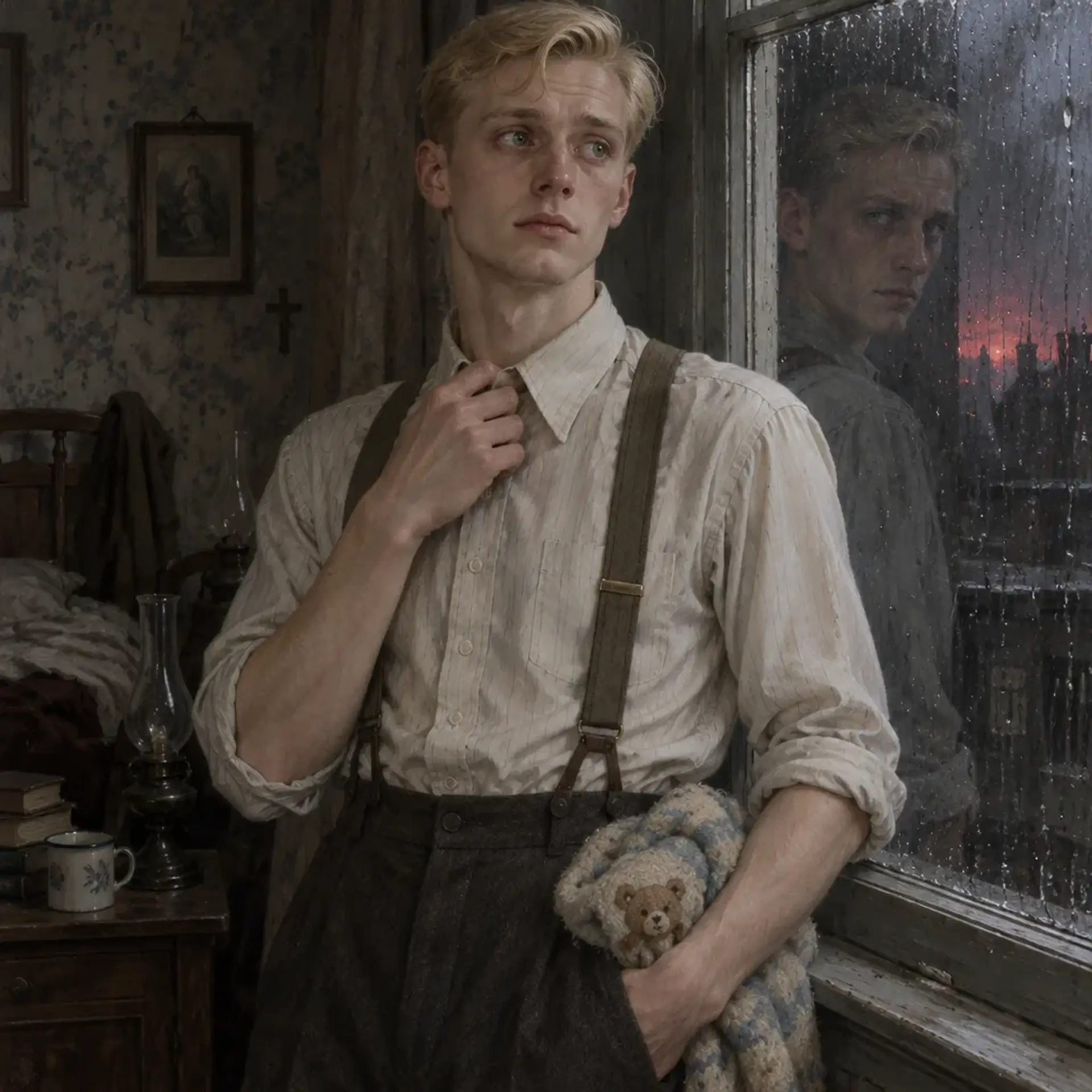
Kent
Kent
At the table
Voice
The sound seems to come from a larger chest than Mary’s, though the borrowed body makes it hard to place. It has a slightly breath-held quality, as if he is always listening for footsteps in the hall. The formal edges come from Kent’s desire to seem respectable; the clipped bursts come from Mary’s exhaustion and the household’s constant interruptions. Since the heart disappeared, the voice sometimes seems to arrive from a nearby pane of glass even when the room is otherwise still.
Kent’s voice is naturally deeper than Mary’s, with a slightly formal, careful delivery shaped by his wish to sound respectable. It carries a faint dryness, as if he is choosing words from a book of manners he only partly trusts. When startled, the polish breaks and his sentences come out quick and defensive. Mary’s tired speech and Kent’s more deliberate phrasing sometimes mingle, leaving a pause or an odd turn of expression that neither can explain.
Speech patterns
How to play them
Treat Kent as a young person with preferences and fears, not as a puzzle to be solved in front of him. Be honest about what is known and unknown. Ask before arranging an outing or touching reflective surfaces he is watching. If Mary is present in the shared body, speak to both of them and do not assume one has consented for the other.
Goal
Secure clothes, privacy, and a life in which others acknowledge him as a person, while discovering who the sea-woman is and why strangers are looking for him.
Motivation
To be recognised as a person, protect the younger children in his own imperfect way, and learn whether the missing heart or the sea-woman can explain his growing independence.
Appearance
Kent is the appearance Mary’s reflection has increasingly insisted upon: a young man of about eighteen, taller than Mary and broad enough through the shoulders that her dresses pull at their seams. His short, bright blond hair looks combed even when it is not, and his malachite-green eyes have an unnerving habit of checking the door, the window, and the people behind him before meeting anyone’s gaze. His mouth is handsome at rest, but the jaw sets hard when he feels patronised; he eats carefully, as though table manners might establish his place in a room. He moves with a long, alert stride that becomes awkward in Mary’s clothes. His unexpected detail is his interest in television: he sits close to the set, studying the flickering faces with the intent attention of a child examining a new machine. He leaves the impression of someone dressed for a better house than the one he is in, trying not to let anyone notice.
Clothing
Usually wears whatever Mary can find that fits well enough to pass unnoticed. Kent prefers neat, good-quality clothes and is increasingly frustrated by ill-fitting skirts, blouses, and worn hand-me-downs. He wants a proper shirt, jacket, and shoes of his own, but obtaining them without raising questions is difficult.
Body language
Kent holds his back straight and shoulders carefully, as if good posture might make him belong. He turns his head toward reflective surfaces before he turns toward a voice. When anxious, he rubs his thumb over the side of his jaw and stands between a doorway and whoever seems most vulnerable. In Mary’s clothes he moves with self-conscious restraint, aware that his stride and shoulders can pull seams or draw attention.
- Height
- Taller than Mary; his apparent height varies with which body is present.
- Build
- Lithe but stronger and taller than Mary, with a young man’s long stride and shoulders that make her clothes fit poorly.
- Eyes
- Malachite green in Kent’s reflection; Mary’s own eyes are blue-grey.
- Hair
- Short, bright blond
- Skin
- Fair, with a healthy-looking colour in Kent’s reflection; Mary is pale from exhaustion and inadequate care.
- Age
- 18
- Gender
- Male
- Size
- Medium
Distinguishing features
Personality
21 traits and drivesKent wants to be regarded as a respectable young man, yet he is shy enough to study a room from its reflections before entering its conversation. He can be considerate toward children and fascinated by unfamiliar things, but he resents being treated as an accessory to Mary’s life. He is a homebody who nevertheless takes over their outings when he can, choosing the pub, the television, or a better route through town because he wants some part of the day to belong to him. He wants to dress well and be seen as masculine, yet the body and clothes available to him may not let him present himself as he wishes. He dislikes being pushed into feminine roles, while sometimes relying on Mary’s knowledge and care to get through ordinary situations. Around Simon, Kent tries for formality and restraint, hoping that composure will earn him a hearing. When Simon reacts with anger or alarm, Kent’s manners give way to wounded indignation. Around Malinda, he is wary of her drunken unpredictability and can become sharp when she corners him. Around the younger children, he is quieter and more patient than he expects to be; he recognises their fear but can still fail to understand why they miss Mary. Henry makes him defensive. Trudy’s refusal to flatter or indulge him irritates him, but he respects that she tells him plainly when he is being selfish. Kent’s moods are shaped by the uncertainty of his own identity. In reflective surfaces he may appear composed while Mary feels panicked, or seem to react with a feeling neither can claim. He is curious about television and machines, yet the closeness and speed of a car can overwhelm him. He is particular about tea, wants clothes that fit, and likes the comfort of home, but resents being unable to choose the terms of his own existence. He wants women to find him attractive; Mary does not share that desire, and he is only beginning to understand the seriousness of that divide. Since the heart vanished, he has become more outspoken, more possessive of his time, and more capable of judging the family for how they have treated Mary. His emerging independence is not pure cruelty or simple liberation. It is the awkward, frightened insistence of someone who has only recently begun to believe his own wishes count.
- Alignment
- Not a Secret Histories rules term here. Protective in purpose, increasingly self-directed in practice.
Quirks
Habits
Traits · 5
Flaws · 5
Fears · 6
Wants and needs · 5
Combat
HP 3 · Ordinary human movement; no fixed game statistic supplied.Avoids fights and seeks an exit. If cornered, he uses his greater reach to shove past someone or protect a sibling, then runs. The actions listed are custom scene guidance, not canonical Secret Histories combat rules. This NPC has no D&D-style armor class, hit-point rules, or imported combat framework.
Kent
Actions
Reactions
Services they sell
Rewards they can give
Equipment
- The Heart of England (missing occult object)A small crudely carved anatomical heart of chalk-like stone, once crusted with barnacles and sea grass. It has been lost; it is not currently in Kent’s possession.
- Tea things (household)An ordinary teacup and whatever tea the family can spare. Kent has become particular about its preparation.
- Mary’s clothes (clothing)A borrowed, ill-fitting outfit that may strain or tear when Kent’s body appears.
Possessions
Background
Kent’s story begins with a small, crudely carved object shaped like an anatomical heart. It looked more like a piece of Dover chalk than a relic: barnacles clung to its hollows, sea grass snagged on its rough surface, and salt had gathered in the cuts. Bartholomew Golden, an amateur alchemist, had once left it as payment for entry to Hush House, wrapped in a newspaper and accompanied by a grand claim that it was the Heart of England, able to bring servants from the shadow of man and the hearts of chalk cliffs and borderlands. Golden was never permitted near Brancrug again. The heart was thrown into the sea. It returned to shore wet with black ooze and brine, its stone faintly red-pink beneath the crust, as if something under the chalk had remembered how to bleed. A young man named Abraham Groff found it and carried it home in his pocket. He had come from London and was living in Wiltshire. The object beat beneath his coat after the train journey. He showed it to neighbours, but in company it seemed to die: no pulse, no warmth, no peculiar colour. When he took it to the Hampshire shore and put it in water, the red-pink glow returned. Abraham came to believe that it disliked visitors as much as he did. At first, he kept it out of fascination, then out of protectiveness. His house acquired unexplained footsteps, voices behind closed doors, and a persistent sense that someone was moving through rooms just beyond sight. Eventually, frightened and exhausted, he sold it to William Windon, a local seventeen-year-old who had once seen the heart before it went still. William hid it in a log. When he struck it with a hammer, its beat stopped. Much later, the heart reached Mary Bell, the eldest of eight children in a strained, outwardly middle-class family in Rochester, Kent. Her mother, Malinda Bell, found it in the log and gave it to Mary for her eighteenth birthday. The present was awkward and ugly, but Mary was grateful that anyone had thought of her. She was already doing more than her share of the work at home. Her father, Simon, was often away taking work as far from the family as he could; when he did come home, his presence could turn a tense household into a dangerous one. Malinda was neglectful and drank too much. Mary’s siblings needed her: Henry, fourteen, had begun turning resentful and crafty; Matilda, twelve, was gentle and eager to help; Olympia, ten, and Chrissy, nine, had their own close bond; Abigail, four, and the youngest children needed watching. Five-year-old Jonas had been brought home by Simon, and the family carried the raw history of affairs and uncertain paternity in every argument. Two-year-old Oswald followed Mary with a blanket and a trust she could not always afford time to honour. Mary worked, kept house, tried to study, and carried the heart without deciding it mattered. Then it began to beat in time with her own. Her reflection changed first. In mirrors and darkened windows, she saw a handsome blond young man with green eyes. The image sometimes looked away from her, sometimes seemed to react before she did. Mary was too tired to devote herself to being frightened. She had chores, siblings, and a part-time job. The strangeness was simply one more thing she could not afford to solve. The first night Mary became Kent began after a bad dream. She woke with a different height, a different face, and a body that did not feel like hers. Her first response was panic: she touched her jaw, checked her hands, and tried to understand how she could be in a stranger’s shape without having left her own bed. By dawn, she had learned that she could get out of the house this way. The change felt temporary, and escape felt more urgent than explanation. She slipped outside and began exploring: the shore, trees she had never had time to climb, abandoned buildings, and the streets of Rochester. The first adventure was not grand. It was a stolen night of air and movement, ending with Mary trying to get home before anyone noticed she was gone. The thrill was sharpened by guilt, because she knew she had left the children behind and had no certain way to explain what had happened. On one early return, Simon came home unexpectedly while Mary was still in Kent’s body. The trip back became a careful exercise in avoiding neighbours and finding a way into the house without being seen. Simon’s arrival forced Mary to hide, wait, and make choices that could have exposed her. She discovered that Kent’s greater height and unfamiliar proportions did not make her more capable of dealing with a father who had the keys and the authority. She got home, but the memory remained: the borrowed body could take her out of the house, yet it could also strand her in the wrong life at the worst moment. Malinda caught her on another night, drunk and suspicious, as Mary-as-Kent was trying to leave. Her questions came too fast and her attention wandered; she did not recognise her daughter, but she did recognise an unfamiliar young man attempting to slip away. Mary had to improvise a story while Malinda swayed in the doorway and searched his face for an explanation. The encounter was frightening less because Malinda was perceptive than because she was unpredictable. Kent’s growing embarrassment and Mary’s instinct to protect her mother from the truth pulled in opposite directions. Mary got away, but afterwards she could no longer pretend that the changes were a private convenience with no consequences for the family. The pub adventure began as Mary’s experiment in seeing the town from another angle. In Kent’s appearance, she entered a pub and met Henry, who was out of place there and watching her with a calculating interest. Mary tried to keep the encounter brief. Kent’s preferences, however, were beginning to intrude. He wanted to be treated as a young man, not as Mary playing dress-up; he noticed the room’s manners, the quality of the clothes, and the difference between being merely tolerated and being welcomed. The pub’s noise made it easier for him to speak through Mary’s thoughts, though not yet in a voice others could hear. Henry saw enough to grow suspicious. Mary left with a fresh fear that her brother might be the first person to identify a pattern, and a sharper awareness that Kent was beginning to have opinions about where they went. Trudy, Mary’s short, wiry friend with dirty-blond hair and a self-proclaimed rebel’s wardrobe, was the first person outside the family to understand something was wrong. Trudy had long noticed Mary’s exhaustion and helped with the younger children. One day she saw Kent’s reflection appear where Mary stood, and then saw the reflected face react independently. Mary tried to dismiss it, but Trudy refused to accept an easy lie. She insisted that Mary deserved a future beyond unpaid family labour and kept urging her to consider college. Once she knew, she became an ally, though not an uncritical one: she asked Mary to tell her when the changes happened, and she challenged Kent when his plans put Mary at risk. The first daylight change made the danger harder to deny. Mary was occupied with ordinary tasks when the shift came without the cover of night. She had to manage clothing that fit badly, keep from being recognised, and invent an explanation for anyone who saw her. A nearby pane of glass showed Kent even when Mary’s face should have been there. Cars fascinated Kent, their engines and movement drawing his attention, until one came too close and made him recoil. New technology delighted him, but the physical world still frightened him when it approached without warning. The heart eventually disappeared. The exact moment and the person responsible are not known to Mary. After it was gone, Kent became more present rather than less: he could speak on his own, make expressions in reflective surfaces, and react to people without Mary intending it. His reflection appeared in windows and water. He grew particular about tea, insisting it be made to his preference, and about how he spent his time. He wanted better clothes. Bathing became a trial because water showed him so clearly. He liked television, but a car passing too close could make him tense. He became more openly frustrated when Mary was in control of the body and more insistent when he got an opportunity to direct their outings. He wanted experiences Mary did not want, including romantic attention from women, and his wishes became a source of conflict rather than a private embarrassment. Henry began watching carefully. Trudy now knew. Strangers appeared in town asking after a blond young man with green eyes. Their interest unsettled both Mary and Kent. At night a woman with straw-like hair and blue-black eyes came from the direction of the sea. She looked like someone drowned and returned without being properly alive. She called Kent her brother and said she would bring the others. She seems independent of the people searching for him, which makes her no less frightening. Four months of changes culminated on 30 May. By then, Mary had begun losing small details of herself: a remembered errand, the exact sound of a sibling’s laugh, the order of a childhood event. Kent’s ways of speaking and judging had crept into hers. On the morning of the thirtieth, he came downstairs in his own apparent body, dressed for the day and preparing breakfast for the children. He was not trying to deceive anyone. He believed the routine was familiar and that he was simply doing what needed doing. Simon came down to leave for work, looked at the young man in his kitchen, and realised that something was terribly wrong. Kent was confused by Simon’s reaction. He did not understand that he was no longer being recognised as Mary. Malinda and Simon were frightened for their daughter, not simply angry at an intruder. Their concern made the moment more painful: Simon asked where Mary was; Malinda tried to reconcile the face before her with the daughter she had raised. The children reacted according to their ages and histories. Matilda looked for Mary in Kent’s expressions. Oswald clung to his blanket and stayed close. Abigail and Jonas watched the adults. Henry studied Kent carefully, trying to decide whether this was a trick, a threat, or the answer to something he had already suspected. Olympia and Chrissy were wary. Mary was not wholly gone, but she could not easily prove that to them. Simon arranged for a physician and a psychologist to speak with Kent and the family. The physician asked about sleep, food, illness, memory, and the physical changes; he found no ordinary explanation for the way Mary’s identity and appearance had become entangled. The psychologist questioned Kent separately, then listened to Simon and Malinda describe Mary’s childhood and recent behaviour. Kent answered sincerely, with gaps that frightened him as much as they did the adults. Neither visitor offered a supernatural diagnosis. Their presence made the family’s private crisis official, and made Kent feel scrutinised rather than understood. Simon wanted a cure; Malinda wanted Mary back; the children wanted the familiar sister they remembered. Kent wanted them to stop speaking as if he were a stranger occupying their home. Now Kent is not simply a reflection Mary can ignore. He has preferences, memories, opinions about the family, and a growing ability to speak without being invited. Mary and Kent are increasingly muddled, and neither knows what remains of the person they were at the beginning. The Heart of England is gone, but its absence has not ended the haunting. It may have made it possible for the thing that answered it to become more alive.
Role in the story
A supernatural mystery and a domestic character drama in one: Kent is at once an ally, a source of danger, and a person whose existence complicates Mary’s right to her own life. He brings the missing heart, the sea-woman, the searchers, and the Bell family into the same unfolding crisis.
“A young man named Abraham Groff found it and carried it home in his pocket.”
- Faction
- No confirmed faction. Bartholomew Golden’s Hush House story and the strangers seeking a blond young man may connect to occult interests, but Kent does not know who they are.
Known connections
Media
0 imagesNo images yet.
Turn Kent into a sheet
A high-res, share-ready sheet you can post or print.