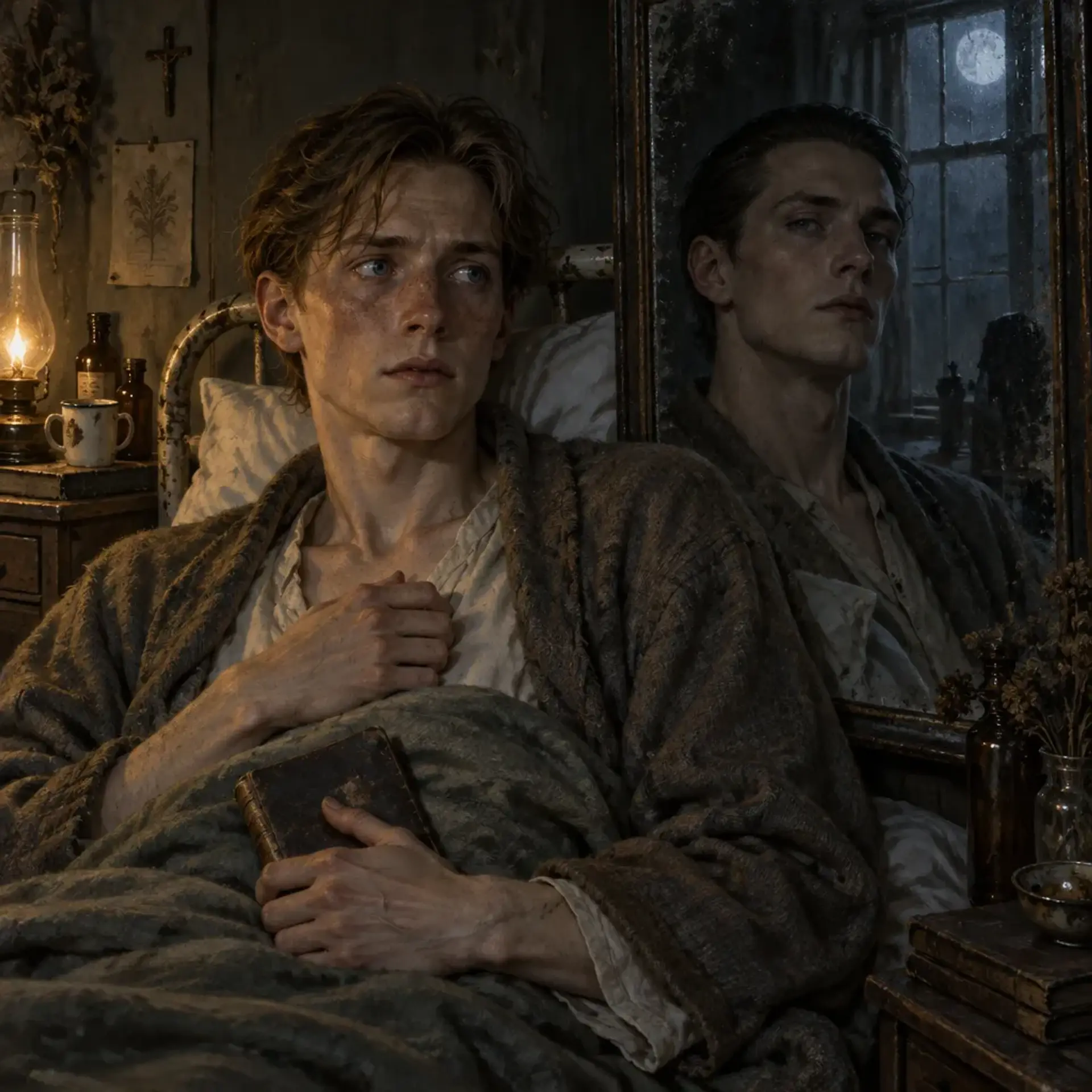
William Windon
William Windon
At the table
Voice
William's voice has the slightly dry, breath-conscious quality of someone recovering from illness, shaped by outdoor work and the habit of speaking plainly. It catches when he is tired, and he sometimes pauses to swallow before continuing. When the reflection uses his voice, the sound is more deliberate and assured, with a deeper placement and an older generation's accent. The distinction is not a magical second voice from elsewhere; it is William's own throat being used with a different intention.
William speaks in an ordinary local English manner, practical and hesitant when discussing his illness. He tends to qualify claims rather than sound certain. The reflection uses William's mouth but gives his words an older cadence and a deeper, more settled sound, with dry precision. It often chooses compact observations instead of long explanations.
Speech patterns
How to play them
Begin with William as a courteous, wary young man who wants to be believed but fears the consequences of disclosure. He is more forthcoming with patient, nonjudgmental investigators. Avoid treating the reflection as a separate combatant; show its presence through mismatched reflections, involuntary gestures, and occasional speech through William. The reflection is curious and sardonic but genuinely afraid of ghosts and fae. It may cooperate when its interests align with William's, but it does not promise that William's wishes come first.
Goal
Find Abraham Gorff and the missing heart, learn what binds the reflection to him, and survive without letting the stranger replace his identity.
Motivation
William wants an ordinary future: recovery, work among plants, time with Adaline, and a home where his family can speak without being watched by an unknown presence. The reflection seems motivated by curiosity, companionship, and a desire to experience the world through William's body. Its deeper motives remain uncertain.
Appearance
William Windon is a young Wiltshire man with a long, slightly hollow face, blue eyes, and dark-blond hair that never quite lies where he puts it. His brown-spotted skin is weathered unevenly by garden work: the backs of his hands are rough and sun-browned, while pale bands remain beneath his sleeves and watch strap. Soil settles into the creases around his nails despite his attempts to scrub it away. He is tallish and lean, with the careful, economical movements of someone accustomed to carrying plants without bruising them. Since his collapse, he moves with a guarded stiffness, as if each step might remind his chest what happened. He repeatedly checks the fastening of his collar and the position of his cuffs, a fussiness that is oddly formal for a gardener. His most unsettling feature is not visible on his face: in a mirror, window, or polished kettle, the person looking back has a longer, more austere face, short slicked-back black hair, blue eyes, and a bearing that seems to belong to another century. The reflection is handsome by an old-fashioned English standard, but its expressions do not always match William's. The impression William leaves is of a decent young man trying very hard to look well, while something behind his composure is waiting for an opening.
Clothing
Practical gardener's clothes when working: a worn jacket, sturdy trousers, boots, and shirts with soil caught at the cuffs. At home he tries to dress neatly, smoothing his collar and arranging his hair with more care than his circumstances warrant. Since the heart stopped, he often wears an extra layer even indoors.
Body language
William keeps his shoulders slightly drawn in since his collapse and moves carefully, conserving energy. He rubs his sternum when the heart is mentioned, though he tries to hide the gesture. He checks his grooming to regain a sense of control. When the reflection is active, his head may turn too sharply, his jaw set into a stranger's sternness, or his fingers move as if he is about to touch something beyond his reach. The two presences are easiest to distinguish in the moment after a remark: William looks embarrassed or alarmed, while the reflection's borrowed expression may remain composed.
- Height
- Approximately 5 feet 10 inches
- Build
- Lean and lightly muscled from gardening, currently weakened by bed rest and the unexplained cardiac episode.
- Eyes
- Blue
- Hair
- Dark blond
- Skin
- Fair, brown-spotted and weathered by outdoor work, with paler areas beneath sleeves and straps.
- Age
- Young adult, approximately 18
- Gender
- Male
- Size
- Average adult human
Distinguishing features
Personality
21 traits and drivesWilliam is considerate without being naturally meek. He wants people to feel at ease, but he is observant enough to notice who is taking advantage of that wish. In ordinary company he softens his opinions, offers practical help, and makes small jokes at his own expense. When someone insults his family or treats a vulnerable person cruelly, his politeness can harden into an unexpectedly direct answer. He is not proud of this temper, especially because the reflection can use it as cover for remarks William would never choose. He is earnest about plants and impatient with grand claims. A seedling's needs make sense to him; a supposedly magical heart does not. He wants to understand things through patient attention, but his experience has made him suspicious of anyone who says an object is harmless because it looks inert. He is tender toward people who are embarrassed or frightened, partly because he knows the feeling of being watched while trying to pretend everything is normal. Yet he can become evasive when he fears that honesty will make his family treat him as ill, foolish, or dangerous. William's self-respect is built around being useful. He worked with soil and plants, expected to learn a trade, and took pride in being able to carry a task through without fuss. Bed rest has made him restless and ashamed. He dislikes being fussed over, even though he is frightened by how close he came to dying. He tries to make his recovery sound routine, then checks his pulse when nobody is looking. When frightened, he becomes unusually precise about small practical details: the lamp wick, the room temperature, whether a door is latched. This is not calm so much as an attempt to make one corner of the world obey him. The reflection complicates every judgment William makes about himself. It is not a simple voice of evil, nor is it an obedient second mind. It can be amused, curious, possessive, frightened, and sharp. William dislikes its cruelty, yet sometimes recognizes a truth in its observations. The reflection's wit can puncture hypocrisy, as it did when Hector spoke dismissively about country people. It can also target a child who made an innocent mistake. William feels responsible for the consequences even when he did not choose the words. He is slowly learning that blaming the stranger does not erase the harm done through his mouth. Around his family, William shifts between affection and concealment. He loves Clare's care but hates seeing her fear him. He can accept her practical help, but if she asks whether he feels another beat in his chest, he may say no before checking. Hector's interest in history ought to make him an ally, and William hopes it will. Instead, Hector's confident explanations can make William feel that the facts of his own experience are being argued away. William does not want to humiliate his father or prove him wrong; he wants Hector to understand that this is not a tale from an old book. With Elizabeth he is more openly exasperated. Her chatter about manners, attractive things, and the boy she likes is familiar enough to feel safe. That familiarity is precisely why the reflection's attention to her unsettles him. The reflection reacts to Elizabeth with a focus William cannot decode. It calls her “interesting,” and the word can sound like a dry joke, a scientific note, or a recognition of something it has never encountered. It listens when she talks about her romantic interests and ordinary preferences. William has caught the reflection's attention sharpening when Elizabeth is near a mirror or speaking candidly. The reflection does not explain itself, and William is embarrassed to ask. He can snap at Elizabeth for prying into his illness, then feel guilty when she withdraws. Her one sighting of the stranger in the dim hall has made their sibling teasing more cautious. William wants her to treat him normally, but fears that normality will leave her exposed. With Adaline, William is more vulnerable than he wants to be. He likes her softness and her directness, and he is frightened that illness has made him dull company. He tries to be thoughtful rather than possessive, but jealousy makes him awkward. The reflection has turned this affection into a contest William never agreed to enter. It notices Adaline's auburn hair and brown eyes, comments on her manner, and may borrow William's posture to appear more self-assured. William can resent the reflection's confidence while also feeling relieved that it can carry a conversation when he is tired. That relief disgusts him. He is protective of Adaline but does not want to decide what she may know or whom she may like. His central fear is not merely that she will prefer the stranger. It is that he will begin to perform the stranger's confidence so convincingly that even he cannot tell which of them she is responding to. With his mates, William wants to keep the old rhythms alive. Tommy DeHare, John Mollask, and Ryan O'Leary can still make him laugh, and their visit mattered because it briefly made the room feel like a place where a young man might recover rather than a sickroom containing an impossible secret. Their reaction to the reflection's physical response broke that illusion. William is now wary of inviting them back, but he misses them. He will joke about the incident if pressed, then become defensive if they treat it as a trick or a symptom they can explain away. William's moral instincts are decent but not immaculate. He can be vain about his appearance, especially now that he feels his own face is being displaced by a more composed one. He resents Hector's authority, envies the reflection's knowledge, and has sometimes enjoyed being the center of attention because of the strange object. These feelings make him ashamed, and shame tends to make him conceal more. He is not naturally brave in the theatrical sense. He is frightened, tired, and often tempted to leave the matter to someone else. What makes him persistent is that the heart has already reached into his family and his relationship. He cannot make the problem private again. The reflection's personality pulls in a different direction. It is observant and often entertaining, but its humor is not reliably kind. It likes books and films, and its body may lean toward a story before William has chosen to be interested. It is fascinated by places it should not enter and enjoys sneaking about. It speaks of its father and siblings as if they belong to a set of sensations: pressure, salt, weather, heat, or the turning of a forge. It has an old-fashioned accent and a stranger's idea of propriety. Sometimes it restrains William from saying something rude, then makes a more cutting remark itself. It seems to value good manners as a form of control rather than kindness. The reflection is not fearless. Ghosts and fae frighten it in a way that changes its usual composure. It may become tense, insist that William leave a place, or stop making jokes. It avoids the paranormal when it can, despite being an uncanny presence itself. This contradiction hints at a history it will not state plainly. Its fear can make it useful, but it can also make it reckless if it believes it is cornered. It wants conversation and experience, yet the restrictions of William's body enrage it. It may speak as if William's life is shared property, then show no concern when its behavior endangers him. William is therefore neither a helpless innocent nor a secretly monstrous host. He is a young man trying to remain responsible while sharing himself with an entity whose desires he cannot read. His warmth, pride, curiosity, jealousy, and fear all matter. The most revealing question is not whether the reflection is good or evil, but whether William can make choices that remain his own when someone else can borrow his face.
Quirks
Habits
Traits · 6
Flaws · 5
Fears · 5
Wants and needs · 5
Combat
HP 9 · Move 8, standard human movement rate; currently limited by bed rest and weakness.William avoids violence and is physically compromised by bed rest. He tries to leave, call for help, or persuade an aggressor to stop. If cornered, he may shove or swing clumsily. The reflection's comments can distract or provoke, but it cannot reliably take control or fight independently.
William Windon
Actions
Reactions
Services they sell
Rewards they can give
Equipment
- Gardening tools (work equipment)A small hand trowel and gardening gloves, kept close even while he is recovering.
- Hand lamp (personal item)A small light he carried into the hall on the night he spoke to Elizabeth in the stranger's voice.
- The Heart of England (unexplained object)The heart-shaped stone is missing. It resembles chalky cliff rock, crusted with marine growth, and may show a red-pink interior when wet.
Possessions
Background
The first thing William Windon learned about the strange heart was that it could be made to look ordinary. It had arrived at the Hush House wrapped in newspaper, carried in by Bartholomew Golden, an amateur arcanist who called it the Heart of England. The name was grander than the object. At a glance it resembled a piece of Dover cliff chalk, carved into the crude shape of a human heart and crusted with barnacles and scraps of sea grass. It was damp, ugly, and faintly offensive. Golden had offered it as payment for entry. Afterward he was never permitted near Brancrug again. The heart was thrown into the sea. It returned to shore, washed up and weeping salt water and black ooze. Beneath its gray, cliff-like crust, a red-pink color showed through, as if blood or a hidden lamp were alive under the stone. A young man picked it up and put it in his pocket to take home. On the train, it beat against his coat. That young man was Abraham Gorff, a Londoner who had gone to Wiltshire. He studied the object, repulsed by it and drawn to it in equal measure. At first he showed it to neighbors. In company, it seemed to die: cold, inert, just a queer rock. When Abraham brought it to the Hampshire shore after weeks of silence and dropped it into water, the pink color returned. He decided it was special, and that it was his. He stopped letting people see it, not out of simple greed but because the heart seemed to dislike visitors as much as he did. Then the house began to make sounds. Voices came from empty rooms. Doors shifted. Footsteps crossed the hall and climbed stairs. Abraham gradually understood that the heart was beating and weeping salt water. The thing frightened him. He sold it to a seventeen-year-old lad from Wiltshire, William, one of the people who had seen it before it went lifeless in company. William was proud to own such an oddity. He was also young enough to mistake secrecy for safety. William had grown up in Wiltshire with his family around him: his father Hector, a historian who could turn supper into a lecture; his mother Clare; and his younger sister Elizabeth, who had a gift for appearing at his door just when he wanted privacy. William worked as a gardener on an estate and hoped to train as a botanist. He liked plants because they answered patiently to care. He liked the visible rules of roots, soil, pruning, and seasons. The heart offered no such rules. At first the stone was only a possession. Then William felt its beat in his own chest, steady and intrusive. After a spell of tasting the sea, he found that blood and soil seemed to share the same taste in his mouth. He decided the rock could be broken. He swung a hammer at it. The pain arrived in his chest, not in his hand. William fell, groaning and weeping, and heard a voice that did not sound like his own sputter through his mouth. He saw the heart's surface twitch, as if something muscular had moved beneath the rock. Then it stopped. So did he. Clare found him and worked over him. William woke to her hands on his face and the news that his heart had stopped. The event left him weak and fearful, and the family has kept him on bed rest while they wait for an explanation that neither a doctor nor Hector's books can provide. William remembers the pain, the impossible motion in the stone, and the humiliating fact that he could not command his own body to live. Days later he hid the heart in a hollow log. When he returned, it looked cold and pristine, untouched by the hammer. Its stillness should have been a relief. Instead it felt like a refusal. It had endured the blow that nearly killed him and had not even bothered to look damaged. The first changes came through reflections. While grooming, William saw a young man of his own apparent age looking back: a long face unlike William's, short, carefully kept black hair combed back and trimmed at the sides, and blue eyes with the cold clarity of moonlight over a pond. The stranger had a stern expression and an old-fashioned handsome quality. William was cautious at first, watching the mirror while he washed and dressed. The reflected face did not always follow him exactly. It would jerk its attention elsewhere, or hold a stern expression after William had relaxed his own. At other times it merely watched, irritatingly composed. William tried to ignore it. The stranger was inconvenient, not yet dangerous. Then, during his bedtime routine, the reflection spoke through William's moving mouth. “Well, it's not often you use that one.” It sounded like William, but older in its accent and deeper in its cadence. The stranger paused after the sentence as if surprised to hear itself. William did not sleep properly that night. The remarks became a sort of unwanted conversation. The reflection commented on William's clothes, the way he combed his hair, and his attempts at politeness. It had dry wit and a taste for precise, cutting observations. It sometimes stopped William from saying something it considered improper, not by magic every time but with a sudden pressure of attention, a stolen breath, or a word spoken through his mouth before he could shape his own. It made remarks about family and neighbors when it thought itself alone. William could not always tell whether the comments were cruelty, amusement, or an attempt at companionship. It described its own family in strange fragments. It said it had siblings and a father, but spoke of them as one might speak of weather, sea conditions, or a forge fire. William could not determine whether these were memories, metaphors, or the nearest words the reflection possessed for its experiences. Its knowledge of history was startling. It could identify old practices and objects with a confidence that exceeded William's education, but it explained them through images of changing weather and work at a forge. It enjoyed books and films William had chosen. When something amused it, William's body might make an eager movement before he consciously felt interest. It also liked exploring and sneaking into places where it had no business being. William began to suspect that being bound to his body did not mean the stranger was content to remain a spectator. The reflection's interests are not all curiosities. It has opinions, preferences, embarrassment, and emotions of its own. It can sound bored, offended, entertained, or suddenly intent. It is particularly wary of the supernatural. It fears ghosts and fae, and reacts to hints of them with a tension William recognizes as genuine rather than theatrical. That fear confuses him: the entity can inhabit mirrors, take over his voice, and share the beat of a stolen heart, yet it wants no dealings with other uncanny things. William's three mates, Tommy DeHare, John Mollask, and Ryan O'Leary, visited while he was confined to the house. William hoped the company would make the day feel ordinary. The first hour almost worked. They spoke of school and local news, and William made jokes about being kept indoors. In a polished surface behind them, the stranger watched the visitors with a different focus. It reacted to them physically through William: his head turned toward whichever friend was speaking, and his hand shifted on the coverlet when William had no intention of moving it. The gesture was slight enough to be passed off as a twitch. Then the reflection spoke aloud through William's mouth while William was trying to answer a question. Its remark was dry, unfamiliar, and too pointed to belong to him. All three friends noticed. Tommy stopped smiling; John stared from William to the mirror; Ryan tried to turn the moment into a joke and could not quite manage it. William denied what had happened, then privately asked them not to repeat it. They left concerned, uncertain whether he was ill, playing a trick, or becoming someone else. Their visit proved the reflection could respond to people, not merely to William's private thoughts, and could use his body to make itself known. The reflection's comments about Elizabeth are particularly difficult to interpret. When she pesters William about a boy she likes, pretty things, or his manners, the stranger listens with a seriousness that makes William uncomfortable. It has called her “interesting,” sometimes as if discussing an unfamiliar plant, sometimes with a hint of amusement. It seems interested in the way Elizabeth moves through a family without fearing that she is being observed. William does not know whether the interest is protective, curious, possessive, or simply the attention of an entity encountering a person it cannot classify. Elizabeth once caught sight of William in dim light and saw, for an instant, not her brother but the stranger. She did not immediately tell their parents. After that, William found her looking at him more carefully, trying to decide which of them had answered when he spoke. The reflection's intrusion into family life has already caused trouble. Hector once made a dismissive remark about how silly country people were in the county. The reflection delivered a cutting answer through William. Hector was offended; William was blamed and got into trouble. On another occasion a Welsh neighbor's child accidentally ran into William with a toy wagon and made a girl cry while apologizing. The reflection used a slur about the child. William would not repeat it, but the offense was serious enough that he had to muck out the neighbor's stables. William was ashamed, and more ashamed that a part of him had enjoyed the reflection's sharpness before the consequences arrived. He is trying to distinguish his own temper from the stranger's influence without excusing either. Adaline, William's girlfriend, has become another source of tension. She has auburn hair and soft brown eyes, and William finds her pleasing to look at for reasons both tender and embarrassingly obvious. He likes her company and worries that his illness will make him seem weak or strange. The reflection noticed her and took an immediate interest. William calls it a competition with himself because that is the least frightening way to describe it. The reflection watches Adaline in glass, comments on the way she speaks and on the small habits William loves, and sometimes takes control of his expression to look at her with a confidence William does not feel. Its remarks can be flirtatious, appraising, or possessive, but it does not seem to understand that Adaline is not a prize to be won. William is afraid that she will notice the difference, and equally afraid that she will prefer it. There have been smaller, stranger episodes. One night William woke cold and shivering and went into the hall carrying a small light. Elizabeth saw him and asked what was wrong. When he answered, the words came in a voice and accent that were not his. He remembers the chill and the fear in her face more than what he said. Another time he woke feeling better, but profoundly cold, and went to the study to warm himself by its private fireplace. He fell asleep on a lounge. Hector found him there with an expression William could not read. William dreamed of salt, forges, dark woods, and a sense of being the reflection rather than the person it watched. He has not told Hector the whole dream. William is now searching for Abraham Gorff, who has moved to Canada, and for the heart, which is no longer where William hid it. He wants to know what it is and how to separate himself from it without dying. He also wants to keep his family safe and preserve his relationship with Adaline. He has begun to recognize that the reflection may want something beyond mere survival, but its talk of father, siblings, sea, and forge has not yet become a clear confession. William does not know whether it is a person, a memory, a spirit, or something older than those words. The reflection has no confirmed name. William has not offered it one, and it has not asked. For now, William is the one forced to answer to both lives. His body remains frail after the cardiac event. He is alert, observant, and stubborn, but his courage is increasingly mixed with dread. He cannot simply throw the stone away again. The heart has already shown that distance, concealment, and violence do not end the connection. Its disappearance from the hollow log may mean it has returned to the sea, or that someone else has taken it. William fears that the next time it beats, it may decide his body is not his at all.
Role in the story
A vulnerable witness and potential ally whose body is shared with an uncertain, articulate presence. His search for the missing heart can draw investigators toward Abraham Gorff, the Hush House, and the object's origin. The reflection may be a source of clues, conflict, and danger, but should remain a character with its own fear and aims rather than a convenient supernatural ability.
“It had arrived at the Hush House wrapped in newspaper, carried in by Bartholomew Golden, an amateur arcanist who called it the Heart of England.”
Known connections
Media
0 imagesNo images yet.
Turn William Windon into a sheet
A high-res, share-ready sheet you can post or print.