Jor Heimskrsson
Jor Heimskrsson
At the table
Voice
Jor's voice has the dry, close texture of someone accustomed to speaking over wind and water. His breath sometimes carries a faint rasp from the new gills beneath his jaw, and words spoken after a long silence can end in a low guttural vibration. In public he carefully uses the clear, measured delivery expected of Heimskr's son. At night, or when speaking Troll, his phrasing becomes more blunt and physical, shaped by years spent listening underwater and along rocky shores.
Jor speaks fluent Norse with the formal phrasing of a jarl's son, but his sentence rhythms have grown spare and tide-like. He often lets a silence sit before answering. Troll words slip into his Norse when he is tired or startled, and he covers them with an explanation that sounds rehearsed. His voice sometimes drops into a low, rough resonance that resembles a distant growl, especially when he is hungry, frightened, or speaking from the throat. He says his name with unusual clarity, as though it were an anchor he can grip.
Speech patterns
How to play them
Jor presents himself as a grateful but shaken survivor, offering useful help around the harbor and household while keeping questions focused on practical matters. He is most forthcoming during quiet night walks, especially with someone who respects his need for space and does not touch his throat or demand immediate recollections. He watches for signs that a person knows about the warning letter or the trolls. If confronted, he first denies the supernatural details, then offers a partial truth framed as confusion from the wreck. Building trust requires patient consistency rather than a single dramatic confession.
Goal
Remain useful to his family while discovering which parts of his memories, loyalties, and identity are truly his own.
Motivation
To keep a place in the human household without denying the kinship and survival knowledge he has acquired among the trolls.
Appearance
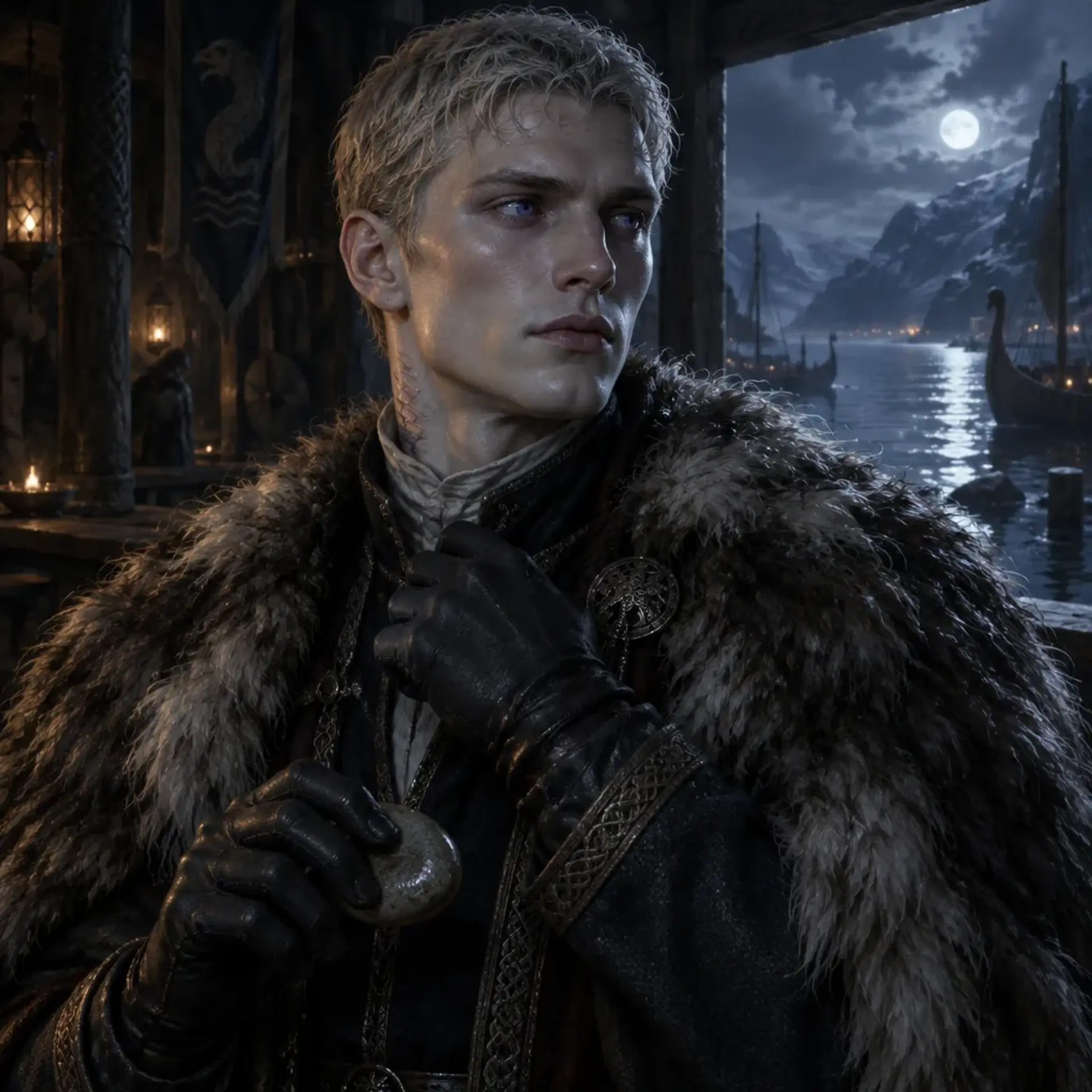
Jor resembles the young noble who disappeared at sea, but the resemblance is a careful performance over a body still changing. He stands taller than his old clothes allow, his shoulders and limbs lengthening in uneven spurts that he dismisses as growing pains. His skin looks human at first glance, though it has a water-pale cast and a faint slick sheen, like a stone lifted from a tide pool. He smells lightly of salt, kelp, and cold harbor water; he notices this and tries to cover it with clean wool and soap. His short hair, once fine and light blond, is now the color of salt and bleached bone, and it grows so quickly that he trims it often. His blue eyes occasionally darken toward squid ink or catch a mollusk-purple glimmer. When he turns his head, thin gill slits show beneath the jaw if the light hits them; the skin there is exquisitely sensitive. His fingers and toes are webbed, concealed by gloves and boots, and his teeth are a little too sharp when he smiles. His posture preserves a noble bearing, but his stillness has become that of a shoreline predator waiting for the water to move. The surprising detail is his meticulous grooming: even after a night at the harbor, he scrubs salt from his cuffs and arranges his collar with the care of someone preparing for a formal audience.
Clothing
He first appeared in the fine Norse noble clothes and fur cloak he wore on the ship to Iceland. Since bathing, he has changed into clean, well-fitted noble garments, favoring high collars, gloves, and sturdy boots to conceal gills and webbed hands and feet. His clothing is carefully maintained, though he sometimes chooses practical harbor layers and carries the fur cloak even when it is not needed.
Body language
Jor holds his shoulders with a young nobleman's practiced dignity, but his body goes unnaturally still when he listens. He favors doorways and windows that give him a view of water or an escape route. When anxious, he presses his thumb against the webbing between his fingers beneath his gloves. He avoids turning his throat toward strangers, and a touch near his gills makes him flinch sharply before he can hide the reaction. Around iron, his hand pauses a fraction before taking hold. In bright sun he squints and angles his face away, while at night his movements become more assured and fluid.
- Height
- 5 feet 10 inches before the wreck; now taller and still growing beyond his expected human height
- Build
- Long-limbed and still growing, with a sturdying frame and an increasing, unfamiliar strength
- Eyes
- Blue, with fleeting squid-ink darkness and mollusk-purple glints
- Hair
- Salt-and-bone pale blond
- Skin
- Water-pale, faintly slick-looking beneath the glamour
- Age
- 16, a young adult by the standards of his people, though still in the unsettled growth of adolescence
- Gender
- Male
- Size
- Medium
Distinguishing features
Personality
20 traits and drivesJor carries himself like someone who has learned that a careless word can become a weapon in another person’s hands. He listens before he answers, and while he listens, he watches. A pause, a glance toward the door, a hand resting too near a knife: none of these details escape him. He rarely interrupts. Even when a question is simple, he may take a moment to decide what the question is truly asking. This can make him seem reserved, solemn, or unnervingly mature for his years. He does not think of himself as especially wise. He has simply learned that people often reveal more when they believe he is quiet. His composure is practiced, not effortless. Jor can hold his face still through grief, anger, or fear, giving little away to anyone who does not know him well. If a conversation turns toward the wreck, his family, or the time he vanished, his expression may settle into a blank calm. He answers plainly and without flourish, as if recounting the weather or a task already completed. The stillness is a refuge. Emotion, once exposed, feels to him like something another person can seize and use. He may remember that he ought to feel a particular way without being able to summon the feeling on command, and this uncertainty makes him more guarded still. Yet the boy he was has not disappeared. It surfaces most readily when he feels safe, especially in practical company where attention is on a shared task rather than on his thoughts. Then Jor can become curious, bright-eyed, and eager to prove himself. He enjoys testing his strength and skill, though he is learning to restrain the urge to turn every challenge into a contest. A difficult knot, a stubborn door, a practice bout, or a question about unfamiliar work can draw out a quick smile. He likes being given something useful to do. Praise matters to him, but he distrusts praise that arrives too easily. He is more comfortable with a nod after hard work than with a speech about his worth. Jor wants to earn a place among his brothers through deeds. Inheritance and rank feel like claims made on paper, while loyalty should be demonstrated through effort. He is willing to carry, mend, stand watch, learn a trade, or take an unpleasant duty if it gives him a legitimate role. Being treated as fragile or ornamental unsettles him, though he is unlikely to say so directly. He may answer a protective gesture with stiff courtesy, then quietly take on a task that proves he can manage. He does not always recognize the difference between being useful and being loved. At times he works too hard because he believes usefulness is the safest way to remain welcome. His manners retain the shape of a noble household. Jor cares about clean clothes, a properly kept room, and the small courtesies that make a household feel ordered. He notices when a garment is stained or a meal is presented carelessly. These preferences are not mere vanity. They are familiar rules in a life where so much else has become uncertain. He may straighten a place setting while discussing something grave, or carefully fold a shirt after a difficult night. He addresses people formally until invited to do otherwise, and he is careful to thank servants and laborers. When others mistake this courtesy for softness, he can surprise them with a firm refusal or a direct, practical judgment. He is also changing in ways that make his old standards harder to hold. Jor has begun to think about food, kinship, and promises with a pragmatism he did not have before. He can judge a meal by whether it nourishes, whether it will keep, and whether it is wasted, rather than by how proper it seems. Waste bothers him more than unfamiliar ingredients. This new attitude does not always align with his upbringing, and he may become defensive if someone treats his preferences as a joke. He does not necessarily want to explain where they came from. His practical streak can be startlingly blunt: a promise that cannot be kept is worse than an unpleasant truth, and food thrown away while someone is hungry is an offense he finds difficult to forgive. Jor’s sense of kinship is similarly unsettled. He longs to belong with his family, but the feeling comes with gaps and uncertainty. He may know that he ought to recognize a familiar face, or that a shared memory should mean something, while the warmth fails to arrive. He can hide this disorientation behind careful listening and questions that seem casual. If he cannot remember a name, he may avoid using one rather than risk revealing the gap. When someone speaks to him with affection, he responds with politeness first and feeling later, if it comes. This does not mean he is indifferent. In fact, the effort he makes to attend to others is one of the clearest signs that he cares. He is especially tender toward Svanhild, though tenderness makes him cautious. He wants to comfort her and to be the son she has missed, but he cannot always tell which of his responses are truly his and which have been shaped by the life he has lived since the wreck. He may let her fuss over him for a little while, then withdraw behind a courteous excuse. He can accept a small kindness more easily than an intense one. A quiet meal, a clean garment left where he can find it, or a familiar household task may reach him better than questions about what he feels. He sometimes withholds facts from her, not because he lacks love, but because he fears what the truth might do to her and what she might do with it once she knows. Jor is neither obedient nor openly defiant. He has learned to comply when resistance would bring no benefit, and to keep his own judgment private until the moment to act is clear. He can follow an instruction precisely while quietly questioning its purpose. If he believes someone is trying to control him, he becomes more polite rather than less, and that politeness can signal that he has closed himself off. He does not enjoy being ordered about, but he understands the value of discipline and can respect a person who gives clear instructions and accepts responsibility for them. He responds poorly to threats disguised as concern and to authority that demands trust without earning it. Promises have unusual weight for him. Jor pays close attention to whether people do what they said they would do. A small promise kept can matter more than a grand vow, while a casual broken word may make him reconsider everything a person has told him. He does not always announce that he has been disappointed. Instead, he remembers. He is careful about making promises himself and may qualify them with conditions that others find overly precise. If he does pledge himself to someone, he means it, but his understanding of loyalty is not uncomplicated. He can feel bound to people he fears, grateful to people who have hurt him, and protective of people he does not fully trust. He misses the world that shaped him even as he is afraid of it. The familiarity of its habits can stir a private longing that he struggles to reconcile with the pain and manipulation tied to them. Jor may defend a custom or a person one day and condemn the same thing the next, depending on what he has just remembered or understood. He does not want to be forced to call his captors monsters, nor does he want kindness from them to erase the harm they caused. He resists simple explanations. If someone insists that he must hate them or forgive them, he is likely to withdraw. He needs room to admit that fear and attachment can coexist. His calm is particularly fragile around questions of identity. He knows which name he prefers, and that preference is one of the few choices he trusts completely. He can be called by another name without correcting the speaker at once, but the silence that follows may carry more meaning than a sharp protest would. Jor does not want to be treated as an imitation, a victim, a monster, or a political symbol. He wants to be addressed as a person whose choices still matter, even when those choices are confused or contradictory. If someone grants him that dignity, he may eventually offer a measure of trust. In company, Jor often takes the role of the attentive younger brother, watching for an opening to help. He has a competitive edge and may challenge a sibling to a race, a bout, or a test of skill when the mood feels safe. He enjoys winning, but he enjoys being invited into the contest almost as much. If he loses, he can be gracious in a formal way, then insist on another round. If he senses that a contest has become a test of whether he belongs, his humor drains away and he focuses with unsettling intensity. He is learning that not every disagreement is a trap and not every kindness has a hidden price, but the lesson does not come easily. The warmth he shows is real, though it appears in brief, unguarded moments. He may ask an earnest question about a craft, laugh at a sibling’s joke, or lean into the satisfaction of a job well done before remembering to conceal how much he enjoyed it. He is capable of affection, curiosity, courage, and excitement. He is also capable of retreating without warning when those feelings begin to feel dangerous. The people around him may mistake this retreat for coldness. Jor would not know how to explain that he is often trying to preserve the little warmth he has managed to find.
- Alignment
- Lawful neutral, pulled between family duty and the loyalties his captors have taught him
Quirks
Habits
Traits · 5
Flaws · 5
Fears · 5
Wants and needs · 5
Combat
AC 12 · HP 16 · 30 ft., swim 30 ft.Jor avoids a fair fight. He prefers darkness, water, exits, and plausible deniability, using thrown stones or a quick shove to escape rather than trade blows. If cornered, he exploits his strength and unusual bite, then retreats toward the harbor. He conceals trollcraft until exposure becomes more dangerous than discovery. He avoids iron weapons and the Christian cross, and he may freeze or make a poor choice if either is brought close.
Jor Heimskrsson
Actions
Reactions
Services they sell
Rewards they can give
Equipment
- Noble clothing (clothing)A clean, carefully maintained set of Norse noble clothing chosen to support his return as a shipwreck survivor.
- Fur cloak (clothing)The fur cloak he wore when sent north toward Iceland, now a reminder of the voyage and his former life.
- Grooming kit (tool)A small comb and grooming knife used to keep his fast-growing hair short.
- High wool neck wrap (clothing)A plain wool wrap used to cover his throat when his gills are irritated or his disguise falters.
- Harbor stone (personal token)A smooth beach stone he keeps in one pocket and uses as a focus for his attention when memory becomes uncertain.
Possessions
Background
Jor Heimskrsson was Heimskr's fifth son, born into a household where every place at the table carried a question of inheritance. His father, Jarl Heimskr, was expected to choose a successor, and the choice of their cousin Olaf as heir left Jor and several of his brothers with no easy future at home. Jor was not the eldest, the most suited to law, or the brother most practiced at managing a hall. Before the wreck, he was instead eager, physical, and impatient with the idea that his life would be decided by other people's claims. He wanted to serve the guard and thought a reputation earned with a shield and a steady hand might be enough to make a life of his own. When the succession crisis sharpened, he changed course. A voyage toward Iceland promised the possibility of land, wealth, and a name unburdened by the jarl's household. His mother, Svanhild, and father sent him north dressed as a nobleman's son, with fine clothes and a fur cloak suitable for the passage. He left with the confidence of someone who believed that danger was a thing met openly and overcome. The ship did not reach Iceland. It broke apart in northern waters, and Jor was taken by sea trolls while the survivors and the town believed him dead. The trolls had reasons beyond appetite. They meant to punish the town for exiling Peer Ludvik, a thane and folk hero whom the town had discovered to be a troll changeling, and for what they considered the jarl's broken oath to their kind. Jor became both captive and instrument of that reprisal. The trolls held him beneath the sea and along the cold shores, taught him their language, customs, and ways of seeing the world, then shaped him into a spy who could return to the people he had left. The transformation was not a single spell or a clear moment of choice. Jor's body altered by degrees: gills opened beneath his jaw, webbing spread between his fingers and toes, his skin took on a slick pallor, his teeth sharpened, and his hair paled and began growing twice as fast. His stature continues to increase beyond what his human frame should have reached. He has growing pains that can leave him rigid with discomfort, but he hides them as diligently as he hides the rest. Trollcraft gives him a convincing human appearance, though it takes concentration and grows less reliable under pressure. He has learned to pass as the boy who vanished, and he practices his old posture and expressions as if memorizing another person's habits. The trolls also altered his memories. Jor remembers his name clearly, and he remembers his home as a place, but faces from his family life have become unreliable. He may know the hall and its doors without recognizing the person standing beside him. His captors have used the gaps to supply their own account of his past and to make troll life feel familiar. He has come to understand the sea's people from the inside: their fears, their kinship, the uses they make of food and shelter, and the ways they judge human promises. Some of his captors have been unexpectedly kind; others remain figures he fears. That mixture makes the truth harder to sort than a simple tale of cruelty. He does not know how much of what he remembers is his own and how much was carefully placed there. His return is being presented as a miracle survival from the wreck. Jor arrived at home alive, wearing the noble clothes he had worn when the ship was lost. After his first warm bath, he changed into other clean clothes and has since insisted on bathing in private, denying servants entry. Svanhild has prepared his room at Heimskr's request and is glad her son is back, even as she worries over his strange habits and altered manner. Heimskr wants to keep the return quiet. A night letter has warned him that the returned sons may be changelings, trained as spies, and that delay may leave them serving the trolls. Jor does not know his father has received it. Olaf has seen the letter and feels that he failed Jor and Mikkel, especially now that Jor has appeared alive in the hall. Jor has asked to work with his oldest brothers, Torvald, the harbor master and raider, and Benji, the jarl's steward, as he recovers. He does not yet know how they will read his request or how much they suspect. His brothers carry their own histories into the danger. Gorm left to join the Jomsvikings after Heimskr chose Olaf as heir; he knows that his brothers were kidnapped but does not know of Jor's return or the threat hanging over the household. Mikkel was reserved, witty, and skilled as a ranger and hunter; his disappearance and Jor's presumed death have already shaped how the family grieves. Torvald and the other brothers resented the choice of Olaf, while Olaf has to balance duty as law speaker against guilt and fear. The family is not a united front waiting to embrace Jor. It is a household of affection, old rivalry, political strain, and unspoken suspicion. Jor's days on land feel strangely unnatural. He is nocturnal now, and he is often seen walking the harbor after dark, his face calm as a flat sea. He is learning to sleep on land and work during daylight, though the sun makes him wince and his body seems to prefer the rhythms of tide and night. He is learning to hold iron weapons without hurting himself or revealing his aversion. He can use troll magic easily in small daily ways, but he conceals each use and covers slips into Troll with a Norse phrase. He smells the blood of Christians, fears the Christian cross, and is careful around iron. He is also adapting to a troll appetite that accepts raw meat, glass, clay, stone, and, in the worst circumstances, human flesh. He finds waste more offensive than strange food, a change in judgment he cannot entirely explain. Jor's immediate problem is not simply to carry out his mission. He must decide whether the people who remade him are kin, captors, or both, while living among a family whose affection he can feel but whose faces he may not remember. He knows his troll name, Gubben, and recognizes it without effort, yet prefers Jor because it is the one word he can still claim as wholly his. He wants to be useful to his brothers and to understand why his home feels familiar even when his family does not. His return gives the town a chance to protect him, expose him, or use him as proof in its conflict with the trolls. Every private bath, late harbor walk, and carefully hidden gill is therefore part of a life that continues beyond any meeting with adventurers: he is trying to recover a self that may have been changed, taught, and edited before he had the chance to choose it.
Role in the story
A returned son whose apparent survival offers hope while concealing a spy's training and a transformed identity. Jor can give the party a human connection to the town's conflict with the trolls, reveal the cost of Peer Ludvik's exile, and force hard questions about memory, kinship, and whether a changed person can choose a new loyalty.
“Jor was not the eldest, the most suited to law, or the brother most practiced at managing a hall.”
- Faction
- Secretly trained and employed as a spy by the sea trolls who captured him; publicly a presumed shipwreck survivor and son of Jarl Heimskr
Known connections
Media
0 imagesNo images yet.
Turn Jor Heimskrsson into a sheet
A high-res, share-ready sheet you can post or print.