Mikkel Heimskrsson (Dovre)
Mikkel Heimskrsson (Dovre)
At the table
Voice
His voice has a dry, slightly rough texture, as if shaped by cold air, long walks, and smoke-darkened rooms. He takes a small nasal breath before speaking, an audible pause that becomes a catch in his throat when he is frightened. Under stress, his vowels flatten and a low growl rides beneath his words; he does not always hear it himself. His volume rises with emotion, and his breathing grows heavy after exertion or when the sun is harsh.
He speaks fluent Troll and Norse, but Norse sometimes catches in his mouth as if he has to search for a familiar tool in the wrong drawer. His phrasing is plain and practical, shaped by hunting and troll life rather than courtly polish. He often begins a sentence with confidence, pauses, then substitutes a simpler word. His jokes are dry when he is calm and blunt when he is tired. He raises his volume when frustrated instead of becoming quieter or more polite. He does not sing or chant; his speech has the uneven rhythm of someone who notices sounds and movement before he chooses words.
Speech patterns
How to play them
Treat him as a person with competing loyalties rather than as a disguised monster. Speak plainly, allow time for him to find Norse words, and avoid making him prove that he remembers his own life. He responds to practical kindness, food prepared to human standards, and invitations to help with a real task. His mother can steady him; Leif's suspicion makes him guarded, while mention of Jor makes his practiced composure fail. A careful character may notice that he remembers faces and feelings more easily than places and sequences. Do not assume his troll nature makes him cruel, but do not ignore the possibility that he has been trained to report what he learns.
Goal
Protect Sivi and her guards without becoming the trolls' instrument against his family, and learn which parts of Mikkel and Dovre are truly his.
Motivation
He wants to be useful to the family that recognizes him and to the troll kin who shaped his daily life, even though those loyalties cannot safely be reconciled. Beneath that conflict is a simpler need: to know that his choices belong to him.
Appearance
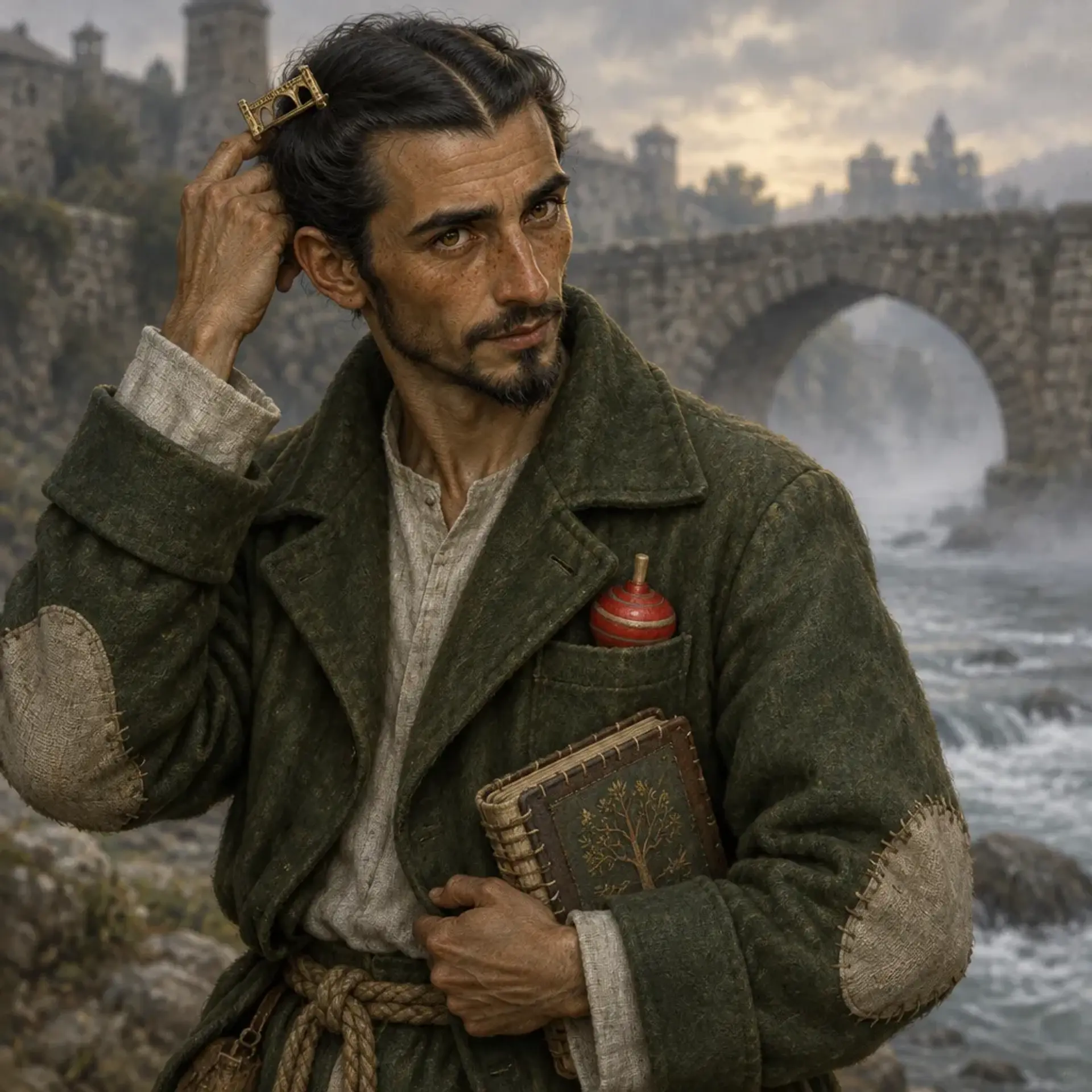
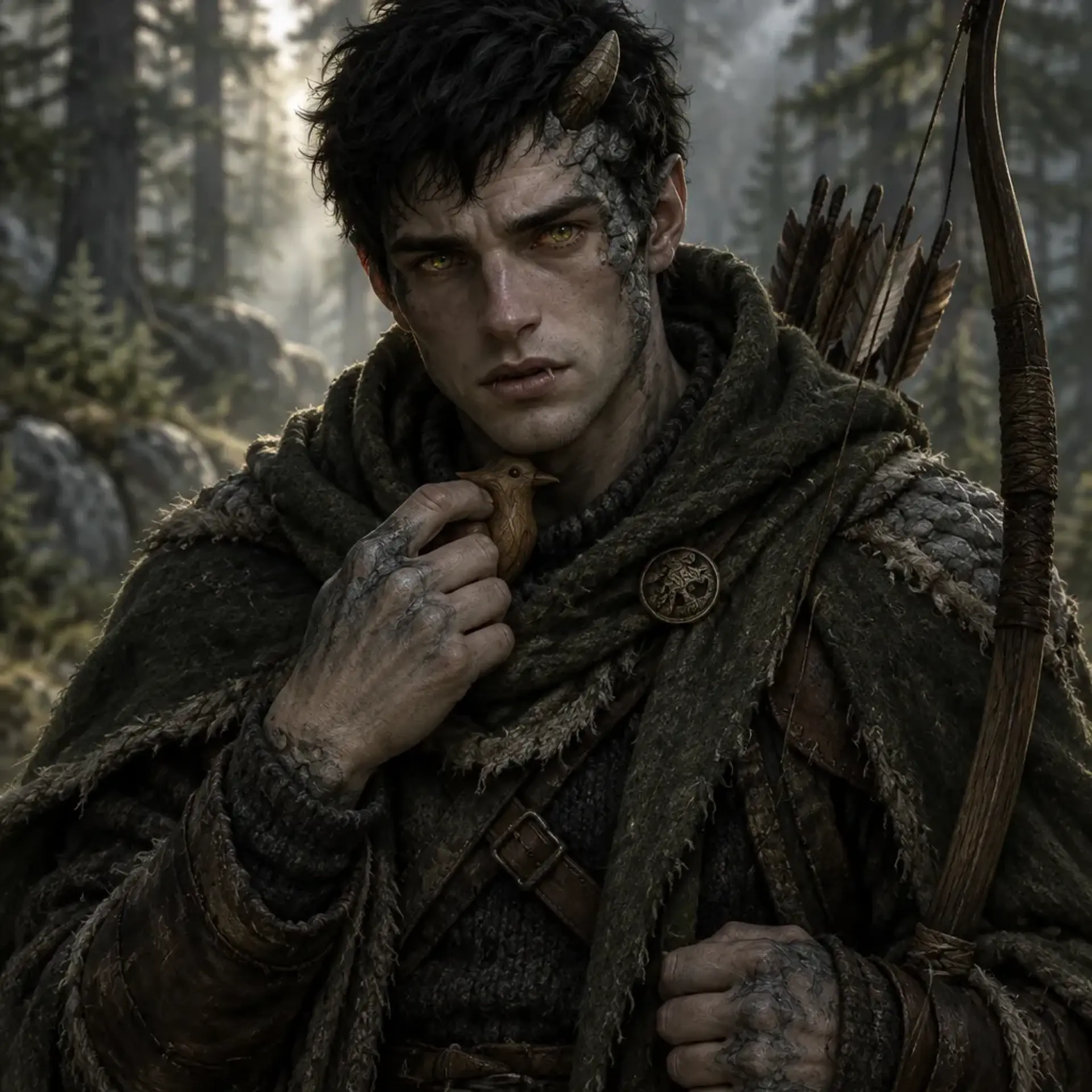
Dovre resembles the young nobleman Mikkel Heimskrsson enough to be recognized by his family, but not enough to pass without explanation. He stands a little over six feet, taller than the five-foot-ten hunter he remembers being, and carries his added height as if he is still learning where his shoulders fit in a doorway. His hair is black now, thick and fast-growing; he cuts it short at the ears, then watches it creep back with visible irritation. Pale human-looking skin stretches over a heavier frame, but when his disguise slips, granite-gray stone texture shows through at his knuckles, temples, and the ridges of his shoulders. His amber troll eyes flare beneath the green appearance his craft attempts to preserve. The canine teeth are longer and sharp enough to show when he speaks. Pointed ears, blunt horns, and a narrow tail press at the limits of his concealment. He smells faintly of wet leaves, bark, and cold earth. His face often looks strained, as though he is holding an unfamiliar expression in place. He moves with a woodsman's economy until anger or hunger breaks through, when his weight shifts forward and his steps become startlingly heavy. Before speaking, he takes a short, audible breath through his nose; when rattled, that breath catches and comes out as a low, gravelly rumble. An unexpected detail for a noble's son and trained spy is that he keeps a tiny carved wooden bird tucked in his collar and rubs its worn beak with his thumb when trying to remember something.
Clothing
His mother expects him to wear noble garments in the hall: a wool tunic, a practical belt, and a cloak suitable to his station. He wears them stiffly and checks that they do not catch on his partly hidden tail. Away from supervision he chooses worn ranger's clothes, layered wool, leather, and his old hunting cloak. Troll-made patches and rough stitching show where his clothing was replaced during captivity.
Body language
Dovre turns his whole head toward a sound, like a hunter tracking movement through brush. At rest, he presses his tongue against one canine tooth and holds his shoulders slightly too high, as if bracing for a cramped doorway. He looks to his mother when unsure how to act in the hall, but watches exits when anyone mentions trolls. When rattled, his nostrils flare, his breath catches, and a low growl vibrates under his next words. His hands open and close as though testing how much force an object can take.
- Height
- A little over six feet, noticeably taller than his former height of 5 feet 10 inches
- Build
- Tall and broad-shouldered, with a hunter's balance over a newly heavy, powerful frame. His strength is plainly greater than his former human build, but he still moves with the cautious economy of someone learning the reach of his own limbs.
- Eyes
- Green in his human guise, with amber showing through when the light catches his eyes or his control slips
- Hair
- Black, thick, and fast-growing; cut short at the ears
- Skin
- Pale in his human guise, with granite-gray stone texture showing at the knuckles, temples, and shoulders when his disguise slips
- Age
- 18, a young adult by human standards and still a young troll by the standards of the trolls who raised him
- Gender
- Male
- Size
- Medium
Distinguishing features
Personality
23 traits and drivesMikkel was once reserved and witty, the sort of young man who waited through a long silence and then found the one dry remark that made it worth enduring. Dovre is louder, more immediate, and more emotionally transparent. These are not cleanly separate personalities. He can still make a sharp observation, but it may arrive after a pause that frustrates him; he can still hold back, but anger or hunger can burst through the restraint before he notices it happening. He hates being treated as stupid, yet he sometimes genuinely misses an implication that would once have been obvious. When he realizes he has misunderstood, shame makes him defensive, and defensiveness makes the misunderstanding worse. In the hall, he tries to act like a noble son. He stands where his mother expects, wears the clothes she chooses, and listens when his father or brothers correct him. The effort is sincere, but the habits are unfamiliar. He may wait for a servant to offer food because that is how he remembers a household working, then ask too bluntly when the meal is coming. He wants to be welcomed as Mikkel, yet he accepts the troll name Dovre without embarrassment. If someone insists that one name must be the truth and the other a lie, he becomes suspicious. He has learned that people can use a name to claim him. With family, his manner is more openly needy than he would have been before his disappearance. He asks questions, repeats family stories, and tries to turn ordinary conversation into proof that the relationship remains. He remembers faces and the emotional weight of familiarity, but not the layout of the house or every shared event. A familiar room can feel foreign; a voice may make him feel safe before he can explain why. When Svanhild corrects his clothes or manners, he may grumble, but he listens. He wants to please her and resents how much that desire can steer him. With Olaf, he is watchful without knowing why, drawn toward his cousin as kin but unsettled by the careful, burdened way Olaf looks at him. Around trolls, Dovre is more fluent in the small courtesies of daily life. He understands when to leave a meal untouched, which jokes are friendly, and who in a group should not be contradicted. He is used to some trolls and even thinks of a few as friends. Others frighten him. He may describe a frightening captor with the casualness of someone discussing a difficult relative, then react with sudden fury if a human calls that troll a beast. This is not a defense of everything the trolls did. It is the consequence of having had to live among them, depend on them, and accept their account of his missing past. He is more genuine than Jor at some things, but less skilled at hiding that the old identity is still present beneath his new habits. As a hunter, he is patient and observant. His attention settles on tracks, weather, broken twigs, and the direction of a bird's alarm call. He is comfortable outside and more at ease with a task than with a question about his feelings. He offers help by carrying, scouting, repairing, or standing watch. He may be awkward when thanked, yet remember the gratitude for a long time. His greater strength delights him when it makes familiar work easier, and frightens him when he breaks something without intending to. The bow gives him confidence: its weight, draw, and release feel like a language his body still remembers. He is less confident in clever plans and social games. He sometimes tries to imitate the witty Mikkel he remembers being, but the joke comes out blunt or too loud; when people laugh, he cannot always tell whether they are laughing with him. His temper is not constant, but it is closer to the surface. Being hungry, confined, startled by iron, or exposed to direct sun makes him irritable. He does not quietly grow more polite when angry. His breathing changes first: a sharp inhale, a caught breath, then a low rough sound under his words. His voice can rise, and his gestures become broad enough to knock a cup over. Afterward, he is often ashamed, especially if someone was afraid of him. He does not always know how to apologize, so he may bring food, offer to take the next watch, or fix what he damaged. His appetite is one of his deepest sources of embarrassment. The trolls taught him that strange things could be food: raw meat, stone, clay, even church glass. He has inherited the capacity to eat them, but often prefers ordinary human meals and is proud of that preference. He does not want his family to watch him test what else he can swallow. He has no ordinary desire to eat people, and the thought can still repulse his human self, but he knows the boundary has become less firm than it used to be. He tries to keep hunger from becoming a public matter. If food is wasted, he reacts more strongly than if it is merely unpleasant, because the trolls taught him that waste is the true offense. Dovre's feelings about the trolls and his family pull in opposite directions without resolving. He can miss the familiar sounds of a troll home and long for the hall at the same time. He can condemn the way the trolls took him and still feel protective of individuals who fed him or taught him. He can love Jor and envy his skill at troll craft. He can fear being used as a spy and still feel a reflexive need to obey the training that made him feel safe. His most painful fear is not that he has become a monster; it is that no one can tell him what he was before, and that the answer he wants might be only another story someone has taught him. With strangers, he is curious and conversational, sometimes too open. He asks practical questions about food, shelter, horses, paths, and local customs. When someone seems kind, he may talk as if they are already acquainted. When he suspects a trap, he becomes blunt and watches their hands. Sivi's suspicion makes him uncomfortable because he cannot dismiss it as ignorance: she is right to consider his loyalties uncertain. He wants her to trust him, but he understands that wanting trust does not earn it. He is most himself when helping protect her, because the work gives his care a direction without requiring him to settle the impossible question of what he is.
- Alignment
- Neutral, pulled between loyalty to his family and the troll society that has made a home for him
Quirks
Habits
Traits · 5
Flaws · 6
Fears · 6
Wants and needs · 6
Combat
AC 15 · HP 52 · 30 ft.Dovre prefers to open from cover with his longbow and choose the ground before a fight begins. He uses Hunter's Mark against a dangerous quarry, then exploits brush, rocks, and elevation rather than standing still to trade blows. He has the mobility and extra attack of a 5th-level ranger, and can use a spell such as Absorb Elements or Goodberry when circumstances call for it. If cornered, he fights with blunt, powerful directness and tries to break away rather than pursue a drawn-out duel. His regeneration encourages him to endure, but iron, fire, acid, and direct sunlight can make that confidence costly. He is reluctant to reveal his troll form in front of his family unless someone is in immediate danger.
Mikkel Heimskrsson (Dovre)
Spells
Actions
Reactions
Services they sell
Rewards they can give
Equipment
- Longbow (weapon)A well-kept hunting bow that sits naturally in his hands, though it belonged to his former human life.
- Quiver and arrows (ammunition)A quiver of hunting arrows; he checks the fletching compulsively after damp weather.
- Ranger's cloak (clothing)A worn, weathered cloak from his old life, one of the few possessions he still recognizes without being told its story.
- Shortsword (weapon)A practical short blade for close defense, skinning, and camp work.
- Troll-worn clothes (clothing)Worn troll-provided clothing with rough repairs, hidden seams, and enough slack to accommodate the shape his disguise conceals.
- Carved bird (keepsake)A small carved wooden bird with a rubbed-smooth beak. He does not remember who made it.
- Heimskr signet ring (family heirloom)His iron-and-emerald signet ring was found near the woods after his escape attempt. He does not ask about it and may not remember it.
Possessions
Background
Before he was Dovre, he was Mikkel Heimskrsson, the fourth son of Jarl Heimskr. He was eighteen, brown-haired and green-eyed, a reserved young man with a dry wit, a steady seat on a horse, and the kind of patience that made other hunters mistake him for being less ambitious than he was. He loved the hours before a hunt more than the kill: checking the weather, reading hoofprints in wet ground, and hearing the forest wake around him. His Fjord horse, Yippie, was a familiar companion on those rides. Mikkel sometimes went looking for trolls, partly from curiosity and partly because the woods beyond the town were full of stories people treated as if they were facts. His family was large enough that every son had to find a different way to matter. Torvald, the eldest, worked as harbor master and raider. Benji served as the jarl's steward. Gorm left to join the Jomsvikings after their father chose their cousin Olaf as heir. Olaf became a law-speaker, carrying the burden of being the chosen successor and the brother everyone measured against their father's decision. Mikkel was not the heir, the household's administrator, or its loudest voice. He found a place in the woods, where skill mattered more than birth order. His mother, Svanhild, could still draw him back into the hall with a look. He listened to his parents, though he sometimes made a joke first to disguise that he had been corrected. The town's relationship with the trolls broke over Peer Ludvik, an exiled Thane and folk hero who was discovered to be a troll changeling. The exile carried old grievances and a family oath that had been broken. The trolls understood the choice as an injury to their own people. They took Mikkel in secret, during a private hunt after a harsh spring storm arrived with no warning. He did not come home. His family searched, and the town filled the absence with guesses: a fall, a wolf, a rival, the forest itself. Later, strange lights appeared near a farm, and a horse was stolen from its stall in the night. At the wood's boundary, searchers found Mikkel's iron-and-emerald signet ring. It marked his escape attempt, though no one knew that at the time. The trolls did not simply imprison him. They made use of the gaps in his memory and gave him an explanation for each one. They taught him their language and their customs, placed worn clothing on him, and gave him a new name: Dovre. They had a culture, jokes, obligations, kinship, and rules about what could be eaten and what counted as waste. They showed him where he belonged in their homes and how to behave around those who frightened him. Some became familiar enough to feel like friends. Some remained dangerous. The gradualness was part of the harm. A meal eaten because there was no other food became a custom; a custom became an expectation; an expectation became something he could defend as his own. He lost memories of his human home and its layout, but he retained the faces of his family. He remembers them as people he loves, though he may not know where he belongs beside them. The trolls changed him physically as well as socially. His strength increased, his body became larger, his hair darkened and grew quickly, and his teeth sharpened. He could tolerate food that would revolt a human. He has no inherent pleasure in eating people, and still prefers human standards of cooking, but the old boundary of what is edible has been badly blurred. His healing is rapid, except when fire, acid, sunlight, or the iron sickness interferes. Iron burns his troll skin. Crosses and consecrated Christian blood stir a fear he does not fully understand; he can smell the latter before he knows why he is uneasy. When Mikkel tried to escape, the trolls responded by training him more carefully. They had already begun to teach him troll craft, a practical art of disguise and misdirection rather than a perfect transformation. He learned how to make his amber eyes gleam green, how to hide horns and tail beneath clothing and posture, and how to give a plausible answer when someone noticed his height or black hair. He is less accomplished at this than Jor, and more emotionally genuine. The disguise slips when he is hungry, angry, frightened, or tired. It cannot make him fully his former self. The trolls also trained him as a spy and coached him to recall his human identity, including the name Mikkel. He can repeat his own history, but sometimes it sounds like a lesson he has been asked to memorize rather than a life he can enter. Jor, his younger brother, was also taken by trolls after seeking fame and wealth in the ice. Mikkel knows Jor was kidnapped, and the knowledge haunts him. His feelings about Jor are tangled with guilt, fear, and the uncomfortable fact that Jor may be better at hiding what they have become. Mikkel does not know that Heimskr has received a night letter about his return, or that the letter describes him as a possible changeling and troll spy. He does not know Olaf has seen it either. Olaf believes he failed both brothers, and Mikkel's sudden presence in the hall has made that guilt immediate. Svanhild is glad to have him back and has arranged a room at Heimskr's request. She insists that he wear noble clothes in the hall. He accepts this with the obedience of a son who wants to please his mother, then changes into ranger's clothes when no one is watching. The homecoming is not a restoration. Mikkel recognizes his family but not the familiar arrangement of the house or the town around it. A corridor may be wrong to him even when it has not changed. He sometimes pauses over Norse words he once spoke fluently, while Troll comes readily. He feels his thoughts are slower and less witty than before, a loss that frustrates him more than he admits. Yet the bow feels easier in his hands, and his new strength makes riding and carrying game feel different. He tries to speak with his family and with strangers, sometimes loudly and too emotionally, because silence feels like another kind of loss. His return is entangled with Peer Ludvik's family. Mikkel has offered to help the Skor family protect Sivi, Peer Ludvik's pregnant wife, and the guards sheltering her. Leif Skor keeps a close watch on him. Sivi is suspicious, and she has reason to be: Mikkel is trained to conceal things and has been shaped by the very people whose exile put her family in danger. Mikkel recognizes Peer not as the old friend of Jarl Heimskr's family but as kin through the change. That instinct unsettles him. He can understand the trolls' grievance and still know that their response has harmed his family. Now Mikkel lives between two homes that each claim a different version of him. The trolls gave him a name, habits, and a place in their society, and they may still expect him to report what he learns. His family gives him a room, fine clothing, and the old name, but not a map back to his memories. He does not know whether the spy training is a mission he has chosen, a command he has absorbed, or simply the only coherent explanation he has for being brought home. His current problem is not merely deciding whom to betray. It is working out whether loyalty can be real when the memories that once taught him what loyalty meant have been altered. He hunts to keep Sivi safe, watches Leif watch him, and tries to learn the shape of his own life from the faces that still feel like family.
Role in the story
A returned son whose presence gives the family hope and alarm in equal measure. He can guide the party through the wilderness and help protect Sivi, while his training and altered memories make him a living security risk. He is not a simple villain or a simple victim: his loyalties, memories, and identity remain contested.
“He loved the hours before a hunt more than the kill: checking the weather, reading hoofprints in wet ground, and hearing the forest wake around him.”
- Faction
- Born to Jarl Heimskr's household; forcibly incorporated into troll society and trained as a covert spy; currently assisting the Skor family in protecting Sivi and her guards
Known connections
Media
0 imagesNo images yet.
Turn Mikkel Heimskrsson (Dovre) into a sheet
A high-res, share-ready sheet you can post or print.