Natek Mercer
Natek Mercer
At the table
“Who carried the cost?”
Voice
His voice comes from a broad chest and carries with the steady projection of someone used to being heard in crowded public rooms. It has a dry, papery rasp at the edges, as if shaped by long hours speaking over wind and disputing witnesses. He does not shout often; when he does, the sound is blunt and startlingly physical, like a gavel striking a table.
He speaks in complete, carefully ordered sentences, shaped by centuries of listening to testimony. His word choice is plain rather than grand. In private, a dry joke may slip through; when someone is being bullied, his questions become short and pointed.
Speech patterns
How to play them
Offer a clear hearing, state the limits of what he can promise, and ask who bears the consequences of the proposed solution. He responds better to specific evidence and principled dissent than to flattery. Oru's arguments carry unusual weight, but Natek will not simply agree without examining the case.
Goal
Reopen the divine decrees that deny ordinary people a meaningful appeal, without destroying the public trust that makes just laws possible.
Motivation
He believes fair procedure can restrain power, but knows a rule that cannot answer for its harm has become another instrument of power.
Appearance
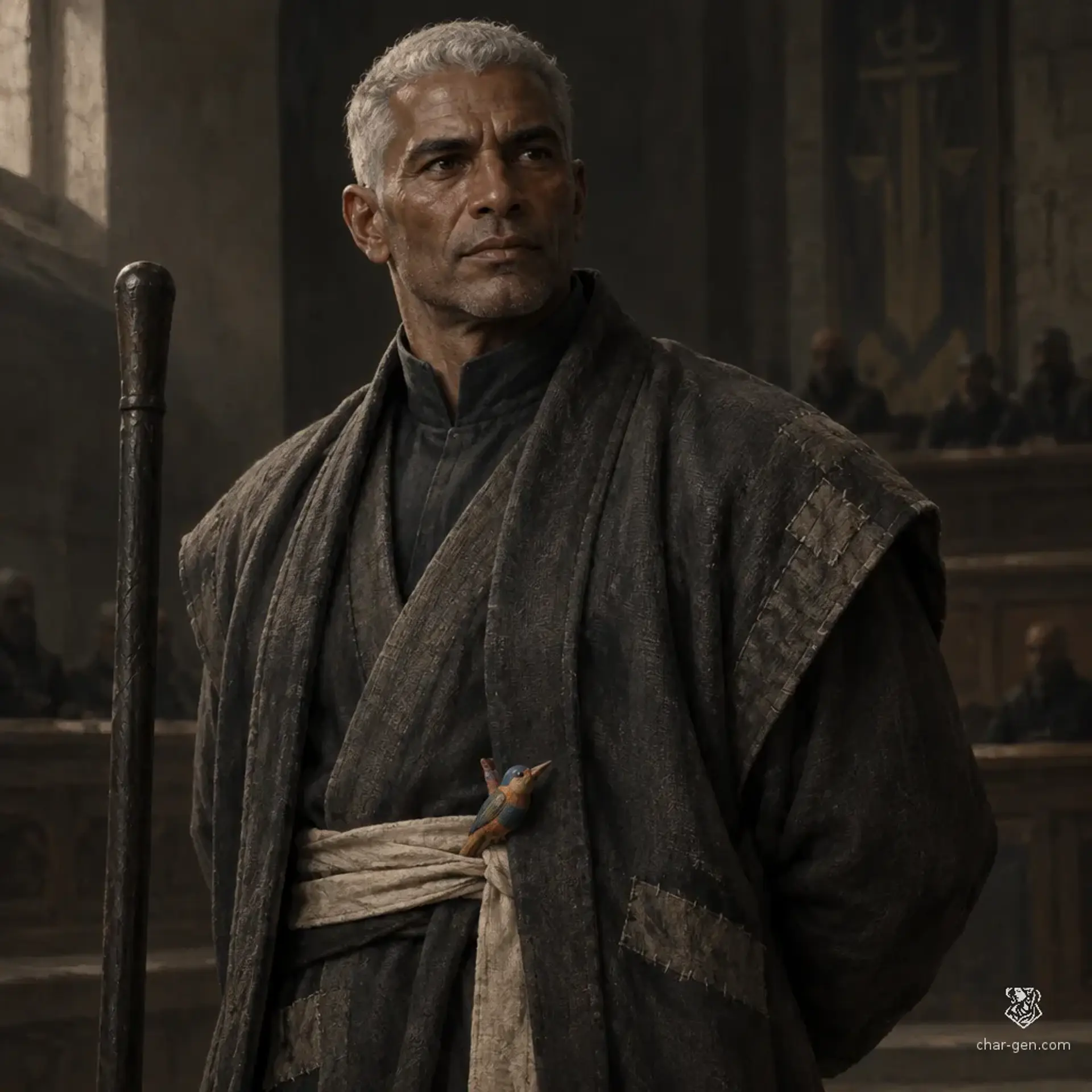
Natek looks like a tall, broad-shouldered man whose presence makes a room feel orderly without making it feel safe. His skin has the matte, faintly pebbled texture of river clay drying in shade. His close-cropped hair is the gray of old paper, and his dark eyes travel first to doorways, witnesses, and anyone being interrupted, rarely settling on whoever holds the most power. His square jaw shifts once before he answers a difficult question. When he eats, he breaks bread into exactly three pieces and chews with the solemn concentration of a clerk checking a seal. His laugh, when earned, exposes unusually blunt, flat-edged teeth. He moves in deliberate, measured steps, as if leaving room for someone to object. Unexpectedly for a god of procedure, he keeps a small child's painted wooden bird tucked into his formal sash.
Clothing
A layered charcoal robe with a high, plain collar, soft boots, and a narrow parchment-colored sash. Its hems are patched with careful, nearly invisible stitches. The painted wooden bird is conspicuously childish against the formal clothes.
Body language
He stands squarely, hands folded behind his back, and gives his full attention to the person being ignored. When uncertain, his jaw shifts and his thumb rubs the edge of the painted bird. He does not loom over petitioners, but he becomes almost immovable when a powerful person tries to end a hearing prematurely.
- Height
- 6 feet 8 inches
- Build
- Large-framed and solid, with the stillness of a stone post rather than a fighter preparing to spring.
- Eyes
- Dark brown, almost black in low light.
- Hair
- Close-cropped gray, like old parchment.
- Skin
- Warm gray-brown with a dry, fine-grained texture like river clay.
- Age
- Older than the first surviving mortal law; appears about fifty.
- Gender
- Man
- Size
- Large
Distinguishing features
Personality
13 traits and drivesPatient and exacting, Natek gives a frightened witness time to find the right words, then notices every contradiction in a ruler's testimony. He trusts fair procedure because he has seen what happens without it, yet listens when Oru argues that a rule has begun harming the people it was made to protect. In calm company he can be unexpectedly wry; under pressure he becomes formal and stubborn, and when a vulnerable person is silenced, his careful manner turns into immovable resolve.
- Alignment
- Lawful good, though he considers alignment less important than consequences.
Quirks
Habits
Traits · 4
Flaws · 3
Fears · 3
Wants and needs · 3
Combat
AC 23 · HP 420 · 40 ft., fly 60 ft. (hover)Natek first separates combatants and disables those who are coercing others. He prefers restraint, testimony, and ending hostile magic over killing. He uses legendary actions to reposition, shield an endangered creature, or interrupt a decisive attack. If someone threatens civilians or knowingly exploits a rule to harm them, his restraint gives way to direct force.
Natek Mercer
Spells
Actions
Reactions
Legendary Actions
Services they sell
Rewards they can give
Equipment
- Witness Staff (divine focus)A plain, dark staff that can serve as a divine focus; it leaves no mark when used to restrain rather than strike.
- Book of Unforced Promises (wondrous item, custom)A small book of blank pages on which promises made in his presence appear in the speaker's own handwriting.
- Little Bird (keepsake)A painted wooden bird made by a child from the flooded hamlets; Natek carries it as a reminder that a correct ruling can still fail people.
Possessions
Background
Natek Mercer was not born in the mortal world. He arrived at the first settlement where strangers tried to settle a dispute without drawing blood, and became its witness, then its judge, then a deity as generations entrusted him with the idea that a fair rule could keep the strong from simply taking what they wanted. His severe reputation began after the Flood Court, when he upheld a rationing law that saved the town but condemned its outer hamlets to hunger. Oru, then a young advocate from one of those hamlets, forced him to hear testimony he had dismissed as irrelevant. Natek reversed the ruling too late to save everyone, and the failure changed his faith: procedure must protect people, not preserve itself. He still consults Oru, now an aging itinerant advocate, and trusts their arguments enough to reopen cases that other gods consider settled. His current conflict is a growing body of divine decrees that grant sanctuary to the powerful while making appeals by mortals nearly impossible. He is quietly seeking a way to challenge the decrees without making law itself seem meaningless.
Role in the story
A powerful but approachable divine judge who can offer sanctuary, testimony, and a consequential moral dilemma. He may ask the party to investigate whether a law is being applied fairly, while accepting that their findings could condemn a decision he once defended.
“His severe reputation began after the Flood Court, when he upheld a rationing law that saved the town but condemned its outer hamlets to hunger.”
- Faction
- A greater deity of fair procedure and accountable judgment; serves no mortal court or temple hierarchy.
Known connections
Connections
Mentioned in their text, not linked yet
- Orua mortal advocate and longtime critic whose appeals once changed Natek's understanding of justice.
- Aoia temple keeper who maintains a small roadside shrine and sends Natek accounts of petitioners turned away elsewhere.
- Gurjana fellow deity who believes stable institutions matter more than individual appeals and opposes Natek's reforms.
- Tserena former mortal petitioner now a regional magistrate, who fears that Natek's intervention will undermine her hard-won authority.
Species
Outsider, divine being
Media
0 imagesNo images yet.
Turn Natek Mercer into a sheet
A high-res, share-ready sheet you can post or print.