Friedreich
Friedreich
At the table
Voice
A dry, breath-shaped rasp from a body that does not need breath, with the clipped precision of drill and the slight strain of a voice trying to prove it is present. When Friedreich wears another face, he can reproduce its vocal texture with unnerving exactness.
His voice has a dry, breath-shaped rasp, as if each phrase has to cross a little distance before it reaches the listener. It carries the clipped diction of military schooling and the careful consonants of someone who learned to make himself understood from behind a borrowed mouth. In his own uncertain form it can sound strangely airy; in a taken face he reproduces the original's cadence with uncanny accuracy. He speaks briskly about practical matters and becomes more ceremonious when angry. The name Friedreich itself has a breathy, sibilant sound in his mouth, though the texture belongs to how he says his name, not to every word he speaks.
Speech patterns
How to play them
Establish who can perceive him, then use a familiar face if the situation is safe. He is most open during football, holidays, and practical errands. Do not force his relationship with Wilhelm into a simple accusation or absolution. If a character treats him as a person when he is not manifesting, he remembers it. If someone treats a borrowed face as proof that he is a liar, he withdraws or becomes coldly formal.
Goal
Find a way to recover a trustworthy account of his life and death, then make Wilhelm tell him what happened in both world wars.
Motivation
To keep the coven together, protect the people he has chosen as family, and discover whether his memories and loyalties are genuinely his.
Appearance
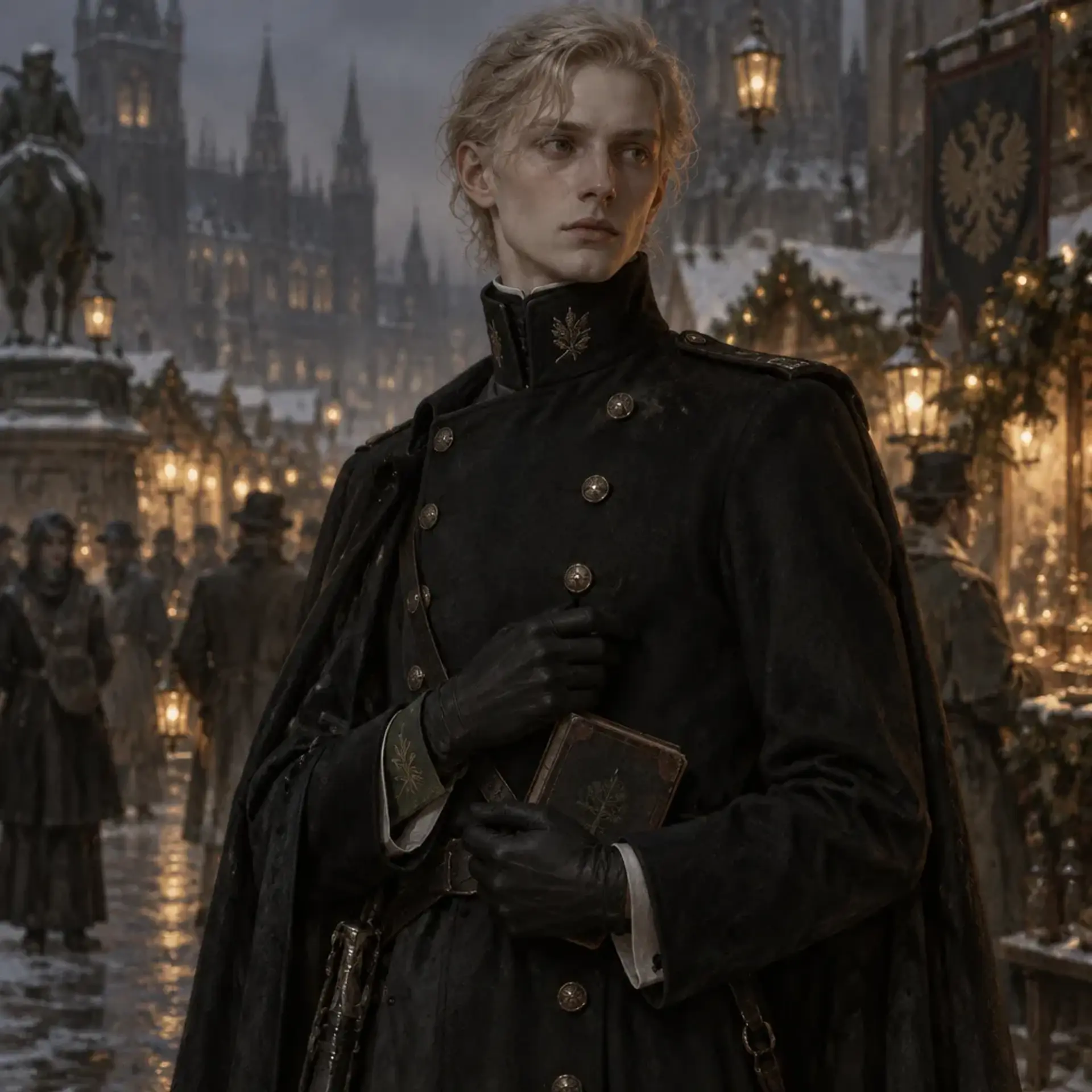
Friedreich appears as a narrow-shouldered young man of seventeen or eighteen, though the impression changes with the face he wears. In his own uncertain shape, his hair is pale wheat-blond, brushed into a severe side part that never quite stays in place; his eyes are gray, according to Wilhelm, and Friedreich distrusts that description. His skin has the chalky, finely powdered look of a portrait left too long in a cold room, with a faint translucence at the temples when the world loosens its hold on the dead. His borrowed faces are unnervingly complete: lips damp with breath, skin warm beneath a handshake, the tiny involuntary crease beside an eye. He moves with old drill-yard precision, heels set carefully, shoulders squared, but crowds make him take up too much space. He does not notice when he blocks a doorway or stands too close. He carries the smell of wet wool, coal smoke, and the sour-sweet scent of a Christmas market after rain, even when he has not manifested. He is faintly embarrassed by this and sometimes asks whether anyone else can smell it. A detail unexpected of a dead Junker-minded military traditionalist: he is delighted by gaudy novelty scarves and has attempted to wear one over a borrowed uniform.
Clothing
Usually wears a carefully maintained dark wool coat, high collar, plain waistcoat, and boots that look polished even when they are not fully tangible. He favors old-fashioned military cuts without claiming a precise regiment. At Christmas markets he adds a bright, ridiculous scarf that he insists is practical.
Body language
Keeps his shoulders squared and his chin level as if waiting for an inspection. In a borrowed face he unconsciously copies the original's posture, then catches himself and adjusts. When frustrated at being unseen, he moves into someone's line of sight and holds still, with the stubborn patience of a sentry. He leans too near friends when he is excited and takes up more space than he realizes.
- Height
- About 170 cm when clearly manifested, though the impression shifts with the face he wears.
- Build
- Lean, straight-backed, and youthfully narrow, with the disciplined posture of someone raised to treat stillness as good manners.
- Eyes
- Gray, according to Wilhelm; Friedreich considers the claim unverified.
- Hair
- Pale wheat blond in his uncertain personal form; borrowed faces vary.
- Skin
- Pale, with the powdered translucence of a portrait under cold light when his own form is clearly visible.
- Age
- Appears about seventeen or eighteen; his exact age at death and the date of his death are uncertain to him.
- Gender
- Male
- Size
- Medium
Distinguishing features
Personality
17 traits and drivesFriedreich is built out of contradictions he does not know how to reconcile. He wants to be treated as a person in his own right, yet often approaches other people through a face that belongs to someone else. He values discipline, loyalty, and plain answers, but he is evasive whenever the subject turns to his own history. He calls Wilhelm his brother with an assurance that surprises even him, then questions Wilhelm's every silence as if the bond were a contract in arrears. He can be tender without being gentle: his instinct is to stand between danger and the people he loves, not to ask whether they want a shield. Mila has taught him that care can feel like distrust when he assumes she needs rescuing. He has heard her, and he is trying, but when danger appears his body is already moving before his good intentions catch up. Around Gunther, Friedreich is amused, curious, and occasionally bewildered. He treats the moss-clothing business as a serious commercial enterprise and asks about durability, price, and whether damp fabric attracts insects. He is less comfortable with Gunther's questions about his face-taking. Friedreich knows the ability is extraordinary, but he cannot tell whether it is a gift, an accident, or something that will eventually take more than it gives. His confidence is situation-dependent. At a Christmas market, he becomes lively and authoritative. He can compare stalls, identify good workmanship, and negotiate a price as if he were born to it. He is happiest when he can advise a friend on what to buy, particularly if the item is something he himself cannot possess. In a room where no one can see him, however, that same confidence becomes brittle. He tries to place himself where someone will notice, then pretends not to care when they do not. If someone makes contact with him, especially without a borrowed face, he can become overwhelmed by the simple fact of being acknowledged. He does not always know what to do with kindness. His temper is controlled until it is not. Friedreich has inherited the manners of a young Junker and the reflexes of someone who expects orders to be obeyed. He rarely shouts. Instead, he becomes exact, formal, and insistent, as if he is reading a charge from a written record. This is most visible with Wilhelm. Friedreich is furious at Wilhelm for deserting during the First World War and for crimes committed during the Second. Yet he is not certain what he remembers firsthand. He resents Wilhelm for withholding explanations, while fearing that any explanation might implicate him too. That conflict makes him alternately accusatory and protective. He can spend an evening criticizing Wilhelm's conduct, then step into danger to keep a threat from reaching him. He does not believe those actions cancel each other out. He thinks loyalty means staying close enough to demand an answer. Friedreich is not simply solemn. He likes cards, football, fishing, and the broad, unceremonious comfort of friends doing something together. He enjoys jokes when they do not make him the joke. He laughs at the possession incident with Wilhelm, but the laughter has a cautious delay: first he checks Wilhelm's face, then Klaus's, and then decides the memory is safe to share. When he is in good spirits he gives advice freely, fusses over people who have not eaten, and uses an old-fashioned courtesy that can sound almost theatrical. When embarrassed, he becomes busier rather than quieter. He corrects a collar, rearranges cards, or invents a practical reason to leave. Klaus's passive-aggressive insults are a particular challenge. Friedreich is tempted to answer with a sharper insult, but Klaus's hesitation around him makes Friedreich suspect there is fear, affection, or an unspoken debt underneath. He does not know which possibility he would prefer. With strangers, Friedreich is cautious and observant. He may take a face suited to the situation, selecting a policeman, officer, or respectable young man, because those identities open doors. He dislikes being treated as a trick. He wants the ability to be useful, perhaps even employable, but knows that a convincing face is not the same as a legitimate identity. He has strict rules for his list: he avoids faces of people who are still nearby, changes names in his notes, and tries not to use any one identity constantly. These rules are both ethical safeguards and a defense against the unsettling envy he feels when a borrowed face comes with a satisfying life. His deepest emotional conflict is a hunger for ordinary sensation. When he manifests well, he can feel a handshake, smell food, taste a mouthful, sleep, and bathe. These small experiences matter more to him than grandeur. He wonders whether he could give some of them to Wilhelm, who has no easy access to human feeling and does not understand what Friedreich means when he describes them. Friedreich's attempt to possess Wilhelm was a mix of affection, curiosity, and a dangerous wish to fix his brother. The comedic disaster did not cure that wish. It taught him that an intimate supernatural act can become frightening quickly, even among friends. Friedreich is capable of compassion, but he can turn compassion into a project and try to impose a solution. When his Shadow pushes at him, it exploits exactly that weakness. It tells him he can be real if he takes the right face, or that Wilhelm deserves to be made to feel what he has done. Friedreich resists, but the more he uses a face, the harder it becomes to identify which feelings came from the original and which were already waiting inside him. His moods change with his visibility. When the world unbinds itself from the dead and he is seen clearly, he grows bolder and more bodily, sometimes forgetting that his friends may not be able to perceive him the next day. When the boundary tightens, he becomes watchful and irritable, counting acknowledgments and interpreting missed responses as rejection. He dislikes pity more than fear. He would rather be challenged, teased, or asked to help than spoken about as if he were a sad relic. Above all, Friedreich wants a family that does not depend on borrowed faces. He is not certain what he would look like if he stopped taking them. He is not certain whether Wilhelm is a brother because of a forgotten blood relation, a shared history, or a decision made in the Shadowlands. But he keeps returning to the coven, to the football, the cards, the market, the arguments, and the people who have learned to recognize him by more than his face. That repeated choice is the closest thing he has to a settled identity.
- Alignment
- Protective and dutiful toward his chosen family, but increasingly resentful when their secrets leave him unable to judge them.
Quirks
Habits
Traits · 4
Flaws · 4
Fears · 4
Wants and needs · 5
Combat
HP 7 · Use the chronicle's normal wraith movement and Embody rules; no separate canonical speed rating is assigned.Avoids a fair fight. Uses borrowed faces to misdirect, separates a threat from the coven, and manifests only long enough to shove, distract, or help an ally escape. Against supernatural opponents he relies on the group's living members and his knowledge of the Shadowlands. He is brave when protecting Mila or Wilhelm, but that bravery can become reckless when old wartime grievances are triggered.
Friedreich
Actions
Reactions
Services they sell
Rewards they can give
Equipment
- Face list (personal record)A small, carefully coded record of borrowed faces, with changed names and notes about which dead are no longer locally present. He never records the original names.
- Wool coat (clothing)A dark, old-fashioned coat that helps him feel properly dressed when he manifests. Its buttons are not always tangible.
- Market scarf (clothing)A bright scarf bought at a Christmas market. Friedreich calls it a sensible purchase and refuses to admit he chose it because it was cheerful.
Possessions
Background
Friedreich's biography is a stack of documents with most of the names rubbed away. He remembers Brandenburg as a landscape of flat fields, dark pines, brick stations, and winter roads that seemed to go on forever. He remembers a house that expected its sons to sit straight, answer directly, and never admit uncertainty in front of servants. He remembers a riding crop, a family seal, and the sensation of being watched by portraits. He cannot say with confidence whether these are his own memories or a face he wore too long. When he first came to himself in the Shadowlands, his living identity was already breaking apart. He knew his name, Friedreich, but even the spelling seemed borrowed from a school register. He had the body of a young man and the habits of someone trained to obey orders, yet no clear recollection of his death. He was not opened by a kindly relative or a former comrade. His Caul was opened during a Harrowing, by an encounter he now recalls as a woman in a black veil who asked him to state his name. He answered. She said it was not enough. She pulled at the veil covering his face, and the first thing he felt after the Caul split was the cold air of the Shadowlands. He remembers the opening as a humiliation before he remembers it as a rescue. The Stygian dead taught him how to endure, but not how to explain himself. He learned that a wraith's Shadow was not a mood or a wicked twin but a voice with its own cruel appetites. He has heard his Shadow tell him that every face he borrows proves he has no face of his own. He refuses to repeat the Shadow's name to anyone. In the early years after his death, Friedreich made himself useful as a messenger and watcher. He gravitated to uniforms, ranks, and people who seemed to know where they were going. His first successful face-taking was accidental. He had followed a dead constable through an abandoned station, trying to get a living clerk to notice him. When the constable's face came into focus, Friedreich found that the clerk could see him, hear him, and answer his questions. The borrowed face had a woolly moustache and a deep crease between the brows. Friedreich felt the man's old confidence as if it had been stitched under his skin. The sensation was intoxicating and frightening. He learned to make the trick repeat, a talent he regards as partly Moliate and partly a private anomaly. He cannot honestly say whether other wraiths could do the same with practice; he has met too few who would discuss it without suspicion. During the World Wars, he stayed near the living world whenever he could. He recalls fragments of the First World War: a breath in his throat, mud sucking at boots, the hard smell of wet leather, and Wilhelm leaving. Friedreich does not know whether that breath was his own, a borrowed sensation, or a memory implanted by longing. He remembers being angry at Wilhelm before he remembers why. Wilhelm, a Tzimisce vampire from Mecklenburg, was already an impossible companion: a dead man's brother-shaped friend who could not remember his own life before undeath. Friedreich regards him as a brother without being able to establish what either of them did to earn the word. Wilhelm deserted during the First World War, or so Friedreich insists. Wilhelm will not explain, and shame has made him silent. Friedreich resents the silence as if it were another desertion. During the Second World War, Friedreich saw enough of Wilhelm's actions to become furious with him. He knows Wilhelm committed crimes and is ashamed of them, but Friedreich cannot reconstruct every event and Wilhelm will not give him the missing pieces. That leaves Friedreich with anger, scattered images, and the alarming possibility that he is condemning his friend for actions he may once have helped enable. His own wartime role is full of gaps. He was with Wilhelm as much as a wraith could be, watching, warning, or taking a face to cross a threshold. He has no wish to be mistaken for innocent merely because his memory is incomplete. The coven gave Friedreich something like a present tense. Gunther, a changeling who spent much of his life in Arcadia before returning to the real world, sells clothing made from moss. Friedreich finds Gunther's trade baffling but admires that he can make a living from something so strange. Klaus is a ronin Get of Fenris, or perhaps a skin-dancer; even Klaus seems unsure which description is least misleading. Klaus's passive-aggressive jabs irritate Friedreich, though he hesitates when he turns that meanness toward Friedreich himself. Mila, a mage from Bremen, can see and touch Friedreich even when he is not wearing a borrowed face. He calls her his little sister. He protects her because he feels it is his duty, not because he thinks she is weak, and she has repeatedly told him those are not the same thing. They gather for cards, hunting, fishing, drinking, and, most importantly, football. Holidays bring more members of the coven together. Friedreich looks forward to the Christmas market, where he advises everyone on bargains, then secretly recommends the expensive thing he cannot own. When he is clearly seen, he likes the smell of hot food and the press of people around stalls. He has also fought beside the group at a cathedral during a service on Walpurgis Night, April 30. The memory is sharp in places and absent in others: candle smoke, stone dust, a prayer interrupted by a blow, and his borrowed hands striking at something that should not have been there. He remembers the cathedral as a place where everyone, living and dead, briefly seemed to be looking in the same direction. One evening, curiosity led Friedreich and Wilhelm to attempt possession. Friedreich wanted to know whether he could give Wilhelm a human sensation or draw out a memory by sharing his corpus. They forced the attempt for too long. It did not give Wilhelm a past or a human heartbeat. Instead, Friedreich's presence crowded into a vampire who was already dead in a very different way. Wilhelm's body jerked upright, announced in Friedreich's clipped Prussian cadence that it required a chair, and then attempted to salute a deck of cards. Klaus stood, hand already on a weapon, and demanded to know which of them was driving. Gunther asked whether the moss garments would be affected by possession and then whether Friedreich could try on a hat. Mila finally ordered them apart. Wilhelm came away with no memories and a strong dislike of Friedreich's opinion about his posture. Friedreich came away with a pounding sensation that he could not decide was a headache, a heartbeat, or a borrowed recollection. He laughs about it now, though often only after checking that Wilhelm is laughing too. Today he keeps a coded list of favorite faces. He selects people who are dead or gone from the local area, changes their names, and records the features he finds useful: a railway man's certainty, an officer's bearing, a young nobleman's smile. He prefers men around his apparent age, especially military figures, police, and nobles whose ideals resemble the ones he thinks he held. He uses the faces intermittently with the coven and wonders whether he could keep a job by changing appearance, perhaps as an interpreter, escort, or guide. Long-term use brings envy and rage. He may begin to remember a face's habits as his own, or feel that his real self is an insult he has to correct. He has considered possessing someone again, but is afraid the temptation is not merely curiosity. Friedreich has a life beyond the coven: he collects market advice, checks on the dead whose faces he borrows, and tries to learn whether his memories belong to him. His immediate problem is Wilhelm. He wants an explanation for the wars, but also knows that an answer may confirm his worst suspicion: that they were brothers in choice, not only in feeling.
Role in the story
A companion, investigator of his own lost past, and emotional pressure point in the coven. Friedreich can provide access to the Shadowlands and a startlingly effective disguise, while his conflict with Wilhelm creates a personal mystery about complicity, memory, and chosen family.
“He remembers Brandenburg as a landscape of flat fields, dark pines, brick stations, and winter roads that seemed to go on forever.”
- Faction
- An informal coven of local supernatural friends; no known formal membership in a Stygian faction.
Known connections
Media
0 imagesNo images yet.
Turn Friedreich into a sheet
A high-res, share-ready sheet you can post or print.