Friedreich
Friedreich
At the table
Voice
Friedreich's voice seems to come from a disciplined body: clipped breath, clean consonants, and the faint rasp of someone used to speaking outdoors in cold weather. His history adds the cadence of command and formal address, though he is not naturally loud. With friends, he lets sentences run longer and the German vowels round out. The voice he uses while wearing a borrowed face can mimic rhythm and emphasis, but strain shows at the ends of phrases when he has held the identity too long.
He speaks with the measured articulation of someone imitating military formality and the rounded Brandenburg German vowels he believes belong to his past. His consonants can sound crisp from years of listening to orders and repeating them, while the rhythm softens around friends. During a face-borrowing performance, he copies a person's cadence more readily than their accent or vocabulary. When angry with Wilhelm, he becomes exact and forensic, using dates and omissions instead of shouting.
Speech patterns
How to play them
Recognize his presence and address him by name when possible. Give him a useful place in the conversation rather than treating his face-taking as a party trick. He responds well to practical questions, shared rituals, and honest boundaries. Do not force a confession about Wilhelm; let Friedreich decide when he can bear to ask. If he appears under an unfamiliar face, ask who he is before assuming hostile intent.
Goal
Build a life among the coven that does not depend on pretending to be someone else, while finding out what happened with Wilhelm in both world wars.
Motivation
To be seen as Friedreich, not merely as a convincing face; to keep his chosen family intact; and to make Wilhelm answer for the past without losing him.
Appearance
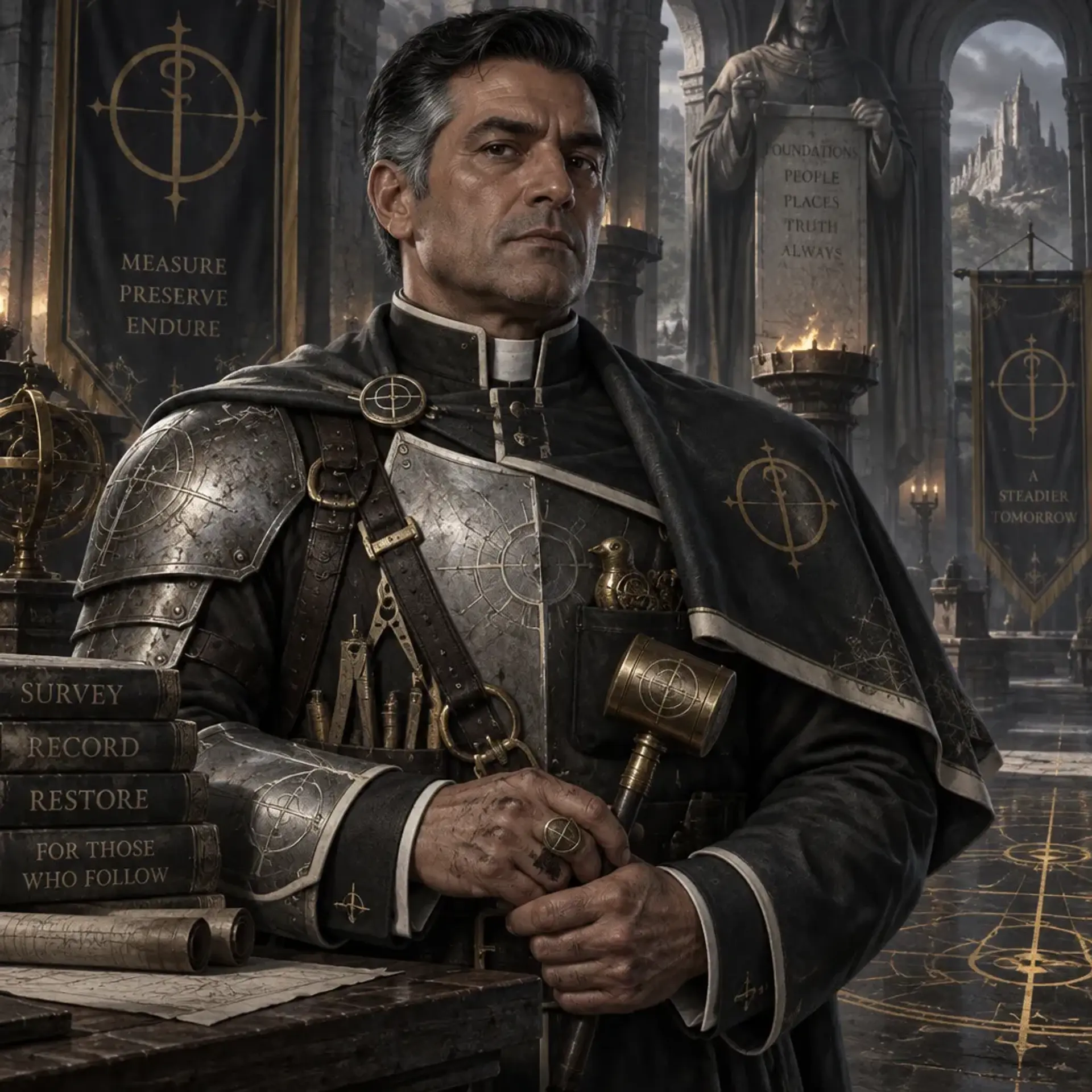
When visible, Friedreich looks like a very young man in an old-fashioned Prussian officer's portrait that has learned to move. He is narrow through the hips, straight-backed to the point of seeming hinged, and carries his weight over the balls of his feet as if awaiting inspection. His skin has the dry, cool look of paper kept too long in a drawer, but under his borrowed faces it takes on convincing warmth and texture. His own face is uncertain: Wilhelm says he had blond hair and gray eyes, so Friedreich tends to picture himself that way, although he cannot verify it. His most striking feature is how carefully he occupies a room: he leaves a precise arm's length around people, steps aside before they ask, then leans forward when they fail to acknowledge him. The unexpected detail is a small, painstakingly embroidered sprig of moss on the inside of his immaculate cuff, a gift from Gunther that Friedreich treats like a medal. His movement is orderly until emotion overtakes him; then his gestures arrive a fraction too late, like a reflection catching up.
Clothing
A dark, high-collared coat inspired by an old Prussian uniform, kept more immaculate than its age should permit; plain trousers, polished boots, and gloves he removes when trying to reassure someone. Under one cuff is Gunther's embroidered moss sprig.
Body language
He stands with his heels aligned and his shoulders squared, often leaving more room than necessary between himself and others. Waiting, he rests his weight forward like a sentry ready to move. When ignored, he leans into a person's sightline rather than raising his voice. His posture softens around Mila and Gunther; around Wilhelm, it becomes formal and watchful.
- Height
- About 173 cm when perceptible, though his outline can be difficult to judge in the Shadowlands.
- Build
- Slender, upright, and carefully held, with the spare silhouette of a young man trained to keep his uniform neat.
- Eyes
- Believed to be gray in his original appearance, based on Wilhelm's account; borrowed faces have their owners' eyes.
- Hair
- Believed to be pale blond when he wears his own face; borrowed faces retain their owners' hair.
- Skin
- In his uncertain original guise, pale with the dry, cool texture of an old portrait; borrowed faces reproduce their owners' appearance.
- Age
- Appears about 17 or 18; exact age and birth date are uncertain even to him.
- Gender
- Male
- Size
- Medium
Distinguishing features
Personality
19 traits and drivesFriedreich is built around a contradiction he cannot neatly resolve: he believes in duty, but the most important duty of his afterlife is to people who have never sworn allegiance to him. He wants to be useful in a clear, measurable way. He will take the late watch, remember who dislikes which drink, find the cheapest stall at a market, and stand between danger and a friend without waiting to be asked. These acts give him a role he can understand. Yet beneath the disciplined service is a young dead man who longs to be included without earning his place every time. If everyone is busy, he may present himself in a familiar face and make a pointed comment just to prove that he has not disappeared. He is embarrassed by this need and often disguises it as a joke or an observation about etiquette. His formality is real, but so is his playfulness. He can arrange himself like an officer awaiting orders, then become intensely invested in football, arguing about a referee's decision with the grave focus of a tribunal. He approaches Christmas markets as if they were supply depots: compare prices, assess stitching, identify the best route through the crowd. Then he will become wistful over a wooden toy or a bright paper star he cannot keep. Sometimes he recommends a purchase because it is genuinely good value. Sometimes he encourages a friend to buy precisely the thing he wants but cannot have, then pretends his advice was purely practical. His friends have learned to ask whether a recommendation is based on quality, sentiment, or a category he calls 'both, but mostly the second.' Friedreich is protective, though he does not always notice when protection becomes control. With Mila, he is naturally attentive. He watches entrances, anticipates danger, and steps in quickly, not because he thinks she is weak but because his mind has made her safety part of his personal duty. He likes her kindness because it does not feel like pity. She can tell him to move aside and he will, though he may look as though a regulation has just been repealed. He is less careful with Wilhelm. Their brotherly closeness is so deep that Friedreich often behaves as if he has the right to demand answers. He is loving, watchful, and angry in proportions that change by the hour. He wants Wilhelm to explain his desertion in World War I and the crimes he will not discuss from World War II. At the same time, he fears what those answers will do to his affection. When Wilhelm evades him, Friedreich may sound like a prosecutor; when Wilhelm is in danger, he reverts instantly to the loyal companion who followed him through war. His idea of himself is assembled from uncertain evidence. He thinks of himself as a young man from Brandenburg, perhaps shaped by Junker expectations and Prussian military ideals. He cannot tell which values are memories and which are roles he has borrowed because they give shape to his existence. Wilhelm says Friedreich had blond hair and gray eyes. Friedreich accepts this description when it is convenient and distrusts it when he remembers that Wilhelm has withheld other truths. The fact that he can become almost anyone makes this uncertainty sharper. He likes men near his apparent age who wear uniforms or carry the authority of nobles and police. Such faces have a structure he can inhabit. He knows the temptation to confuse outward composure with goodness, and he does not always resist it. When Friedreich is comfortable, he is attentive and surprisingly easy to tease. He accepts jokes about his market advice, provided the joke does not imply that he is not there. He enjoys cards, fishing, shared drinks, holiday visits, and the simple arrangement of people around a table. He does not fully understand why these ordinary rituals matter so much, but he knows that a place kept for him matters. His pleasure is physical when his unusual ability is working: a hot drink, the smell of wet coats, the feeling of cold air, a bath, sleep. He approaches these sensations with a careful gratitude that can make friends feel both touched and faintly guilty. He wonders whether he could give Wilhelm such experiences, not realizing that a vampire's condition is not something he can simply fix. When excited, he can become almost boyish, especially if the coven is gathering for a holiday or a football match. When hurt, he becomes precise. He does not always grow louder; instead, he chooses exact words and repeats them until the other person answers the question he actually asked. With Wilhelm, this precision can turn into a weapon. Friedreich lists dates, omissions, and contradictions, as if assembling a case will protect him from grief. With strangers, he may withdraw behind an appropriate borrowed face and let them believe the performance. With friends, he is more likely to make a brittle joke, announce that he has been overlooked, or appear directly in someone's line of sight. His frustration when unseen is genuine. He knows that the Shroud and circumstance can make him impossible to perceive, but knowledge does not cancel the hurt of watching people talk over the place where he stands. Friedreich has a real capacity for compassion. He notices when someone is frightened and alters his approach. He can borrow a comforting face, make his voice familiar, or quietly stand guard while another person recovers. But compassion is tangled with the belief that he should be able to solve things. He wants to make himself useful to the coven and has wondered whether his skills might support a job: finding people, working as an intermediary, or helping someone pass unnoticed. He needs to learn that a face is not a qualification and that being loved is not the same as being employed. He is capable of hearing this, especially from Mila, but he may need to hear it more than once. The deepest conflict in him is between loyalty and judgment. He is angry at Wilhelm, yet loyalty makes him feel responsible for Wilhelm's choices. He is proud of discipline, yet he knows discipline can serve terrible ends. He wants his own face, yet much of his comfort comes from becoming someone else. He wants to protect his friends, yet he does not want them to mistake him for a harmless accessory. These conflicts change with his mood and with the face he wears, but they are not caused by the face alone. Friedreich is not secretly a different person underneath. He is a person trying to discover what remains when every outward sign can be copied. The coven's ordinary affection, their games, their arguments, and their annual holiday reunions give him a practical answer: he is the one who shows up, the one who keeps the list, the one who complains about being ignored and then saves someone a seat.
- Alignment
- Protective and dutiful, but not reliably forgiving. He judges himself by ideals of loyalty and service, then struggles to apply those ideals when Wilhelm's wartime actions come up.
Quirks
Habits
Traits · 5
Flaws · 5
Fears · 4
Wants and needs · 5
Combat
HP 6 · No canonical movement speed assigned in this profile; use the Storyteller's Wraith rules for movement in the Shadowlands and any established manifestation.Avoids direct fights and seeks a way to make the conflict stop without exposing the coven. He uses a borrowed identity to distract, bluff, or draw attention away from an ally, but never assumes that a copied face grants authority or abilities. If cornered, he interposes himself between a threat and Mila or another friend, then retreats. The profile's Corpus is a compact custom durability value for table convenience, not a universal Wraith stat block.
Friedreich
Actions
Reactions
Services they sell
Rewards they can give
Equipment
- Face List (personal record)A small, carefully maintained notebook listing favorite borrowed faces, the situations they suit, and cautions about how long he has worn them.
- Moss Sprig (keepsake)A small keepsake of moss embroidery from Gunther, kept inside the cuff and shown only to trusted friends.
- Formal Coat (clothing)An old-fashioned coat and gloves that help him feel composed; they are not magical armor.
Possessions
Background
Friedreich remembers Brandenburg as a sequence of cold mornings, polished boots, and the sensation of being expected somewhere. He does not remember his parents' names, the exact town where he was born, or the day he died. He believes he was seventeen or eighteen when his life ended, but age is one of the facts he reconstructs from his appearance and from the scraps others tell him. Wilhelm says Friedreich had pale blond hair and gray eyes. Friedreich has made that description part of his identity, though he privately suspects Wilhelm might be wrong. The uncertainty is not a small inconvenience. For a person who can borrow almost anyone's face, not knowing which face was once his feels like losing the one piece of property he ought to own. His first clear memory after death is not of a battlefield or a funeral. It is of a room with a high ceiling and a woman he could not recognize standing at the foot of his bed. She was dead, too, though he did not know the word for what he had become. She called herself a Pardoner, a wraith who tended to the dead and their dangerous Shadows. She told him that the living world was no longer quite his, and that a dark reflection within him would try to make his grief into a weapon. Friedreich remembers her hands more clearly than her face: ink-dark at the fingertips, careful when they touched his shoulder. He never learned whether she opened his Caul, whether another wraith did it, or whether the woman merely guided him after it had already happened. The Caul, the cocoon of death that keeps a newly dead wraith from confronting existence, is a real piece of his story, but its exact opening remains a blank in his memory. When he asks the Pardoners he encounters, they give him different answers or tell him the question belongs to him. The Shadowlands became his strange, enduring country. The living world lay behind the Shroud, close enough to see in moments, impossible to treat as ordinary. He learned that he could walk through places and people that had once mattered, but could not simply return to a household, announce himself, and be believed. At first, he followed uniforms. He watched soldiers because their routines seemed legible: ranks, orders, a right way to stand. He was drawn to the old Junker ideal of duty, though he could not say whether it came from his own upbringing or from a borrowed image of what a young Brandenburg noble should have been. He became very good at imitating the outside of a life. His first serious turn toward face-taking happened after he tried to speak to the living and no one heard him. He had been following a young man near his own apparent age, a municipal clerk or perhaps a junior policeman, and had watched him for days. Friedreich shaped his own Corpus in a fit of desperate concentration. The clerk's face emerged, detail by detail, until a woman in a doorway looked straight at Friedreich and answered him. For a few minutes, he could feel the cold air on his borrowed cheeks. He smelled damp wool. He could pick up a cup, taste its bitter coffee, and swallow. The experience was so vivid that he cried, then apologized to the clerk's face in the mirror. He could not later explain how much of the sensation came from genuine contact with the living world and how much came from his own need. He has repeated the experience often enough to know it is not merely a single hallucination, but he still does not know whether it is unusual among wraiths. World War I formed the first lasting knot in his relationship with Wilhelm. Friedreich encountered the young German Tzimisce in the churn of wartime Europe, though both now have holes where their lives before death ought to be. Wilhelm is a vampire, not a wraith, and Friedreich's loyalty to him is not explained by family records. It simply feels older than their meeting. Friedreich thinks of him as a brother. He was with Wilhelm as much as he could be during the war, sometimes appearing under borrowed faces, sometimes a presence Wilhelm sensed but could not quite address. One memory comes back in fragments: Friedreich recalls a breath, a living breath in his own chest, during the First World War. He remembers the pressure of air and the shock of needing it. He does not know whether he briefly crossed into life, borrowed someone's sensations, or remembers a soldier's breath as if it were his own. Wilhelm deserted. Friedreich remembers waiting, then realizing that the person he trusted had gone. Wilhelm is ashamed and refuses to give him a full account. That silence became a wound in their brotherhood, though Friedreich still cannot bring himself to abandon him. They later shared the horrors and moral compromises of World War II. Friedreich is angry at Wilhelm for crimes committed during that era, crimes Wilhelm will not discuss, and also furious that he continues to love someone whose actions he cannot forgive. He feels implicated in Wilhelm's choices, though he cannot say why. Perhaps he was present and failed to stop them; perhaps he fears that the same obedience and pride he admires in himself helped make those acts possible. Wilhelm's refusal to explain leaves Friedreich arguing with a blank wall and sometimes dressing that wall in another man's face. Over the years, his knack for borrowed faces became almost unnaturally dependable. He can speak, be seen, and at times experience touch, scent, taste, sleep, and bathing with a bodily completeness that surprises him. He favors men around his own apparent age: military men, police officers, and nobles whose posture suggests order, authority, or an ideal he wishes he could remember. He keeps a private list of favorite faces, annotated with practical observations: which one is best for reassuring a stranger, which one makes Klaus pause, which one is suitable for the Christmas market. He does not only use the faces to deceive. Sometimes he puts on a familiar one because his friends know to look for it, or because it lets him sit among them without having to explain, again, that he is present. There is a cost. Long stretches in another person's likeness leave him uncertain which remembered gesture belongs to him. Envy comes first, then anger: the borrowed person has a history, a body, and a future, while Friedreich has a list and a place at the edge of the room. He is particular about limiting the time he wears any one face, but the rule weakens when he is lonely or trying to help. He has considered possessing the living. The one attempt he and Wilhelm made was not an ambush or a dark ritual. It was curiosity among friends. Wilhelm agreed to let Friedreich try, and Friedreich's effort went about as well as one might expect when an older brother's ghost tries to climb into a vampire. Klaus was alarmed, Gunther emerged with more questions than before, and Wilhelm was left with the unmistakable experience of being crowded by someone who felt entitled to fuss over him. Friedreich now refers to it as an experiment and insists it was nearly successful. Nobody agrees on what nearly means. His most durable home is a loose supernatural circle that its members call a coven, though it is less a formal magical organization than a collection of people who keep making room for one another. It includes Wilhelm, Gunther, Klaus, Mila, and others who come and go. Gunther is a changeling whose time in Arcadia far exceeded his time in the ordinary world; he sells clothes made from moss. Friedreich admires the clothes, though he is not sure how one launders them. Klaus is a ronin Get of Fenris, or possibly a skin-dancer, depending on which account one believes. He is passive-aggressively cruel to most people and strangely hesitant with Friedreich, a hesitation Friedreich takes as a sign of fondness. Mila, a mage from Bremen, visits on holidays and has always been able to see him. She is kind without treating him as fragile. Friedreich sees her as a little sister and protects her out of duty, not because he thinks she is weak. The group gathers for cards, hunting, fishing, drinks, and, with greater seriousness, football. Holidays matter to Friedreich because more of the coven comes together and because seasonal rituals give him something he can anticipate. The Christmas market is a particular joy. When visible, he advises people on what to buy, which stall offers a fair deal, and which ornament will survive the trip home. Sometimes his advice is selfless. Sometimes he recommends the exact item he cannot own because he wants to stand close to its warmth, hear its bell, or watch someone else carry it away. His enthusiasm becomes a kind of practical comedy: he will spend half an hour comparing prices for a scarf he cannot wear, then get offended when nobody asks his opinion. Another memory that has not settled is a fight in or near a cathedral during a service on Walpurgis Night, April 30. The bells, the crowded nave, and the sense that the dead and living were momentarily pressing close remain vivid. Friedreich recalls fighting there, but not who started it, what the enemy was, or whether he was defending someone. He sometimes remembers a flash of stained glass, a dropped prayer book, and the certainty that he had to hold a doorway. The details may belong to the same event or to different memories tangled together. He is reluctant to investigate because the cathedral feels like a place where his missing past might answer in a voice he does not want to hear. His current problem is not simply recovering memories. He needs to decide which of his lives are his. The orderly young noble he imagines, the dead companion who followed Wilhelm, the faces he borrows, and the protective older brother he has become are all real parts of him. None is the whole. He wants a job that uses his talent without turning his existence into a permanent performance: perhaps helping the coven with introductions, discreet observation, or finding people who have slipped between worlds. He also wants Wilhelm to speak plainly about both wars. Friedreich knows that a confession might make him angrier rather than kinder, but the uncertainty is eating at him. For now, he stays close to his friends, turns up at holidays, makes himself useful, and tries to remember to take the borrowed face off before it begins to feel like home.
Role in the story
A loyal, funny, and troubled wraith whose uncanny ability to borrow faces makes him useful to a supernatural ensemble, while his missing memories and conflict with Wilhelm create emotional and investigative storylines. He can bring levity to the coven's gatherings without making his identity crisis or wartime anger trivial.
“He does not remember his parents' names, the exact town where he was born, or the day he died.”
- Faction
- The coven, an informal supernatural circle rather than a formal faction. Friedreich is a wraith of the Shadowlands and has encountered Pardoners, but no confirmed guild or organized wraith affiliation is established.
Known connections
Media
0 imagesNo images yet.
Turn Friedreich into a sheet
A high-res, share-ready sheet you can post or print.