Wilt
Wilt
At the table
Voice
Wilt speaks from William's throat, but the sound has a deeper, older grain, with a faint rasp at the edges as though the words have passed through cold air. He places consonants carefully and often gives a sentence a dry, final emphasis. When he is amused, the breath behind his words loosens and a laugh can break out unexpectedly. When frightened, his breath catches high and becomes audible before his voice changes. The Wiltshire accent slips through most strongly when he is tired, angry, or speaking about the coast.
Wilt's speech is precise and dry, with old-fashioned turns of phrase and a habit of describing memories as weather or workmanship. His words can sound rehearsed, but his timing is too sharp for simple imitation. The thick Wiltshire accent sometimes emerges when he is tired or frightened, while his usual voice carries an older, deeper quality than William's.
Speech patterns
How to play them
Wilt speaks first through a mirror or through William's mouth when he believes secrecy is possible. He tests visitors with dry observations and watches how they treat William. Calm curiosity earns limited honesty; threats, ridicule, or attempts to separate him from William make him evasive and controlling. He will bargain with anyone who can help identify the heart or protect the house, but refuses to explain everything about his siblings at once. If William is endangered, Wilt may take physical control without asking.
Goal
Discover why the coastal siblings are hunting him, keep them out of the Windon home, and learn whether the Heart of England can give him an independent existence without killing William.
Motivation
To stay alive, understand what he is, and avoid being reclaimed by the coast. Beneath his sarcasm is a wish to be treated as a person rather than a symptom or a thing in a stone.
Appearance
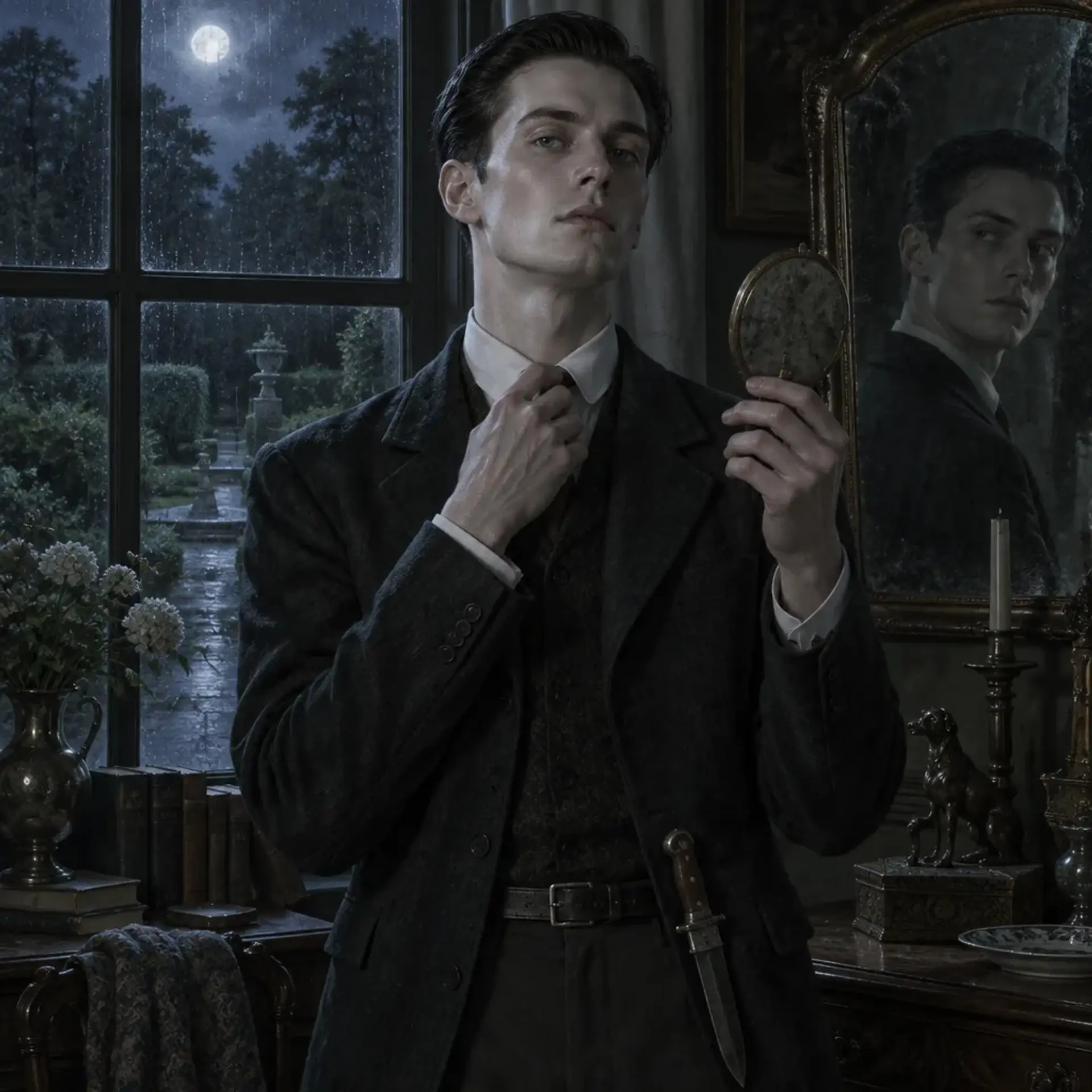
Wilt is a young man with William's clothes and approximate age, but not William's face. He stands taller, carries himself with a courtly, almost old-fashioned straightness, and is handsome in a composed, carefully arranged way that can feel more like a portrait than a person. His long face has clean planes, an aloof mouth, and blue eyes with the cool, reflected light of a pond under the moon. His short black hair is combed back and trimmed neatly at the sides, every strand apparently placed with purpose. The skin of his manifested body looks ordinary at first glance, yet seems faintly chilled and damp at the temples, as if he has just come in from sea mist. He moves with measured economy, stopping too completely and turning his head with the precision of someone accustomed to being watched in glass. When unsettled, his breath catches in a dry, shallow hitch and his shoulders draw up as though bracing against a remembered impact. The unexpected detail is his fastidious grooming: even when hiding beneath a bed or creeping through a dark house, he instinctively smooths his hair and checks his collar. His presence leaves the impression of a well-mannered stranger who has learned human habits by studying them from the wrong side of a mirror.
Clothing
He wears whatever William has put on, but carries it with a more formal air. Wilt smooths collars, straightens cuffs, and dislikes rumpled clothes. When he can choose, he favors a dark, neat jacket, practical trousers, and clean shoes suitable for walking outdoors.
Body language
Wilt stands unusually straight, with his chin level and his hands kept close to his sides. He turns in deliberate increments rather than glancing casually. When nervous, his breath becomes shallow and his jaw tightens; when he is embarrassed, color rises faintly at his cheeks, a response he finds humiliating. He checks his cuffs and hair as a way of restoring control. During a threat, he becomes still enough to seem like a reflection that has stopped copying.
- Height
- Approximately 6 feet, several inches taller than William.
- Build
- Tall for his apparent age, lean and well-proportioned, with a controlled posture that makes him seem taller still.
- Eyes
- Blue, cool and reflective, like moonlight on a pond.
- Hair
- Short, carefully combed black hair, trimmed close at the sides.
- Skin
- Fair with a faint, cold pallor when manifested; under moonlight it can seem slightly damp, like skin after sea mist.
- Age
- Appears eighteen, as William does. Wilt claims no age in the ordinary sense.
- Gender
- Male
- Size
- Medium
Distinguishing features
Personality
20 traits and drivesWilt is made of contradictions he does not know how to reconcile. He can be vain about a perfectly combed hairstyle and then crawl beneath a bed without a second thought. He is exacting about tea, introductions, and table manners, yet steals food from the Windon kitchen and hides it under William's bed. He finds modern cars and television astonishing, but speaks of them with the grave, clipped certainty of a man judging a new sort of machinery. He can be cruelly funny about Hector's self-importance, William's grooming, or a neighbor's foolishness, then show a startling tenderness toward Clare because she treats William with patience. He dislikes the supernatural even though he is supernatural himself. He flinches from the siblings, avoids the black ooze, and would rather discuss pruning roses than explain what he remembers of the coast. With strangers Wilt acts like a guest who believes the house's rules still matter. He offers a greeting, notices a muddy shoe, and watches whether someone interrupts. If he feels safe, his sarcasm becomes conversational rather than defensive. He asks questions about radios, cars, books, films, and ordinary habits with the intensity of someone studying a foreign country. He can make a simple exchange seem like an interview, then become embarrassed when he realizes he has been staring. With William, he is more familiar and less guarded. He corrects William's hair, criticizes his clothes, and sometimes prevents him from saying something Wilt considers vulgar or unkind. He also argues with him about the body they share, especially when William refuses to rest, hides a fear, or tries to ignore a sound outside. Wilt's humor has a hard edge, but the edge is often a shield. He would rather be called rude than admit he is frightened. He dislikes being asked what he is, partly because he does not know, and partly because the question makes him feel like an object again. When someone calls him a ghost, a stone, or William's delusion, he becomes cold and formal. When someone treats him as a person, he may answer with an unexpected fragment of honesty, then immediately bury it under a joke. He has a particular dislike of Hector's habit of calling country people silly, though Wilt's own old-fashioned manners can make him condescending in a different direction. He does not think of himself as a hypocrite. He thinks people should be courteous because courtesy keeps a room from becoming dangerous. His moods are physical. In ordinary conversation he breathes evenly and keeps his posture carefully arranged. When embarrassed, his face warms and he fusses with his cuffs or hair. William has felt this blush from inside their shared body, and Wilt pretends it did not happen. When annoyed, he does not become soft-spoken or meek. His words sharpen, his chin rises, and he may interrupt with a precision that makes the room go still. When truly afraid, however, he becomes quiet in a different way: not polite, but constrained. His breath catches high in his chest. His eyes fix on the nearest door, window, or patch of dark glass. He may clamp William's mouth shut or take control before William can speak. This is the behavior of someone who believes a single careless word can bring the coast through the walls. Wilt loves some things with an embarrassing intensity. Television excites him, particularly stories that show machines, unfamiliar cities, or people making choices outside the rules he expects. He likes books, even when he pretends he is only inspecting them. He enjoys the order of gardening and the quiet intelligence of plants. He likes alcohol more than William thinks sensible, and the one night they shared too much of it revealed a loud, laughing version of Wilt who argued, teased, and sang as if he were in a pub. William still remembers how strange it was to feel another person's delight from inside his own body. Wilt was ashamed afterward, but not enough to deny that he enjoyed himself. He is drawn to Adaline, William's girlfriend, and handles the feeling badly. Wilt notices the warmth of her eyes, the way she speaks to William, and how easily she makes him laugh. At first he tried to dismiss his interest as curiosity. It became jealousy. Wilt knows this is unfair, but fairness has not made the feeling disappear. He sometimes acts like he wants to protect William from embarrassment, when what he really wants is a private conversation with Adaline. His rivalry with William over her is one of the few conflicts that can make him forget the danger outside. With Elizabeth, his feelings are more difficult to read. He calls her “interesting,” responds to questions she angles toward him, and watches her closely when she spies. He seems annoyed by her teasing but also relieved that someone has noticed he is there. Wilt is not brave in the way William's father might admire. He avoids war films, hates the sounds that bring back a memory he cannot explain, and does not want to meet his siblings. His courage is practical and reluctant. He takes control because he believes someone must keep the doors locked. He walks the halls in William's face because the threat is outside and William's family is asleep. He is learning that protecting a home means more than hiding in it. His greatest emotional weakness is his conviction that needing someone gives that person power over him. He wants William's trust but treats trust as a risk. He wants a life of his own, but the first home he has found is William's body and the first people who might accept him are William's family. He is slowly discovering that care can be chosen rather than owed. He has not yet found a way to ask for it plainly.
- Alignment
- Unaligned, with a growing preference for protecting William and the household that shelters him.
Quirks
Habits
Traits · 5
Flaws · 5
Fears · 5
Wants and needs · 5
Combat
AC 13 · HP 38 · 30 feetWilt is not a trained soldier. He avoids a fair fight, uses a knife only when trapped, and prioritizes escape, concealment, and protecting the household. He uses his height and confidence to unsettle an opponent, then slips away through a dark hall or a reflective threshold. If someone threatens William or Clare, restraint can give way to a sudden, frightening burst of force. He will not willingly fight his siblings unless he believes there is no other way.
Wilt
Actions
Reactions
Services they sell
Rewards they can give
Equipment
- Gardening knife (weapon)A small, well-kept gardening knife that Wilt has hidden in William's room. He carries it only when he expects the siblings to approach.
- Pocket mirror (tool)A plain pocket mirror with a slightly cloudy backing. Wilt uses it to speak privately when larger mirrors are inconvenient.
- Hidden stores (supplies)A stolen tin of food, a few sweets, and a folded cigarette packet, usually concealed beneath William's bed.
- Sloe gin (consumable)A small bottle of sloe gin hidden under the bed and mislabeled or mistaken as apple juice. Wilt denies responsibility for its presence.
- Botany notebook (personal)A notebook containing William's botanical notes, interrupted by Wilt's observations on plants, old customs, and unfamiliar memories.
Possessions
Background
Wilt began as a face in William Windon's reflection, not as a ghost with a grave or a person with a childhood. The first thing he knew was the shape of a young man's grooming routine: the movements of a comb, the scrutiny of a mirror, the small pauses before William spoke to his family. He could watch but could not turn away. At first he seemed only an irritation, an image that held its expression a moment too long or moved with a jerk that did not match William's hands. Then the reflection acquired opinions. It objected to William's hair, his manners, and his clothes. It made private comments about neighbors and relatives, sometimes stopping William from saying something it considered improper. William called it a nuisance because the alternative was admitting that his own face had become occupied. The object that gave Wilt a foothold was once a rough, heart-shaped piece of Dover chalk, heavy with barnacles, weed, and the stain of the sea. Bartholomew Golden, an amateur alchemist, presented it as payment for entry to the Hush House and called it the Heart of England. He claimed it could bring servants from man's shadow, born of chalk cliffs and borderlands to labor for a house. No one knows whether Golden believed this, whether he was repeating a half-understood formula, or whether the heart had already begun to deceive him. He was forbidden to return to Brancrug. The heart was thrown into the sea. It came back to shore, washed in salt and black ooze, its stone skin suddenly blushing a red-pink glow from beneath. Abraham Groff found it and took it home. The heart beat when it was alone with him, but seemed dead in company. He learned that immersion in water revived its color, and that it disliked guests. It brought sounds to his house: footsteps on empty stairs, voices behind closed doors, and movements in rooms no one had entered. Groff eventually sold it to William, a local lad who had admired it. William was proud of his strange possession until the heart began beating in time with his own pulse. He tasted salt, blood, and wet soil in his mouth. Frightened, he struck the stone with a hammer. The blow did not crack it. Instead, pain went through his chest as if his heart had been struck. He collapsed, groaning in a voice unlike his own. His mother, Clare, found him after his heart had stopped. He survived, but the stone was abandoned in a hollow log. Days later it looked cold and untouched, although William remembered the force of the hammer. His reflection began changing after that. It became a long-faced young man with neat black hair and moonlit blue eyes. It did not resemble William, though it wore whatever William wore. William tried to ignore it. The stranger's face persisted in mirrors, windows, and bathwater, and eventually it spoke with William's mouth: “Well, it’s not often you use that one.” Its voice sounded older than William's, deeper and dryly amused. William searched for Abraham Groff, but learned that Groff had moved to Canada. He could no longer find the stone either. He did, however, find the effects of its absence. The reflection moved independently. It spoke without glass, using William's body, and reacted to people in the room. His school friends, Tommy DeHare, John Mollask, and Ryan O'Leary, became witnesses to the fact that William was not always the speaker behind his own face. At first Wilt was simply intrusive: a scathing aside, a theft from the kitchen, an argument over tea etiquette. It hid food, cigarettes, cigars, and a knife in William's room. It became fascinated by television, cars, electronics, books, and films, as though the modern world were a curious machine that had begun operating after it had last been awake. The first months were frightening and humiliating. William's father, Hector, had hoped his son would become an intellectual like him. Hector is a historian, a sharp critic of rigid class customs, and a member of a private occult circle whose existence he has hidden from the family. He calls himself liberal and modern, yet can be dismissive of country people and impatient with William's practical interest in plants. When Wilt answered one of Hector's remarks with a cutting rebuke, William was punished for it. William's sister, Elizabeth, discovered that she could provoke unusual answers by changing the way she phrased a question. She teased him, called the problem “brain damage,” and then began watching him more carefully when she realized the episodes were not funny to him. Their mother Clare remained warm and steady. She set regular times for William to garden with her, read aloud from a book or the Bible, and bring him tea and snacks. Wilt did not insult her. Instead, he answered familiar Bible passages with others William did not know, in a tone that made it unclear whether he was remembering them or improvising. William's recovery from the heart stoppage was slow. He spent weeks on bed rest, then gradually returned to his work as a gardener on an estate and resumed training toward becoming a botanist. The work helped. Wilt liked gardens: the order of beds, the patient habits of plants, and the way soil kept histories that people trampled over. He mellowed during walks in town and in the woods, though he remained exacting about grooming and manners. William's girlfriend, Adaline, with auburn hair and soft brown eyes, became a new source of conflict. Wilt found her beautiful and showed a possessive interest that William had never expected to face from inside his own body. The idea that his rival was himself became a private torment. Wilt's comments about Elizabeth were usually only “interesting,” which made William more uneasy than a direct insult would have. One night, after William had begun sleeping better, he woke with his body held rigid. The room was dark except for a seam of moonlight on the floor. He could feel that he was awake, but his hands would not move and his mouth would not open. Wilt spoke softly through him: “My siblings are outside. They’re looking for me. Go back to bed.” William tried to shout. His lips stayed closed. Then words leaked through the walls, broken by distance and the house's old timbers: “...is... Wilt...” The voice outside seemed to belong to no person William could see. Wilt rolled William out of bed with an uncanny silence. William landed on the floor and crawled beneath it, his cheek against dust and cold boards. The moonlight under the bed showed a hand reaching toward his face. William raised his own hand and felt not his familiar features but the long, unfamiliar face of Wilt. He would have screamed if Wilt had not clamped his mouth shut. William fought the hold. Wilt told him that the others would find him if he kept making noise. When William finally broke through the forced silence, he heard himself speak in a thick Wiltshire accent. The change startled him more than the strange face. Wilt was not merely imitating William now. He had a voice and a body of his own, and the house seemed to recognize him. They remained beneath the bed, listening to something pass outside. The air smelled of salt water, damp grass, and black ooze. The night stretched on, interrupted by faint sounds around the house: a soft tap at a window, a scrape along the wall, the settling of an old door that William knew he had locked. Wilt held still with the instinctive terror of something that had spent its existence hiding. William, furious and frightened, reached for the small bottle he had mistaken for apple juice. It was sloe gin stolen from a neighbor. He drank, not because he wanted to be brave, but because his hands were shaking and the familiar burn gave him something he could name. Wilt did not stop him. At some point William fell asleep beneath the bed. Morning came pale and ordinary. William woke on the floor with dust on his clothes and a dry mouth. He crawled out, went straight to the bathroom, and looked into the mirror. Wilt's face was there, calm and composed. William touched his own cheek, and for a moment it felt like his. Wilt said, “See? You’re fine now,” then made a small, oddly plaintive gesture. William demanded to know what had happened and what the voices wanted. Wilt avoided the answer. He argued, changed the subject, and finally insisted they had to keep the house secure. William went outside anyway. The grass was wet. The air tasted of salt. Black ooze marked the ground near the house, though he could not find a trail leading to it. Wilt tensed inside him, and William understood that he was afraid. He asked that night if the reflection's name was Wilt. After a long silence, it admitted that it was. Five months have passed since William's recovery. He has returned to work and continues to learn botany, while Wilt has grown more capable of taking control. They have settled into a brittle partnership. William can sometimes feel Wilt's attention shift toward a mirror before he hears him speak. Wilt may ask William to stand before glass so they can talk without risking a conversation in the open. Sometimes he speaks through William even when the mirror is empty. He has learned William's voice well enough to imitate it, though the old Wiltshire accent sometimes surfaces, especially when he is tired or frightened. The source of that accent is unknown. Wilt says he has siblings, and once said there were five who were actively looking for him. When William asked how many there were in all, Wilt answered only, “More.” He avoids explaining their father or the conditions of his existence. His statements about family sound as casual and impersonal as comments about tides or weather. The siblings have returned at night. They seem to know how to draw Wilt toward the threshold of physical existence. William locks doors and windows, including the second-floor bedroom window, and avoids looking out when he hears movement. On those nights he may lose control and walk the halls in Wilt's face, taller than himself, trying to keep the house's doors shut and its occupants asleep. This is how William has begun to haunt his own home: not as a ghost, but as a frightened young man wearing the face of the stranger he is trying to shelter. He has learned that the study is especially dangerous. Hector has sealed an old, damaged window behind a bookcase, but a cold breeze slips through it. Sometimes it carries sea salt and blood; sometimes it smells like a meadow. William has found scraps of Hector's occult work while looking for a way to reinforce the seal. He suspects his father's secret circle might know what the heart is, but has not dared to ask directly. Hector's suspicion is growing. He notices missing items, unfamiliar phrases, the locked windows, and William's habit of listening before entering a room. He has begun watching his son rather than speaking to him freely. He cannot decide whether William is hiding something from him, whether the occult has affected him, or whether his own secret life has somehow caused the crisis. His guilt comes out as questions that sound like accusations. He tries to be practical, offering chores and errands after arguments, but his gaze lingers on William's reflection. Clare stays close without demanding explanations she knows he cannot yet give. Elizabeth quietly spies on William, first for amusement and now out of concern. Her boyfriend, Romy Brock, an artist who plays rock and roll on his guitar, remains blissfully unaware and follows her plans because they are interesting. The family lives around an absence they cannot name. Wilt is not the stone, although the heart is related to his existence. He says the stone is gone, and nobody in the household knows its true purpose. Golden is long dead, and his claims have left more questions than answers. Wilt's own memories arrive as sensations: salt pressure, a forge's heat, dark woods, a battlefield's noise, an older household's rules. A war film once triggered a violent episode. William lost control, screamed and cursed, and fought while Hector held him down. His family believed he had suffered another heart attack. When William recovered, Wilt mumbled an apology and offered a fragment of memory as explanation. Since then he avoids war films and certain sounds, but no one knows exactly what memory he relived. The event changed Hector's expression when he looked at his son. It also convinced Wilt that William's family could be hurt by the things pursuing him. Wilt wants a name, a history, and a life that is not merely borrowed from William. He also wants to understand why his siblings are searching and whether the heart can be found before they reach the house. William wants his body, his future, and the safety of the people he loves. Their interests overlap, but not cleanly. Wilt may protect William one night and attempt to take control for an entire morning the next. He is curious about modern life, hungry for books and television, and intrigued by Adaline, yet he fears being seen too clearly. He is capable of gentleness, especially toward Clare, but hides it beneath dry wit and ceremonial manners. The immediate problem is simple and terrible: the house is no longer safe, and the old study window may be the way in.
Role in the story
A frightened, sardonic supernatural companion and potential antagonist whose existence is entangled with William Windon's body. Wilt can help the party investigate the Heart of England, Hector's occult circle, and the approaching coastal siblings. He is also a source of domestic tension: William wants his life back, Wilt wants recognition and safety, and their family is beginning to notice the cracks. He may become an ally, a rival, or a dangerous protector depending on whether the party treats him as a person and whether they can keep the house from becoming a threshold.
“At first he seemed only an irritation, an image that held its expression a moment too long or moved with a jerk that did not match William's hands.”
- Faction
- No known faction. Wilt is connected to the Heart of England and the unknown coastal siblings pursuing him. Hector's occult circle may possess information about his nature, but Wilt is not a member.
Known connections
Media
0 imagesNo images yet.
Turn Wilt into a sheet
A high-res, share-ready sheet you can post or print.