William Windon
William Windon
At the table
Voice
William's voice is a little breathy from recovery, with a slight catch before difficult words and the grounded rhythm of rural Wiltshire. He clears his throat when unsettled. Wilt's voice comes from the same body but carries a deeper pitch, deliberate pauses, and an older regional accent. When he is frightened, William's breathing becomes shallow and Wilt's voice can arrive over it, making the words seem to come from two intentions at once.
William's voice has the breathy catches of someone recovering from illness and the everyday Wiltshire cadence of a young man who has spent more time outdoors than in lecture rooms. He sometimes clears his throat before speaking, especially when anxious, and his breathing becomes shallow when he sees someone waiting outside a window. Wilt uses the same mouth but changes its timing: crisp consonants, longer pauses, and a deep, older-sounding Wiltshire accent. His words often sound like a considered verdict. When rattled, William's breath catches while Wilt's voice presses through it, producing an unnerving overlap. Wilt does not become softer or more polite when angry; his delivery gets more exact, and his insults more carefully chosen.
Speech patterns
How to play them
Approach William gently and speak to him as a person, not as a mystery or a patient. He responds best to practical conversation, gardening, and direct questions that leave room for him to refuse. Do not assume Wilt is a symptom or a possession with no agency; Wilt has opinions, memories, and independent preferences. If Wilt appears, establish boundaries clearly, especially around control of William's body and his relationships. Offering help with the missing heart or the old study may earn trust. Threats toward the family are likely to make William desperate and Wilt dangerous.
Goal
Discover what the heart made Wilt, learn why Wilt's siblings are searching for him, and keep his family safe without surrendering his own life.
Motivation
William wants safety, answers, and the chance to return to an ordinary life of gardens and study. Wilt wants to avoid his siblings, preserve his independent existence, and explore the strange modern world he has inherited through William.
Appearance
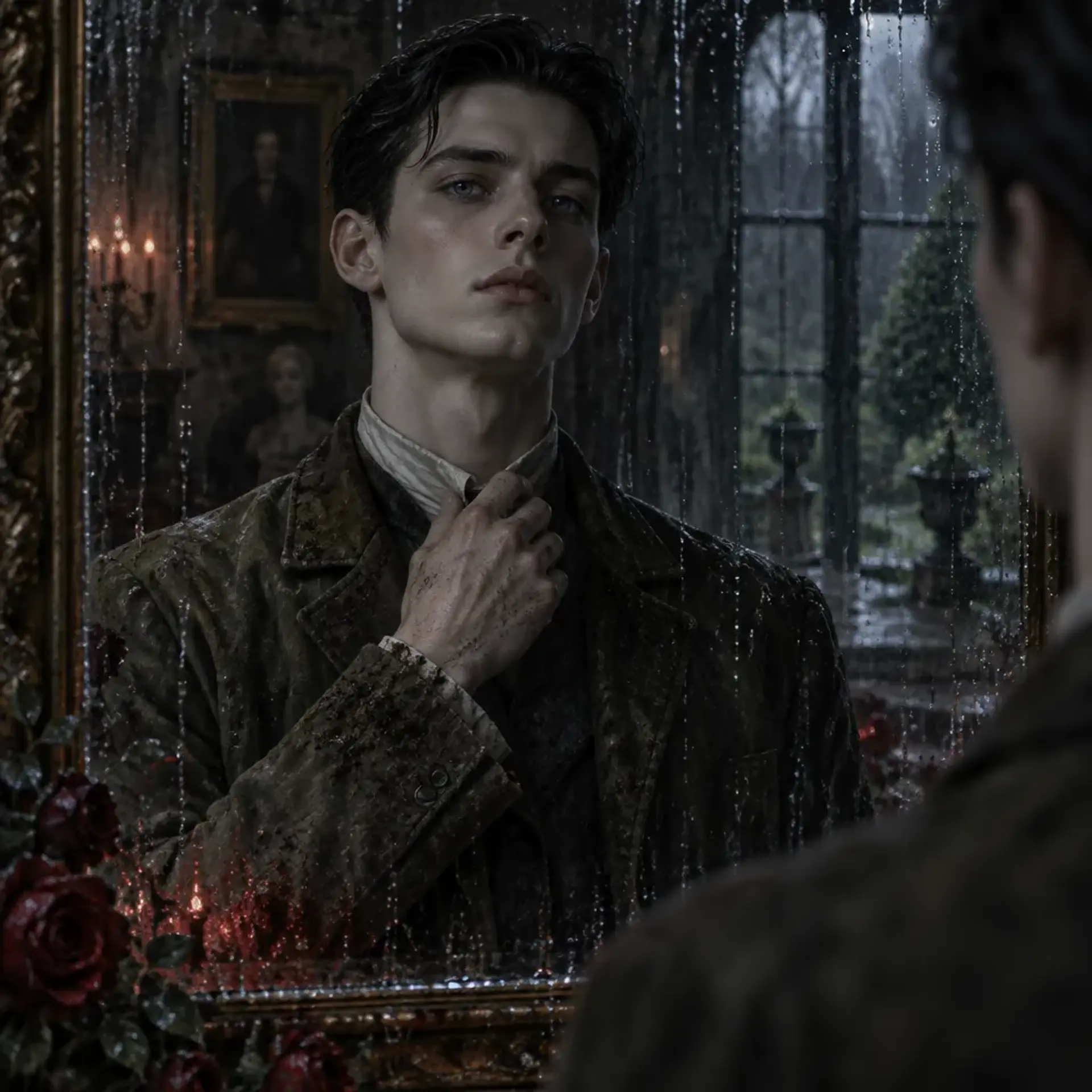
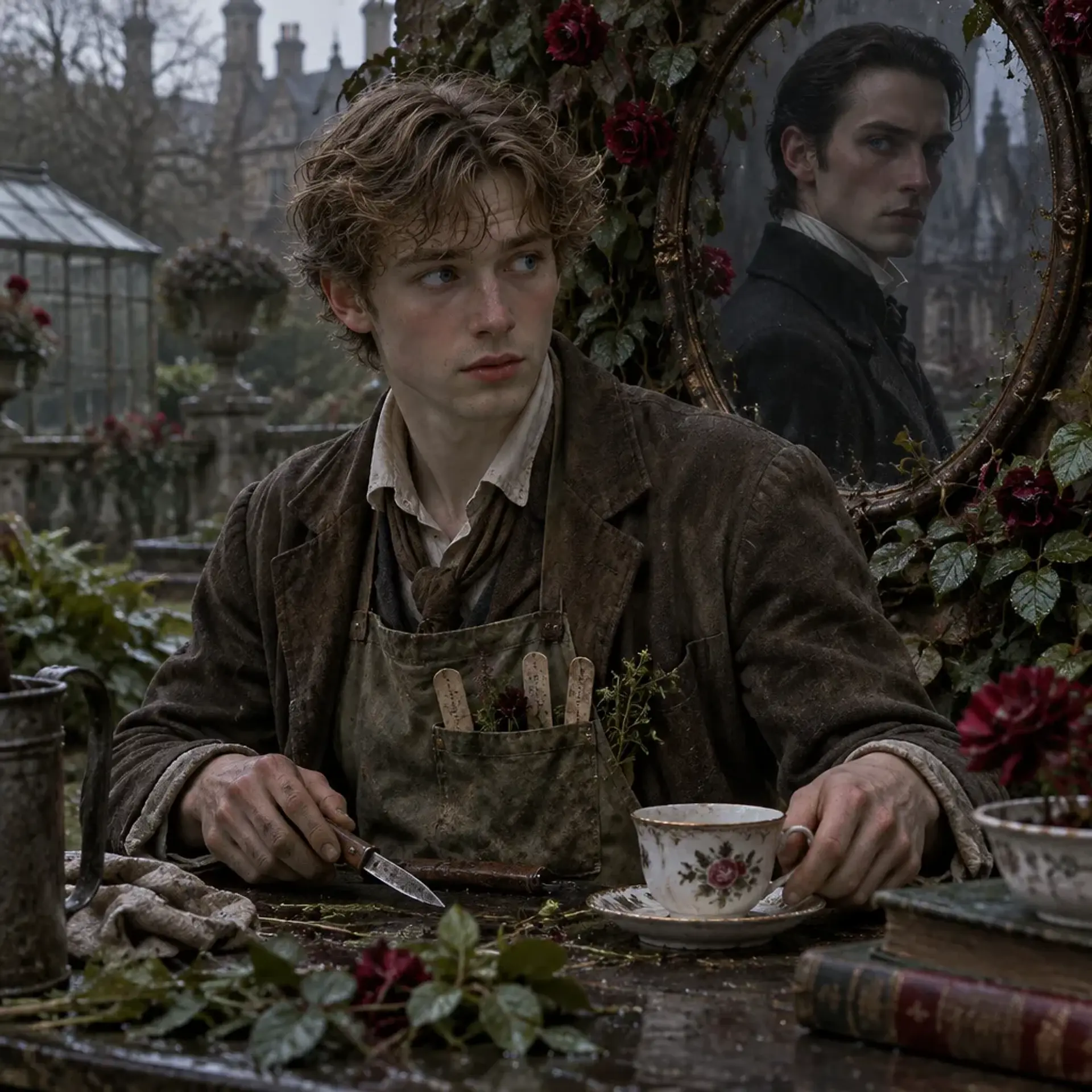
William is a young Wiltshire man with a soft, open face, blue eyes, and dark-blond hair that refuses to stay neatly combed through a day's gardening. He is shorter than Wilt and carries a little softness in his shoulders, as if he has learned to make himself unobtrusive. His hands show soil in the creases and small, ordinary nicks from gardening tools. Wilt's face, when it replaces William's in glass or takes control, is not a copy: it is longer, more formally handsome, and held in an aloof, stern expression. His short black hair is carefully combed back with the sides trimmed, and his blue eyes have the cold gleam of moonlight on a still pond. Wilt stands taller, moves with economical certainty, and makes even borrowed clothes appear to have been chosen deliberately. In moonlight, black brine sometimes beads along his cuffs and hairline, carrying a faint smell of seaweed and wet chalk. The surprising detail is that the supposedly stern, ancient-seeming presence becomes visibly absorbed by television, especially cars, machinery, and ordinary modern devices; its attention can be caught by a remote control as readily as by an occult text.
Clothing
Practical shirts, wool jumpers, work trousers, and boots marked by garden soil. William dresses for comfort and work. Wilt prefers the same clothes worn neatly, with collars straightened and cuffs aligned. He has occasionally hidden stolen items in William's coat pockets.
Body language
William tends to tuck his chin and hold his hands close when uncertain. Wilt straightens his spine, squares the shoulders, and turns his head with measured precision. When control shifts, William's breathing catches, his jaw sets, and his gaze fixes on the nearest reflective surface. On dangerous nights he moves low and silently, sometimes crawling under furniture rather than risk being seen through a window.
- Height
- William: about 5 ft. 9 in. Wilt's apparent form: about 6 ft. 1 in.
- Build
- William is lightly built and a little shorter than average; Wilt's apparent form is taller and carries itself with a lean, formal elegance.
- Eyes
- William's are clear blue; Wilt's are a colder blue, like moonlight on a pond.
- Hair
- William's dark blond hair is practical and untidy; Wilt's is short, black, slicked back, and neatly trimmed at the sides.
- Skin
- Fair, with a weather-reddened cast after working outdoors. During Wilt's manifestation it can look unnaturally cold and damp, as if moonlight has drained the warmth from it.
- Age
- 18 years old; William and Wilt both appear approximately 18.
- Gender
- Male
- Size
- Medium
Distinguishing features
Personality
20 traits and drivesWilliam is warm and sensitive, but not helpless. He notices when other people are uncomfortable and tries to make room for them, yet can become stubborn when someone dismisses his experience as foolishness. He is curious enough to investigate the heart and the study even after being frightened, while also wishing he could go a week without anything uncanny happening. He dislikes arguments and often gives people the benefit of the doubt; when his family is threatened, that gentleness turns into a quiet, immovable refusal to cooperate. Wilt pulls in the opposite direction. He is controlled, proud, exacting, and frequently funny in a dry, cutting way, but he is not simply cruel. He has moments of genuine protectiveness, especially when he believes a person is being mistreated or a custom is being carelessly discarded. He can be unexpectedly embarrassed, tender, or delighted by a television program, a car, or a well-kept garden. He takes manners seriously, yet breaks rules whenever he believes his own purpose warrants it. He may scold William for being improper, then hide stolen alcohol under the bed. Their moods vary with company. Around Clare, Wilt is restrained and will answer religious passages with unexpected familiarity. Around Hector, he is sharp and openly disrespectful, especially when Hector mocks rural people or old customs. Around Elizabeth, he can be amused and unnervingly perceptive, sometimes answering her directly. Around Adaline, he becomes competitive and attentive, making William feel like a rival to himself. When the siblings are outside, both are frightened: William tries to reason and resist, while Wilt becomes urgent, controlling, and focused on silence. In safe moments, they bicker over grooming, television, clothing, and what counts as a proper cup of tea.
- Alignment
- Neutral, with William's instinctive compassion in conflict with Wilt's strict, antiquated notions of propriety and ownership.
Quirks
Habits
Traits · 5
Flaws · 5
Fears · 5
Wants and needs · 5
Combat
AC 11 · HP 27 · 30 ft.William avoids violence and tries to flee, protect bystanders, or talk an opponent down. Wilt is more calculating, uses the environment, and may try to frighten a pursuer with Voice from the Glass. Neither is a practiced combatant. If cornered, they use a pocketknife only to create an opening for escape. The statistics represent a level 5 story character rather than a conventional player character; the custom possession features are narrative and should be adjudicated by the DM.
William Windon
Actions
Reactions
Services they sell
Rewards they can give
Equipment
- Pocketknife (weapon)A small folding knife that Wilt once stole and hid in William's coat. William dislikes carrying it.
- Gardening gloves (tool)A work-worn pair of gardening gloves with soil ground into the seams.
- Field notebook (possession)A small notebook containing plant observations, scraps of occult notes, and questions about the heart.
- Shed key (possession)A key to the estate garden shed, useful for tools and shelter but not a weapon.
- The Heart of England (story object)The heart-shaped chalk stone is missing. It may be found near the coast, in the hollow log, or wherever the DM places it.
Possessions
Background
William Windon was born in Wiltshire into a family that had lived among its lanes, fields, and old stone walls for generations. He grew up kind, observant, and more interested in living things than in the arguments his father brought home from London. He could spend an afternoon watching a beetle work its way through a garden bed and then remember the plant beside it weeks later. His father, Hector, is a historian with a modern, skeptical manner and a deep dislike of rigid social hierarchies. Hector's own father, remembered by the family as Bobby, was a fierce veteran of the Second World War. Hector has spent much of his adult life rejecting the old man's attitudes, sometimes so forcefully that he has little patience for anyone who seems to prefer old rules to new ideas. William absorbed both his father's curiosity and his unease with his contempt for the past. He wanted a life among plants, not a life spent proving that he was clever enough for Hector. William works as a gardener on a local estate and has been training himself toward the study of botany. He knows how to prune without damaging a plant, how to judge whether a bed has been overwatered, and how to find the small signs that a season is turning. He is not a great scholar yet, but he is patient enough to become one. His mother, Clare, has been his most reliable ally. During his recovery she set regular times for them to garden together, reading from a book or the Bible while he worked and bringing him tea and snacks. She does not demand explanations he cannot give. Her steadiness has helped him feel like a person rather than a patient or a puzzle. The trouble began with a stone shaped like a human heart. It had once been brought to the Hush House by an amateur alchemist, Bartholomew Golden, who called it the Heart of England and claimed it could summon inhuman laborers from the chalk cliffs and borderlands. The object looked like a piece of Dover chalk crudely carved into an anatomical heart, crusted with barnacles and sea grass. Golden left it as payment for entry and was never allowed near Brancrug again. The stone was thrown into the sea, then returned to shore with salt water and black ooze on it. Beneath its pale crust a red-pink color seemed to glow like blood returning to a body. Abraham Groff, a young man from London, found it and took it home. The heart seemed to die whenever other people looked at it, then revive when it was brought to the Hampshire shore and submerged. Abraham became convinced it was special and belonged to him. He was not simply greedy; he sensed that it disliked company. Strange voices, footsteps, and moving doors followed it through his house. Eventually Abraham sold it to William, one of the local young men who had seen it before it appeared to die in company. William treasured the oddity at first, showing it to neighbors and treating it as a curiosity. Later, after it began to beat in sympathy with his own chest, he grew afraid. William tasted salt, blood, and soil in his mouth. He thought the stone might be broken with a hammer. When he struck it, pain tore through his chest as if the blow had landed on his own heart. He collapsed, groaning in a voice that was not quite his, while the stone seemed to twitch beneath its crust. His mother found him after his heart had stopped. He woke again, but the event left him frightened and physically fragile. He hid the stone in a hollow log. Days later it was pristine and cold, apparently unharmed by the hammer. William tried to return to ordinary life, but his reflection no longer belonged to him. At first the stranger in the mirror only differed in small ways. It was a handsome, long-faced young man with slicked-back black hair and moonlit blue eyes, not William's own face. William's reflected posture seemed to have a private intention. It could look stern while he was only grooming himself, or jerk away as if it wanted to leave the mirror's frame. One night, while William was doing his bedtime routine, the reflection spoke through his mouth: “Well, it's not often you use that one.” Its voice sounded like an older generation, with a deeper pitch and a Wiltshire accent that seemed older than William's own. The stranger commented on his hair, his clothes, and his manners. It sometimes stopped William from saying things it considered improper, then made cutting comments of its own when it believed no one else was listening. William's friends Tommy DeHare, John Mollask, and Ryan O'Leary visited, and the reflection reacted to them as if it were a person sharing the room. Its presence became harder to dismiss. William's sister Elizabeth noticed that changing the wording of questions could make her brother answer in a different manner. She jokes that he has “brain damage,” but the joke has grown less convincing as she has become genuinely concerned. She watches him when she thinks he cannot see her. Romy Brock, Elizabeth's boyfriend, is an artist who plays rock and roll guitar and remains blissfully unaware of the full truth. William's girlfriend, Adaline, with auburn hair and soft brown eyes, became a different kind of problem: Wilt saw her and wanted her. William had never imagined that his most determined romantic rival would be the presence sharing his own face and body. A war film on television revealed that Wilt's history was not merely a collection of odd opinions. William suddenly lost control of his body. He shouted, fought, and cursed as if reliving an old terror. Hector and Clare believed his heart had failed again. Hector held him down while Elizabeth changed the channel, frightened and wide-eyed. When William regained control, Hector looked at him differently. Wilt later offered a mumbled apology and a memory as consolation, but the memory was difficult to understand: salt, dark woods, forge heat, and the blunt terror of a conflict that did not belong to William's life. Wilt avoids certain scenes and sounds now. He has begun to explain himself in fragments, though he often describes people and history as if they were weather, soil, or work at a forge. William's illness required bed rest, and his father's worry initially came out as anger. Hector left scotch and bourbon for William's health by mistake or poor judgment. Wilt drank it, and one night William experienced the ridiculous spectacle of the presence becoming drunk. Wilt argued, teased, smiled, shouted, and sang as if they were together in a pub. It wanted to take off William's shirt in an act of rebellion, but they agreed that would be too much. In the morning Clare found the empty bottle and told Hector. Hector shouted, then quieted and offered William chores around the house, unable to find a less awkward way to care for him. Clare has kept her tea-and-garden routine with him ever since. Wilt is particularly respectful toward her, answering Bible passages with quotations William does not know. He can be strict about tea-time etiquette and old customs, which irritates Hector, who regards such rules as relics. Five months have passed since William recovered enough to return to work at the estate. The routine of gardening, walking through town, and exploring the woods has eased some of Wilt's agitation. Wilt has become fascinated by cars and electronics, and comments on television with the ardor of someone encountering a new world. It steals cigarettes, cigars, cheese, sweets, tinned fish, and tools, hiding them in William's room. Once William discovered a bottle labeled as apple juice that turned out to be sloe gin. Wilt has also hidden a knife in William's coat. William does not know when the items are taken; he finds them afterward and has to decide whether to confront a presence that shares his hands. The worst change came on a cold night when William woke unable to move. Wilt held his mouth shut and told him, very quietly, that his siblings were outside looking for him. Beyond the walls came words and sounds that William could not make out, as if someone were calling from the dark. Wilt said that the more it spoke, the more likely they were to find it. William tried to resist. His body rolled from the bed and slid beneath it, silent and rigid. When he forced his voice through, it came out with a thick Wiltshire accent. He asked, “Your siblings?” Wilt warned him to be quiet, but William felt someone else's face under his own hand and knew he was not dreaming. They stayed under the bed while moonlight crossed the room. William reached for a bottle he believed was apple juice, discovered the sloe gin, and drank from it with the stolen knife near his hand. The fear and exhaustion blurred together. He fell asleep under the bed. In the morning he pushed himself out and went straight to the bathroom mirror. The stranger was still there. William touched his own face and felt his familiar features again. Wilt told him, “See, you're fine now,” with an oddly plaintive gesture. William demanded an explanation. Wilt evaded the question, and William went outside to inspect the ground. The night had left the smell of salt water, damp grass, and black ooze. Wilt wanted to hide. William made himself look around anyway. William asked, calmly and directly, whether the reflection's name was Wilt. After a long pause, it admitted that it was. Wilt said only five siblings were actively searching, then added that there were “more.” The siblings appear at night, seeking Wilt and finding ways to make him tangible. They seem to know how to wake him into the world. When they pass close to the house, William sometimes loses his own face and takes on Wilt's height and features. The sensation is not a costume or a simple disguise. His limbs move differently, his voice changes, and he can feel the house around him as if it were a place he once knew. He has begun haunting his own home in Wilt's face, hiding from his family and working to keep the searchers from getting inside. Hector has become increasingly suspicious. He notices doors secured at odd hours, the disturbed study, missing household objects, and William's habit of avoiding the old window hidden behind a bookcase. The window is damaged and was sealed by Hector, who knows more about the occult than he has told his family. He belongs to an occult circle and did not know what the heart was, though he recognized it as unnatural. Hector's private interests are one reason he has always wanted William to become an intellectual like himself. Now he fears that William may have stumbled into an occult danger, or that his own secret activity has somehow invited it. He is guilty and suspicious at once. He watches William with the careful attention of a man trying to catch a lie while hoping he is wrong. William has found hints of Hector's occult work in the study. At night he searches for answers without waking his parents, keeping the windows and doors firmly closed. The old window behind the bookcase lets in a faint breeze. At times it smells of salt and blood; at others, of a meadow after rain. William does not know how well Hector sealed it. Elizabeth has heard William speak to himself and spies on him less for amusement now than for fear. She has learned that Wilt will sometimes answer her directly if it thinks she is speaking to it. Wilt finds Elizabeth “interesting,” a word it uses with unsettling frequency. Clare remains warm and composed, though she has surely noticed more than she says. Adaline is still at the edge of this crisis, while Wilt's possessive fascination makes William afraid to let them meet alone. The heart itself is missing. William wants to find Abraham Groff, but learned that Abraham moved to Canada. No one living knows the heart's true purpose or name. Only Bartholomew Golden, now long dead, apparently understood the claim he made about it. William is no longer certain he wants to separate from Wilt without knowing what would happen to either of them. He wants to protect his family, learn why the siblings are hunting Wilt, and keep his own life from being consumed by the mystery. For now he works by day, follows clues by night, and listens for footsteps in the dark. The house is his home, but on the nights the searchers come, he moves through it as a stranger wearing Wilt's face.
Role in the story
A vulnerable but resourceful ally, mystery, and potential complication. William needs the party's help investigating the missing heart and keeping the searching siblings out of his home. Wilt can provide a second perspective and unsettling information, but his independence, possessiveness, and fear of his kin create conflict. The party may have to decide whether separating them is rescue, murder, or something neither of them understands.
“He grew up kind, observant, and more interested in living things than in the arguments his father brought home from London.”
- Faction
- No known formal faction. Hector is secretly part of an unnamed occult circle, but William does not know its membership or purpose.
Known connections
Media
0 imagesNo images yet.
Turn William Windon into a sheet
A high-res, share-ready sheet you can post or print.