Lord Callum Carver
Lord Callum Carver
At the table
Voice
A sturdy, slightly rough voice shaped by years of speaking over work and battle noise. It has a dry edge at the end of long days and an unforced warmth when he speaks to someone he trusts. Before he speaks, he usually draws a brief breath through his nose and clears his throat once, a small habit people notice quickly.
His words carry the clipped practicality of someone used to giving instructions over hammering, cart wheels, and battlefield noise. He begins with a short intake through his nose and a faint throat-clear before speaking, as if lining up the sentence like a board before cutting it. He does not decorate an answer unless he is attempting court manners, when he becomes stiff and overcareful. Anger makes him more direct and more specific, not quieter: he names the action, the consequence, and who must answer for it.
Speech patterns
How to play them
Approach him with a concrete problem and he will listen, especially if someone vulnerable is involved. He is wary of flattery, vague promises, and anyone who speaks for workers without having spoken to them. He responds well to candor, practical proposals, and people willing to share risk. He can be persuaded by evidence and clear terms, but pressure framed as an appeal to his new status will make him stubborn.
Goal
Stop the riverside clearances without becoming a noble's convenient hero-story, and learn enough of his new office to protect people through the law as well as through a sword.
Motivation
Callum wants to make the authority placed in his hands useful to ordinary people, while proving to himself that he can learn a new kind of service without surrendering his judgment.
Appearance
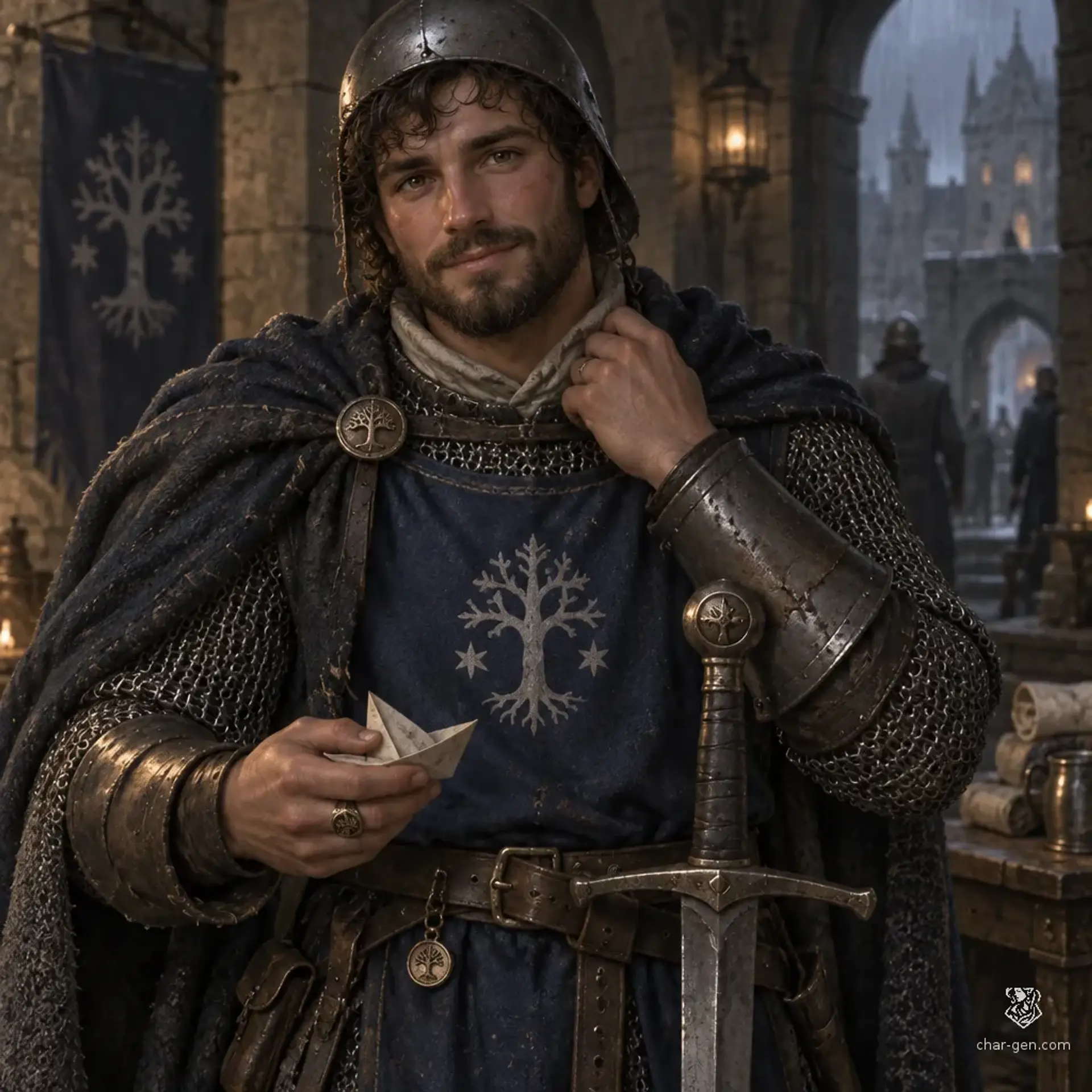
Lord Callum Carver looks like a man who was interrupted halfway through a hard day's work and handed a lord's seal. His brown curls spring loose around his temples, usually flattened on one side by his helmet, and his trimmed beard is thickest along a broad, square jaw. His teeth are slightly crowded, noticeable when he chews thoughtfully or breaks into a sudden, disarming laugh. He moves with a laborer's economy: shoulders forward, weight set as if bracing a beam, then a startlingly quick turn when danger shifts. His unexpected softness is an almost fussy habit of folding discarded scraps of paper into tiny boats, which he sets afloat in gutters when he thinks nobody is watching. He leaves an impression of sturdy warmth under the polished armor, like a workbench somebody has tried to dress for court.
Clothing
A serviceable mail shirt beneath a dark blue surcoat bearing a modest, newly granted device. His cloak is good wool but repeatedly mended at the hem. For court he wears a stiff collar that he keeps tugging away from his throat, and his boots are meticulously cleaned but visibly resoled.
Body language
Callum stands as though he expects to take the weight if a shelf gives way. He squares himself toward whoever is speaking, keeps his hands open when negotiating, and rubs a thumb along the seam of his belt when caught off guard. In combat his feet are surprisingly light, with short, exact adjustments that make his heavy armor seem to follow rather than hinder him.
- Height
- 5 feet 11 inches
- Build
- Broad-shouldered and powerfully built from years of manual labor, with a thick neck and the compact balance of someone accustomed to lifting awkward loads.
- Eyes
- Hazel brown, usually intent on the person speaking rather than the room's important decorations.
- Hair
- Brown, curly, and often flattened by a helmet.
- Skin
- Weathered light olive, reddening readily across the nose and cheeks after a long day outdoors.
- Age
- 28
- Gender
- Male
- Size
- Medium
Distinguishing features
Personality
15 traits and drivesCallum is humble without being meek and honest without being tactful. He is patient with people doing difficult work, but impatient with people who use polished speech to hide responsibility. In a quiet room he can be warm, awkwardly funny, and unexpectedly attentive; in a council chamber he becomes guarded and blunt. When frightened for someone else, he turns decisive. When the danger is to himself, he is more likely to make a joke and keep working than admit he is afraid.
- Alignment
- Lawful good, though his faith in institutions is thin; he trusts specific people and kept promises more than titles.
Quirks
Habits
Traits · 4
Flaws · 4
Fears · 3
Wants and needs · 4
Combat
AC 18 · HP 130 · 30 feetCallum tries to place himself between danger and bystanders, using his first attacks to disrupt the enemy most likely to break through. He uses Arresting Line to pin a mobile threat and Hooking Current to drag an enemy away from a vulnerable ally or into reach. Impossible Footwork lets him reposition after a hit without allowing that target to punish the movement. He saves his reaction for Predatory Awareness when a dangerous attack threatens an ally or himself. He reserves Sovereign Cut for a decisive opening, not a show of force. If civilians are in danger, he prioritizes evacuation and control over finishing an enemy.
Lord Callum Carver
Actions
Reactions
Services they sell
Rewards they can give
Equipment
- Greatsword (martial melee weapon)A well-maintained greatsword with a plain crossguard and a grip rewrapped more than once. Its blade carries a restrained, cold shimmer when he spends an Awakened Edge use.
- Heavy crossbow (martial ranged weapon)A serviceable heavy crossbow for threats beyond his sword's reach.
- Chain mail (armor)A fitted suit of chain mail, polished for public appearances but marked by field repairs.
- Lord's signet (insignia)A small signet bearing the recently granted device of his lordship, which he still handles as if it belongs to someone else.
- Workman's kit (tools and personal effects)A whetstone, sewing needle, spare bootlace, and folded notes listing practical questions to ask at city meetings.
Possessions
Background
Callum Carver grew up hauling timber and repairing carts outside a market town, the eldest child of a wheelwright who taught him that a job unfinished is a promise broken. He enlisted young, first as a camp laborer and then as a soldier who could hold a breach. At the Battle of Dawnshires Keep, a collapsing gate trapped defenders and civilians in the lower passage. Callum disobeyed an order to fall back, wedged his sword into the gate's gearing, and held the gap long enough for the trapped people to escape. The act earned him a knighthood, but the officer who issued the order to retreat later quietly endorsed his promotion, hoping to turn the inconvenient hero into a useful symbol. Callum was then granted a minor lordship and assigned to Rexxentruum, where he now has a cramped residence, a ceremonial title, and no working knowledge of the city's elaborate courtesies. He writes regularly to his younger sister, Tamsin, who runs their late father's workshop, and sends money to the family without mentioning that it is often short. His former sergeant, Olek, remains a blunt and trusted adviser. Callum's current problem is that city factions want his public approval for a redevelopment scheme that would displace poor families from the riverside. He distrusts their fine language, but the law and the local power brokers are new territory, and he has not yet learned how to oppose them without putting his post and the people he means to protect at risk.
Role in the story
A newly elevated local power who can become a principled ally, a target of political manipulation, or a test of whether the party supports reform through institutions or outside them. His military past gives him credibility, but his inexperience leaves room for the characters to teach him, challenge him, or help him uncover the truth behind the city's plans.
“He enlisted young, first as a camp laborer and then as a soldier who could hold a breach.”
- Faction
- Recently appointed lord and knight in Rexxentruum; formerly served in the force that defended Dawnshires Keep. He has no settled allegiance to a city faction.
Known connections
Media
0 imagesNo images yet.
Turn Lord Callum Carver into a sheet
A high-res, share-ready sheet you can post or print.