Oswin Hirst
Oswin Hirst
At the table
Voice
Oswin speaks from a chest and throat conditioned by cold mornings, calling sheep, and years outdoors. His voice is roughened by wind and smoke, with a broad Yorkshire cadence and a dry, deliberate humor. He does not become softer when angry; instead, his consonants grow hard and his sentences shorten. In his headless shape, the same voice seems to come from just behind the listener.
His words have the blunt, work-worn rhythm of a Yorkshire farmer, shaped by a lifetime of wind, wool, and speaking over livestock. Old Norse and Anglo-Saxon sounds sometimes slip into his phrasing. He laughs dryly at his own absurd stories, but when using a forbidden tongue his mouth forms crisp, unfamiliar consonants and he cuts himself short.
Speech patterns
How to play them
Meet suspicion with useful work, practical hospitality, and carefully chosen truths. Be gentle with anyone who treats William patiently. If asked about the wedding night, Oswin deflects at first; if Mary is endangered or directly confronted with evidence, his evasions become strained and the red-eyed form may show. Give players a chance to earn his trust by protecting the family without treating William as a monster.
Goal
Keep Mary and William safe, preserve the farm, and find a way for his family to live without fear of his nature or the boundary's claims.
Motivation
Love has given Oswin a home, but it has also made him afraid of being known. He wants Mary and William to stop fearing the dark and the fair folk, yet cannot bring himself to admit that his own lies helped make that fear.
Appearance
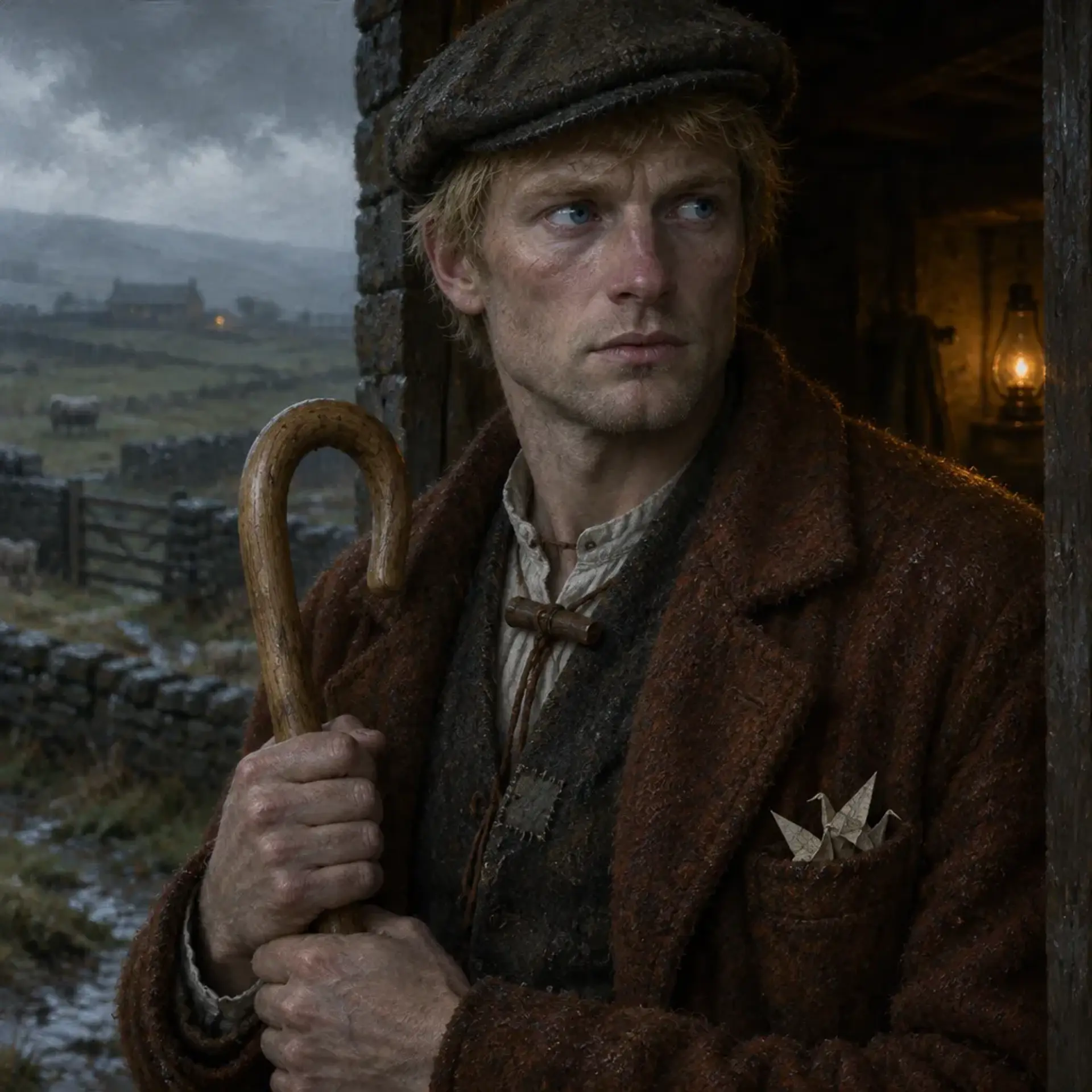
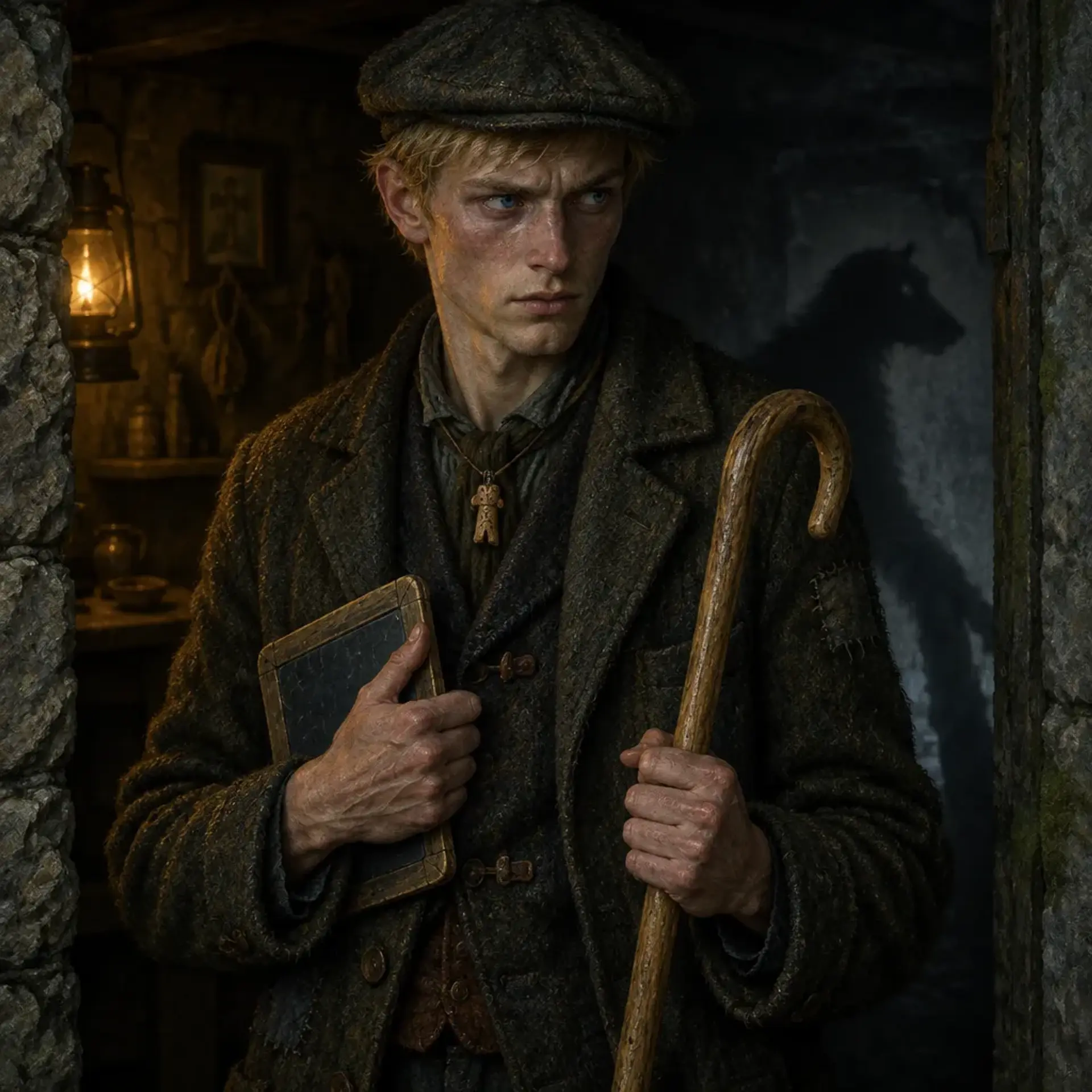
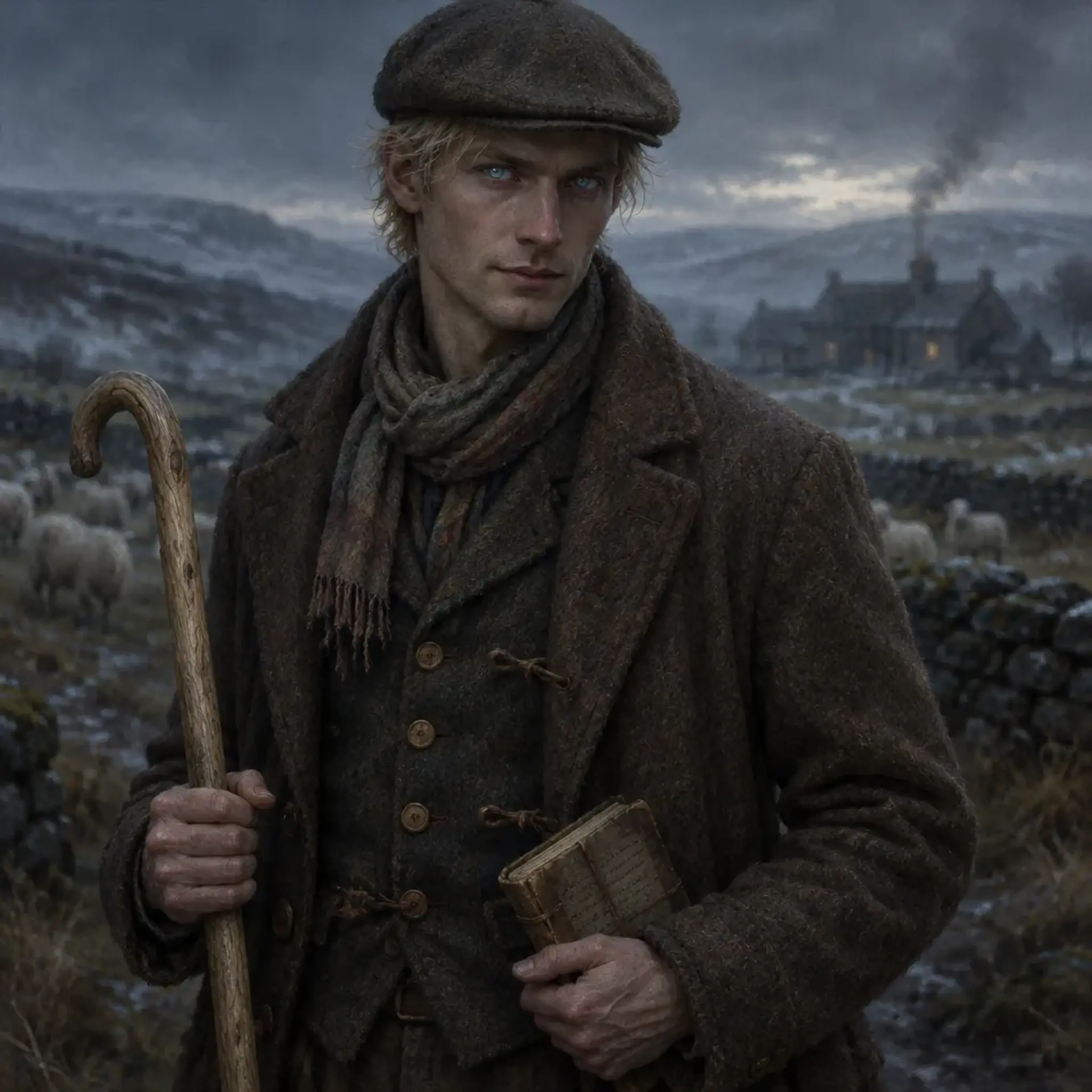
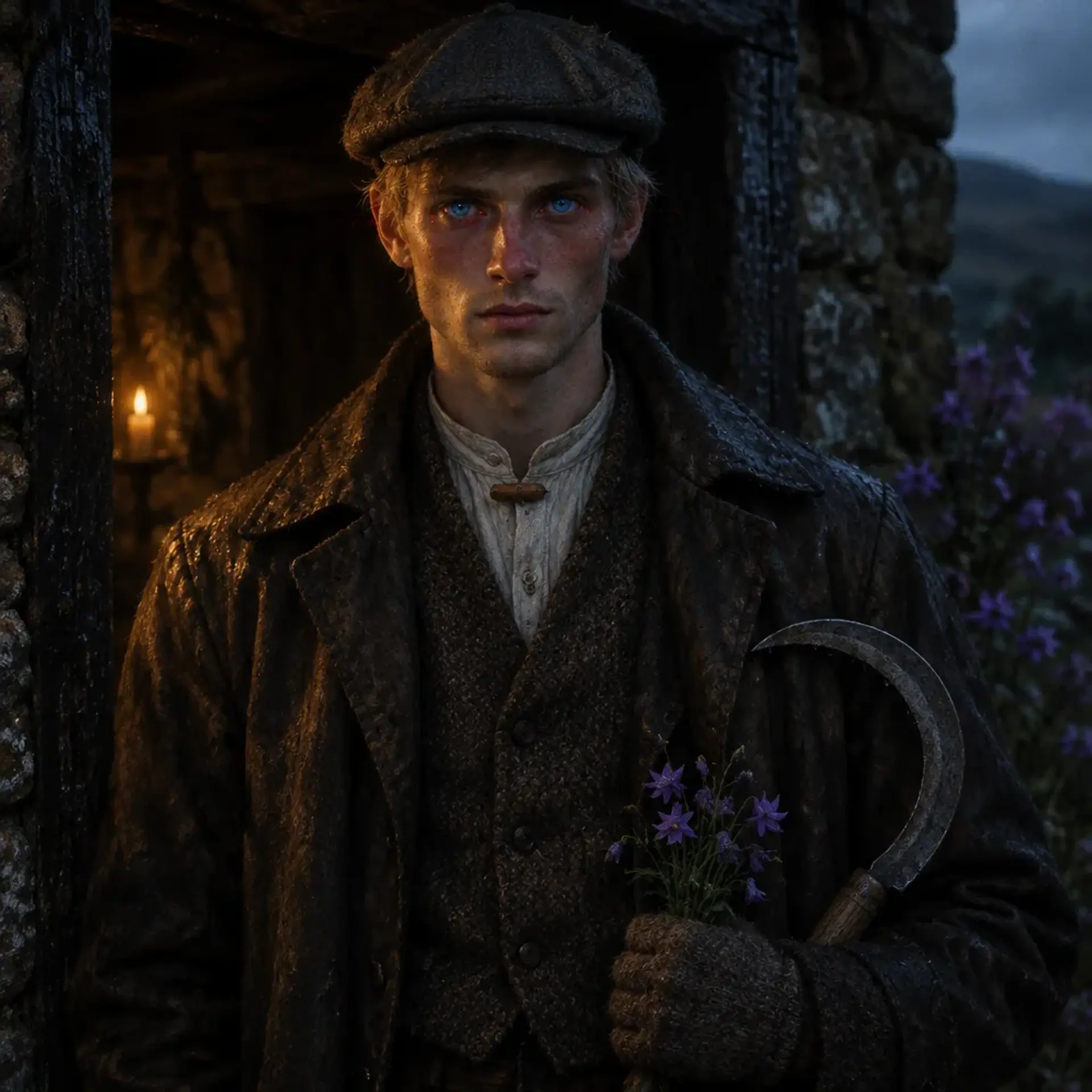
Oswin stands six feet tall and has the youthful, handsome face Mary remembers from their courtship, though his life should have marked him more plainly. Pale and straight-haired, he wears his blond hair tucked under a flat cap. He takes up more room than his lean frame seems to warrant, shoulders squared as if bracing against a gale; when waiting, he plants his weight evenly and goes so still that people sometimes mistake him for a carved post. His movements are economical until something startles him, when his head snaps toward it with a hound's suddenness. He smells faintly of lanolin, damp earth, and cold smoke. Unexpectedly for a sheep farmer, he keeps a tiny, carefully tended patch of purple flowers beside the kitchen door, and knows each one by name.
Clothing
A common flat cap, homespun shirt, wool waistcoat, weatherproof coat, sturdy trousers, and mud-dark boots. He wears a plain wooden button at the throat and avoids metal buckles when he can.
Body language
He stands square and still, taking up a broad patch of space without seeming aware of it. He sets both feet before difficult conversations and keeps his hands visible, except when iron is near, when they curl close to his sides. Around William, he lowers himself to the boy's height and waits without rushing him.
- Height
- 6 feet
- Build
- Lean, long-limbed, and stronger than his farm clothes suggest, with the compact endurance of someone accustomed to carrying feed and wrestling sheep.
- Eyes
- Clear, burning blue, unusually bright in low light.
- Hair
- Pale blond, straight, usually hidden beneath his flat cap.
- Skin
- Pale, weathered by wind, with a faint pinkness across the nose and cheeks after a day outdoors.
- Age
- Looks about 29; was born in the age of the Danelaw and has lived for centuries.
- Gender
- Male
- Size
- Medium
Distinguishing features
Personality
19 traits and drivesOswin is kind in the steady, practical way of someone who will mend a gate before offering comfort, yet he can turn frighteningly ruthless when his family is threatened. He is shrewd about land, weather, and people, but naïve about the damage his concealment does to those he loves. In company he is wry and unassuming; alone at night he is restless and full of old roads.
- Alignment
- Neutral good, with a protective streak that can become frighteningly possessive.
Quirks
Habits
Traits · 5
Flaws · 5
Fears · 5
Wants and needs · 4
Combat
AC 14 · HP 38 · 30 ft.He prefers to keep danger away from his family, opening with control or a frightening transformation rather than a lethal strike. He uses eldritch blast at range, thorn whip to pull a threat away from an ally, and sickle attacks only when cornered. He shifts into a hound to pursue fleeing enemies or a horse to carry someone out of danger. Against iron, he retreats or uses cover.
Oswin Hirst
Spells
Actions
Reactions
Services they sell
Rewards they can give
Equipment
- Farmer's sickle (weapon)A plain farming sickle, carefully wrapped when not in use.
- Golden sickle (custom magical tool)A golden sickle hidden in the house, a gift from his northern 'brother'; its unusual use is known only to Oswin.
- Leather armor (armor)A leather coat worn beneath his work clothes; it accounts for his listed armor class.
- Farm clothes and tools (gear)A flat cap, wool clothes, feed sack, and practical farm tools with wooden handles where possible.
- Prayer book (keepsake)A worn prayer book with passages marked in a language Oswin refuses to read aloud.
Possessions
Background
Oswin Hirst was born in a dale that had not yet learned to call itself English. His mother was human, a farmer’s daughter who had survived the passage of Viking raiders through her valley. The raiders left behind broken doors, missing livestock, and a child whose father was never named. Oswin’s mother gave him her own family name and raised him among people who had more pressing matters than asking why the boy’s eyes shone blue in certain light. His first memories are small and ordinary: the warmth of a hearthstone, his mother’s hands knotting wool, rain tapping the roof while she sang in a tongue that sounded old even then. She died while he was still a child. Afterward, the neighbors took turns feeding him and watching over him, at first from kindness and later from unease. Oswin grew, but not at the pace they expected. Boys who had once fought him in the lane became fathers, then grandfathers, while he remained a young man with the same bright eyes. Some called him blessed. Others crossed themselves or muttered that his mother had taken a strange lover. Oswin learned that gratitude and fear could live in the same face. He had a gift for languages, or perhaps simply a need to listen. He learned Old Norse from the words left behind by the raiders and Anglo-Saxon from the people who raised him. Later he picked up scraps of speech wherever he wandered: traders’ phrases, prayers, insults, and the names people used when they hoped no one else was listening. There were other languages too, ones he was warned against. He learned the bargaining speech of devils, the muttered words of witches, and the quick, bright talk of the fair folk. He never became careless with any of them. A word might open a door, but it could also make someone on the other side remember your name. For centuries, Oswin moved between settlements, staying long enough to earn a place and leaving when questions began to gather. He worked as a shepherd, a drover, a laborer, and once as a guide for travelers who had lost their way in weather that seemed determined to keep them lost. He learned the habits of land and sky. He could tell when a river would rise, which slope would hold snow, and when a man’s pleasant offer concealed a threat. He also learned to recognize the places where the world thinned. Beyond those boundaries he met beings who were neither quite neighbors nor quite enemies. Some became uneasy friends. A few gave him names he has never repeated, even in the privacy of his own thoughts. One of those companions was a northerner Oswin called his brother, though the word meant something different between them. The brother gave him a golden sickle. It was a strange gift, too fine for a farm tool and too sharp for ordinary harvesting. Oswin accepted it without asking all the questions he should have asked. He keeps it hidden and brings it out for tasks he does not explain. When Mary has asked about the locked chest where he stores it, he has answered with a joke or a change of subject. He tells himself that secrecy is safer than truth. He has told himself this for a very long time. Eventually, he wanted something less uncertain than another road. He settled on a sheep farm and built a fine house for a man of his standing. The work suited him. Fences needed mending, lambs needed turning, and weather did not care whether he had lived a hundred years or ten. His neighbors knew him as a capable, wry man who did not boast. He could be generous without making a performance of it, and he preferred fixing a broken gate to offering words of comfort. He was shrewd about land and people, though less shrewd about what his silences did to those who trusted him. Mary Pickles came into his life with a steadiness he admired. He loved her, and he wanted to be the husband she deserved. On their wedding night, the thing he had kept buried beneath habit and careful explanations broke through. In human shape he could not consummate the marriage. Fear and shame pressed in until he became a headless man with burning red eyes. Mary struck him with iron scissors. The blow ended the encounter, but not the memory. Five days later, Oswin asked if they might try again, this time with him as himself. Mary agreed. He never confessed what had happened on the first night, and the secret became the foundation of a marriage he meant to protect. Their son William was born with black hair and Oswin’s burning blue eyes. The family called him Black William, or Blackby. He was slow to learn and often frightened by things other children barely noticed. Fear sometimes turned to anger, sudden and fierce. Oswin tried to meet each difficulty with patience and practical care. He watched the boy closely, made allowances, and hoped time would soften what troubled him. Mary feared something else. She believed William might be the Barguest’s spawn, and she told her father, Thomas Pickles, what had happened on the wedding night. Oswin has never learned the full measure of what Thomas knows, but he sees suspicion in the older man’s looks. Thomas wants him driven from the farm and Mary made to divorce him. Oswin understands why Thomas is afraid, though he resents the judgment and will not surrender his family to it. Mary’s brothers have their own ways of watching him. Hugh is blunt enough to make his mistrust plain. Edward says less, but notices small things: a pause, a locked door, a story that changes in one detail. Oswin finds Edward harder to answer than Hugh. The family’s losses have made every silence heavier. Alice died of a winter fever. Thomas once saw a black hound before her illness, and the sight has stayed with him. Oswin saw something worse when baby Edmund lay dying: hellish eyes where no eyes should have been. Rose is gone as well. He does not know whether these deaths belong to chance, to some old debt, or to the presence that has followed him across too many seasons. He knows only that he cannot bear the thought of another child lost, and that fear makes him more ruthless than he likes to admit. At night, when Mary and William sleep, Oswin walks the house or stands listening to the fields. Certain dates and changes of season pull old roads back into his mind: the sound of hooves on frozen ground, a voice speaking from the far side of a boundary, the names of people who may still remember him. By morning he returns to the sheep and the gates, offering his family the ordinary man they believe they know. He means to keep them safe. He does not understand that every truth he withholds gives their fear more room to grow.
Role in the story
A loving but secretive husband whose uncanny nature is entangled with a family tragedy. Oswin can be a protector, a source of local knowledge, or the center of a painful reckoning when Mary and Thomas discover how much he has hidden.
“His mother was human, a farmer’s daughter who had survived the passage of Viking raiders through her valley.”
- Faction
- No formal faction. He keeps old, wary friendships with beings who live along the boundary between the mortal world and the fair folk's realm.
Known connections
Media
0 imagesNo images yet.
Turn Oswin Hirst into a sheet
A high-res, share-ready sheet you can post or print.