Eber
Eber
At the table
Voice
His voice is clear and slightly dry, with a faint rasp from years of workshop dust and the careful mouth movements he developed after his teeth changed. It has the compact, practical rhythm of someone used to speaking over tools, family, and rain on a roof. He places stress on unexpected words when making a point, then lets the pause do the work. His name, Eber, has a clipped, off-beat sound; he does not sing or draw it out.
Eber speaks with measured precision shaped by workshop instructions and a childhood spent among overlapping family conversations. He favors concrete comparisons, mechanical metaphors, and questions that sound casual but are meant to test an assumption. He does not lisp despite his altered teeth; he has carefully adjusted his speech to them. When tired, his phrasing becomes clipped and he pauses before swallowing, as if even conversation has to be arranged around his body's new habits.
Speech patterns
How to play them
Approach Eber through a practical problem, a broken device, or a genuine question about his craft. Do not make a spectacle of his eating or body. He responds to competence and honest curiosity, but withdraws when treated as a curiosity or a family burden. If trust develops, he reveals concern for his siblings and the community through small acts of help before speaking openly.
Goal
Develop practical tools and repairs that help the Marshwake meet the needs of their growing high-blood population, while finding a place in his family that does not depend on pretending he is unchanged.
Motivation
To be useful without being reduced to his usefulness; to protect his family while learning what the Marshwake's inheritance is doing to the next generation.
Appearance
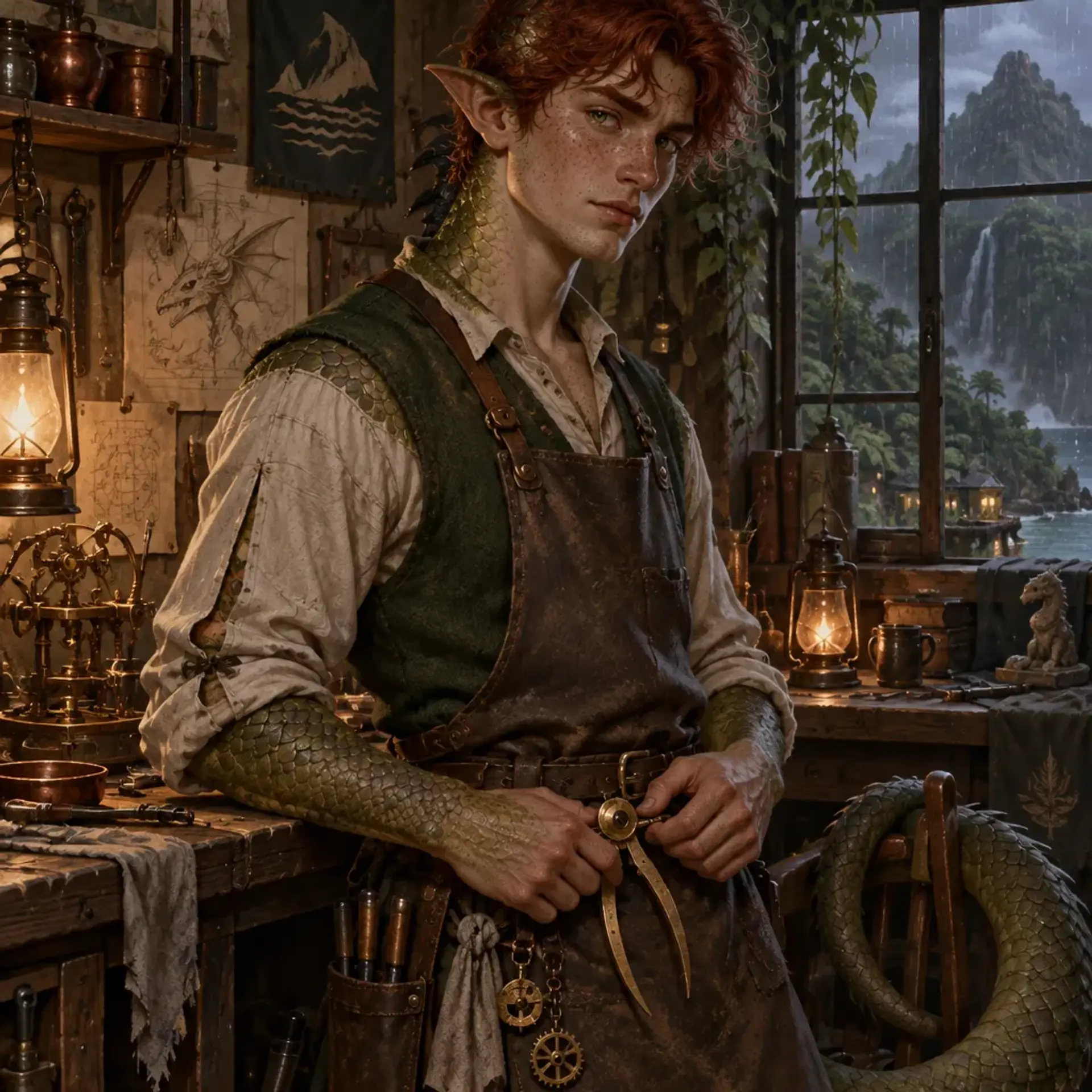
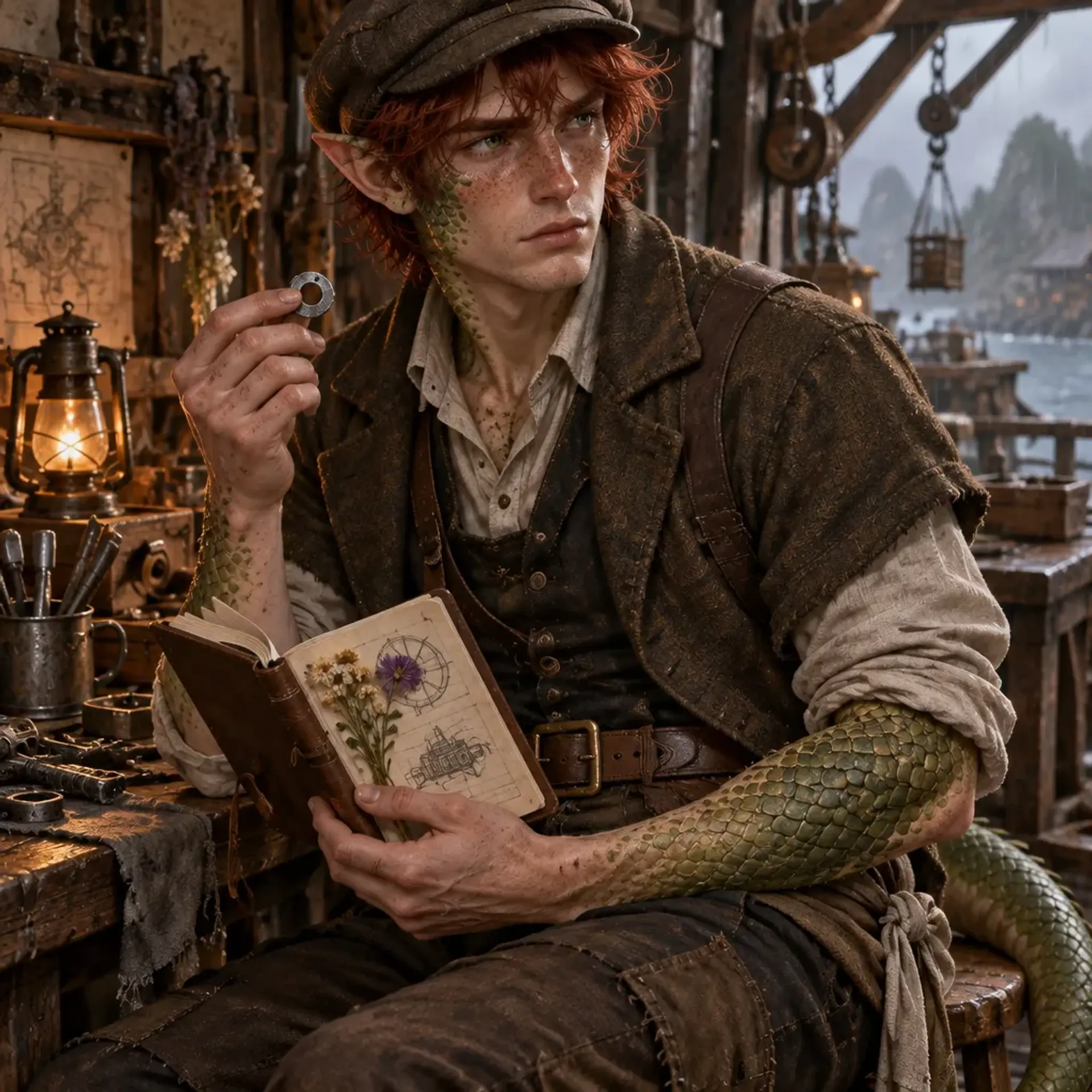
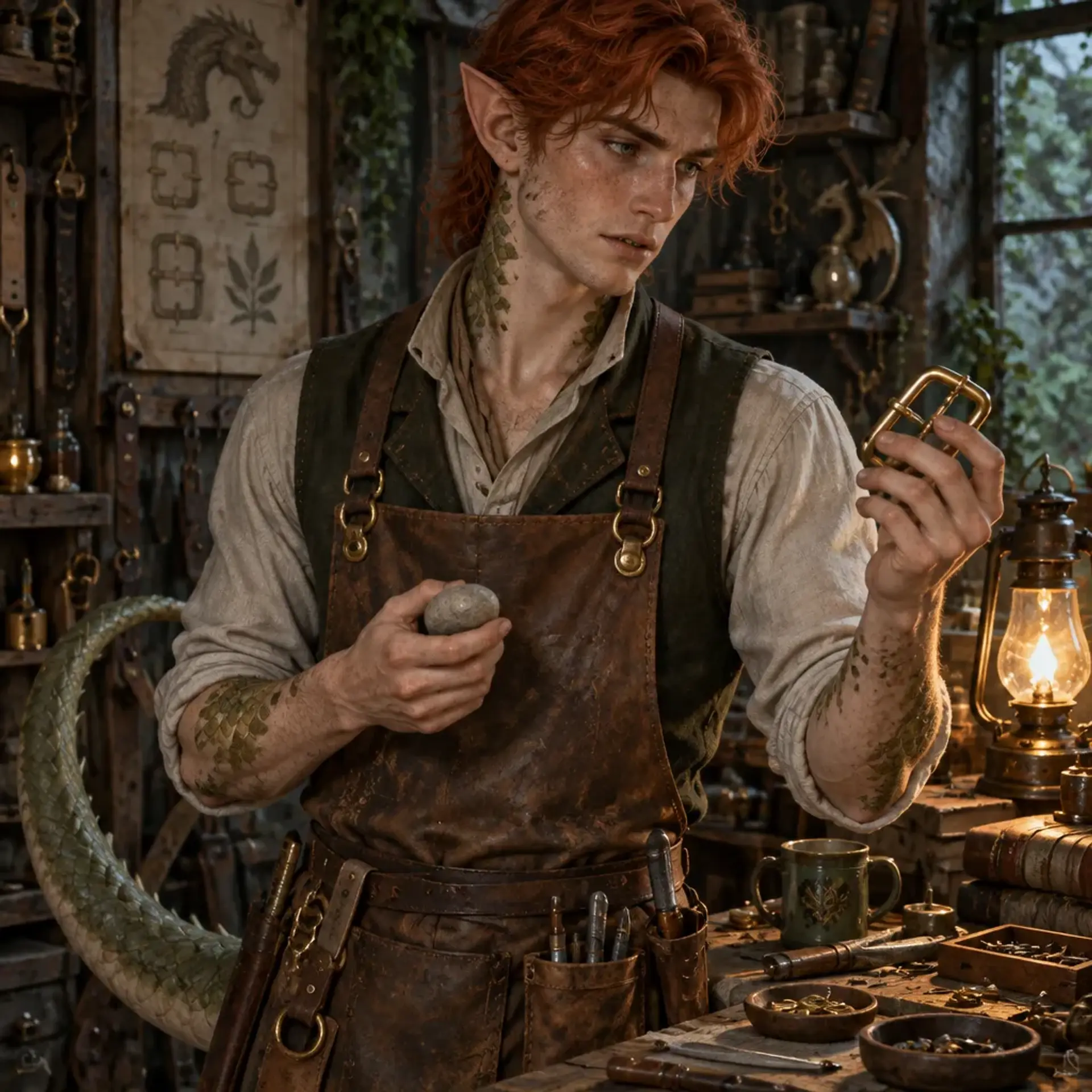
Eber is a young man who seems to have been stretched upward out of a halfling family portrait: five feet ten inches tall, long-necked, and narrow through the waist, with the forward-leaning balance of someone always judging a tool's reach. Fair skin and red hair remain visible between patches of olive-green scales, which overlap like small, flexible leaves along his throat, shoulders, ribs, and tail. Freckles scatter across his nose and cheeks, breaking the uncanny effect of his sharp, green-dragon teeth. Those teeth are sound and strong, but their shape is poor for chewing; he works soft food back with his tongue and swallows carefully. His pointed ears angle toward every conversation, while his tail makes small, unconscious counterbalances when he turns. His eyes are a bright draconic green, and in a crowded room they keep returning to people's hands, pockets, buckles, and other polished surfaces. The scales at his elbows and tail have a satin sheen, but the skin of his knuckles is roughened by filings, oil, and repeated contact with tools. He is striking not because he looks fearsome at first glance, but because his stillness feels deliberate: a lanky young craftsman who watches as if every person in the room might be a mechanism with a hidden latch.
Clothing
Halfling-influenced craftsman's clothes adapted for his height: a sturdy linen shirt, wool waistcoat, leather apron, reinforced trousers, and boots repaired at the seams. The cut borrows from the family's German-influenced workwear, with brass toggles and deep pockets. He keeps sleeves rolled back from his scaled forearms and wears a soft scarf when the weather turns cold.
Body language
Eber stands slightly angled rather than square to people, his tail balancing each turn. His gaze makes quick, deliberate trips to hands and reflective objects. When thinking, he rolls a smooth pebble between thumb and forefinger; when uncomfortable, he presses his lips together as if testing whether a word is safe to swallow. He rarely fidgets with tools, but his tail gives away irritation by going rigid.
- Height
- 5 feet 10 inches
- Build
- Tall and lean, with a long neck, narrow waist, and a flexible, counterbalancing tail. His strength is practical rather than bulky, built by carrying stock and working at a bench.
- Eyes
- Bright draconic green
- Hair
- Red
- Skin
- Fair skin with olive-green scales
- Age
- 19
- Gender
- Male
- Size
- Medium
Distinguishing features
Personality
18 traits and drivesEber is watchful, clever, and more tender than he wants strangers to notice. He can make a conversation feel like a quiet contest, testing what people mean rather than accepting what they say. In the workshop he is patient and generous with knowledge; if someone asks how a device works, he will show them, even if he has to take it apart first. At home, however, he may answer a loving question with a dry joke and retreat before anyone can see that it touched a sore place. He longs for the ease his stout-halfling parents share: the same bowls, the same crowded bedspace, the same unthinking warmth. His body makes those ordinary comforts awkward or impossible, and that loss leaves him envious, ashamed of the envy, and occasionally unfair to the people who are trying to help. His aloofness is partly a shield and partly a real preference. He enjoys quiet work and dislikes being watched while he eats, but he is not indifferent to people. He tracks small needs with almost embarrassing precision: a sibling's frayed cuff, a nephew's missing lunch, a tool returned to the wrong drawer. His affection tends to arrive disguised as a repair or a useful observation. He is more at ease beside someone doing a task than across from someone demanding a confession. When the family gathers, he may hover at the edge of the room, listening and appearing bored, while remembering every detail of what was said. Eber takes pride in being clever, but he is wary of the sort of cleverness that manipulates people. The green-dragon inheritance has left him with a taste for secrets, patterns, and shiny things; he dislikes that these impulses feel older than his own choices. He is not above keeping information to himself, especially when he thinks it will spare someone pain, and he can persuade himself that withholding the truth is an act of care. Yet he is troubled by deceit and is quick to notice when someone else uses a comforting lie to control a person. He would rather offer an unpleasant fact than a false promise, though he sometimes wraps the fact in enough wit that the listener misses its seriousness. His moods change his manner more than his voice. When calm, he is precise, lightly sarcastic, and willing to let another person take the lead. When excited by a mechanism, he talks with his hands and forgets to hide his enthusiasm. When worried, he becomes brisk and practical, asking questions as if the right measurements could keep disaster away. When embarrassed, he looks at the nearest polished object instead of the person who has made him feel seen. When angry, his humor disappears. He does not shout by default; he goes still, fixes his green eyes on the person responsible, and states exactly what they have done. That stillness can be more unnerving than a threat. Eber is protective of his siblings, but his protectiveness is not always gracious. He dislikes Rodrick's teasing, yet does not want outsiders to speak of Rodrick as a monster. He supports Ignatz and understands his guilt, while also believing that Ignatz must face what happened rather than hide behind shame. He loves Yonda's warmth but bristles when she treats sociability as a simple cure for loneliness. He respects Windle's responsibility and worries about the fear he will not admit. Family loyalty is one of Eber's strongest values, and one of the easiest to turn against him: he will do too much, keep too much quiet, and accept discomfort rather than risk making a relative feel accused. In the wider community, he is cautious but not timid. He reads a room for exits, tools, and signs of tension. He can be charming when he wants information, but he dislikes feeling that he has performed charm for approval. He is interested in people who make, mend, or grow things, and suspicious of anyone who treats the Marshwake's changing bodies as entertainment or a useful resource. He is especially alert to the difference between curiosity and entitlement. A sincere question may earn a detailed answer; a demand for him to demonstrate his teeth, tail, or eating habits may earn a cutting remark and a swift departure. Underneath his reserve is a young man who wants ordinary belonging. He wants to sit with his family without thinking about the height of the chair or the texture of the food. He wants to be admired for a repair rather than stared at for his scales. He wants to be able to protect the younger generation without deciding their futures for them. He does not yet know how to ask for these things plainly. For now, he shows love by fixing what breaks, noticing what is missing, and staying nearby even when he looks as if he would rather be elsewhere.
- Alignment
- Neutral Good
Quirks
Habits
Traits · 5
Flaws · 4
Fears · 4
Wants and needs · 5
Combat
AC 15 · HP 17 · 30 ft.Eber avoids trading blows with stronger enemies. He uses Fire Bolt from cover, positions himself near allies who need help, and uses Faerie Fire to expose hidden or evasive foes. He uses Shocking Grasp when an enemy closes in and needs to be kept from making reactions. He saves his draconic presence for a dangerous approach or an ally's escape, rather than using it to start a fight.
Eber
Spells
Actions
Reactions
Services they sell
Rewards they can give
Equipment
- Workshop knife (weapon)A practical knife with a broad, repairable blade, kept sharp for workshop use and usable in a fight.
- Tail-slit leather armor (armor)Studded leather armor assembled from sturdy panels and adapted to leave room for his tail.
- Workshop shield (armor)A small shield reinforced with a hand-fitted metal rim.
- Tinker's tools (tools)A compact set of artisan's tools, including pliers, files, wire, and a small hammer.
- Stomach stones (personal)A cloth pouch of carefully smoothed pebbles and a few small metal pieces used to aid digestion.
Possessions
Background
Eber was born the eighth and youngest child of Trogi and Wilma, in a house designed for stout halflings and already crowded by seven older siblings. The family lived by a workshop that smelled of hot iron, wet wood, and oil. Trogi made and repaired tools with quiet patience; Wilma kept the garden, chickens, and family fed, and somehow knew which child had skipped a meal before that child knew it himself. Their Stout-halfling heritage shaped every room, every bed, and every expectation. As a child, Eber could fit beneath the workbench with his brothers and sisters. He learned early that the workshop was a place where a small hand could still make a large difference: holding a spring, sorting screws, listening for the wrong click in a repaired clock. His siblings made the household its own unruly country. Windle, the oldest, worked steadily in the shop and was already raising two young children; he was expected to inherit the business, a duty he accepted without much talk. Karl was happiest among gears and tools, though his marriage to Leanora, a rough sailor descended from famous dragon hunters, was often strained by her absences and their unsettled household. Yonda, the only sister, had a gift for gathering people around her and five children of her own; she loved Eber, but her kindly reminders that he should be more social could feel like another measurement he failed. Alder divided himself between part-time guard work and merriment. His son, Black Alder, was clever, and his amber, serpentlike eyes marked him as another high-blood cousin. Kasper repaired watches and kept the family accounts, then escaped to tend chickens or the garden when the shop grew too loud. Rodrick, a high-blood brother older than Eber, was bigger and stronger, blunt to the point of cruelty, and delighted in showing off the sorcery he believed his dragon blood had granted him. Ignatz, closest to Eber in age, had offered him kindness when no one knew what to do with the changes overtaking their family. The Marshwake were already living with a difficult inheritance. Their ancestors, castaways who survived a dragon-haunted wilderness, had accepted the blood of a wounded green dragon. Over generations, the community divided into those whose halfling traits remained prominent and those whose bodies developed more pronounced draconic features. People called these expressions low-blood and high-blood, words that could sound like family shorthand or an accusation depending on who spoke them. Eber knew the terms before he understood their weight. In the first years of his life, he imagined adulthood as a larger version of the life his parents had: a place at the family table, a bed close to the others, work beside Trogi, and food shared from the same bowls. At adolescence, his body changed with painful speed. He grew taller than the doors and furniture had been built to accommodate. Scales emerged beneath his skin and then spread over it; his ears sharpened, a tail formed, and his teeth changed. The first weeks were full of fever, sore gums, split seams, and the exhausted, frightened looks his parents tried to hide. Food became a daily puzzle. He could no longer chew the way his family did, and swallowing was uncomfortable without smooth stones to help break down what he ate. At first, the pebbles were a healer's suggestion. Eber hated the attention and the grit between his teeth, but the stones helped. His mother kept a bowl of washed river pebbles beside his place. His father quietly began polishing them smooth. The household adjusted as best it could. A bed was moved, then moved again. Clothing was let out, patched, and eventually replaced with garments made for a body that did not fit the local patterns. Meals were softened and prepared separately. The family worried about the expense, the shortage of cloth, and how much more food Eber and the other high-blood children required. The high-blood siblings sometimes slept in the dining room or kitchen because there was nowhere else to put them. Wilma and Trogi were grateful for their children and grandchildren, yet their pride could not make the overcrowded house less cramped or the food stores more plentiful. Their tenderness was sometimes harder for Eber to bear than anger. He felt their love as a warmth he could not fully return, not because he loved them less, but because his body and habits had made even ordinary closeness unfamiliar. The moment that changed him most came during a night of heavy rain, when the workshop roof leaked onto a half-repaired spring mechanism. Eber was still recovering from a particularly bad flare of pain and had been told to rest. He ignored the advice, climbed under the bench, and rebuilt the mechanism by lamplight so it would not rust. His hands shook from hunger and his jaw hurt from trying to eat a heel of bread. Ignatz found him there, curled around the little machine, and sat down beside him without asking for an explanation. They listened to rain tick against the roof. Ignatz admitted that he was afraid of what his own new instincts might make him do; Eber admitted he was afraid that his family would remember him as a problem to manage. They did not solve either fear. But Eber understood that the change was not his alone to endure, and that silence could be a kind of isolation even when a house was full. That night helped turn his fascination with tools into a vocation. A mechanism could be taken apart, studied, and adjusted without asking permission to become something else. He began learning repairs from Trogi, and then from the small problems that found their way into the workshop: a broken fishhook, a jammed latch, a cracked clock case, a kettle handle that had come loose. Eber became particularly interested in objects that made difficult tasks easier. He is now a second-level artificer, still learning, not a master of impossible inventions. His work combines careful observation, a knack for practical improvisation, and a modest amount of magic. He has begun experimenting with tiny devices and infusions, hoping to make tools that can be repaired locally rather than imported at great cost. His interest in shiny things began as simple curiosity. He likes brass, polished steel, glass beads, and the shifting light on wet scales. The dragon inheritance sharpened that interest into an almost involuntary attraction to bright objects, but Eber resists the idea that a biological urge gets to decide who he is. He collects small, useful things: a bent washer with an unusual pattern, a glass button, a brass gear that fits nothing he owns. Some are experiments; some are simply beautiful to him. He will deny that the distinction matters. Eber's family remains close, though closeness is not always comfortable. Windle fears his own young children could someday become high-blood and is stoic about it in a way Eber recognizes as fear. Yonda keeps trying to draw him into community life, and Eber does not know how to tell her that her affection can make him feel even more conspicuous. Karl's household is a source of both noise and affection, complicated by Leanora's long absences and the children whose parentage and place in the family are not simple subjects. Rodrick still teases him about eating, but the teasing stops when Eber's anger becomes unmistakable. Ignatz remains his closest confidant, though even Ignatz sometimes retreats into work rather than face his own guilt over the chicken he once killed in a sudden hunting impulse. Trogi says he wants to retire, then appears at the bench before dawn. Wilma would rather be in the garden than the shop, but she watches Eber's meals more carefully than anyone else. The family's current problem is practical and urgent. Their home and workshop were built for smaller bodies, and the whole community is struggling to supply enough food, clothing, beds, and safe living space as more high-blood children mature. Eber wants his inventions to help with these needs, but his ambitions are tangled with a private hunger to prove that he can contribute without being treated as an extra burden. He also wants to know why the changes seem to be intensifying in some young Marshwake, including Yonda's two sons and Black Alder. He fears that asking too openly will turn a family worry into a public panic, and he has not decided whether curiosity is courage or another kind of selfishness. For now, he divides his days between repairs, experiments, and the difficult work of remaining part of a family whose ordinary habits no longer fit him. He can be distant in company, but he notices who has not eaten, which tool is missing, and whose boots are splitting at the sole. Eber's way of caring is often indirect: a repaired latch left on a doorstep, a small polished pebble placed beside someone's bowl, or a practical suggestion disguised as an observation. He does not want to be pitied or feared. He wants to help build a life in which being different does not mean being made to sleep in the kitchen.
Role in the story
A young artisan and family member whose personal struggle mirrors the Marshwake's larger transition. Eber can provide repairs, insight into the high-blood changes, and an intimate route into the crowded family workshop, while his guarded research may reveal that the next generation faces a problem no one yet understands.
“The family lived by a workshop that smelled of hot iron, wet wood, and oil.”
- Faction
- The Marshwake community and the family workshop. He has no formal faction membership.
Known connections
Media
0 imagesNo images yet.
Turn Eber into a sheet
A high-res, share-ready sheet you can post or print.