
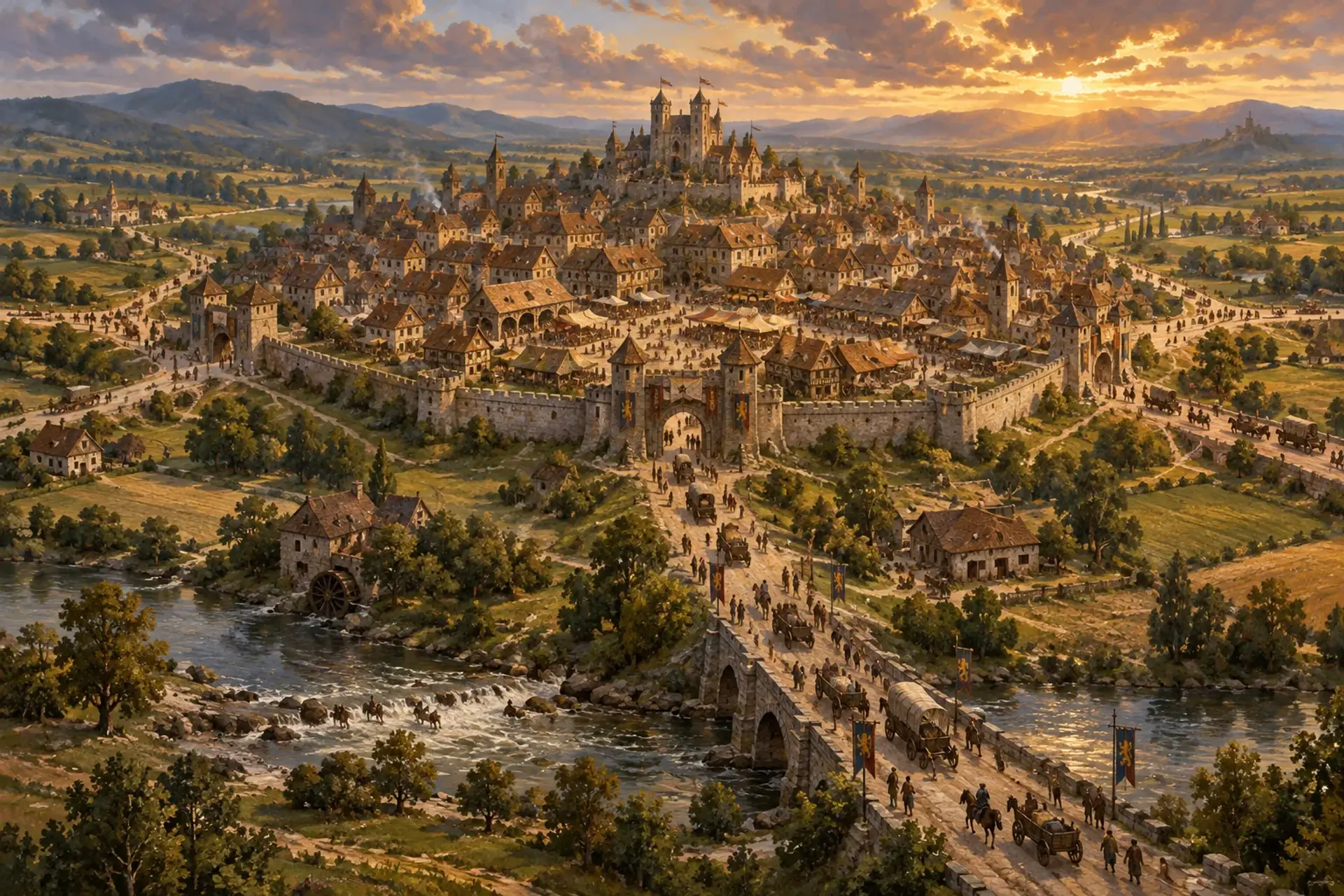
Brindlewick
Brindlewick grew where four dependable roads meet on a broad shelf of dry ground, with a modest river ford close enough to supply water but far enough to avoid seasonal flooding. Its market yards, repair sheds, and storehouses serve caravans crossing the realm in every direction. The city’s wartime toll charter was supposed to fund emergency road repairs. The war ended generations ago; the tolls did not.
Brindlewick
- Population
- 18,000
- Rule
- First Speaker Haldor…
- Wealth
- Moderately prosperous
- Defence
- Road Watch
Overview
Brindlewick grew where four dependable roads meet on a broad shelf of dry ground, with a modest river ford close enough to supply water but far enough to avoid seasonal flooding. Its market yards, repair sheds, and storehouses serve caravans crossing the realm in every direction. The city’s wartime toll charter was supposed to fund emergency road repairs. The war ended generations ago; the tolls did not.
Atmosphere
Brindlewick is busy in the practical, impatient way of a place where every road seems to arrive at once. Wagons queue beside messengers on tired horses, and locals judge strangers by which gate they use and how long they intend to stay. The city’s four road tolls are officially temporary, remnants of an old wartime charter. In practice, their income keeps the council solvent, pays the watch, and gives every faction a reason to fear peace.
Culture
- Worship of road, hearth, and harvest deities
- Small roadside shrines maintained by travelers
Humans, Dwarves, Halflings, Elves
Economy
- Caravan trade
- Wagon and harness making
- Grain milling
- Warehousing and freight brokerage
- Wagon repairs and replacement parts
- Milled grain
- Leather harnesses
- Caravan services
- Salt
- Fine cloth
- Iron bars
- Exotic goods from distant provinces
Geography
Ways in and out
Places to see
- The Four-Road MarkerA weathered stone marker stands at the point where the four main roads meet. Its inscription has been worn down to a few strokes, though travelers still leave buttons, coins, or scraps of ribbon at its base before setting out.
- The Gravel FordA broad, shallow crossing below the eastern road made Brindlewick a practical stopping place long before the city walls. The stones are safe in ordinary weather, but floodwater can make the ford treacherous with little warning.
Power
4 factionsGovernment
Laws
Trouble
- A challenge to the toll charter could shut the gates or fracture the council.The toll charter is meant to last only while the realm faces a stated emergency. The council has renewed it for decades, and a veteran's petition now threatens to make the charter's expiry a public test of authority. Haldor Vesk wants to delay the hearing, while clerk Toma Rill has found records that could prove the council misrepresented the charter's terms.Involves
Haldor Vesk, Toma Rill, Mikel Orsa
- The council's grain reserves are lower than reported.A shortage of winter grain is being concealed in the public accounts. If the real figures emerge, residents may demand that toll money buy food rather than road repairs. If the shortage remains hidden, the city could face hungry workers and empty storehouses before the first deep frost.Involves
Bera Sorn, Haldor Vesk
Factions
- Charter CouncilCivic governmentThe Charter Council is a bloc of landholders and trade representatives that administers the old toll agreement. It claims the revenue prevents roads from falling into disrepair, while using the same funds to pay for services that would otherwise be unaffordable.GoalsKeep the toll charter in force and preserve council control over its revenue.Allies
Road Watch
RivalsOpen Road League
- Open Road LeagueReform movementThe Open Road League joins merchants, veteran teamsters, and residents who believe the emergency tolls have outlived their purpose. It wants the gates open and the accounts made public, but members disagree about how to replace the money that currently pays for the watch.GoalsEnd the wartime toll charter and force a public accounting of its collections.Allies
Carters' Yard
RivalsCharter Council
- Road WatchCity militiaThe Road Watch keeps order at gates, markets, and caravan yards. Many guards depend on toll revenue for wages, but the captains also resent being ordered to punish people for refusing charges they know are disputed.GoalsKeep the gates staffed and prevent either faction from turning a toll protest into a fight.Allies
Charter Council
RivalsOpen Road League
- Carters' YardTrade associationCarters' Yard represents wagoners, muleteers, and repair crews who bear the costs of delays most directly. It can halt traffic through coordinated work stoppages, but many members fear that a prolonged strike will ruin small businesses before it moves the council.GoalsEnd double charges and secure compensation for delays caused by toll inspections.Allies
Open Road League
RivalsCharter Council
Defences
- Four stout toll gates on the main roads, each with a raised portcullis and a guardroom
- A low stone wall around the oldest market ward
- Signal bells on the council hall and the northern storehouse
Law and order
People and places
10 entriesFirst SpeakerHaldor Vesk Human Male
A middle-aged human elected from the market ward, Haldor has a habit of smoothing the edge of his papers while other people argue. He wants to keep the city functioning without a split in the watch, and fears that a public defeat will make every council decision unenforceable.
Veteran carter and organizerMikel Orsa Human Male
A broad-backed human veteran, Mikel has an old campaign scar across one knuckle and taps it against a table when he is holding back anger. He wants the charter ended before another generation inherits it as normal. He fears the council will provoke violence and use the resulting disorder to justify the tolls forever.
Grain factorBera Sorn Dwarf Female
A dwarf grain factor with cropped hair and a brass measure on her belt, Bera can spot a light sack by its sound. She wants the city to publish honest reserve figures before she commits her own stores to winter prices. She fears that either panic or a council seizure will leave her workers hungry and her business ruined.
Gate captainYori Kett Halfling Male
A halfling watch captain with a pale streak in his hair, Yori checks every gate hinge personally before a storm. He wants the Road Watch to remain a civic force rather than a council weapon. He fears that a single order to arrest peaceful toll protesters will make his own guards choose sides.
SmithyKett's Ironwork Kept by Gerta Kett
A narrow-fronted shop beside the western freight yard, crowded with axle pins, harness buckles, and tools hung from the rafters. The owner repairs urgent damage first and argues about payment later, a practice that earns loyalty from drivers and suspicion from creditors.
ApothecaryThe Ford Measure Kept by Sada Mori
A tidy apothecary on the lane toward the Gravel Ford, with bundles of dried herbs arranged by the weather they are meant to treat. The shop stays open late for travelers delayed at the gates. Its owner cares more about keeping the ford safe than growing the business.
TavernThe Last Mile Kept by Ota Venn
A long, low room built around a hearth large enough to dry a wet cloak. The common tables fill with road news before supper and toll complaints afterward. The keeper welcomes arguments as long as nobody blocks the serving hatch or starts swinging a chair.
TavernThe South Ledger Kept by Jeno Arv
This upper-room tavern overlooks the south road and has a reputation for decent beds and careful service. Travelers leave route notes beside the door, and locals read them for news of road conditions. The keeper will host a private conversation, but refuses to let anyone use the place to plan a gate raid.
Civic hallFourfold Hall Run by Lida
A squat stone hall on the market rise, with four doors facing the roads and a central chamber designed for hearings. The council keeps toll ledgers in a locked upper room. Each door has a different threshold stone, brought from the road it faces, and locals argue over which one is oldest.
ArchiveThe Old Toll Office Run by Toma Rill
The city archive occupies a former toll office behind Fourfold Hall. Its shutters are thick, its shelves are too close together, and the clerks keep a basin of sand by every desk in case ink spills. The official record is incomplete, but old receipts and private copies still surface when someone knows which family to ask.
Events
Lately
- A veteran's petition challenging the toll charter has gathered enough signatures to demand a public hearing.The council has postponed the hearing, and both sides are recruiting witnesses.
- Two grain consignments arrived lighter than their recorded weights.Bera Sorn has delayed sales while the council insists the shortage is only a clerical error.
- A gate crew let several protest wagons through without collecting tolls.Haldor Vesk is pressing Yori Kett for an explanation, while the Open Road League treats the incident as a sign of support.
Calendar
- First thawRoad ReckoningThe four roadwardens inspect culverts and mile markers before spring traffic swells. Traders can challenge a toll assessment in public, though few can afford the delay.The twist · GM only
- MidsummerFour Roads FairCarters, teamsters, and innkeepers hold a crowded market around the old milestone. The council announces road works and renews the wartime toll charter for another year.The twist · GM only
- Last harvest weekMeasure DayThe city weighs grain shipments for winter stores and settles disputes between local millers and passing merchants. Watch patrols are doubled around the toll houses.The twist · GM only
History
Brindlewick began as a practical stop at a reliable crossing and became a city because every long journey through the realm eventually met another road here. Its prosperity grew alongside its toll system. The council calls the charges the price of safe passage; travelers call them a wartime tax that survived its war. Both accounts have enough truth to keep the argument alive.
- Founding yearsThe Four TracksThe first permanent market grew around a ford that stayed passable when the surrounding tracks turned to mud. Traders began leaving wagons overnight, and a few families made a living repairing them.
- The Crown's WarThe Emergency CharterDuring a war that threatened the central roads, the crown granted Brindlewick authority to collect temporary tolls for repairs and defense. The surviving charter says the charges end with the emergency, but the council's public copies omit a clause defining who declares that end.
- Three generations agoThe Ash LedgerThe official account says a fire destroyed the toll books during a riot. Old watch records instead note that the archive was emptied the night before the fire, and the riot began only after the gates had been closed.
Secrets
3 secrets · 4 rumours- Secret 1 · GM only
- Secret 2 · GM only
- Secret 3 · GM only
Rumours
Plot hooks
3- 1The Ledger That Wasn'tToma Rill asks the characters to escort a locked archive chest from the Old Toll Office to a neutral magistrate outside the city. He says the contents may settle the charter dispute. The Open Road League plans to intercept the chest, but the council's own guards have already replaced the document inside.
Investigation and escort · Starts with Toma Rill · Reward: A copied travel warrant valid at all four gates, plus a favor from the archivist.
- 2Short MeasureBera Sorn hires the characters to find out why winter grain weights do not match the storehouse books. The missing measure is being used by a clerk to hide losses, but revealing the fraud will expose that the council has already promised the same grain to two neighboring districts.
Investigation and civic dilemma · Starts with Bera Sorn · Reward: A substantial food allowance and access to Bera's freight contacts.
- 3A Gate Kept OpenMikel Orsa asks the characters to protect a peaceful procession of veterans demanding an end to the tolls. Someone has planted forged orders showing the marchers intend to seize a gate. Yori Kett can prove the orders are false, but doing so would reveal his own unauthorized toll exemptions.
Protection and political intrigue · Starts with Mikel Orsa · Reward: A place in the carters' network and a debt owed by the Open Road League.
Media
0 imagesNo images yet.
Turn Brindlewick into a sheet
A high-res, share-ready sheet you can post or print.