
Bremen
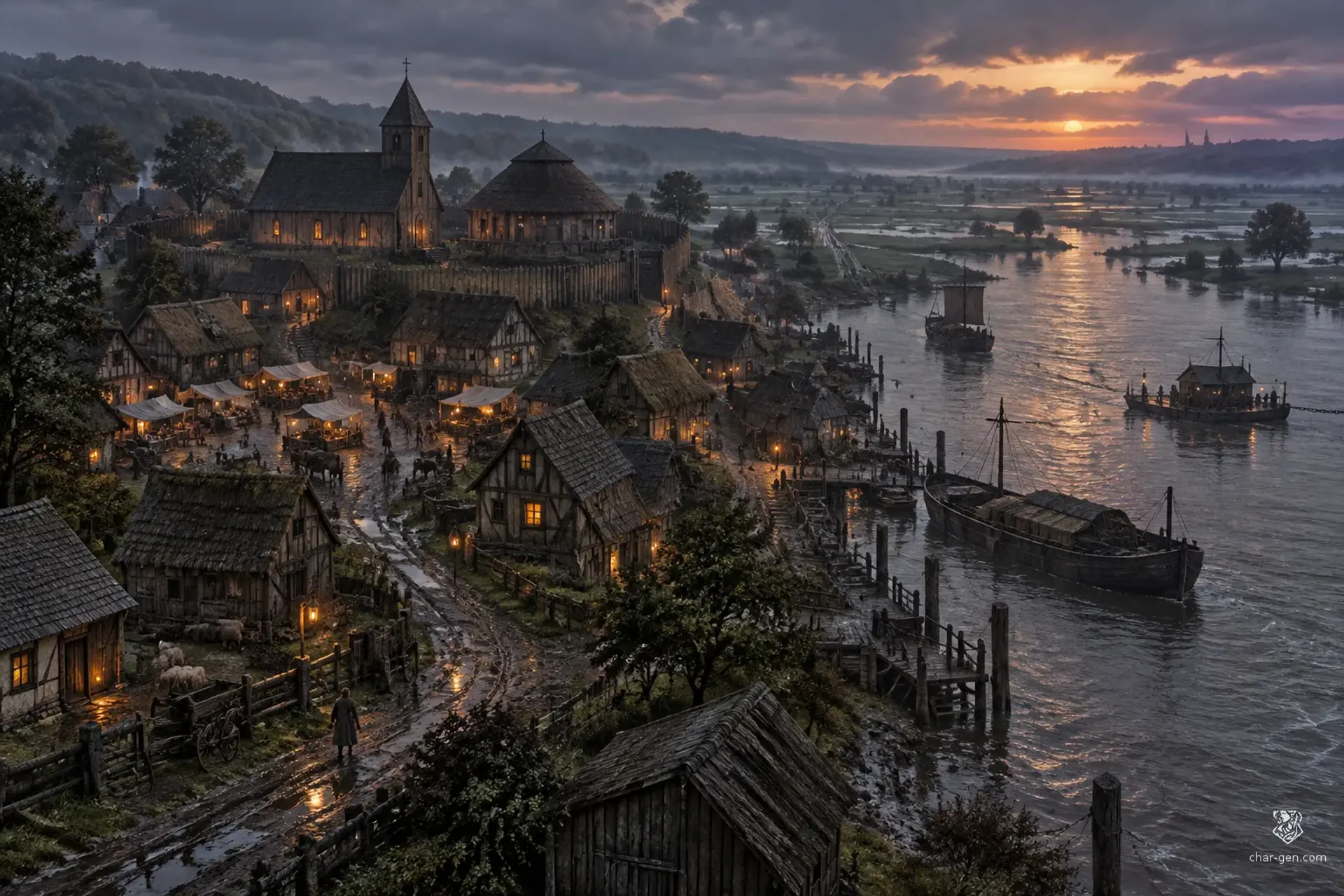
Bremen is an early river town built where a reliable landing meets higher ground and an inland track. The first houses cluster around a market clearing and a timber church, with new cottages creeping along the bank. Barges bring salt, grain, and news from downstream; carts carry hides and timber toward the interior. It is not yet a grand trading city. Its people are building one plank, ditch, and argument at a time.
Bremen
- Population
- 1,300
- Rule
- Tavi
- Wealth
- Modest
- Defence
- River Watch
Overview
Bremen is an early river town built where a reliable landing meets higher ground and an inland track. The first houses cluster around a market clearing and a timber church, with new cottages creeping along the bank. Barges bring salt, grain, and news from downstream; carts carry hides and timber toward the interior. It is not yet a grand trading city. Its people are building one plank, ditch, and argument at a time.
Atmosphere
Bremen is a town still learning where its streets belong. Mud lanes run between timber houses, and the river's smell reaches even the market on dry days. People watch the water gauge as carefully as they watch one another. The council insists the annual flood-mark grants certain households a voice in town business. Those households know that a voice is not the same thing as power, but they attend every meeting anyway.
Culture
- The River Mother, honored with bread and clean water
- The Dawn Father, whose small shrine stands near the market
Humans, Dwarves, Halflings
Economy
River transport, Fishing, Leatherworking, Grain milling
Timber, Hides, Smoked river fish
Salt, Iron tools, Fine cloth
Geography
Ways in and out
Places to see
- The River LandingThe landing is a set of timber steps and muddy mooring posts. Barges queue here when the river runs high, and cargo arguments begin before the boats are tied. The ferry chain crosses the narrow channel nearby.
- The Gauge PostA raised patch of ground above the market holds the town's public river gauge. Its markings are cut into an old post, visible to anyone who cares to compare them with the council's records.
Power
2 factionsGovernment
Laws
Trouble
- The altered gauge threatens the council's flood-mark custom.The river gauge has been scraped below the last recorded high-water line. If the town cannot agree which households qualify for the speaking custom, the next council meeting may break into a fight. Tavi wants to delay the reading until repairs are made, while Hadi says delay is simply another way to silence the affected families.Involves
Tavi, Hadi, Bork
- Urgent bank repairs threaten to shift floodwater onto poorer homes.A section of the market bank is softening, and the next hard rain could put stored grain under water. Bork wants the Landing Masters to rebuild it with a channel that would protect the landing first. Zulek argues that the channel would push water toward the poorest houses, and Tavi cannot authorize work without the council's disputed vote.Involves
Bork, Zulek, Tavi
Factions
- High-Mark HouseholdsHousehold blocThe High-Mark households are families whose homes flooded in the previous spring. By custom, they speak first at council until the next gauge reading. Some lost furniture and grain; others gained influence without losing much at all. Their members insist the arrangement keeps the town honest about flood risk, while their opponents say a misfortune should not become a permanent claim to authority.GoalsKeep the flood-mark custom and expand it into a formal right to approve river works.Allies
Hadi
RivalsLanding Masters
- Landing MastersTrade associationThe Landing Masters are boat owners and cargo brokers who maintain the landing, ferry chain, and towpath. They argue that repairs must be decided by those who pay for and perform them. Several are willing to help the poor after a flood, but they resent losing trade days to council disputes and will not accept the High-Mark families' veto over river improvements.GoalsTake control of river repairs and prevent flood-mark households from blocking construction.Allies
Bork
RivalsHigh-Mark Households
Defences
- A timber palisade encloses the highest ground, with a gate facing the river landing.
- A chain can be drawn across the landing channel, though it is old and often needs repair.
- Raised earth banks protect the market quarter, but leave several riverside homes exposed.
Law and order
People and places
7 entriesFisherHadi Human Female
Hadi is a human fisher whose house flooded high enough to earn her family the first council voice. She wants the town to repair the low lane before protecting more cargo, and fears the next spring will take her nets and her mother's stored grain. She ties a strip of red cloth around one wrist and reties it whenever someone speaks over her.
Boatwright and cargo boat ownerBork Dwarf Male
Bork is a dwarf boatwright who owns two cargo boats and keeps the ferry chain working. He wants a channel cut beside the market bank before the next flood, and fears the town will lose its trade if repairs wait on another council quarrel. He tests every plank by striking it twice with a knuckle, even when the wood is plainly sound.
HealerNadira Halfling Female
Nadira is a halfling healer who tends injuries after storms and keeps dry herbs in baskets hung from the rafters. She wants the town to build a raised walkway between the low houses and the church, and fears people will be trapped when the river rises at night. She taps the doorframe twice before entering any home, even when invited.
Grain sellerJorin's Grain Shed Kept by Jorin
Jorin's stall is a low timber shed beside the market, with sacks stacked above the floor on spare planks. He sells grain by the measure and will accept labor or fish when coin is scarce. He wants reliable records of the town's stores more than he wants a larger profit, because he fears being blamed when the next flood spoils what remains.
TavernThe Chain House Kept by Penda
The ferry house is a broad room above the landing, with benches that can be moved upstairs when the water rises. Its keeper serves warm ale and fish stew, and lets crews sleep on rush mats when trade is delayed. She wants reliable news from downstream more than extra custom, because her brother has not returned from a cargo run.
ChurchThe High Church Run by Zulek
The church is a timber hall on the highest settled ground, plain inside except for a painted river sign above the door. People gather there during floods because its floor stays dry. Zulek keeps a ledger of offerings and repair promises, though no one agrees whether that makes him a priest's helper or the town's most careful witness.
Council hallThe Round Hall Run by Tavi
The council hall is a rough timber room beside the market, with benches set in a circle so no household can claim the head seat. Its floor smells of wet wool and old rushes. Tavi holds meetings here because the space is neutral ground, though the High-Mark families insist the circle is only fair when they are allowed to speak first.
Events
Lately
- The river gauge was found scraped below the last recorded high-water mark.Households are arguing over who qualifies to speak first at the next council meeting.
- The market bank began to slump after several days of rain.Grain sellers are moving stores uphill, and the Landing Masters are pressing for immediate work.
Calendar
- First week of springThe MarkingThe river gauge is checked in public, and households whose doorsteps flooded last year claim the right to speak first at council.The twist · GM only
- MidsummerChain DayBoat crews race from the landing to the old ferry chain while market stalls sell bread, smoked fish, and river ale.The twist · GM only
History
Bremen grew from a landing and ferry crossing into a small town because the Weser offered a dependable route for trade, while the higher bank gave people somewhere to build. Its leaders have always needed both boatmen and household labor. The flood-mark custom was meant to keep the people most at risk in council discussions, but it has become a contested source of authority.
- Founding yearsThe First LandingBoatmen established a landing on the higher bank and drew a market around it. Local stories say the first landing was built by a priest, though the oldest account names a group of ferrymen.
- Two generations agoThe High Water PromiseA spring flood destroyed several riverside homes. The council began letting the worst-affected households speak first when discussing repairs. Official accounts call this a gift from the reeve; older families say it was a bargain made after the ferry crews refused to work.
- Recent yearsThe Bank and PalisadeThe market bank was raised and a timber palisade built around the higher ground. The work brought safety to the stalls but left the lower lane more exposed than the council's public account admits.
Secrets
2 secrets · 3 rumours- Secret 1 · GM only
- Secret 2 · GM only
Rumours
Plot hooks
3- 1The Missing WaterlineHadi asks the party to find out who scraped the river gauge before the public Marking. The clue trail leads from a broken lantern hook to the ferry landing, but the culprit says the gauge was altered to prevent a false flood claim, not to steal a council voice. The party must decide whether to expose a well-meaning crime that could still destroy the town's trust.
Investigation and civic conflict · Starts with Hadi · Reward: A share of the next fish catch and a public debt owed by the High-Mark households.
- 2Where the Water GoesBork hires the party to escort a surveyor along the market bank before the council votes on repairs. The surveyor discovers that the proposed channel would flood the low lane, but also finds signs that an older bank wall is already failing. Stopping Bork's plan may save one neighborhood while leaving the landing vulnerable, and the surveyor's measurements could become evidence in the council dispute.
Negotiation and investigation · Starts with Bork · Reward: A repaired boat or a paid place on a cargo run.
- 3The Reserve SacksJorin asks the party to recover grain stolen from his storehouse before the town reserve is counted. The trail points to hungry households, but the stolen grain was already promised to a downstream trader, and its disappearance may expose Jorin's secret sale. The party can return the sacks, protect the families who took them, or bring the full story before Tavi and risk a riot.
Moral dilemma and investigation · Starts with Jorin · Reward: A modest payment in grain, plus access to the market's stores during the next flood.
Media
0 imagesNo images yet.
Turn Bremen into a sheet
A high-res, share-ready sheet you can post or print.