
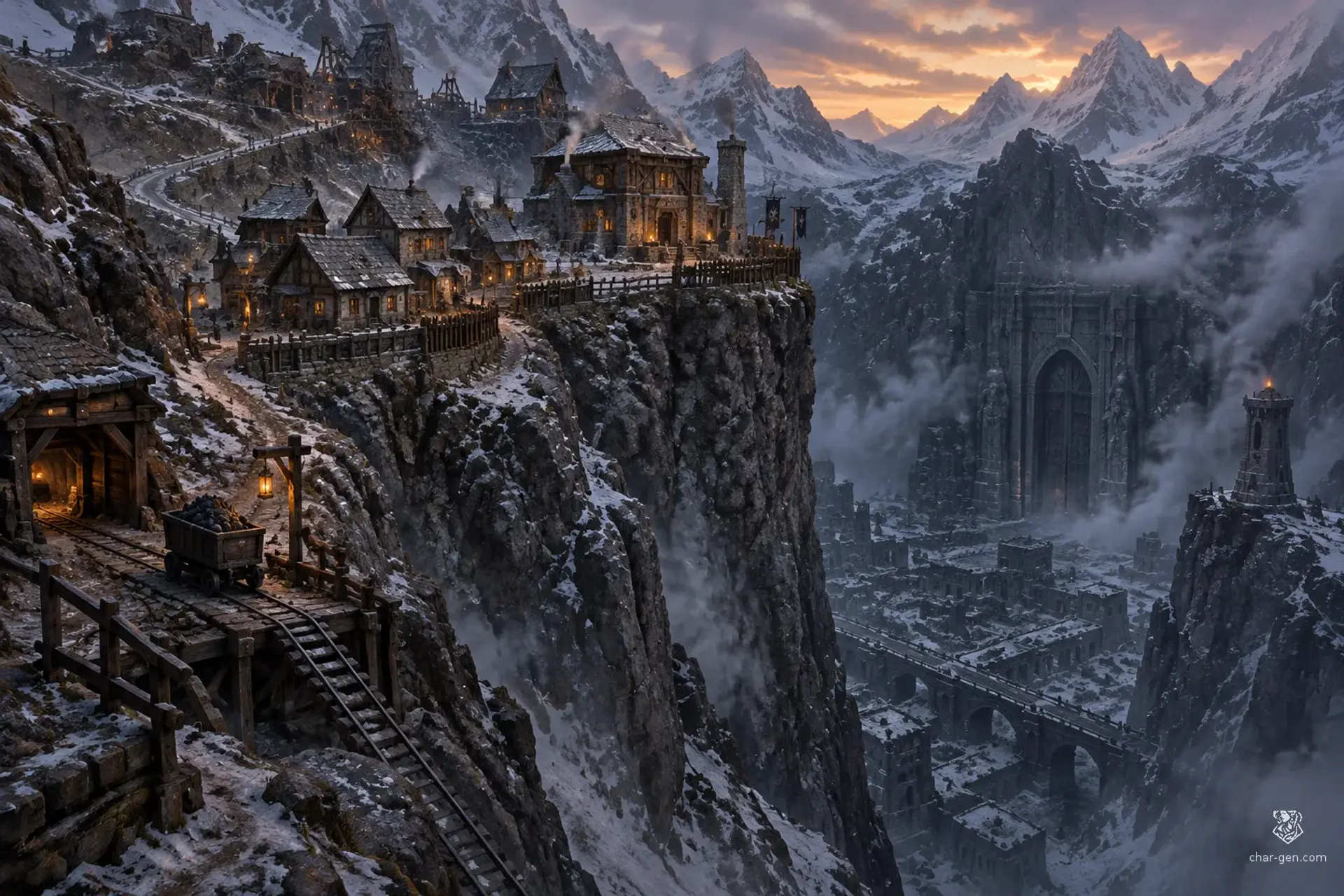
Last Mouth
Last Mouth is a hard-scrabble town built around the only safe approach to an abandoned mountain city. The old streets below are sealed, but the city is not empty: immortal Kesis live within its walls, confined by iron gates and old wards. The town sends condemned prisoners down as a death sentence, calling the practice necessary containment. Most residents have never entered the ruins. Those who have returned do not discuss what the Kesis eat, or why the seals need renewing.
Last Mouth
- Population
- 1,150
- Rule
- Magistrate Varo Senn
- Wealth
- Poor overall
- Defence
- Gate Watch
Overview
Last Mouth is a hard-scrabble town built around the only safe approach to an abandoned mountain city. The old streets below are sealed, but the city is not empty: immortal Kesis live within its walls, confined by iron gates and old wards. The town sends condemned prisoners down as a death sentence, calling the practice necessary containment. Most residents have never entered the ruins. Those who have returned do not discuss what the Kesis eat, or why the seals need renewing.
Atmosphere
Last Mouth survives by pretending the sealed city beneath it is only a prison. At dusk, the mountain wind carries a low, almost human sound up through the old vents, and nobody nearby admits to hearing it. Prisoners condemned by the town’s courts are marched below the gate and never return. Most residents call this justice; families of the condemned call it a bargain paid in other people’s blood.
Culture
- The Hearth Saint, honored as a guardian of households and the dead
- The Open Hand, a mountain faith that teaches mercy must be freely given
Humans, Dwarves, Orcs
Economy
Mining, Quarrying, Road maintenance, Warding and gate repair
Iron ore, Cut stone, Mountain herbs
Grain, Lamp oil, Cloth, Salt
Geography
Ways in and out
Places to see
- The Red SpringA spring-fed trough on the cliff shelf supplies most households. The water runs clear except after the lower gate is opened, when it briefly tastes of copper. Yelena knows which channels can be diverted if the town must evacuate, but she has never told the council how quickly she could do it.
- The Empty RowA row of empty stone houses stands between the town and the lower road. Their doors were bricked shut after the city was abandoned, yet several have fresh soot around their chimney mouths. Children dare one another to knock on the doors at night. The wardens claim the houses are empty and forbid anyone from breaking the seals.
Power
3 factionsGovernment
Laws
Trouble
- The town’s courts are being pressured to supply the lower city.The council needs prisoners to sustain its bargain, but the court has run short of serious offenders. Magistrate Varo Senn has begun approving sentences on thin evidence. He wants to keep the Kesis fed and the gates shut, yet fears that a public challenge will expose his role. Nima, who keeps the court copies, has found discrepancies in the latest list.Involves
Varo Senn, Nima
- A failing seal pits public safety against the town’s livelihood.The lower gate has shifted in its frame, and the last inspection found a fresh crack through one ward-stone. Warden Terek insists the damage is repairable, but he wants the mines closed until it is fixed. Quarry foreman Sada refuses, arguing that closure will bankrupt families and that the council is exaggerating the danger.Involves
Terek, Sada
Factions
- Seal CouncilCivic authoritiesThe Seal Council controls the lower gate, sentencing records, and the official account of the Kesis. Its members claim that secrecy prevents panic. In practice, they decide who is sent below and who gets to know why. They have the militia’s support, but even loyal wardens resent being ordered to conceal the fate of prisoners.GoalsPreserve the prisoner bargain and keep the Kesis confined, even if the town’s courts must manufacture convictions to maintain the arrangement.Allies
Gate Watch
RivalsOpen Hand Circle
- Open Hand CircleMutual aid and reform movementThe Open Hand Circle includes families of the condemned, a few miners, and people who believe a sentence should not erase a person’s humanity. They gather quietly at the old road shrine and keep records of those sent below. They lack weapons and legal standing, but they know which names disappeared from the court books.GoalsEnd the death sentences and expose the council’s use of prisoners as food, even if revealing the truth forces the town to confront the Kesis directly.Allies
Open Hand Circle
RivalsSeal Council, Quarry Compact
- Quarry CompactTrade interestThe Quarry Compact is a loose alliance of mine owners and foremen who profit from the protected mountain road. They fear that a public crisis will bring outside authorities, disrupt ore shipments, or close the mines. Several members privately doubt the official story but prefer a profitable lie to an uncertain rescue.GoalsKeep the town’s bargain quiet and maintain the road and mine contracts, while preventing the Open Hand Circle from forcing a public investigation.Allies
Seal Council
RivalsOpen Hand Circle
Defences
- A timber palisade across the only broad approach to town
- A stone watch post above the old city’s sealed gate
- Three iron-bound doors set into the lower tunnels, each opened by separate wardens
Law and order
People and places
9 entriesQuarry hauler and organizerDain Orc Man
Dain is a quarry hauler with a flattened nose and a habit of rolling a pebble across his knuckles when angry. He wants the town to name every prisoner sent below and let their families attend the final hearing. He fears his younger sister will be sentenced after he speaks too loudly, but his silence has begun to feel like consent.
Quarry foremanSada Human Woman
Sada oversees the iron crews and wears a brass tally ring on her thumb, adding a mark for every cart sent down the road. She wants to keep the mines open long enough to pay her workers through winter. She fears that the gate will fail on her shift and make her responsible for deaths she cannot prevent.
Spring keeperYelena Human Woman
Yelena tends the town’s spring channels and keeps a strip of red cloth tied around one wrist. She wants to take her family down the southern road before the next sentencing hearing. She fears that leaving will expose Dain to the council’s anger and that staying will make her complicit in the bargain. She watches every cart that travels toward the lower gate.
Council runnerOmaru Human Man
Omaru carries messages between the council and the gate, with a small brass bell sewn inside his coat so he can hear it ring when he moves. He wants to learn what happened to his mother, who was sentenced years ago. He fears that the answer will make Varo his enemy, and that he will find his mother alive among the Kesis.
Mining and travel suppliesThe High Step Kept by Miyo
A narrow shop stocked with lamp oil, pitons, rope, and tools repaired from old city iron. Its shelves are labeled in charcoal, and the counter has a notch cut for each winter the shop has survived. The proprietor refuses to sell climbing gear to anyone without asking where they plan to go. She wants customers to return, but she has started setting aside supplies for an escape she hopes she will not need.
Herbalist and healerRed Thread Remedies Kept by Pavel
This stall sells dried herbs, salves, bandages, and bitter tea from a timber room beside the spring channels. The owner marks each jar with a different colored thread because she distrusts written labels. She wants the town’s healers to share their notes, not guard them as trade secrets. Residents come for ordinary remedies and leave with questions about the strange taste in the water.
TavernThe Last Lamp Kept by Raisa
The common room is low-ceilinged and warm, with a stove that smokes whenever the wind comes from the ravine. A chalkboard lists the day’s road conditions beside the menu. The keeper wants to turn the back room into a place where families can meet privately, but she knows that a room without questions is exactly what the council fears.
Civic hallThe Quiet Hall Run by Nima
The council meets in a squat storehouse built from dressed blocks taken from the abandoned city. Its narrow windows make the room easy to defend and difficult to read from outside. Court sessions happen here, as do ration hearings and the private meetings where gate records are sealed. A shallow groove across the entry stones is said to be a survey mark, though Nima believes it was cut to hide an older inscription.
FortificationThe Lower Gate Run by Terek
The old city gate is set into a sheer rock face below town, with a ledge broad enough for a cart and little else. Three doors bar the way, each worked by a different crew. The outer arch is carved with a boastful inscription claiming the city will never fall. Residents touch the inscription when passing, though few can read the worn letters.
Events
Lately
- A prisoner was sentenced at dawn, but the lower gate crew found the lock already warm when they arrived.The wardens are checking each other’s keys, and families are afraid the council has begun moving prisoners at night.
- A shipment of grain failed to arrive from the southern valleys.The council has tightened rations, while the Quarry Compact argues that the mines must stay open to pay for another order.
Calendar
- First thawThe Opening RollThe town opens the high road after winter and reads the names of those sentenced below during the closed season. Families may appeal before the list is sealed, but the hearing is public and brief.The twist · GM only
- MidsummerQuiet SupperResidents leave bowls of milk and bread at the old city’s upper gate, a custom said to keep the confined Kesis quiet. The offerings are collected by the wardens before sunrise.The twist · GM only
- Last day of harvestThe Binding DayThe magistrates renew the confinement seals in a ceremony attended by the militia, the miners, and anyone with a sentence pending. No one is allowed to ask what the seals are made from.The twist · GM only
History
Last Mouth grew from a mining camp beside a sealed city. The town teaches that the Kesis are a remnant of an ancient plague and that condemned prisoners are sent below because no ordinary cell can hold them. The evidence points to a more deliberate bargain: the Kesis remain behind the gate, and the town supplies them with living people. Most officials inherited the system rather than inventing it, but each new sentence makes them responsible for keeping it alive.
- Before the townThe Closing of the CityThe mountain city controlled the pass and its iron trade before an outbreak of violence emptied its upper districts. Town records call the survivors a plague dead and say the gates were closed to protect the valley. No burial ground from that supposed plague has ever been found.
- FoundingThe First Gate WatchThe first settlement grew around the gate after miners discovered the iron seam. The official account says the early wardens trapped the Kesis below and drove them away from the pass. A damaged ledger, kept by the Open Hand Circle, instead records deliveries of prisoners from the first year onward.
- Forty years agoThe Necessary SentenceAfter a winter famine, the council declared the prisoner sentence a necessary safeguard. Several families protested and were told their relatives had been transferred to a distant prison. The old jail has no road leading out of town, and no transfer order has ever been produced.
Secrets
2 secrets · 4 rumours- Secret 1 · GM only
- Secret 2 · GM only
Rumours
Plot hooks
3- 1Names BelowDain asks the party to retrieve a ledger page from the drainage passage before the council can burn the archive. The page records names and dates, but it also shows that a living prisoner was once sent back up to town. The Open Hand Circle wants the page published; Nima insists it first be checked against her copies, while the council is already searching for the missing document.
Investigation and moral choice · Starts with Dain · Reward: A share of the Circle’s hidden provisions and a guide through the drainage passage
- 2The Door That MovedTerek hires the party to escort repair stone to the lower gate. The route is safe until they find the outer door standing open and a chain pulled from the inside. Sada will pay to finish the repair without stopping the mine, while Terek demands an immediate retreat. The sound beyond the next door is not a Kesis calling for food, but a prisoner using the town’s old watch signal.
Expedition and crisis · Starts with Terek · Reward: Tools, supplies, and a formal favor from the Gate Watch
- 3The Return on the ListOmaru asks the party to find his mother’s name in the council records before the next public hearing. The trail leads to a witness who claims she returned from the old city years ago and has been living under a false identity. If the party finds her, she may prove that the Kesis can be negotiated with, but her account includes a demand that the town surrender the gate and everyone who has profited from the sentences.
Rescue, investigation, and negotiation · Starts with Omaru · Reward: A safe route out of town and testimony from a former prisoner
Media
0 imagesNo images yet.
Turn Last Mouth into a sheet
A high-res, share-ready sheet you can post or print.