Eber Waldner
Eber Waldner
At the table
Voice
His voice has a dry, breath-warmed rasp, shaped by years around sawdust, hot metal, and the humid island air. A little reedlike whistle threads through his breathing, most noticeable when he is trying not to show fear. When rattled, the whistle catches sharply and his next words may arrive with a rough click in his jaw. When absorbed in a repair, his speech is brisk and clear, punctuated by small breaths through his nose. His laugh is brief and startled, often cut off by the uncomfortable awareness of his teeth.
Eber speaks in carefully assembled sentences, often using precise workshop terms when ordinary language feels too exposed. He likes clever phrasing but dislikes empty flourish. He answers direct questions directly when he trusts the asker; otherwise he redirects with a joke or a question of his own. His words come out quickly when explaining a mechanism and more slowly when discussing his family.
Speech patterns
How to play them
Treat Eber as a capable young craftsman, not a medical curiosity. Give him room to choose whether to discuss his body or his family. He responds best to practical questions, honest offers of help, and people who notice what he can do. Do not grab his wings or tail, and do not make a spectacle of his meals. Earn trust by respecting his competence and following through on small promises.
Goal
Build practical tools, clothing, and sleeping arrangements that let High-blood relatives live comfortably without being treated as burdens, while learning whether the Marshwake transformation is still progressing across the islands.
Motivation
To make a life that fits the person he has become without losing the family and traditions that made him who he is.
Appearance
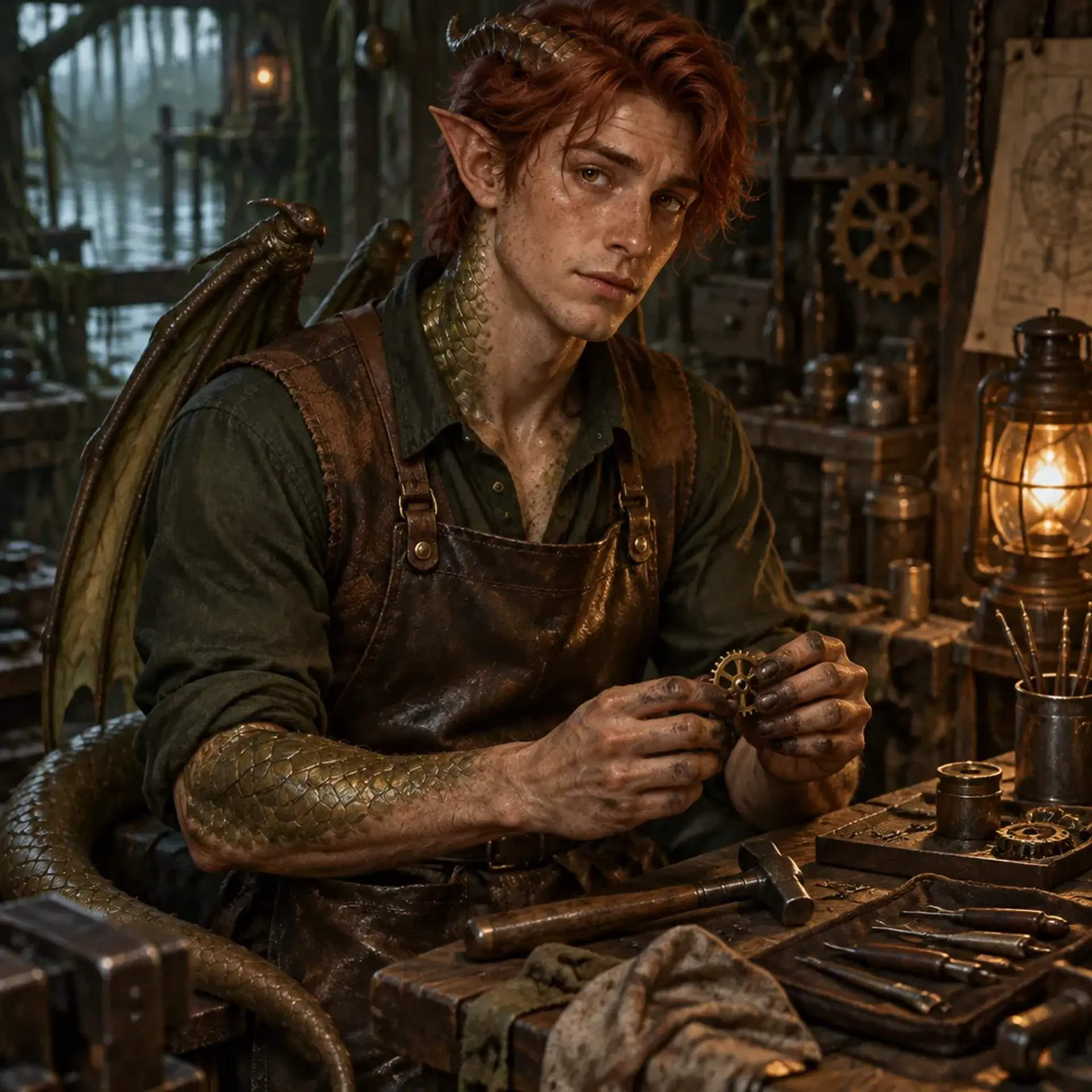
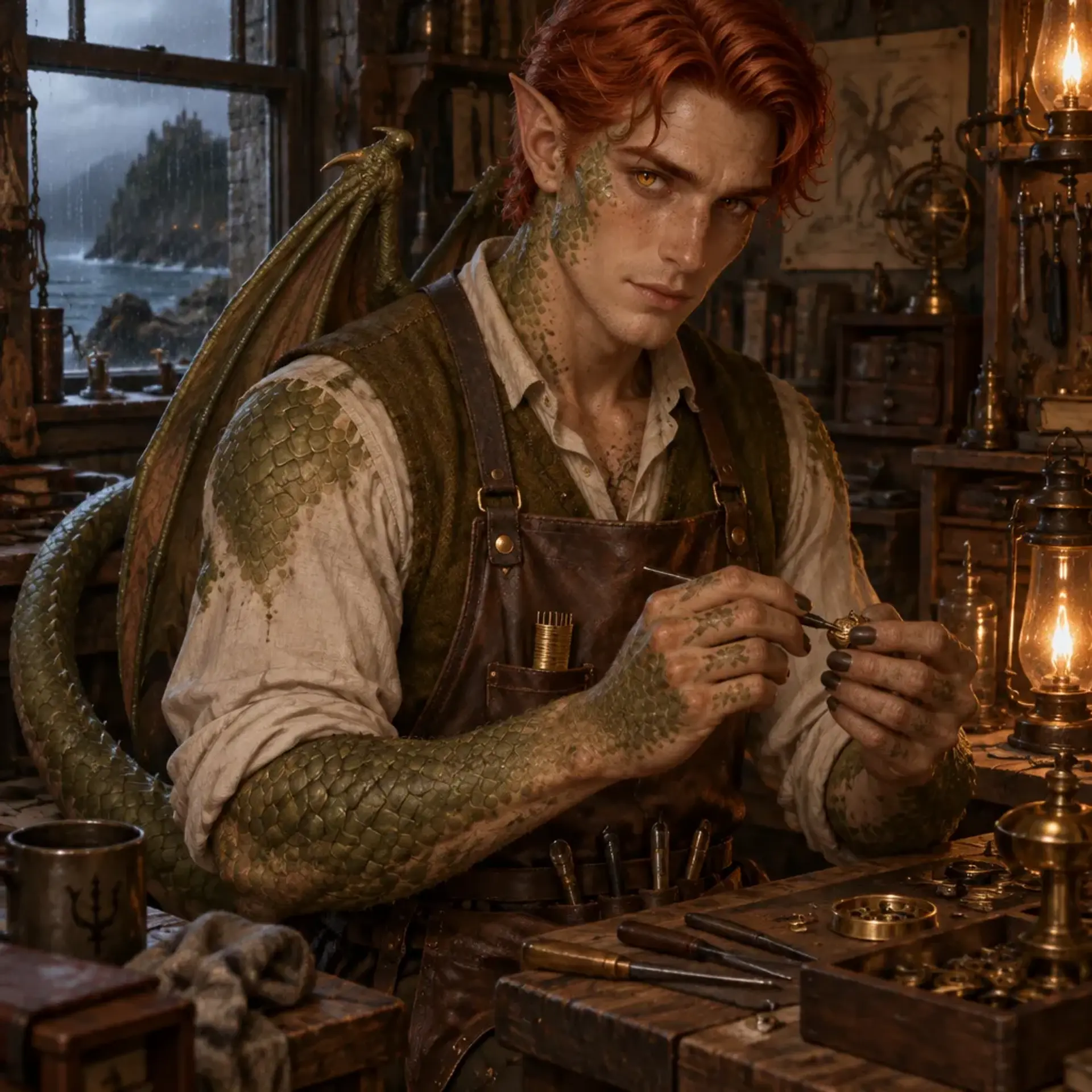
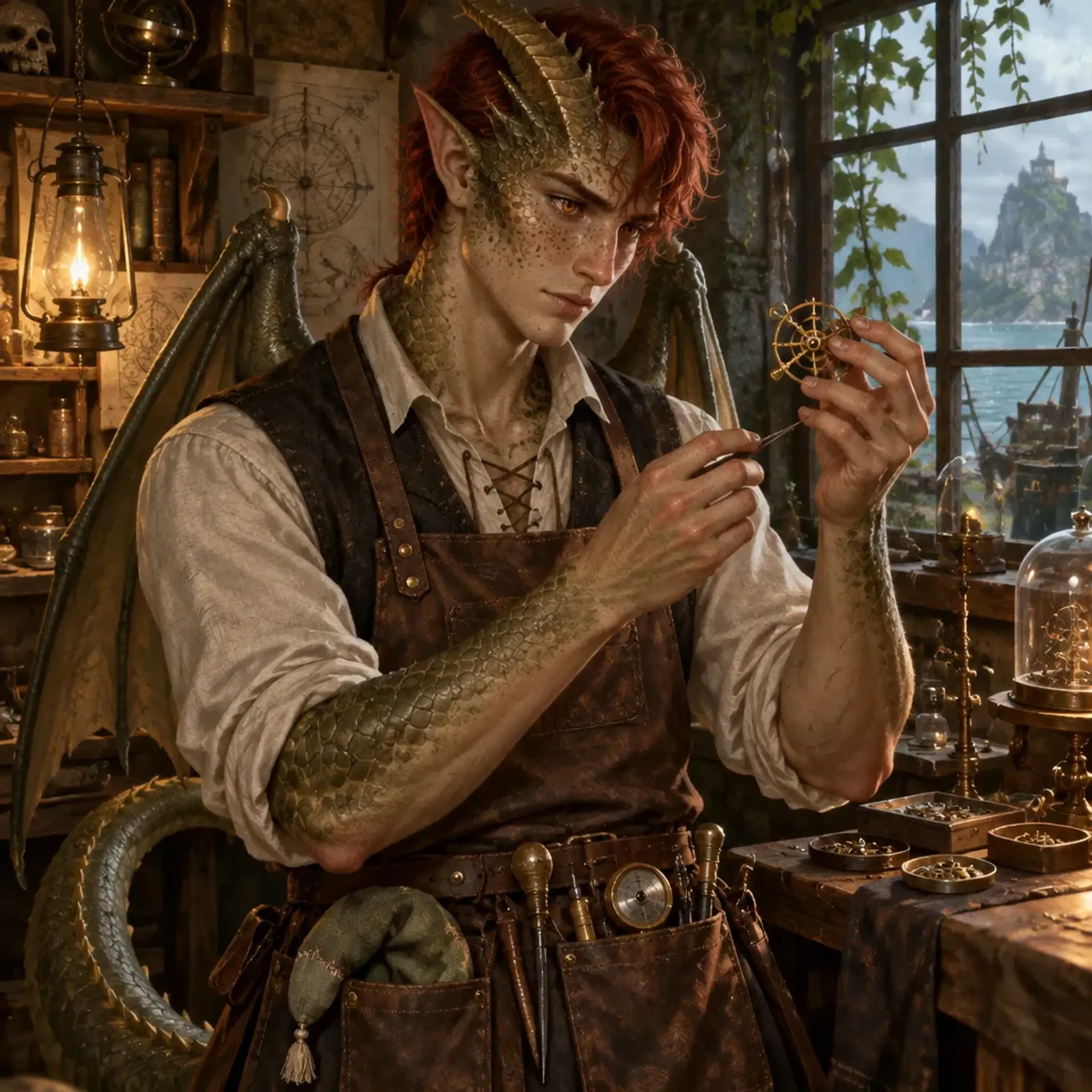
Eber is five feet ten inches tall, almost absurdly large beside his Stout-halfling parents, with fair skin freckled across his nose and shoulders and olive-green scales laid over it in flexible, overlapping patches. The scales are darkest along his spine and wing joints, then thin to a dappled green at his hands and face. His red hair sticks up in uneven tufts between a low, narrow crest that folds back when he squeezes through a doorway. His amber eyes have a molten, slit-pupiled focus that can make even a friendly look seem like an appraisal. Pointed ears angle back when he listens. A long tail balances him as he moves, and two strong but relatively compact wings fold close to his back. His teeth are hard, narrow, and sharp, suited to swallowing rather than chewing; he eats with the careful concentration of a clockmaker fitting a tiny gear. His breathing has a faint wet rasp, like air drawn through reeds. When rattled, it catches and whistles through his nose, and his jaw works as if trying to bite down on a thought. He walks with a light, deliberate step, placing his feet as though the floor might disclose a secret. Despite his dragonlike build and love of bright objects, he wears an unexpected thing for a young craftsman: a small, patched woolen bedcap knitted by his mother, tucked in a pocket and brought out when he cannot sleep.
Clothing
A craftsman's outfit with strong Germanic influence: a laced linen shirt, dark wool waistcoat, sturdy trousers, leather apron, and a belt fitted with narrow tool loops. His clothes are altered with extra room for his tail and slits for his folded wings. His boots are handmade and broad across the toes. A patched woolen bedcap from Wilma is tucked into a pocket.
Body language
Eber keeps his shoulders slightly angled so his folded wings do not crowd the person beside him. His tail betrays his mood before his face does, curling around a chair leg when anxious and going very still when angry. He handles tools with precise, economical movements. When he is embarrassed, his jaw shifts and his eyes track the nearest reflective surface. When rattled, his breath catches in a wet nasal whistle and his wing joints twitch.
- Height
- 5 feet 10 inches
- Build
- Tall for the Marshwake, lean through the waist and strong through the shoulders, with flexible draconic joints and wings built for gliding rather than sustained flight.
- Eyes
- Molten amber with narrow pupils; dark brown before adolescence
- Hair
- Red
- Skin
- Fair beneath flexible olive-green scales, with freckles across the nose and shoulders
- Age
- 19, a young adult by Marshwake reckoning
- Gender
- Male
- Size
- Medium
Distinguishing features
Personality
16 traits and drivesEber is clever with mechanisms and words, but the two kinds of cleverness serve different purposes. With a broken watch, he is patient and willing to test every possibility. With a person, he can be so quick to find the weakness in an argument that he misses the hurt beneath it. He likes being useful and hates being fussed over. He can spend an hour adjusting a tool for someone else's comfort, then bristle when that person asks whether he is comfortable himself. He is proud of surviving adolescence, yet dislikes being praised for it. To Eber, survival was not a heroic choice. It was a fever, a mouth that stopped working, and a succession of mornings when the mirror showed another change. He is grateful that his family protected him, but protective attention can feel like a cage when he is already too large for the house. He wants his parents' warmth and also wants to stop being treated as the youngest child who must be watched. At the workshop he is focused, methodical, and quietly competitive. He enjoys small, exact repairs, especially watches, clasps, and mechanisms whose hidden structure rewards patient attention. He is less comfortable carrying on the family's familiar work as though nothing has changed. When a project can make daily life easier for the High-bloods, he becomes animated and generous. When someone calls such work a special accommodation, he can turn cold and insist it is simply good design. With strangers, Eber is reserved but not shy. He studies people before offering much of himself, noting what they value and what they avoid. He can use a dry, clever remark to steer a conversation away from his body. If the other person accepts the diversion, he relaxes. If they press, he becomes exacting and sometimes cruel in his precision. He knows how to make a questioner feel foolish, and later regrets using that skill against someone who was merely awkward. His moods show through his body more clearly than through his face. When he is amused, his tail makes a slow curl and his eyes brighten. When anxious, he checks an object in his hands for flaws, even if it is already sound. Anger stills him. The wings draw close, his jaw shifts, and his breath catches in its wet nasal whistle. He does not get quieter or gentler when angry; he becomes blunt, choosing words with the same care he would give a sharp tool. Eber is fond of his family in a way that can make him stubborn. He remembers Windle's steady presence, Karl's jokes over the tools, Yonda's invitations, Alder's stories, and Kasper's calm in the garden. He loves Trogi's patience and Wilma's practical kindness. Their household's closeness is a comfort, but it also reminds him of what he cannot share in the old way. He cannot eat at the table without planning every swallow. He cannot sleep in his childhood bed. He cannot squeeze into a familiar seat without folding wings and tail around himself. He sometimes envies the easy compactness of the Low-blood relatives, then feels ashamed of the envy. Ignatz is the person he trusts most to understand without explanation. Eber knows his brother's changes have brought urges that frighten him, including the deliberate killing of a chicken during a sudden hunting impulse. Eber does not excuse the act, but he understands the shame that followed it. He stands up for Ignatz when others speak as though one frightening moment defines him. He expects the same understanding in return, and can feel betrayed when Ignatz is too cautious to take his side. Rodrick draws out Eber's most contradictory feelings. Eber admires his brother's courage and resents his arrogance. Rodrick's sorcery makes their changes look like a source of power, while Eber's altered eating looks like a humiliating limitation. Eber knows Rodrick's teasing is not always malicious, but he will not pretend it is harmless. He can needle Rodrick's vanity with remarkable accuracy, then worry that he has made a family conflict worse. With Yonda, he is affectionate and impatient. She treats social connection as a kind of nourishment and believes that invitations will eventually overcome his reluctance. Eber knows she is trying to include him, not correct him, but repeated reminders to be more social make him feel like a faulty part being adjusted. He sometimes goes to her gatherings anyway, then spends the evening near the edge of the group listening more than speaking. Eber's love of shiny things is not simply greed. A polished screw or colored shard is a small promise that something overlooked can be made useful. He collects bright fragments and takes pleasure in arranging them, but gives away many of his finds when he discovers someone needs them. He is proud of being able to repair what others discard. He is less willing to admit that he likes having a private hoard of objects that nobody else can ask him to explain. He is protective of children, especially Otto and Anika, and watches for signs of change without wanting to become the source of their fear. Seeing Windle study his own children can sting. Eber wishes his brother would see him as a person, not a forecast. At the same time, he understands why the possibility frightens Windle. Eber's empathy often arrives alongside resentment; he can recognize another person's pain and still be angry that they have made him carry it. When he is relaxed, Eber can be funny, curious, and surprisingly generous with his time. He likes explaining how a mechanism works, so long as the listener is genuinely interested. He enjoys hearing Black Alder's travel stories, though he distrusts the idea that leaving home automatically means freedom. If someone needs a repair, he will often do it before being asked. If someone asks him to talk about his feelings, he may answer with a small joke, a technical metaphor, or a question about what they actually need from him. At his worst, Eber becomes aloof and treats distance as proof of independence. He can convince himself that family members are only protecting him out of obligation, even when their actions show love. He may hide a concern until it has become a real problem because he does not want to make anyone worry. At his best, he sees that accepting help need not mean surrendering his dignity. He is learning that a home can change shape without ceasing to be a home, and that asking his family to make room for him is not the same as asking them to pity him.
- Alignment
- Neutral Good
Quirks
Habits
Traits · 4
Flaws · 4
Fears · 4
Wants and needs · 4
Combat
AC 15 · HP 17 · 30 ft.Eber prefers to stay behind sturdier allies, using Fire Bolt and Magic Missile to attack from range while keeping cover between himself and danger. He uses Faerie Fire when allies can capitalize on it, and uses Cure Wounds when someone is badly hurt. He is reluctant to use his custom breath weapon unless cornered, because its rattling cough and poison smell frighten his family. If escape is possible, he glides from a height or withdraws behind cover rather than trading blows.
Eber Waldner
Spells
Actions
Reactions
Services they sell
Rewards they can give
Equipment
- Workshop hammer (weapon)A balanced craftsman's hammer that serves as his practical weapon.
- Tool apron (equipment)Leather apron with small loops and pockets for tools, screws, polished stones, and a miniature pair of pliers.
- Stone case (personal item)A lidded case made by Trogi, holding smooth digestion stones selected and polished by Wilma.
- Waldner work clothes (clothing)A red-haired craftsman's clothing altered for tail and wings, with a patched woolen bedcap tucked into a pocket.
- Repair kit (tools)A small set of brass gears, springs, wire, and lenses used for watch repairs and experimental devices.
Possessions
Background
Eber Waldner is the youngest of eight children in a Stout-halfling-descended family of craftsmen living on a remote volcanic island in the Marshwake archipelago. Their people are the descendants of castaways who survived a dragon-haunted wilderness by accepting the blood of a wounded green dragon. Three generations later, that bargain is no longer an old tale. It is a family matter, an argument about beds and food, and a change that can arrive in a child's body before anyone is ready. The Waldner workshop is the family's center of gravity. Trogi, Eber's father, is a Low-blood craftsman with black hair going grey and green eyes. He says he wants to retire, then finds himself back at the bench repairing a hinge or setting a tool in order. He is calm, patient, and quietly patriarchal, though he has lately become preoccupied with the idea of growing a beard after seeing one on a visiting man. Wilma, Eber's warm and sharp-minded mother, prefers her garden and chickens to the workshop's noise. She can butcher a chicken or clean a fish without hesitation, but violence between people makes her go faint. She and Trogi fish together at a local stream when they can steal time from the household. Eber grew up among a busy crowd of siblings and cousins, where food was shared, tools were borrowed, and privacy was mostly a hopeful idea. Windle, the eldest, is a Low-blood with a family of his own and is expected to take over the workshop. His son Otto has brown hair and hazel eyes; his baby daughter Anika's cheerful smile lights up her brown eyes. Windle is stoic, but Eber knows he fears his children could develop High-blood changes. Karl, the second oldest, loves tools and gears. His marriage to Leanora, a rough sailor descended from the dragon hunter Wilks and the halfling heroine Nailia, is rocky and often stretched by her absences at sea. Their son Hansel has black hair and black eyes. Ragni, Leanora's pale, white-haired child with milky blue eyes, is also part of the household's tangled family life. Yonda, Eber's only sister, is a beautiful, friendly Low-blood with a gift for knowing everybody's news. She is kind to Eber and never stops gently urging him to be more social. Her five children include Hans, whose vivid green eyes have begun to worry the adults, and Birke, whose hazel eyes seem to turn yellow in certain light. Her daughters are Willow, Trude, and Liesel. Alder, a Low-blood with green eyes and cropped black hair, works part-time as a town guard but is easily drawn away by merriment. His twenty-two-year-old son, Black Alder, is a High-blood cousin with amber serpent eyes and green scales over pale skin; he visits often and tells Eber stories of adventures beyond the island. Kasper, another Low-blood, tends the workshop's accounts and repairs watches, then retreats to the chickens and garden. He and his wife are content with their two daughters, Wonda and Ilse. Eber's adolescence changed the family from a cluster of people into a protective household watch. His red hair had marked him as unusual since childhood, but his eyes were dark brown until the transformation began. It started with a feverish ache behind his teeth and a deep pressure in his ribs. His brown eyes lightened to molten amber. Scales appeared in uneven patches, his ears sharpened, a tail grew, and his back strained as wings forced their way out. Most frightening was the change in his mouth. His teeth hardened and narrowed until chewing became impossible. The first time he tried to eat a piece of bread, his jaw simply could not do the work. He remembers the bread going cold in his hand while everyone watched. The healers who came to examine him had theories and questions, but no quick cure. Eber began cutting food into tiny pieces and swallowing it with smooth stones. The stones helped his altered digestion grind food, but they were painful to pass and painful to swallow when their surfaces were rough. Wilma found river stones and polished them until they were smooth. Trogi made a small, lidded case to carry them. Ignatz, only a year older and undergoing his own changes, stood by Eber even when he was unsure how to help. Ignatz had ashy light-blond hair and draconic green eyes, grey-green scales, a long flexible tail, claws, and the sudden predatory urges that frightened him. In the weeks after Eber's transformation, the High-blood members of the family slept together in the dining hall and kitchen. Their ordinary beds were too short, their clothes too tight, and the older house was never built for broad wings or tails. They laid blankets between the kitchen table and the cold hearth. Wilma kept water close. Trogi left a lamp burning. The arrangement was meant to keep the changing children safe, but Eber also remembers the shame of being unable to fit into the small, warm rooms where his parents slept. He could hear their voices through the wall and knew they were awake, worrying about him, while he lay too large for the bed and too distant from their old way of being a family. Rodrick, a High-blood three years older than Eber, is taller and broader still. His auburn hair, yellow eyes, fair skin, reddish-tipped green scales, and predatory build make him difficult to overlook. His sorcery is a source of constant bragging. He teases Eber about his eating and insists he means no harm, though he stops when Eber's anger turns frighteningly sharp. Rodrick works in the shop, carries heavy loads, and helps with the chickens, but he is eager for work beyond the family business. Eber loves him as a brother and resents how easily Rodrick treats their changes as a contest. The family has had to adapt in practical, unglamorous ways. High-blood relatives need more food, more fabric, longer beds, and doors that do not catch wings. Every repair takes time away from paying work. The workshop's business depends on familiar tools and familiar customers, while the family's needs keep changing. Eber has become a careful artificer-in-training, drawn to watch mechanisms, clasps, tiny hinges, and any device that makes a hard task easier. He takes apart broken things to understand where a weakness begins. He dreams of building a chair that will accommodate a tail, a sleeping frame wide enough for folded wings, and a quiet mechanism that helps him prepare meals without making a spectacle of his mouth. His closest bond remains with Ignatz, who understands that a change can feel like an unwanted appetite as much as a new shape. His relationship with Yonda is affectionate but strained by her efforts to bring him into every gathering. Eber wants to be included, but he hates being treated as a problem to solve. Windle's worry about his own children troubles him. Eber sees the way Windle watches Otto and Anika for a glint in their eyes, and he fears his own body has become a warning in his brother's mind. Black Alder gives him a glimpse of a possible future, one not limited to the workshop, but Eber cannot tell whether those adventures are freedom or merely a different kind of flight. Eber's current conflict is not that he rejects his family. He loves their noise, their meals, the workbench polished smooth by generations of hands, and the familiar smell of Trogi's tools. What hurts is that love cannot make him fit the old life. He is too tall for the childhood bed, too strong for the old scale of the work, and increasingly distant from the halfling warmth that once seemed effortless. He cannot eat the way his parents do. His body makes him conspicuous even in his own kitchen. He wants to remain a Waldner without pretending he is still the child who could sit at the family table without planning every swallow. At present, Eber is working on a set of adjustable workshop tools and a folding bed frame for the High-bloods. He is also quietly investigating whether the dragon's blood that remade his family is still active in the island's environment. He does not want to alarm his parents, and he is especially reluctant to give Rodrick another reason to boast. The island's forests, hot springs, ash-prone fields, and shifting ground keep reminding him that the Marshwake are still adapting to a home that may not be done changing them. Eber's ambition is modest in the way a useful invention can be modest: he wants the next child to transform without having to sleep on a kitchen floor, eat in pain, or mistake being protected for being unwanted.
Role in the story
A young artificer whose changing body and family needs make the Marshwake's inherited dragon blood personal rather than abstract. Eber can provide repairs, local knowledge, and a human connection to the island's uneasy transformation. His investigations may lead the party toward the source of continuing changes, while his family ties create stakes that cannot be solved by treating him as a quest-giver.
“Their people are the descendants of castaways who survived a dragon-haunted wilderness by accepting the blood of a wounded green dragon.”
- Faction
- The Waldner family workshop and the Marshwake community. He has no formal guild or military affiliation.
Known connections
Media
0 imagesNo images yet.
Turn Eber Waldner into a sheet
A high-res, share-ready sheet you can post or print.