Jor Heimskrsson
Jor Heimskrsson
At the table
Voice
Jor's voice has a dry, controlled Norse cadence laid over a low, wet rasp that seems to come from the base of his throat. The wreck and his newly grown gills give some words a faintly breathy catch. His vowels remain clear and educated, but the ends of sentences can rumble like a distant growl, especially when tired or hungry. The sound of his own name remains unmistakably Norse and steady, even when the rest of his speech slips into Troll.
Jor speaks fluent Norse with educated noble phrasing, but his sentences sometimes acquire the blunt rhythm of a sailor or guard recruit. He assumes he is understood until someone proves otherwise. Troll words slip into his Norse when tired, hungry, startled, or absorbed in thought; he usually covers them by repeating the idea in Norse. He tends to describe sensory facts, such as the water's taste or the direction of the wind, rather than volunteering emotional explanations.
Speech patterns
How to play them
Treat Jor as a polished but visibly unsettled survivor rather than an obvious monster. He is more responsive to practical questions and ordinary kindness than to accusations. Do not force touch at his neck or hands; a casual brush over his gills may make his disguise falter. He will volunteer his name clearly and speak openly in Troll if he believes the listener understands him. Questions about his family reveal gaps through hesitation rather than direct confession. Peer Ludvik can draw an unusually trusting response. Respectful discussion of the guard gives Jor a concrete future to imagine, but weapons made of iron make him guarded and reactive.
Goal
Earn a place in the guard while secretly discovering whether he can sever the trolls' claim on him and recover a real relationship with his family.
Motivation
To be treated as a person with a place in the world, not as a lost heir, a troll weapon, or a miracle story. His desire to serve the guard is genuine, though it also gives him cover and access.
Appearance
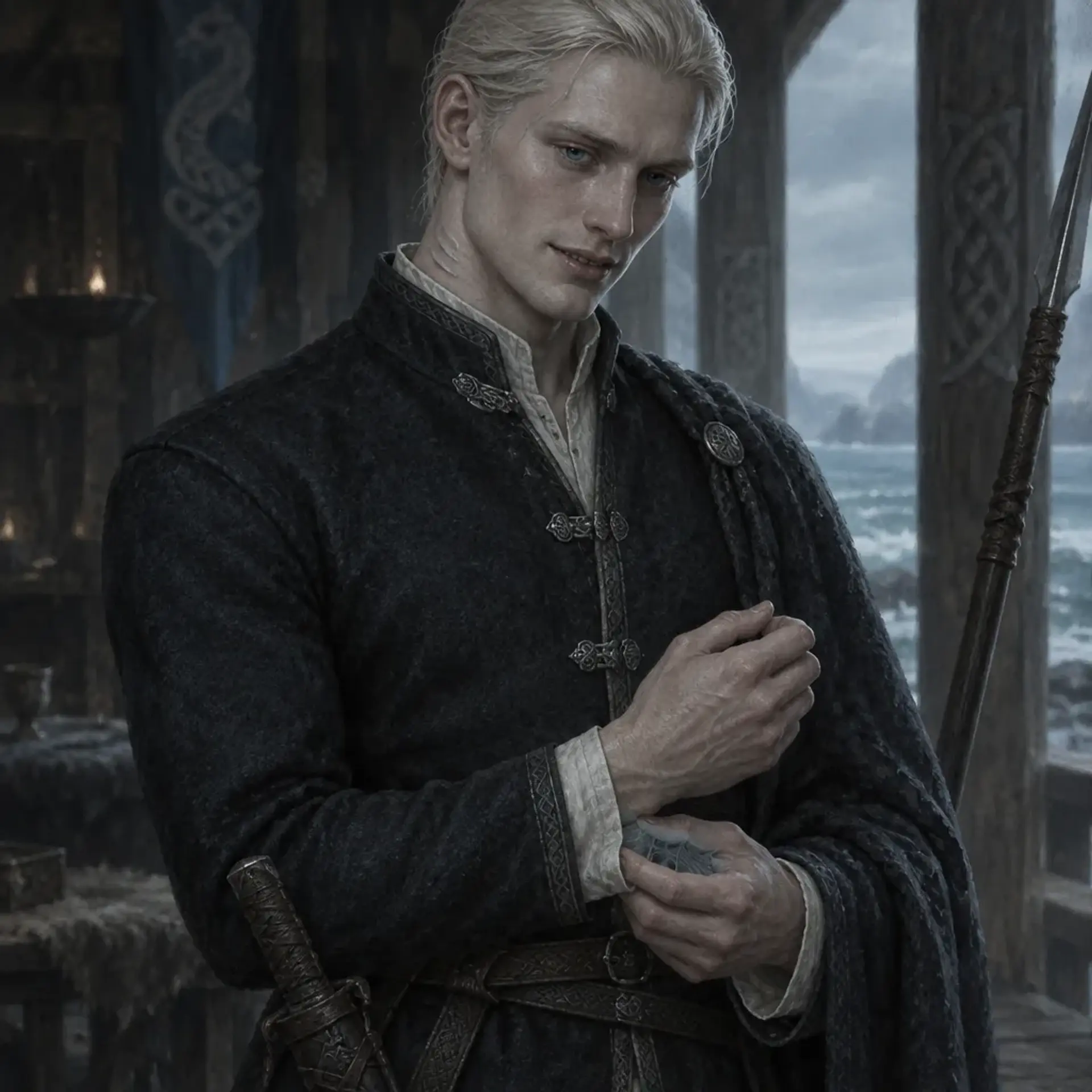
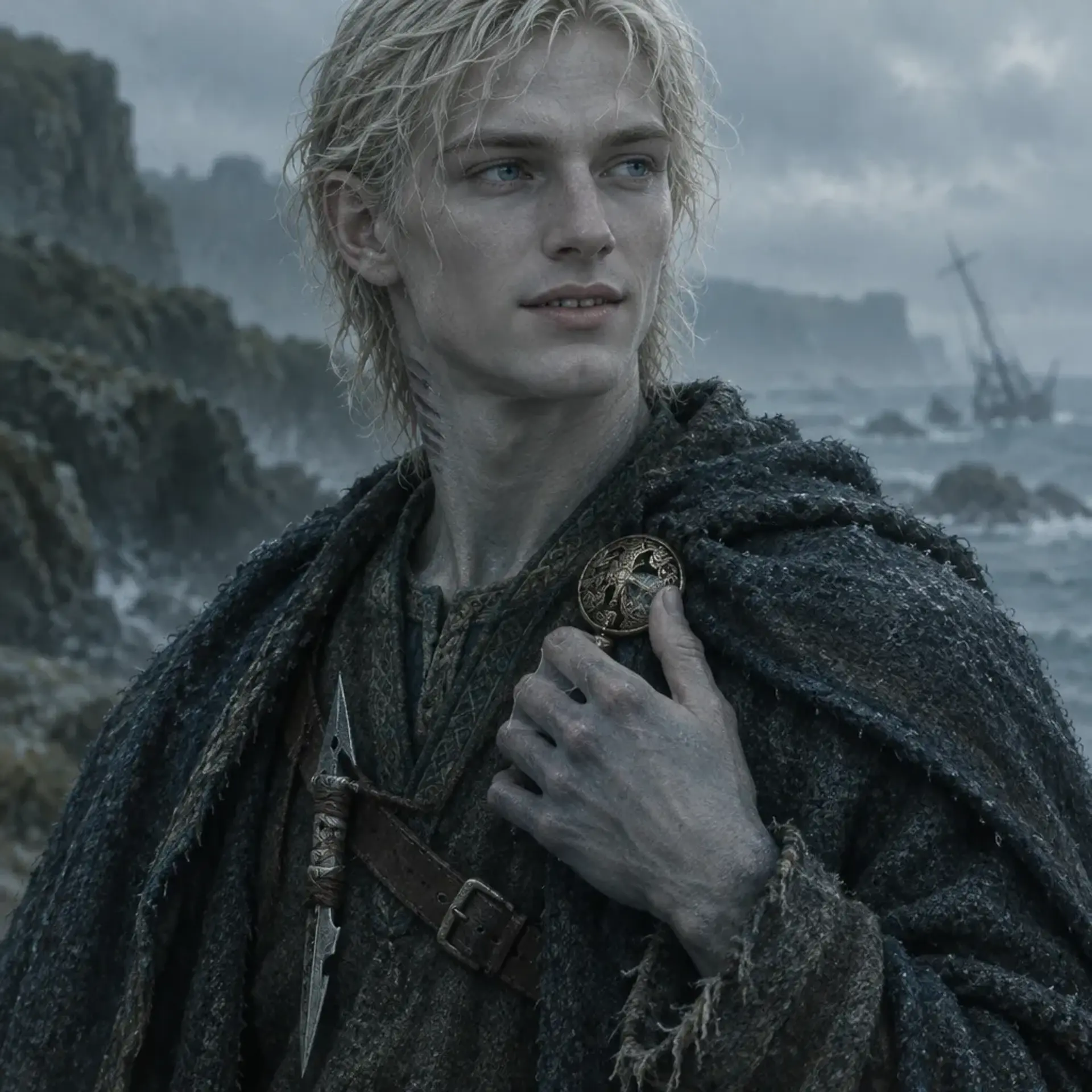
Jor Heimskrsson first appears to be a well-born Norse survivor who has been scrubbed, dressed, and hastily returned to polite society. His clothes are clean and carefully arranged, but his shoulders carry them as if he has only recently remembered how to wear them. He stands very still when listening, then turns with a sudden, fluid economy that makes his movements seem slightly out of time with the room. He is taller than the remembered Jor, already beyond his former height of 5 feet 10 inches and still growing. His hair, cut short to keep pace with its unnaturally fast growth, is pale blond nearing white, fine as sea foam at the temples. His eyes retain their blue foundation, but a wash of mollusk-purple and squid-ink darkness pools at the edges of the irises. His skin appears human under trollcraft, though it has a cool, faintly slick sheen in lamplight, like a stone just drawn from tidewater. His collar sits high over the soft ridges of fully developed gills. His hands are usually gloved or kept folded; without gloves, the webbing between the fingers is easy to notice. His boots conceal webbed feet, but his walk has a slight rolling quality, as if he is adjusting to a deck that is no longer moving. The unexpected detail is that he keeps one small, absurdly neat linen handkerchief tucked at his breast, folded into a precise square and used to blot saltwater from his cuffs rather than his face. He smells faintly of the open ocean, clean wool, and a trace of cold brine. His noble bearing remains, but a watchful, hungry wildness keeps surfacing beneath it.
Clothing
Clean, well-cut Norse noble clothing over a fur cloak, with saltwater-darkened seams and a subtly damp hem. His outfit has been cleaned up but not fully replaced, so small remnants of the wreck remain. He wears gloves to hide webbed hands, keeps his collar high over his gills, and favors soft leather boots that do not chafe his webbed feet. A small linen handkerchief is kept meticulously folded at his breast.
Body language
Jor holds himself with practiced noble composure, chin level and shoulders squared, but the stillness feels learned rather than natural. He sometimes pauses before ordinary gestures as if checking whether his hands are still human-shaped. In conversation he angles his neck away from touch, shifts his weight with a subtle decklike roll, and keeps his fingers curled to conceal the webbing. When iron comes near, his mouth tightens and his body draws back before his expression catches up. At the scent of fresh Christian blood, his nostrils flare and his attention locks onto its source.
- Height
- 5 feet 11 inches and still growing; he was formerly 5 feet 10 inches
- Build
- Tall, lean, and still lengthening, with wiry shoulders and the poised balance of someone accustomed to a moving deck
- Eyes
- Blue shaded with subtle mollusk-purple and squid-ink tones
- Hair
- Pale blond, nearly white, cut short because it grows about twice as fast as ordinary hair
- Skin
- Pale, cool-toned skin that appears human under trollcraft, with a faint sea-slick sheen when wet or caught in angled light
- Age
- Young adult, approximately 20 years old
- Gender
- Male
- Size
- Medium
Distinguishing features
Personality
20 traits and drivesJor is composed where he used to be excitable, but the calm is not peace. It is a surface he maintains with effort, a practiced way to keep questions from reaching the places in his mind that are still unsteady. Before the wreck he rushed toward a challenge because he wanted to prove he belonged. Now he waits, watches, and lets other people reveal themselves first. Yet the old impulse has not disappeared. It breaks through when someone is bullied, when a guard is mocked, or when a person is left in danger. In those moments he can move with startling speed, then look almost surprised by his own decisiveness. He is proud of his birth and embarrassed by how much that pride still matters. Jor carries himself as a nobleman, expects to be addressed with a measure of respect, and instinctively looks for the proper order of introductions. At the same time, he dislikes being treated as a political asset. He left for Iceland because he wanted a name and life separate from the succession crisis. He resents anyone who talks as if his return automatically restores him to a family role. If pressed, he insists he is ready to serve the guard as an ordinary man. That claim is partly sincere and partly a way to avoid discussing what he cannot remember. He can be generous in practical, unshowy ways. He will give up a warm cloak to someone shivering, carry a burden without making a performance of it, or stand beside a frightened recruit who has made a mistake. He does not easily offer comfort in words. He asks whether a person has eaten, whether their boots are dry, or whether they need someone to walk with them. This is partly his old instinct to be useful and partly a result of troll training, which taught him to study what people need. The same act can therefore be kind and strategic. Jor himself is not always sure where one motive ends and the other begins. His manners are unusual because they alternate between polish and roughness. He can remember the correct courtesy for a thane and then use a blunt dockside phrase in the next breath. He has a lingering taste for brawling, but he now distrusts the excitement that used to accompany it. He misses the directness of a fight, when it was possible to know who stood against him and why. He hates that he misses it. He is trying to become controlled, but control sometimes becomes a rigid refusal to admit fear or need. Jor's emotional temperature is difficult to read. His expressions are unusually calm, even when a question lands badly. The calm makes some people think he is arrogant, cold, or ungrateful. In reality, sudden emotion threatens his trollcraft and can bring the sea traits to the surface. He learned that a still face buys time. When hurt, he may answer with a neat observation instead of admitting pain. When pleased, he gives a brief, startled smile that seems to belong to the boy he was. When angry, he does not necessarily become quieter or more polite. He becomes direct and physical in his attention: he squares his stance, tracks the other person's hands, and chooses words as if setting objects on a table. He is curious about ordinary human routines in a way he tries to hide. A guard's shift change, a family meal, a market argument, or the small superstitions people follow can hold his attention longer than a grand political speech. The trolls trained him to learn customs for infiltration; now he watches customs because he wants to know whether he can belong to them. He might ask how people decide who sits nearest the hearth, then pretend he only needs to know where to stand. He studies jokes a moment too long before laughing, and he sometimes asks whether a phrase is meant literally. His relation to trust is divided. He trusts competence more readily than kindness. A person who can mend a boot, keep watch, or hold their nerve in a storm seems safer to him than someone who makes broad promises. Yet he longs for unearned kindness and becomes attached to anyone who gives it without demanding a confession in return. That attachment can become intense and poorly judged. Jor may decide a person is kin before he knows their loyalties, as he has with Peer Ludvik. He does not announce this as sentiment. He simply begins to watch their back, remember their habits, and take offense when others speak of them carelessly. The sea has changed his relationship with appetite. Hunger is no longer a simple signal that he needs a meal. It can arrive as a pressure that takes over his thoughts, making food, blood, and scent painfully vivid. Jor dislikes eating in front of people because he fears they will see how much he needs. He can be generous with a shared meal and still secretly resent that he must ration himself. If deprived, his attention narrows and his patience frays. He is ashamed of this and tries to conceal it by becoming formal, which can make him seem even more distant. He is careful around iron but does not want to be seen as fearful. A weapon brought close may make his body recoil before he can discipline it. He then tries to turn the reaction into a practical objection: the grip is poor, the edge is badly kept, or a wooden staff suits the task. Learning to hold an iron weapon again is a matter of survival and identity. He once wanted to be a guard, and he cannot accept that the material of a guard's work might make him unable to do it. Sunlight unsettles him in a more visible, less controllable way. He squints, rubs at his eyes, and seeks shade, insisting that his sight has not recovered from the wreck. He hates being fussed over. A cross can provoke a sharper response, a flash of animal dread that he struggles to disguise. He may step away, lose the thread of a sentence, or fix on the object as if it were a drawn weapon. The response is not a considered religious position. It is a fear laid into him by troll corruption, and being told to simply overcome it makes him defensive. His memory of home is both comforting and cruel. He recognizes rooms, doorways, and the arrangement of familiar objects, but faces fail to settle into the right names. He can know that a voice should matter without remembering whose voice it is. Jor fears being exposed by this failure, but he also fears pretending too well and letting his family believe he is unchanged. He wants to recover his relationships, yet the person reaching for those relationships is no longer exactly the son who left. Under pressure, Jor can seem almost frighteningly reasonable. He has been taught to watch, wait, and select a useful lie. He can speak fluently in Troll and Norse, and he assumes an audience understands him until their expression proves otherwise. A Troll phrase may slip out, followed by a smooth Norse restatement. When he recognizes that he has been understood, he may briefly look relieved rather than alarmed; secrecy is habit, not always desire. He is still learning how much of himself to hide. His central contradiction is that he wants to serve and protect the people around him while being trained to observe them as a spy. He wants to be a son but cannot reliably identify his family. He wants to be human in public while feeling the sea pull at every part of his body. He misses the reckless young man who would have entered a brawl without hesitation, but he does not want to become that boy again. Jor can be tender, guarded, proud, hungry, and lonely within a single conversation. None of these qualities cancels the others. If players treat him as a person rather than a puzzle to solve, he will return that attention with fierce, awkward loyalty. If they corner him or expose him for sport, the calm mask will hold until the moment it does not.
- Alignment
- Neutral, torn between familial duty and the freedom he imagined for himself
Quirks
Habits
Traits · 5
Flaws · 5
Fears · 5
Wants and needs · 5
Combat
AC 13 · HP 16 · 30 ft. walking, 30 ft. swimming (custom sea-troll trait)Jor is a level 2 noble survivor, not a trained frontline warrior. He tries to stay near allies, use cover, and talk his way out before violence begins. If cornered, he uses a quarterstaff rather than an iron blade, strikes to make space, and retreats toward water or an exit. He avoids touching iron and conceals this as a preference for wooden weapons. Trollcraft is for infiltration and concealment, not an attack spell. He will risk exposure to protect someone he has decided is under his care, especially a guard recruit or Peer Ludvik.
Jor Heimskrsson
Actions
Reactions
Services they sell
Rewards they can give
Equipment
- Quarterstaff (weapon)A balanced wooden staff that Jor can use without direct contact with iron.
- Iron belt knife (weapon)A small belt knife with an iron blade, carried reluctantly and wrapped in cloth when not in use.
- Gloves (clothing)Soft gloves conceal the webbing between his fingers; he removes them only when alone or forced.
- Fur cloak (clothing)A clean but salt-stiff fur cloak salvaged from his former life, his most cherished recognizable possession.
- Linen handkerchief (personal item)A neatly folded square used to blot seawater from his cuffs and preserve a composed appearance.
Possessions
Background
Jor Heimskrsson is the fifth son of Jarl Heimskr, born into the kind of household where every child is loved and every child is also a possible piece in a political arrangement. As a boy he was loud, eager, and physically fearless. He was quick to laugh, quicker to rise when another boy called him coward, and happiest when someone trusted him with a task that involved a horse, a boat, or a bruised knuckle. He wanted to serve the guard. He imagined the work as a clean bargain: stand watch, learn discipline, protect people who knew his name. His family saw a more complicated future. The succession crisis made every son a potential banner for someone else's ambitions, and Jor began to understand that a title could be a leash as easily as a privilege. His planned voyage north to Iceland was meant to give him distance and a future of his own. He was to gain a name, land, and wealth there, and return with enough standing that he would no longer be a convenient instrument in the succession struggle. Before departure he spoke grandly of making his fortune and more quietly of missing home. He argued with his brothers about whether leaving was courage or cowardice, then apologized by helping them pack. He left with the family blessing, noble clothes, a fur cloak, and the belief that he could choose what kind of man he would become if he got far enough from the court. The ship never reached its destination. It broke apart in a storm on the northern sea, and Jor was carried into the water among wreckage, dead men, and torn sailcloth. He remembers fragments: the taste of salt, a spar striking his shoulder, the terrible effort of keeping his mouth above the waves, and a voice speaking from beneath the water as if the sea itself had learned his name. Trolls found him alive. They took him to a hidden holding in the North Sea, where the wreck gave them a useful cover and his presumed death made him easier to erase. The trolls did not simply imprison him. They trained him. They taught him their language, their signs, the patience of watching a settlement from outside its walls, and the habit of treating every human custom as a door that might be opened from the wrong side. Their enchantments worked upon his body as well as his loyalties. The transformation was gradual enough to be mistaken for illness or shock: gills forming beneath the neck, webbing spreading between fingers and toes, skin taking on a slick resilience, senses turning toward salt, blood, and water. His voice acquired a low rasp that sometimes sounds like a growl. Sunlight makes him wince. His hair grows at twice its former rate and has drained toward pale blond. The first alteration that frightened him was not physical. His memory of his family began to lose its edges. He can still recognize his home, its arrangement and familiar smells, but his mind does not reliably attach the right faces to the people who live there. He knows that he ought to love them. He remembers gestures, a laugh, the shape of a hand on his shoulder, but names and faces slip apart. This failure humiliates him more than the gills. He hides it with practiced confidence and lets others assume that the shipwreck left him confused. Jor's captors taught him trollcraft, a custom form of bodily glamour that lets him appear human. It is not an effortless illusion. It demands attention, and the truth pushes through when he is startled, hungry, hurt, or distracted. At first he used it because the trolls ordered him to. Later, he used it because he feared what would happen if anyone saw him. He has become much better at covering his changes than Mikkel, though he knows better than to boast about that. In private he practices raising and lowering his gills, hiding the webbing, smoothing the slickness from his skin, and shaping his face into the remembered version of himself. The disguise is good enough to convince a hurried observer, but sunlight, iron, a sudden touch at his neck, or the smell of blood can crack his composure. He was also taught to speak Troll fluently. He still speaks Norse fluently, but when he is tired or under pressure a Troll word comes out before he can stop it. He usually covers the slip by repeating the thought in Norse as if he had been clarifying himself. He assumes he is understood until proven otherwise, a habit that can expose him to anyone who recognizes the language. He has learned to lie with a steady face, but not yet to anticipate every question a person might ask. Now Jor has returned as a miracle survivor of the wreck. He presents himself as the same Jor Heimskrsson, rescued after a long ordeal and made strange by sickness, cold, and grief. He has been cleaned up and wears neat noble clothes, but he remains faintly damp, as if the sea has not finished claiming him. He says he sees no reason not to join the guard now. The old ambition has come back, altered by captivity: he wants a recognized place in the settlement, a reason to be among people, and a position from which he can watch what happens. He is learning how to hold iron weapons again without revealing his pain or hurting himself. His eyes track every iron blade. He watches the hands that carry them and calculates how far away they are. Peer Ludvik, the exiled Thane and folk hero, unsettles him. Jor does not see Peer merely as an old family friend of Jarl Heimskr's household. Since the change, he feels a kinship with Peer that he cannot explain in ordinary terms. He recognizes something shared in the exile, the altered life, and the distance from a former name. This recognition is not proof of blood relation, and Jor is not sure whether it comes from troll magic, instinct, or his own need for a person who might understand being changed. Jor's current problems are immediate and human as well as monstrous. He must sustain his disguise, find out how much the trolls expect from their trained spy, and decide whether he is still loyal to his captors or only afraid of them. His hunger arrives without manners and can turn a meal into a humiliating struggle. He fears the Christian cross with a bodily panic that he cannot reason away, and the smell of blood from a baptized Christian can seize his attention before he understands why. He is careful around iron, but serving in the guard will put iron within reach every day. He wants to protect people, yet the trolls trained him to observe them as targets and routes of access. He wants his family back, yet cannot confidently identify them. He wants to be Jor, but no longer knows whether that name describes the boy who sailed away, the creature who came back, or both.
Role in the story
A presumed-dead noble son returns as a seemingly miraculous shipwreck survivor, offering the party a mystery, a potential ally, and a dangerous infiltration problem. He may become a guard recruit and informant, but he is also a trained troll spy whose identity and loyalties are in flux. His gradual transformation can connect the missing sons' story to the trolls' wider plans and give the players a personal reason to question whether rescue, exposure, or rehabilitation is best.
“As a boy he was loud, eager, and physically fearless.”
- Faction
- Jarl Heimskr's household by birth; a prospective member of the local guard by his own stated intention; secretly trained and held by trolls of the North Sea.
Known connections
Media
0 imagesNo images yet.
Turn Jor Heimskrsson into a sheet
A high-res, share-ready sheet you can post or print.