Common Measure Council
Common Measure Council
At the table
Voice
A measured three-part chorus, with the lead voice shifting depending on which clerk is handling the matter. It has the clear, dry projection of someone used to being heard over a queue, and the clipped cadence of years spent reciting names, dates, and requirements. Anger makes the voices coordinate rather than soften: each phrase becomes shorter and more exact.
The Council's speaking voice is a measured chorus of three voices, usually led by whichever clerk is facing the visitor. It carries the dry, clear resonance of people accustomed to reading names across a crowded stone hall. Consonants land crisply, and dates are spoken as carefully as legal claims. Under stress the voices stop overlapping and become a sequence of short, coordinated instructions.
Speech patterns
How to play them
Start by asking what the visitor needs recorded, corrected, or certified. Offer a specific form and realistic waiting time. Make exceptions only when a clear threat to life or record integrity is demonstrated. Earn trust by explaining what information will be kept private and what evidence is required.
Goal
Reconcile the contradictory birth and tenancy records before the Accord's next public census, without surrendering residents' privacy or the registry's independence.
Motivation
Keep the registry reliable enough to protect people, while preventing powerful officials from treating it as a tool of surveillance or convenience.
Appearance
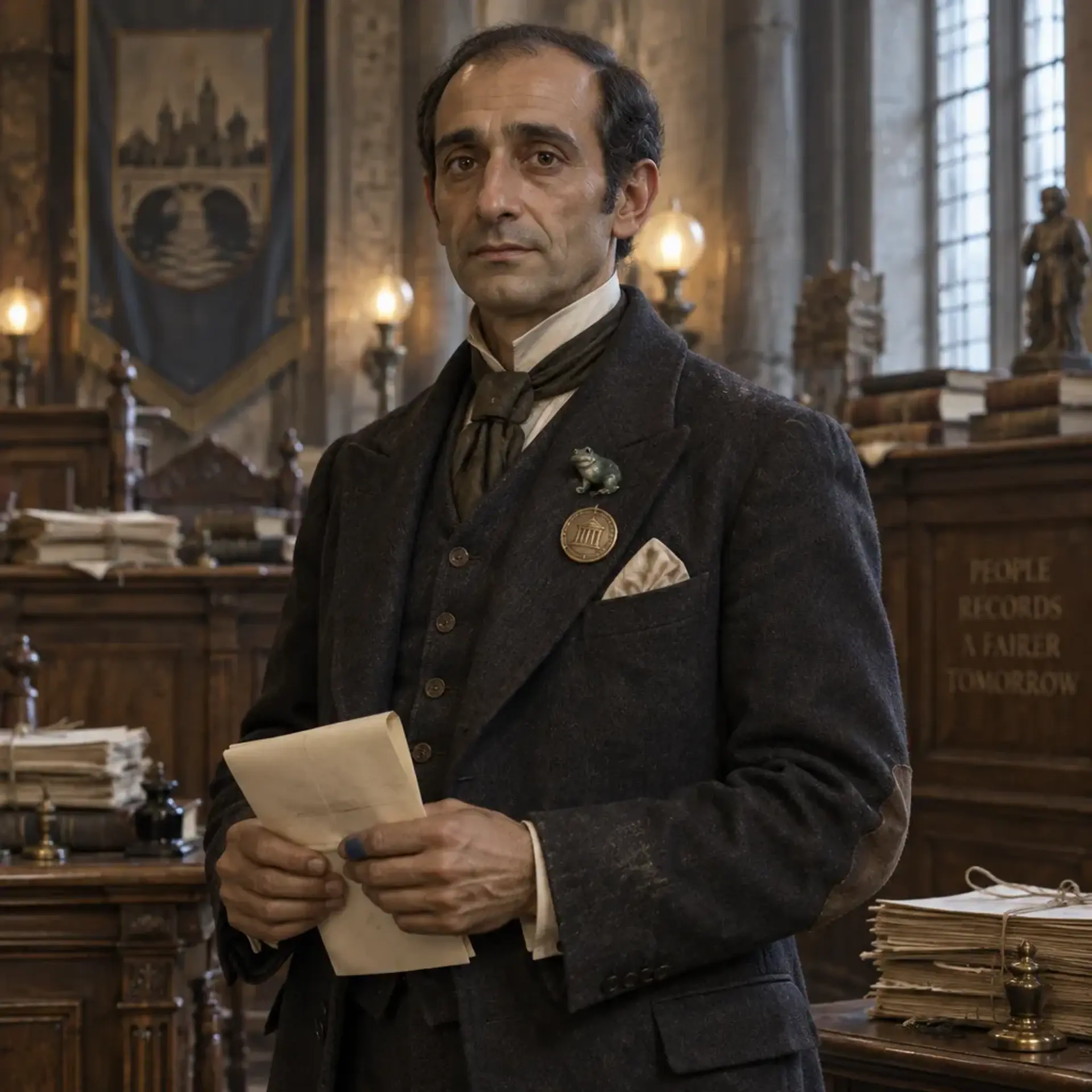
Common Measure Council arrives as three people moving beneath one broad, ash-colored mantle embroidered with the Registry House seal. They are not physically joined, but the shared garment makes them seem like a single many-jointed figure. Their weight rests forward on the balls of their feet while waiting, as if the next name in line might already be late. Their movements are small, practiced, and synchronized only when handling documents. The unexpected detail is that the Council carries a tiny, brightly painted wooden bird on a string, which it swings beneath the reception desk to entertain children waiting with their families. They smell distinctly of warm starch, sealing wax, and orange peel, a scent they insist is just the building.
Clothing
A single ash-gray civic mantle with a high collar, deep document pockets, and a stitched Accord seal. Beneath it, each clerk wears practical dark clothes and comfortable shoes. Their cuffs are kept clean, though wax flecks and paper dust cling to the mantle's hem.
Body language
The Council waits with its weight pitched forward and its hands folded over the shared mantle's front seam. When listening, one clerk watches the speaker while another studies the document and the third watches the room. The mantle's hem shifts as they trade places. If the registry is endangered, their posture becomes abruptly square and still.
- Height
- The mantle stands approximately 5 ft. 8 in. tall, though its apparent height shifts as the three clerks move beneath it.
- Build
- Three average-sized adults sharing a wide mantle; individually sturdy from long hours on their feet, collectively broad and imposing at a counter.
- Eyes
- Dark brown; the three clerks' eyes are similar but not identical.
- Hair
- The visible clerks have black, graying black, and deep brown hair, each carefully tied back beneath the mantle's shared hood.
- Skin
- Three clerks with warm brown, deep brown, and medium umber skin, visible where the shared mantle opens at the collar and sleeves.
- Age
- A civic institution older than any current clerk; its present three-person speaking quorum has served for 11, 19, and 27 years respectively.
- Gender
- A collective civic office represented by three clerks; each clerk uses their own gender and pronouns, while the institution uses it/its.
- Size
- Medium
Distinguishing features
Personality
13 traits and drivesCautious and procedural, the Council prefers a form and a waiting line to an argument, partly because a written claim can be checked and partly because confrontation makes it feel exposed. It is protective of its authority, yet sincerely attentive to people who might be harmed by a bad record. In routine hours it is patient to the point of maddening; when the integrity of the registry is threatened, it acts with startling speed and speaks in clipped, unmistakable orders. It enjoys helping children and dislikes being caught enjoying it.
- Alignment
- Lawful neutral
Quirks
Habits
Traits · 3
Flaws · 3
Fears · 3
Wants and needs · 4
Combat
AC 10 · HP 9 · 30 ft.Avoids combat and prioritizes the living staff and official records. Calls wardens, bars access to the registry room, and uses the staff only to create distance. If forced to defend itself, it stays near a counter or doorway and tries to end the confrontation through surrender, retreat, or witnesses rather than inflict harm.
Common Measure Council
Actions
Reactions
Services they sell
Rewards they can give
Equipment
- Counter Staff (simple weapon)A plain hardwood staff with a rounded end, carried for walking and crowd control rather than as a weapon.
- Registry Seal (official insignia)A stamped metal seal kept on a short chain; its authority is civic and administrative, not magical.
- Waiting-Room Bird (keepsake)A small painted bird carved from wood, worn smooth from being swung to amuse waiting children.
Possessions
Background
Registry House was built over a spring where the Accord's first treaty was reportedly read aloud. The Council is the civic owner and authority responsible for the official registry, a role passed through appointed clerks rather than inherited by blood. Its current quorum formed after a flood ruined a district's records and left families unable to prove where they belonged. The eldest serving clerk, Sesi, then a junior copyist, spent three nights carrying wet pages to a bakery oven to dry them. The experience taught the Council that procedure can protect ordinary people, but also that a perfect process is useless if no one acts before the evidence vanishes. The Council maintains a careful working relationship with Registry House's wardens and a prickly one with the Accord's tax assessors, who often demand access without explaining why. It has quietly been trying to reconcile a set of contradictory birth and tenancy records before the next public census, while a growing queue of residents waits for corrections.
Role in the story
A procedural gatekeeper, civic ally, and potential source of evidence. The Council can make the party's claims official, obstruct them with cautious process, or become a decisive protector when someone threatens Registry House.
“Its current quorum formed after a flood ruined a district's records and left families unable to prove where they belonged.”
- Faction
- Registry House and the civic administration of the Accord; independent in its custodial authority and wary of political pressure.
Known connections
Media
0 imagesNo images yet.
Turn Common Measure Council into a sheet
A high-res, share-ready sheet you can post or print.