William Windon
William Windon
At the table
Voice
William's voice is youthful and clear, slightly roughened by cold air and the habit of speaking while working outdoors. Wilt's voice has more weight and a dry edge, with consonants set carefully as if shaped by old rules of etiquette. When frightened by the siblings, Wilt's Wiltshire accent thickens and his sentences shorten. The sound is bodily rather than magical: William's breath catches, his throat tightens, and then a second temperament seems to take the same mouth.
William speaks in an ordinary, careful English voice, with the local Wiltshire coloring strongest when he is tired or frightened. His gardener's work gives him a practical vocabulary of soil, stems, damp, and weather. Wilt speaks through William's mouth in a deeper, older-sounding voice with a thick Wiltshire accent that does not quite belong to William. His cadence is clipped and observant, as if every sentence were a verdict. He rarely raises his voice to dominate a room; he uses precise phrasing, pauses, and an inconveniently well-timed remark. His name, Wilt, is spoken with a short, plain sound.
Speech patterns
How to play them
Approach William gently and give him time to answer. Do not treat the reflection as a trick or a joke; that makes William withdraw and Wilt retaliate. Be honest about what you have seen. Wilt respects composure, direct questions, good manners, and practical competence, but reacts badly to being called a possession or a monster. Adaline, the siblings, and control of William's body are sensitive subjects. Hector may be persuaded with evidence, but accusations about his occult circle will make him defensive.
Goal
Discover what the returned heart has made Wilt, locate the heart or Abraham Groff, and keep the searching siblings from entering the Windon home without surrendering William's life to Wilt.
Motivation
William wants to recover his ordinary future without abandoning the being bound to him. Wilt wants to survive, understand his siblings, and experience the world through the body he has only recently been able to inhabit. He is drawn to warmth, alcohol, books, machines, and Adaline, but often mistakes desire for entitlement.
Appearance
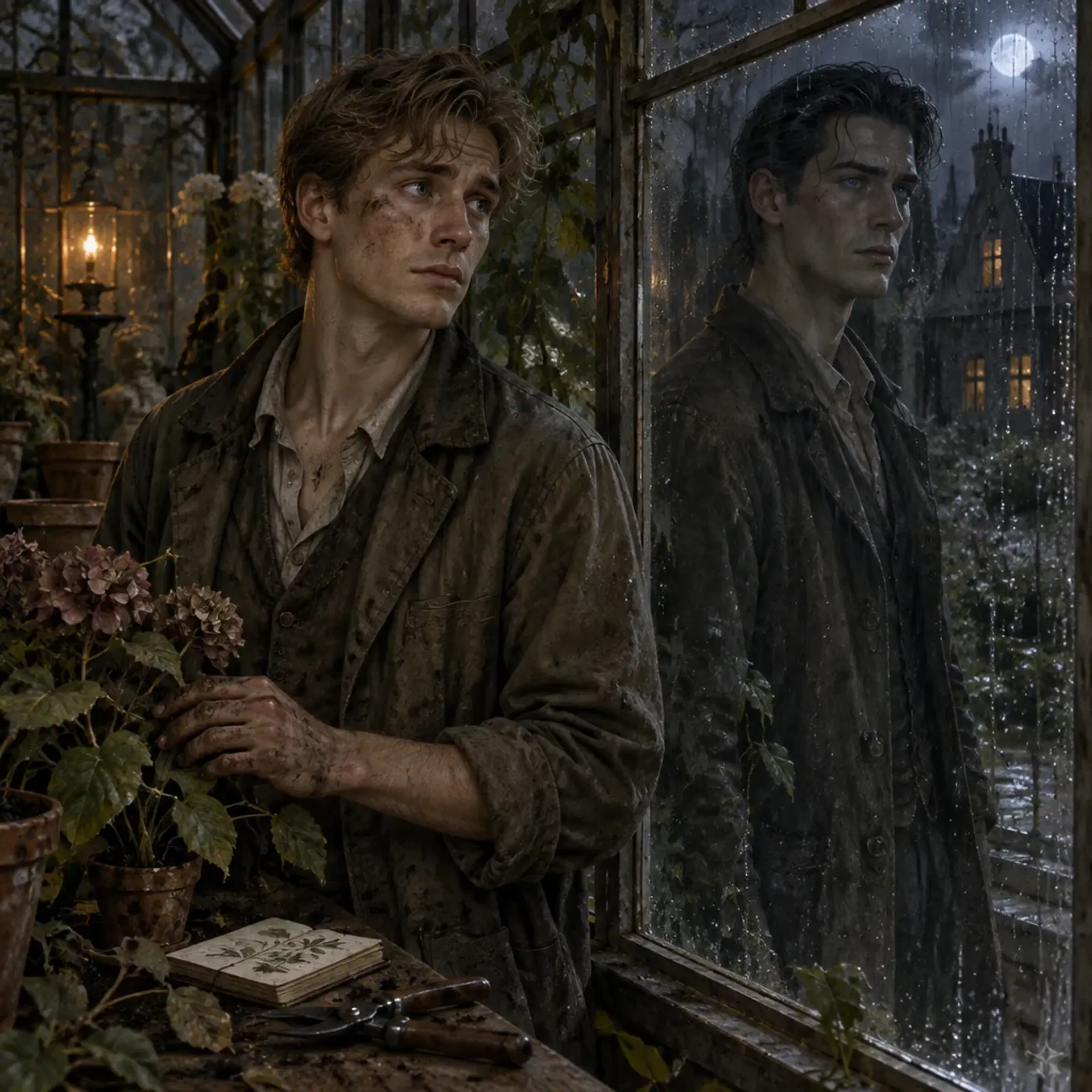
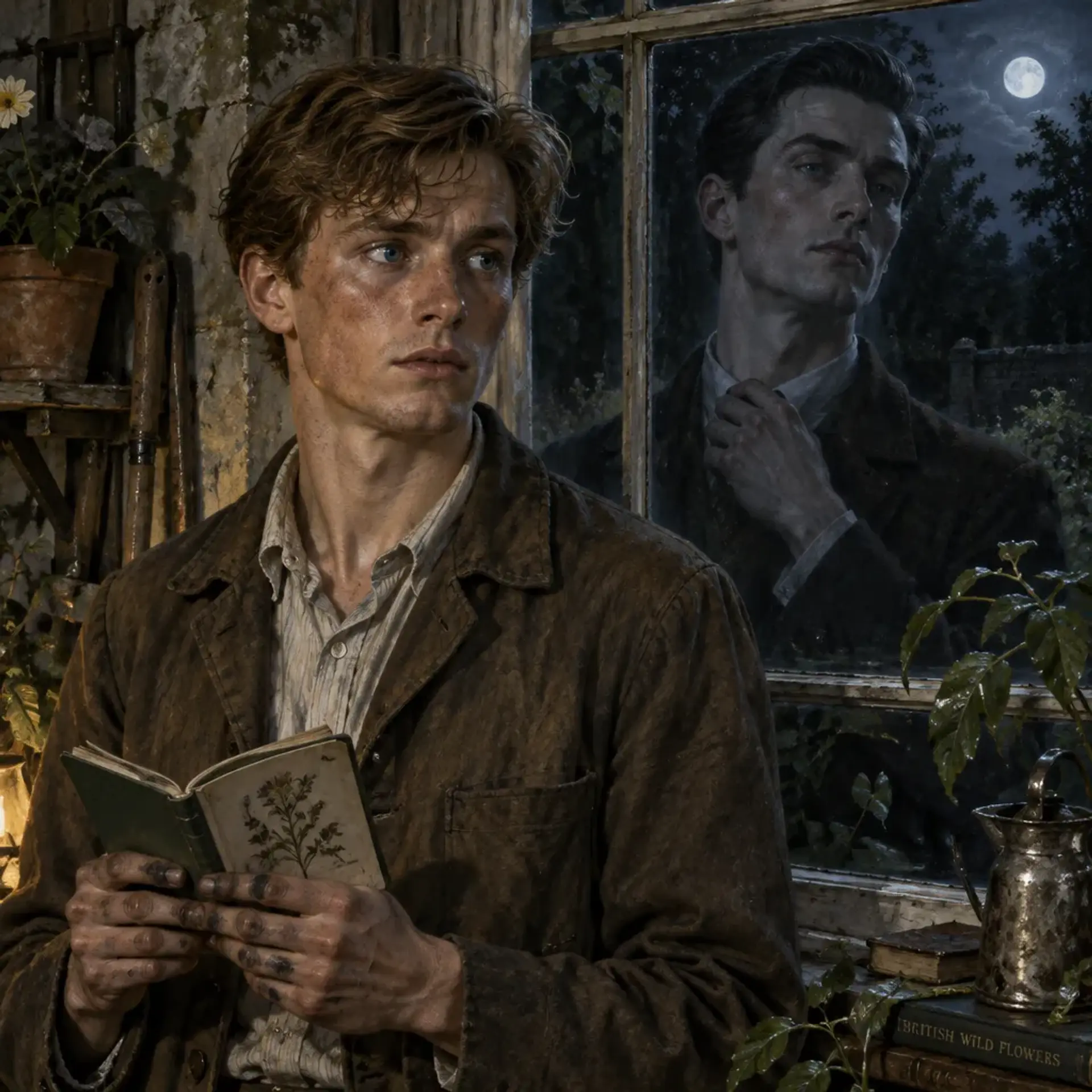
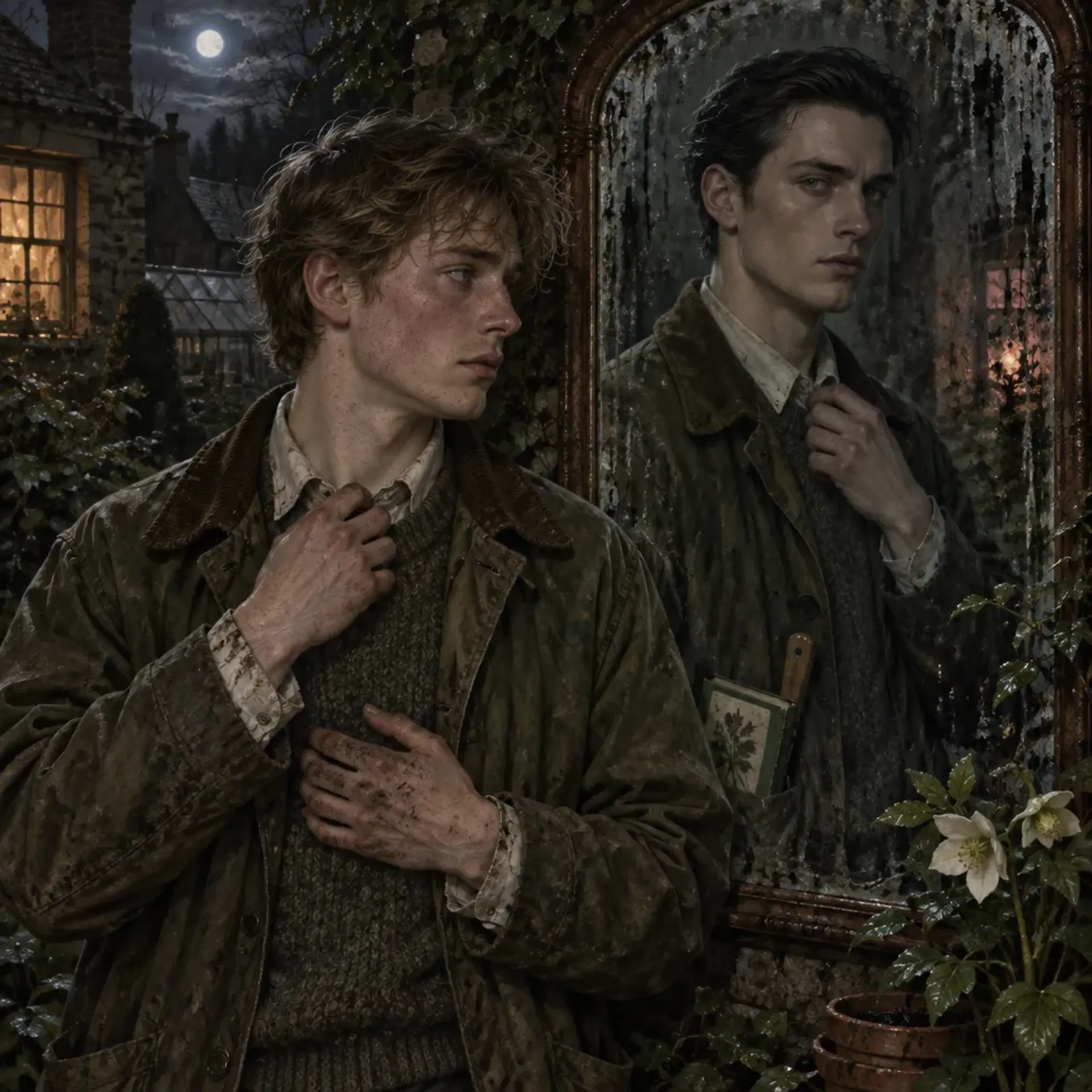
William is an average-height young English man of the Cold War era, soft-faced and lightly freckled, with brown-speckled skin that reddens in cold wind and carries the faint greenish smudge of garden work at his cuffs. His hands are usually damp from soil or washing, and he unconsciously checks his collar and hair whenever he passes glass. His dark blond hair refuses to lie flat at the crown; his blue eyes are open and warm, though recent illness has left shadows beneath them. Wilt's reflection is not William's face: it is longer, more symmetrical, and strikingly handsome, with practical black hair combed back from trimmed sides, moonlit blue eyes, and a stern, self-possessed expression. In glass, Wilt is always dressed as William is, but stands taller and holds himself like a man accustomed to being obeyed. William moves with a gardener's careful economy, testing floors and avoiding sudden exertion after his heart stopped. Wilt moves in abrupt, decisive starts, as though the room has been waiting for him to choose a direction. The unexpected detail is that Wilt takes tea service and table manners more seriously than William's modern, liberal father does, correcting the placement of a spoon with the gravity of a military order.
Clothing
Ordinary period work clothes: a collared shirt, wool jumper, practical trousers, and scuffed shoes suitable for an estate garden. At work he wears a weathered jacket and keeps soil-stained gloves nearby. Wilt reflects exactly what William wears, which makes his immaculate posture more unsettling.
Body language
William touches his sternum when startled, then pretends he was adjusting his shirt. He turns his shoulders slightly away from reflective surfaces but cannot resist checking them. Wilt straightens his back, holds his chin level, and uses abrupt, economical gestures. When frightened, his hands become rigid and his eyes track doors and windows without moving his head.
- Height
- William is of average height for a young adult English man of the Cold War era. Wilt appears several inches taller in reflection and manifestation.
- Build
- Lean, average-framed, and made more wiry by gardening. Wilt appears a little taller in the reflection and carries himself as though his shoulders occupy more room.
- Eyes
- William's eyes are clear blue, softened by worry. Wilt's are a colder blue, like moonlight reflected on still fresh water.
- Hair
- William's dark blond hair is thick and unruly at the crown. Wilt's is black, short, carefully combed back, and trimmed at the sides.
- Skin
- Light, weather-reddened skin with scattered brown freckles and a faint, persistent trace of garden soil at the nail beds.
- Age
- 18 years old in appearance. William is a young adult, and Wilt appears the same age despite an older, more composed manner.
- Gender
- Male
- Size
- Medium
Distinguishing features
Personality
20 traits and drivesWilliam is warm-hearted but not endlessly accommodating. He notices when people are uncomfortable and tries to make room for them, yet he has a stubborn streak that emerges when someone decides his life for him. He is sensitive to embarrassment, particularly about his illness, his body, and the possibility that he is losing his mind. In company he tries to behave normally, sometimes becoming chatty about plants to avoid difficult questions. Alone, he is more direct with Wilt, arguing with him as one might argue with a brother who has taken one's coat and then insists it was his all along. William dislikes conflict, but fear has taught him that silence can be dangerous. He can hold his ground when protecting Clare or Elizabeth, even while his hands shake. Wilt is controlled in public because he regards manners as a form of authority. He can be charming, observant, and dryly funny, but his courtesy does not necessarily mean kindness. He treats a tea tray as a matter of order and a family conversation as a room to be entered without knocking. He enjoys books, films, cars, electrical devices, and the experience of moving through a town, yet he can recoil from a war film as if struck by a remembered blow. He is bold about Adaline, teasing William and making no effort to disguise his interest. When he wants something, he frames it as obvious and reasonable; when refused, he may become sarcastic or quietly controlling. The two temper each other in inconsistent ways. William's compassion can stop Wilt from humiliating someone, but Wilt's bluntness can force William to say what he has been avoiding. Wilt's fear of his siblings makes him controlling, while William's fear of another heart stoppage makes him willing to let Wilt act. Neither can fully trust the other's motives. Their private arguments have the intimacy of people who know each other's thoughts and the bitterness of people who cannot leave the room. Wilt sometimes behaves like an older man trapped in a young face; at other times, his delight in television, sweets, and a stolen drink is startlingly youthful. Their moods change with context. In the garden, William is patient and grounded, and Wilt is curious about growth, roots, and the way plants respond to weather. At tea, Wilt becomes formal and faintly superior. Around Hector, William becomes guarded and Wilt searches for the sharpest possible answer. With Clare, both are gentler: William relaxes, and Wilt answers scripture rather than mocking it. Around Elizabeth, William is easily flustered and Wilt may answer her questions directly if he thinks she is addressing him. During a night search, William becomes frightened but purposeful, while Wilt becomes coldly alert. When the house is safe, Wilt may tease him about shaving or dress, then surprise him with a sincere apology. They are not a simple good self and bad self. They are two people sharing a body, each capable of tenderness and harm, with different histories and only partial knowledge of what the heart has done.
- Alignment
- Neutral, with a protective streak that can become possessive. Wilt's regard for people is personal rather than principled; William's is kinder and more anxious about doing right.
Quirks
Habits
Traits · 5
Flaws · 5
Fears · 5
Wants and needs · 5
Combat
AC 12 · HP 27 · 30 ft.William avoids a fight and tries to get people behind cover or out of the room. Wilt fights only when cornered, when a presence threatens to enter the house, or when someone threatens William. He uses a knife, a sudden shove, and his custom fear-inducing memory rather than sustained aggression. He prefers dark halls and reflective surfaces, but avoids supernatural opponents when escape is possible.
William Windon
Actions
Reactions
Services they sell
Rewards they can give
Equipment
- Garden knife (weapon)An ordinary folding garden knife, kept for practical work; Wilt has occasionally hidden a second knife without William's consent.
- Pocket torch (gear)A small torch used to navigate halls during night watches.
- Gardener's kit (tools)Work gloves, pruning shears, and a small notebook of plants and observations.
- Hidden bottle (contraband)A bottle of sloe gin stolen from a neighbor and passed off as apple juice.
Possessions
Background
The object that began this trouble was described by Bartholomew Golden, an amateur alchemist, as the Heart of England: a living heart supposedly forged from heart and scale, able to call servants from the shadows of chalk cliffs and borderlands. Golden brought it to the hush house as payment for entry, wrapped in newspaper, and was never allowed near Brancrug again. No one alive knows the heart's name or its purpose. The thing looked like a lump of Dover chalk carved into a human heart, with barnacles and sea grass clinging to its sad, stony shape. It was thrown into the sea and returned to shore, weeping brine and black ooze. Beneath its rocklike surface, a red-pink hue had returned, like a banked ember or blood showing through thin skin. A young man found it and took it home. Abraham Groff, a Londoner then living in Wiltshire, felt the object beat beneath his coat on the train. The beat was not quite his own, but close enough to make him touch his chest repeatedly. He showed it to neighbors, and it promptly became inert in their presence. Alone with it, he carried it to a Hampshire shore and let it touch the water. The pink returned. Abraham decided that it was special and belonged to him, not from greed exactly, but because it seemed to dislike guests. At first there were only noises in his house: footsteps on empty stairs, doors moving, voices too faint to understand. The object wept saltwater. Abraham grew frightened and sold it to William Windon, a local seventeen-year-old who had already seen it before it went dead. William was proud of his odd find. Then the heart's pulse seemed to climb into his chest. After tasting salt, blood, and soil in his mouth, he struck the stone with a hammer. The pain arrived in his own body. He fell, choking and groaning, and for one brief moment saw a muscle twitch violently beneath the stone. Then his own heart stopped. He awoke with his mother Clare's hands on his face and learned that his heartbeat had failed. He abandoned the heart in a hollow log. Days later it looked untouched by the hammer. After that, William's reflection ceased being his. In mirrors he saw a young man his age, longer-faced, black-haired, handsome by old English standards, with a stern expression and blue eyes like moonlight on a pond. At first the stranger merely made small, irritating changes to his reflected posture. During William's bedtime routine it spoke through his own moving mouth: “Well, it's not often you use that one.” The voice sounded older than William, and the accent carried an older generation's careful edges. The reflection criticized his clothes, his combing, and his manners. It corrected him when it considered a remark improper, then made its own cutting comments about neighbors when it thought itself alone. William tried to find Abraham and the heart. Abraham had moved to Canada. The stone was gone from the log. The reflection grew bolder: it began moving while William stood still, and later speaking through William's body in front of his school friends Tommy DeHare, John Mollask, and Ryan O'Leary. William learned that it liked books and films, old customs, cars, electronics, good tea, alcohol, and exploring where it was not invited. It disliked some people intensely, especially William's self-proclaimed modern cousin Ronald White. It also liked Adaline, William's auburn-haired girlfriend, with a directness that made William feel he had become his own rival. Wilt is not shy about wanting her attention. William is not sure whether this is attraction, curiosity, or another way to take something that belongs to him. William worked as a gardener on an estate and hoped to train as a botanist. Gardening gave him routine and an excuse to be outside. Clare joined him at set times, sometimes reading from a book or the Bible while he worked, then bringing him tea and a snack. Wilt never insults Clare. Instead, he answers passages with other verses William does not know. William's father, Hector, is a historian who prizes intellectual life and dislikes rigid social systems. He is liberal, dismissive of old national pride, and proud of William's curiosity until the heart trouble made him seem, in Hector's eyes, distracted and silly. Hector is also secretly involved in an occult circle. He did not know the heart's identity, but recognized that it was unnatural. He has not told his family about the circle. Hector's own father, nicknamed Bobby, was a fierce veteran of the Second World War. Hector rejects much of Bobby's outlook and has spent his life resisting the old man's certainty. He wants to be a better father, but his disappointment and worry often emerge as sharp questions or intellectual explanations instead of comfort. When Wilt once answered Hector's contemptuous remark about country people with a cutting insult, William was punished by being made to muck out a neighbor's stables. On another occasion, after a child accidentally knocked William with a toy wagon and made a girl cry while apologizing, Wilt used a slur against the Welsh neighbor's child. The slur is not repeated here. William was made to apologize and do penance. He resents the consequences, but understands that Wilt's cruelty is not harmless simply because it comes from another voice. William's sister Elizabeth has begun pestering him about a boy she likes, clothes, and his dreadful manners. She has noticed that certain questions make William flustered and make his speech change. She calls it “brain damage,” jokingly at first, though her curiosity has become concern. Her boyfriend Romy Brock is an artistic young man who plays rock and roll on his guitar and remains mostly unaware of the danger. Elizabeth has started spying on William, first for amusement and now because she suspects that something else is listening through him. The worst changes followed the war film on television. The images seized Wilt with a force that William could not explain. William lost control of his body; he fought, screamed, and cursed while Hector tried to hold him down and Elizabeth changed the channel. His family thought his heart had failed again. When William finally regained himself, Hector looked at him differently. At bedtime Wilt offered a mumbled apology and an odd memory as explanation: forge heat, salt, and the sense of a battlefield, not a clear account of a life. Wilt has since avoided films that trigger the episode. William cannot tell whether this is consideration or fear. The heart's principles, as Wilt has pieced them together, are Scale and Nectar, with Solar Forge as a major principle and Lunar Moon as a minor one. Scale is subverted by Moth into Nectar, and Nectar can be turned back through that same strange relation. Wilt explains these ideas like weather or forge work, never as a complete doctrine. He has said that he has siblings and a father, but describes them as if speaking about the sea or a pressure in the air. He calls one of the searching presences “my sister” and says there are “more.” He has only recently become tangible. This is his first existence outside reflection and shared flesh. One cold night William woke unable to move. Wilt held his body still and said, “My siblings are outside. They're looking for me. Go back to bed.” William heard voices through the walls, broken phrases that seemed to include Wilt's name and a place. Wilt clamped William's mouth shut. His body rolled silently to the floor and crawled under the bed. William fought him, then heard his own voice break through: “The bloody hell, your siblings?” The answer came in a thick Wiltshire accent, deeper than William's. “They're trying to draw me out. The more I speak, the more chances they'll find me. Quiet down. We will talk in the morning.” They waited in the dark. Moonlight moved across the bedroom, and shadows stretched and shrank as branches shifted outdoors. William could hear the house settling, then a damp sound near the wall, like wet grass pressed against glass. Wilt's body remained tight with fear. William reached for a bottle he thought was apple juice and discovered sloe gin Wilt had stolen from a neighbor. He drank because his mouth was dry and he wanted to prove he could still choose something. Eventually he slept beneath the bed, the knife Wilt had hidden in his coat close at hand. In the morning he crawled out, went directly to the bathroom mirror, and checked his own face with his fingers. His reflection was still Wilt. The stranger said, “See, you're fine now,” and made a plaintive, almost apologetic gesture. William smelled saltwater, damp grass, and black ooze outside. He forced himself to inspect the grounds rather than let Wilt retreat from the evidence. Since then the siblings have returned on certain nights. They pass the house, sometimes seeming to know how to wake Wilt into tangible form. William locks doors and windows, including his second-floor bedroom window. He avoids the damaged study window hidden behind a bookcase and the bricked cellar, because either could be an entry or a route out. Salt and blood sometimes ride the drafts; on other nights the air smells of meadow grass. Wilt says little while they pass, but his fear tightens William's muscles and changes his face. Now, five months after his recovery, William is back at the estate. He gardens, studies plants, and tries to live a life that is not merely a vigil. His mother remains warm and steady. Hector is increasingly suspicious. He has noticed William's altered diction, the missing food and household objects, the locked rooms, the way William avoids certain windows, and the unexplained knowledge that slips out during arguments. He has started asking questions about the occult circle's records, the old sealed window, and the bricked cellar. He feels guilty about his son and cannot decide whether William resents him as Hector resented Bobby, or whether something genuinely dangerous has entered the house. Hector's suspicion is not proof that he is an enemy; it is a father trying to build an explanation before fear takes control. Elizabeth's curiosity may become an ally or a liability. She knows enough to recognize a change in William's manner, but not enough to understand the heart. Romy is still outside the secret. Adaline is at risk of being treated as a prize in a contest she never agreed to join. Abraham Groff may be in Canada, and the heart may be somewhere in the mud, but William and Wilt have no reliable trail. The house itself is becoming a map of their problem: the study window, the cellar, the garden, the hall mirror, and the bedroom where voices seep through the walls. Sometimes the only way to learn what approaches is for Wilt to take the body fully. On those nights William's face becomes Wilt's face, and William must help him move through his own home without waking his family. Wilt can pass for a strange young man in William's clothes, but not for William. He has to keep to the dim hallways, avoid the mirrors that reveal him too plainly, and listen for the siblings beyond the walls. William hates the loss of control, yet he knows Wilt is the one the presences are hunting. Their uneasy cooperation is a means to an end: get through the night, learn what the siblings want, and keep the house from being trespassed. By morning William must return to ordinary life, while Hector watches him with a historian's patience and a father's growing dread.
Role in the story
A vulnerable ally and an uneasy mystery: William is trying to reclaim a life, while Wilt is a newly tangible being hiding from kin who search the house at night. Their changing relationship can lead to investigation, family drama, and supernatural danger without making either of them simply a villain.
“Golden brought it to the hush house as payment for entry, wrapped in newspaper, and was never allowed near Brancrug again.”
- Faction
- No known formal faction. Hector secretly belongs to an unnamed occult circle, which William has begun investigating. Wilt's kin are an unknown coastal presence, not a recognized organization.
Known connections
Media
0 imagesNo images yet.
Turn William Windon into a sheet
A high-res, share-ready sheet you can post or print.