William Windon
William Windon
At the table
“s speech can carry an older generation”
Voice
William sounds as though he is trying to be kind even when uncertain, with a natural local cadence shaped by family conversation and outdoor work. His breath can catch after exertion since the heart stoppage. Wilt's voice comes from the same mouth but has a deeper, more settled texture, old-fashioned diction, and a sharper rhythm, like someone accustomed to giving an order and expecting it to be understood.
William's voice is young, warm, and local, with the careful phrasing of someone accustomed to avoiding arguments with his father. His work has given him a practical vocabulary for plants, soil, weather, and the needs of a garden. Wilt uses William's body as an instrument, but his voice is deeper and carries an older generation's English phrasing; when frightened, he can produce a thick Wiltshire accent unlike William's usual speech. Wilt speaks with dry precision and has a talent for making an insult sound like a simple observation. Neither voice is reliably separate from William's mouth, which makes their conversations unnerving even when no mirror is present.
Speech patterns
How to play them
Approach William with patience and practical kindness. Ask direct questions but do not demand that he explain everything at once. He responds better to gardening, family safety, and concrete help than to sensational curiosity. Wilt may answer through him, test the visitor with dry remarks, or attempt to redirect conversation. Do not assume that a change in voice means William has agreed to what Wilt says.
Goal
Find the vanished heart or someone who can explain it, learn why Wilt's sister is searching, protect his family, and keep a say in what happens to his own body.
Motivation
William wants a life with work, study, family, and Adaline that remains his own. Wilt wants to avoid being found by his sister, understand his first tangible existence, and experience the strange world of human habits, machines, books, gardens, and desire.
Appearance
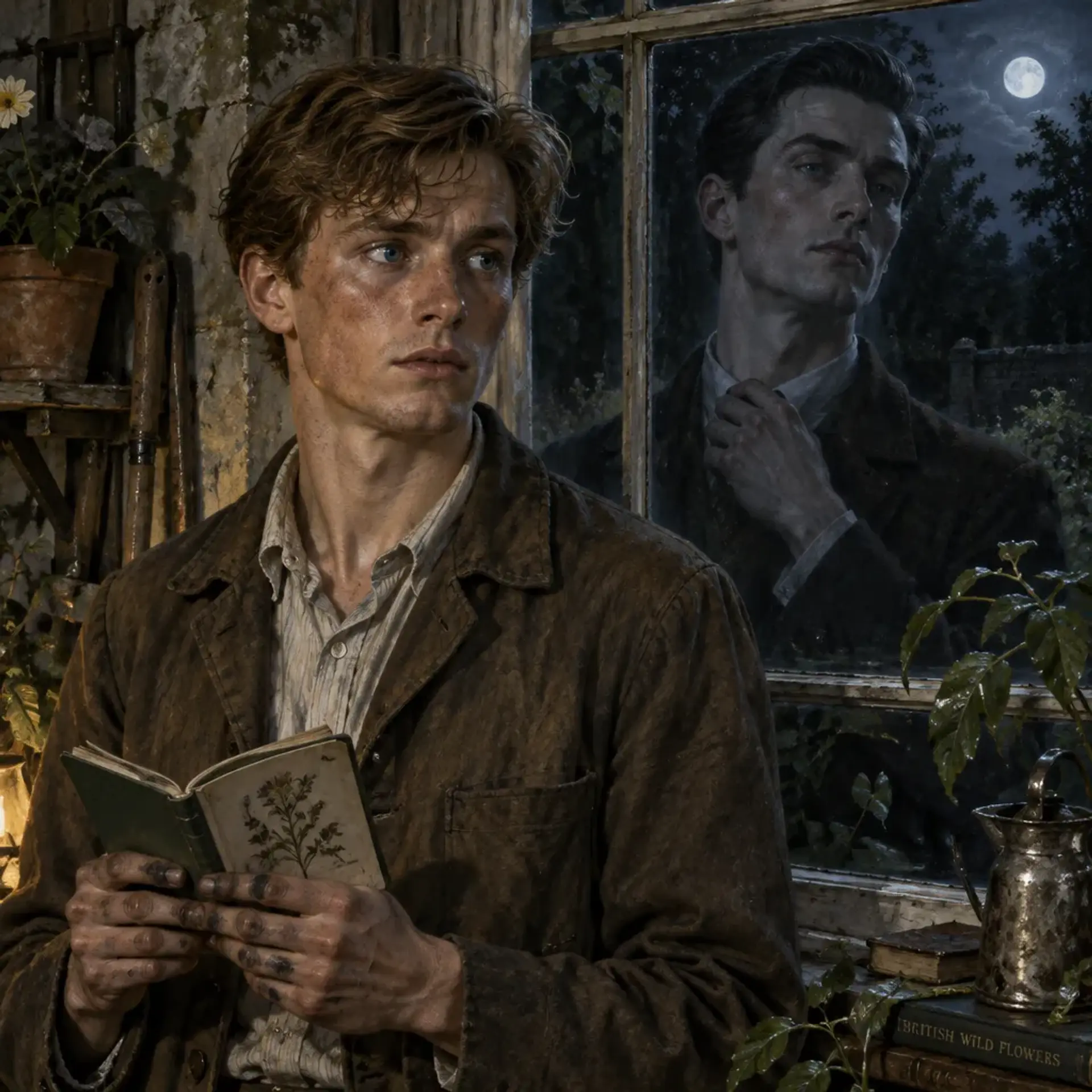
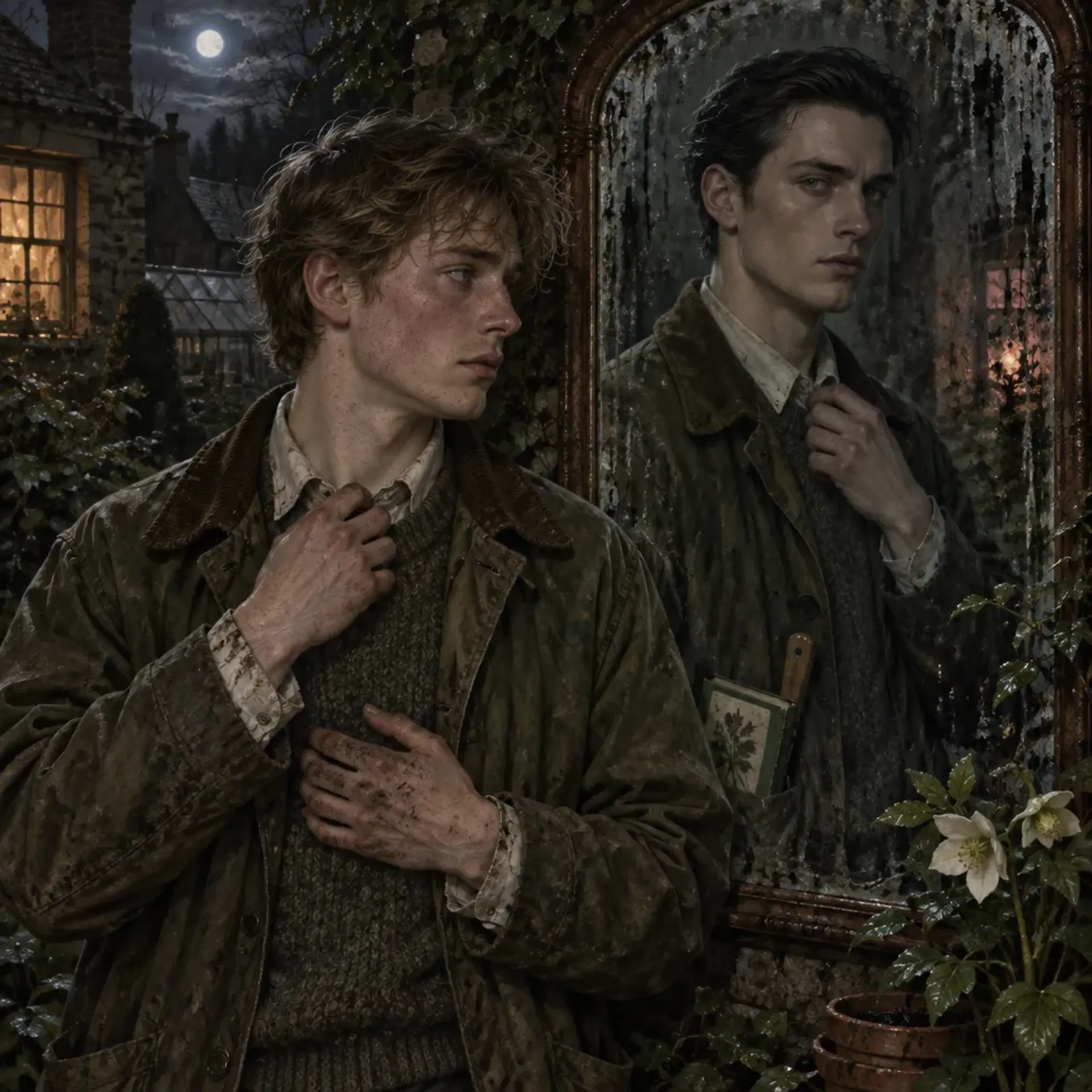
William is an average-height young man by the standards of Cold War-era England, with a gardener's practical balance and a tendency to hold himself as if apologizing for taking up space. His brown-spotted skin, blue eyes, and dark blond hair are ordinary at first glance, but his attention is not: he checks exits, glass, and the faces of people who have gone quiet, often in that order. His gait is soft-footed and slightly uneven after his illness, with a carefulness that looks like shyness until one sees him moving among beds of plants. He has a warm, open expression that can become watchful without warning. Wilt's reflection is not William's double. In reflective surfaces it shows a handsome, long-faced young man with moonlit blue eyes, short black hair slicked into a neat practical part, and an aloof, stern composure. It matches William's clothes, but carries them like an old-fashioned gentleman who thinks a collar is a moral issue. When Wilt controls William's body, the face seems to lengthen and the posture grows taller, straighter, and less familiar. The unexpected detail for a young gardener is that he can identify a surprising number of plants by the smell of bruised leaves, even in darkness, but is hopeless at recognizing fashionable clothes.
Clothing
Work clothes suited to estate gardening, sturdy trousers, a serviceable shirt, and weather-worn outerwear. For meals he tries to dress neatly. Wilt insists on correct grooming and has old-fashioned opinions about collars and manners, though he must wear whatever William already owns.
Body language
William keeps his shoulders slightly rounded and his hands busy, rubbing soil from a thumb or worrying a seam. He looks toward glass before looking directly at a person. When Wilt is close to the surface, William's spine straightens, his chin lifts, and his gaze fixes on a person's face with an old-fashioned, appraising steadiness. During a struggle for control, his posture appears divided: one shoulder draws back while the other reaches forward.
- Height
- Average height for a young man in Cold War-era England. Wilt appears taller when he takes control, though he has no separate physical body.
- Build
- Average, lean young man with a gardener's practical stamina, still somewhat weakened by his heart stoppage.
- Eyes
- William's eyes are blue. Wilt's are a colder blue, like moonlight on a still freshwater pond.
- Hair
- William's hair is dark blond; Wilt's reflected hair is black.
- Skin
- Brown-spotted skin, as described for William.
- Age
- 18; William and Wilt appear to be the same age.
- Gender
- Male
- Size
- Human-sized; Wilt appears taller while controlling William's body.
Distinguishing features
Personality
19 traits and drivesWilliam is gentle without being passive. He dislikes humiliating people and is especially uncomfortable when someone weaker is mocked, yet he can become stubborn when others treat his illness as proof that he cannot decide for himself. Around Clare and the garden he is more open; with Hector he edits himself, anticipating criticism before it arrives. With friends he is warm but increasingly distracted, listening for the other voice and worrying that a joke might become Wilt's. In a crisis he can act with unexpected resolve, as when he forced himself to inspect the grounds after the moonlit search rather than retreat indoors. Afterwards the courage often turns into guilt and second-guessing. Wilt pulls against William in almost every social situation. He is fastidious about grooming and table manners but steals food and alcohol; he can be cutting toward Hector yet answers Clare's Bible passages with care; he is curious about people and machines but wary of the paranormal; he claims fearlessness in a sarcastic voice while plainly wanting to hide from his searching sister. He enjoys television and books, and is fascinated by cars and electronics, but avoids war films that can trigger traumatic reactions. He can be protective of William when danger is immediate, then immediately make a humiliating comment about William's clothes. His interest in Adaline is bold enough to embarrass William, yet he does not fully understand the human boundaries he is crossing. The two are not a harmonious pair. William resents being interrupted, corrected, or physically overruled. Wilt resents being treated as a symptom or a stone's afterimage. Their rare moments of cooperation arise from shared danger, not settled trust. When calm, William tries to negotiate rules; Wilt treats rules as interesting customs that might be obeyed, revised, or evaded depending on who is watching. Both can be tender in ways they do not know how to name, and both are capable of being cruel when frightened.
- Alignment
- Not applicable as a Secret Histories rules statistic. William is compassionate and cautious; Wilt's ethics are older, more proprietary, and still developing.
Quirks
Habits
Traits · 5
Flaws · 5
Fears · 5
Wants and needs · 4
Combat
HP 1William avoids violence and is physically recovering. He retreats, calls for help, and uses doors, furniture, or garden tools to create distance. Wilt may seize control if he believes a sibling is near, but his control is frightening and unpredictable, not a trained combat technique. Use no D&D-style combat assumptions for this character.
William Windon
Actions
Reactions
Services they sell
Rewards they can give
Equipment
- Garden tools (work equipment)An ordinary gardener's working tool. It is useful for work and could be used defensively in an emergency, but no damage statistic is assigned.
- Botanical notes and borrowed occult papers (personal effects)A small collection of books and notes on botany, alongside materials he has quietly found in Hector's study.
- Under-bed cache (concealed possessions)Hidden by Wilt among William's belongings; contents vary and may include sweets, tinned fish, tobacco, or a concealed weapon.
Possessions
Background
William Windon was born in Wiltshire into a family that had occupied the same patch of country for generations. The family's history was not grand, but it was thick with ordinary continuities: names repeated in parish records, old tools kept after their handles split, and a habit of knowing which lanes flooded before the rain arrived. His father, Hector, works as a historian and wants to be thought of as a modern man. Hector distrusts rigid class expectations, likes artists and arguments about social change, and has little patience for the old military certainties of his own father, remembered in the family as Bobby. Yet Hector has his own rigidities. He expects William to be intellectually ambitious on terms Hector respects, and can dismiss a subject as silly when it does not fit his idea of a serious future. William's interest in plants, soil, and practical work has therefore been a quiet source of friction. His mother Clare is warmer and more consistent. She makes time to garden with him, reads while he works, and brings tea and small snacks. William's sister Elizabeth has a sharp eye and a teasing streak. She has noticed that certain questions make her brother pause or answer in a manner that is not quite his. She calls it brain damage when she wants to provoke him, but her curiosity has gradually turned to concern. She is also preoccupied with her boyfriend, Romy Brock, an artist who plays rock and roll guitar, and with the everyday pleasures of clothes, boys, and things that look nice. William's own life had seemed modestly mapped out. He was gentle, studious, and more sensitive than his father thought useful. He worked as a gardener on an estate and hoped to train as a botanist. He had friends from school, Tommy DeHare, John Mollask, and Ryan O'Leary, and was courting Adaline, whose auburn hair and soft brown eyes had made him feel both fortunate and clumsy. The turning point began with an object that had already passed through several hands. Bartholomew Golden, an amateur alchemist, had once left a supposedly fossilized living heart as payment for entry to the Hush House. He described it as the Heart of England: a thing of heart and scale that could bring servants from man's shadow, born of chalk cliffs and borderlands to labor for a house. He wrapped it in a newspaper and left it behind. He was never permitted near Brancrug again. The object looked like chalk from Dover carved into the rough shape of a human heart. Barnacles and sea grass had clung to it. It had been thrown into the sea, returned to shore soaked in salt, water, and black ooze, and acquired a red-pink glow beneath its stone shell, as though blood or light had come back to it. Golden was long dead before William heard any of this. At the time, William knew only that a young man named Abraham Groff had once found the strange stone, taken it home to Wiltshire, and grown increasingly frightened of it. It beat beneath Abraham's coat after a train journey. It seemed to die when other people watched, then reddened again when brought to the Hampshire shore and dipped in water. Abraham kept it not out of greed but because the object seemed to dislike guests. His house filled with unexplained voices, moving doors, and footsteps. Eventually he sold it to a seventeen-year-old local boy, William, who had once been among the people present when the heart went inert. Abraham later moved to Canada, beyond William's reach. William was proud of his queer new possession until he felt its pulse as if it were his own. At times the taste of ocean, blood, and soil rose in his mouth. He tried to break the stone with a hammer. Pain shot through his chest, and he collapsed, weeping and groaning in a voice that did not sound like him. For an instant he saw muscle twitch inside the heart before his own body failed. He woke with Clare's hands on his face. She told him his heart had stopped. He left the stone in a hollow log. Days later it looked cold and pristine, unmarked by the hammer. The stone vanished. William thought the matter might be over. Then his reflection began to misbehave. At first it was only a different face in the glass: long-faced, handsome, black-haired, blue-eyed, and stern in a way William was not. It moved late, then too early, as if it had its own intention. During his bedtime routine it spoke with his mouth: "Well, it's not often you use that one." The accent was of an older generation, the voice deeper than William's. Its observations began as dry comments on his hair and clothes, then widened into remarks about his family and neighbors. Sometimes it stopped him from saying something it considered improper. It could speak when there was no mirror, and William discovered that it could react physically to other people through him. Its opinions were not always harmless. After a neighbor's child accidentally knocked William with a toy wagon and apologized when a girl began to cry, the reflection used a slur against the Welsh child. William was made to muck out the neighbor's stables as a consequence. He hated the punishment and hated, more, that the cruel impulse had come from inside his own face. The reflection liked certain things. It enjoyed television and books, and it made William's body shift with excitement when an interesting scene appeared. It was curious about cars and electronics, and about exploring places where it had no right to go. It knew old history in odd, oblique fragments, describing the past as weather, metalwork, or the condition of a landscape. It had a strict sense of table manners that could irritate Hector, and it took grooming seriously enough to remind William to shave the next morning if he had neglected it. Bathing became awkward: the stranger in the water had a body, but William did not know where the stranger's sense of modesty began or ended. Sometimes Wilt took the lead in washing, making sarcastic comments that embarrassed them both. Once William felt the reflection blush. Adaline made the arrangement worse. When Wilt first saw her, the contest began at once. Wilt was not shy about wanting her. William had never expected to compete with himself, and he resented the confidence with which Wilt called attention to her beauty. The knowledge that his body was both his and not wholly his made every affectionate encounter feel newly precarious. A period of bed rest followed William's heart stoppage. During it, he tried to understand the reflection and to keep the household from noticing how much was wrong. At night he sometimes woke cold and wandered to the study, drawn to the warmth of a private fireplace. Once Hector found him asleep on a lounge after a dream of salt, forges, and dark woods. Hector looked at him strangely. The most violent episode came during a war film on television. The scene struck Wilt as if it were a memory. William lost control of his body, began to fight and scream, and could not immediately distinguish his fear from Wilt's. His family thought his heart had failed again. Hector held him down; Elizabeth changed the channel, wide-eyed and alarmed. When William regained himself, his father did not look at him as before. Later, in bed, Wilt mumbled an apology and offered a strange memory as consolation. It was the first time he had tried to explain himself instead of merely comment. William began to understand that Wilt was not simply an enchanted copy of him. Wilt said he had siblings and a father, but spoke of them as one might speak of weather, salt, or a remembered sensation. He seemed not to know how to make a human account of his own life. William dreamt once of being the reflection, watching a young man beside a pond in wild woods. He began to suspect that Wilt had a past, even if it did not fit into ordinary biography. Wilt also loved alcohol. When William's parents left Scotch and bourbon intended as a restorative, Wilt drank through the supply using William's body. He teased, argued, smiled, yelled, and tried to sing as if they were together in a pub. He even took off William's shirt in an act of rebellion, though the two agreed that taking off his trousers would be too much. When William asked whether Wilt was the stone, Wilt scoffed: "Dad isn't here." In the morning Clare found the empty bottle and told Hector. Hector first shouted, then shifted into offering William work around the house. Clare set regular times to garden with him, a routine William still values. She reads as he tends the beds and feeds him tea and snacks. Wilt does not insult her. Instead, he sometimes answers Bible passages with others William does not know. Five months after his recovery William returned to work on the estate. The garden's steady tasks have helped Wilt mellow, though not become safe. He still hides cigarettes, cigars, cheese, sweets, tinned fish, weapons, and once a bottle of apple juice that turned out to be alcohol, in William's room. Hector has become increasingly suspicious. He is a historian, and he has an occult circle of his own, unknown to the rest of the family. He does not know what the heart is, and he did not knowingly bring it into William's life, but he knows enough to recognize that the house is acquiring patterns no ordinary illness explains. His suspicion is tangled with guilt: he wonders whether he has somehow brought this on, whether William resents him, and whether his own father's legacy has made him repeat the very failures he criticizes. William has begun to inspect Hector's study quietly. There he has found signs of his father's secret life and the occult works Hector has tried to keep private. The house has other vulnerabilities: an old, damaged window hidden behind a bookcase, which Hector sealed, and a bricked cellar that was already sealed before he bought the house. Sometimes a breeze comes through the building carrying salt, blood, or meadow scents. The family does not know about the stone's alleged name or purpose. No one alive seems to know what Bartholomew Golden meant by his claims. William and Wilt have only the evidence of the heart, the voices, and the presence outside. Wilt calls the others his siblings. So far, only one has come searching actively. He calls her his sister. He has refused to say how many there are. The worst night began when William woke unable to move. The room was cold. Wilt was holding his body still and speaking softly: "My siblings are outside. They're looking for me. Go back to bed." William tried to answer, but Wilt closed his mouth. Through the walls, he heard a voice bleed into the house, broken by distance and plaster: "... is ... Wilt ..." William strained against Wilt's control. Wilt insisted that his sister was trying to draw him out, and that the more he spoke, the easier it would be for her to find him. William's defiance forced a few words past his teeth. "Your siblings?" The accent that came out was thick Wiltshire, but it was not William's. The distinction shocked him more than the cold. Wilt had taken the mouth, the pitch, and the local shape of speech as if putting on a coat. Wilt growled that William would be fine if she did not get in. They argued without moving. Moonlight filled the room in a pale strip, sharpening the edges of furniture and making the glass of a framed picture look like a second window. A shadow swelled on the wall and thinned away. William could smell damp grass, salt water, and a greasy trace of black ooze. He felt Wilt tense with the desire to hide. For once, William realized, Wilt was not fighting him. He was afraid. That did not make William trust him, but it changed the nature of his resistance. William held his ground as best he could and forced himself to listen. Something moved outside the house without making the sound of footsteps. A voice searched, broken into fragments. It was close enough to make the old window in the study seem dangerous, and close enough that the bricked cellar seemed less like a wall than a held breath. Wilt said the sister could wake him into tangible existence. William understood then that the danger was not merely being found in a mirror. He had to keep the house closed and quiet without alerting his parents, and he had to help Wilt conceal himself, even though Wilt's presence had already made William a stranger in his own home. The hours seemed to stretch. William felt Wilt's face beneath his own skin, the longer shape of it pressing against the familiar one. He could not tell when his fear turned into exhaustion. He remembered the moonlight, the smell of the damp lawn, and the silence after the searching voice passed. Then he fell asleep. In the morning he woke beneath the bed, cramped and dusty, as if his body had crawled there without his permission. He pushed himself out and went straight to the bathroom mirror. The stern young man was there. William touched his own face and felt William's face: the familiar planes, his own skin, his own breath. Wilt spoke, "See? You're fine now," with a plaintive gesture that looked almost like an apology. Their argument resumed. William demanded to know what had been outside. Wilt did not want to add to the fear, but he admitted that the presence had been looking for him. William went outdoors to inspect the ground. The smell of salt water, damp grass, and black ooze lay near the house. Wilt wanted him to go back inside. William made himself look around anyway. That morning changed their arrangement. Wilt had been a voice, an image, an intrusion, and an unwanted companion. Now he was a fugitive with siblings who could apparently reach into a house and wake him into the physical world. William had helped him survive the night. Neither of them could pretend the bond was only a nuisance after that. Since then, the two have worked in uneasy silence to keep the house from being trespassed. William locks doors and windows, including his second-floor bedroom window. He avoids the study's hidden window and keeps away from the cellar wall. He listens at night and tries not to wake the family. The siblings sometimes pass outside. The house smells of salt or blood, and William loses his familiar face more often. At times Wilt's face and form haunt the halls while the family sleeps. William has to haunt his own home in Wilt's skin to reach the study, check a lock, hide evidence, or make sure the old window remains shut. He does not do this because he has accepted Wilt's right to his body. He does it because he cannot allow the searching sister into the house. The most dangerous discovery happened one night when Elizabeth woke and caught William in Wilt's skin. She had come quietly down the landing after hearing footsteps and saw a taller, handsome stranger standing near the study, wearing William's clothes. The stranger's black hair and stern face were wrong, but the coat and shirt were unmistakably her brother's. She did not scream at once. She watched the figure turn toward her with an expression that was too composed to be William's. Then Wilt, using William's voice with that older, local accent, told her to go back to bed. Elizabeth recognized the mismatch. She asked whether this was the thing she had been calling brain damage. William tried to take his face back, and for several seconds could not. The struggle showed in his shoulders: one side drawn back, the other reaching for the banister, as if two people were trying to step through one doorway. Elizabeth's fear hardened into a furious whisper. Wilt told her that something outside was looking for him and that she must not wake Hector. Elizabeth believed enough to obey, but she refused to let Wilt decide what she was allowed to know. She asked William, not Wilt, if he was in there. William forced his own voice through and said yes. Elizabeth stayed with them until the first grey light, then helped William arrange his clothes and return to his room without waking their parents. She has not told Clare. She is watching more carefully now, not out of sport but because she has understood the risk. Hector has noticed the new locks, the late-night sounds, the evasions, and William's unexplained knowledge of the study. His questions have become gentler and more pointed at the same time. He is increasingly suspicious, and William knows that a historian who has hidden an occult life will eventually notice when someone else is hiding one. Wilt can give William access to old knowledge and strength of nerve, but he can also embarrass him, endanger him, and covet Adaline. William's current problem is not simply to discover what Wilt is. He must find the vanished heart, learn why the siblings are searching, keep his family safe, and decide whether Wilt can be treated as a person without surrendering his own life. He is trying to do all of this while recovering, returning to garden work, maintaining his courtship, and preventing his father from discovering that the stranger in the hallway wears his son's face.
Role in the story
A young gardener whose struggle with a heart-bound reflection turns a domestic haunting into a dangerous question of identity, family, and occult history. William can be a vulnerable ally, an unreliable witness, or the person who reveals that the house is already being watched.
“His father, Hector, works as a historian and wants to be thought of as a modern man.”
- Faction
- No known formal affiliation. Hector belongs to a secret occult circle, but William and the rest of the family do not know its full nature. Wilt is connected to the heart and to searching siblings whose number he refuses to disclose.
Known connections
Media
0 imagesNo images yet.
Turn William Windon into a sheet
A high-res, share-ready sheet you can post or print.