William Windon
William Windon
At the table
“re fine now,”
Voice
William's voice is soft but not weak, with a breath that sometimes snags after his heart illness. His work makes him speak plainly about things he can see and touch. Wilt's older, thicker Wiltshire accent uses the same throat but seems to place the words differently, with a dry rasp on certain consonants. When frightened, William's breathing becomes high and uneven; Wilt's jaw sets and his speech shortens. They do not become quieter or more polite when angry: William gets quick and blunt, while Wilt becomes incisive and openly scornful.
William speaks in a natural, slightly hesitant English voice, warm and unshowy, with the local Wiltshire sound softened by his age and company. His gardener's work shows in practical words for soil, weather, and growth; after the heart episode his breath may catch between phrases. Wilt uses William's mouth but sounds like a different generation: a thicker Wiltshire accent, measured consonants, and an old-fashioned turn of phrase. The voice has a dry, grain-edged quality, as if shaped by cold air and long use rather than by any theatrical vocal range. When rattled, William's breath gets shallow and his words run together; Wilt's phrasing becomes abrupt, and the unfamiliar accent grows stronger. Their names have no special sound rule beyond their ordinary pronunciation.
Speech patterns
How to play them
Treat William as an ill young man in a frightening situation, not as a possession or a puzzle. Ask before addressing Wilt directly, and do not assume William has consented to a takeover. Calm routines and practical help build trust. William may share what he knows if a question is specific and nonjudgmental; Wilt responds better to precise questions than to demands for a complete account. Avoid sudden war imagery, forced confrontation with mirrors, and jokes about brain damage. If the coastal siblings are near, help secure doors and windows without drawing attention to reflections.
Goal
Find out why the heart returned, what the coastal siblings want, and how to keep the family home secure without letting Wilt erase William. In the nearer term, William wants to recover his health, return to gardening, and continue learning botany.
Motivation
William wants an explanation that does not require him to abandon his family or his future. Wilt wants to survive the coastal kin searching for him, learn the modern world, and maintain a claim to the body he now inhabits. Their motives overlap in the need to keep the house safe, but diverge over who gets to decide what happens next.
Appearance
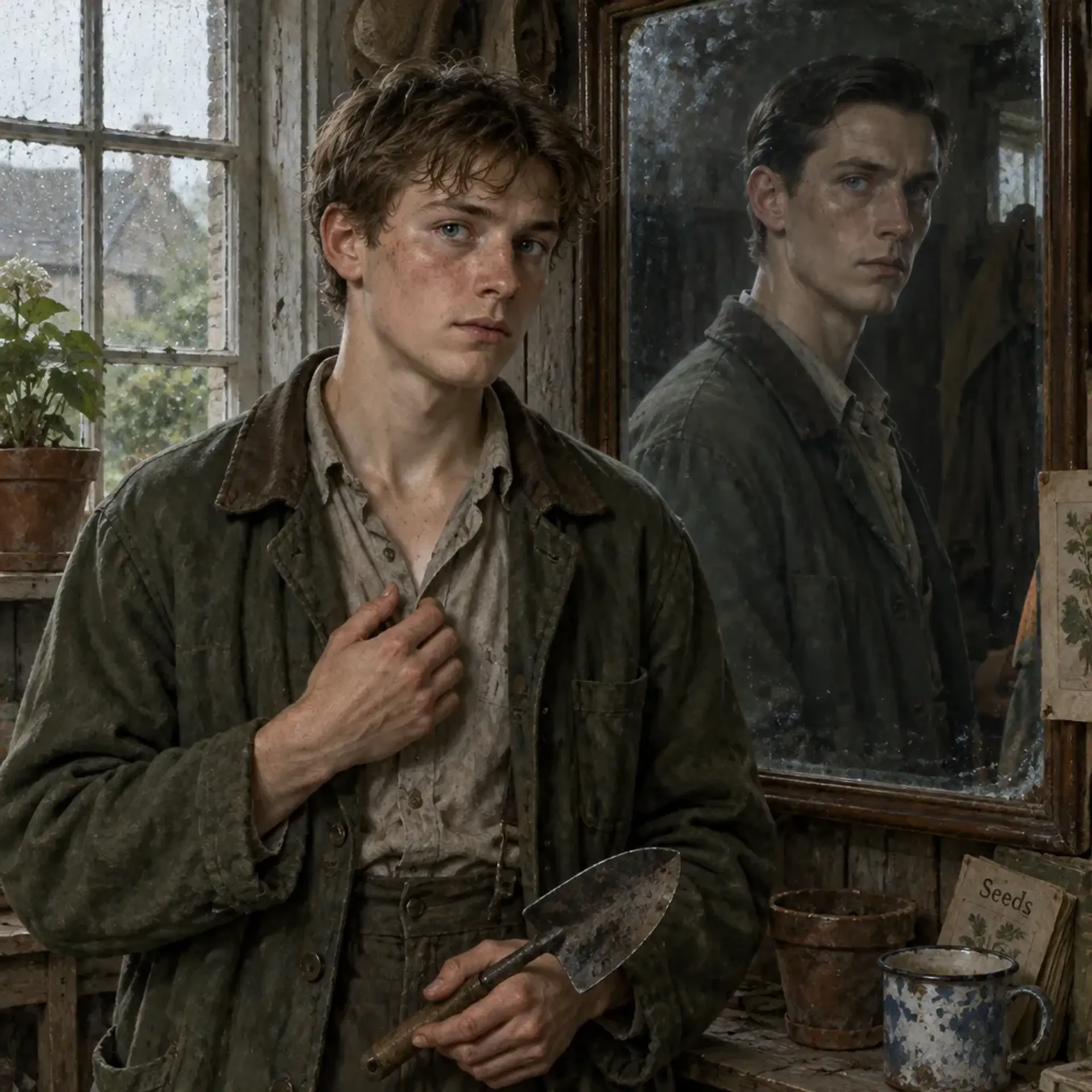
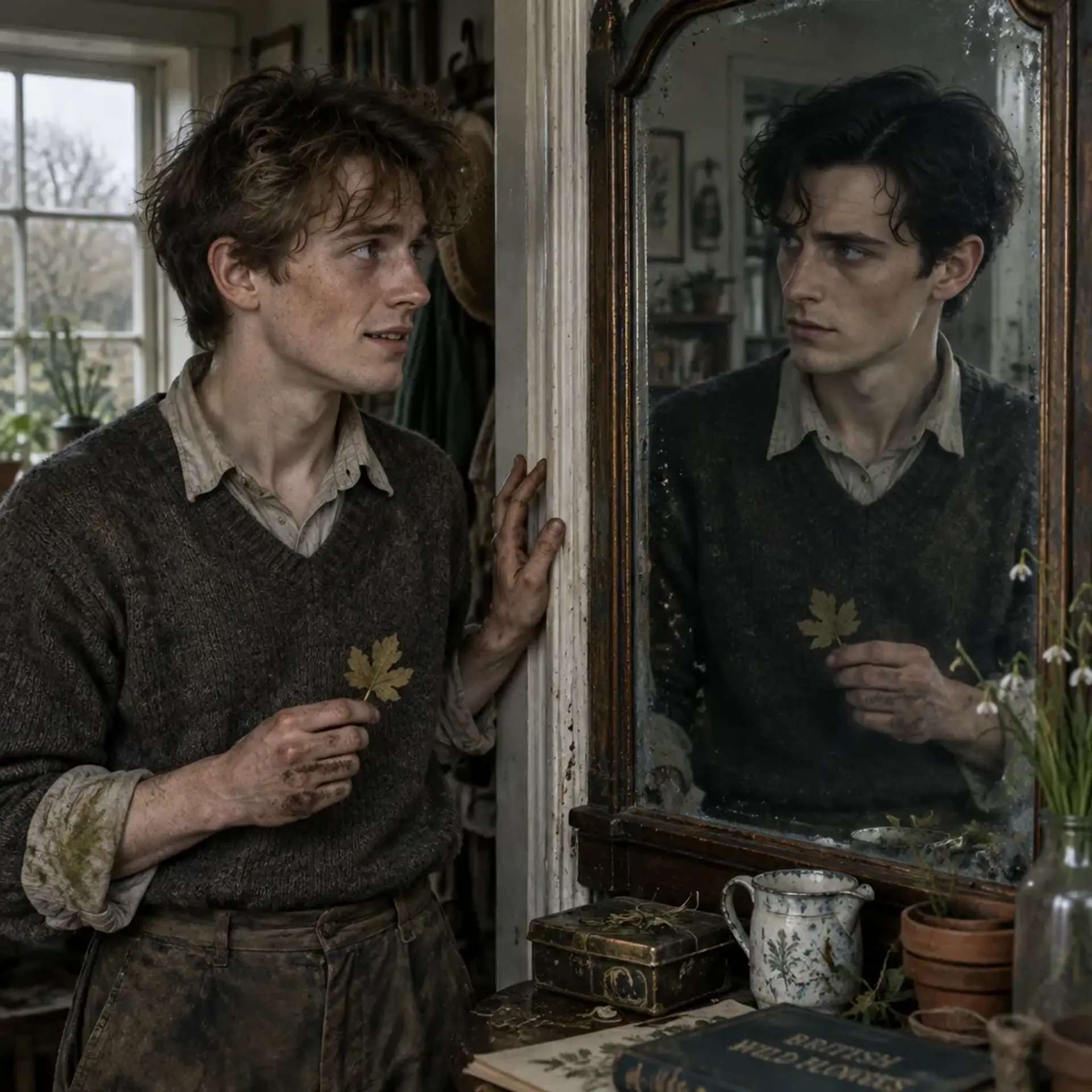
William is an average-height young Englishman of the Cold War era, with a soft, open face that often looks as though he is about to apologize for taking up space. His dark-blond hair is usually a little too long at the sides, and his blue eyes tend to follow whoever is speaking, even when he is trying not to stare. Brown freckles stipple his skin. His gardening work leaves fine soil in the creases of his knuckles and a green stain near one cuff. He moves with a slightly guarded economy since his heart stopped: careful turns, a hand briefly touching a doorframe, and an instinctive pause before stairs. Wilt's image is taller, handsome in a smooth, almost formal way, with a long face, black hair kept in a neat short style, moonlit blue eyes, and a stern expression. It is never a copy of William's face. In glass or water, the difference is unmistakable: Wilt's posture is straighter and his attention seems to come from a much older social world. When Wilt takes the body, William's clothes remain, but the face and bearing become Wilt's. A surprising detail for a gardener is that Wilt takes great care to arrange a tea tray correctly, as if a misplaced spoon were a moral failure. Their shared presence leaves the impression of a household portrait that has learned to watch back.
Clothing
Practical mid-century English clothes: work shirt, worn trousers, knitwear, and boots marked by soil. William dresses for comfort and often misses a button or lets his hair grow untidy. Wilt wears the same clothes when reflected or embodied, but arranges them more carefully, straightens cuffs, and insists on a clean collar when circumstances allow.
Body language
William's shoulders round inward when he is embarrassed, and he rubs a thumb along his fingertips as though checking for soil. Wilt straightens the spine, levels the chin, and holds still in a way that makes his attention feel deliberate. When the two struggle for control, William's jaw locks, his breath catches high in his chest, and the hands may begin a movement he did not choose. Wilt's gaze lingers on thresholds and reflections. Both have conspicuous, slightly uneven front teeth; William hides his when laughing, while Wilt shows them in a narrow, dry smile. At meals, Wilt chews neatly and watches others' table manners with disapproving interest.
- Height
- Average height for a young man in Cold War era England. Wilt appears taller through bearing and posture, though his reflected figure seems physically longer.
- Build
- William is slight-to-average in build, with the guarded, wiry condition of someone recovering from illness and accustomed to garden work. Wilt's presence makes him look taller through posture, not through a change in height.
- Eyes
- William: blue. Wilt: blue, with a pale, moonlit look in reflections.
- Hair
- William: dark blond, usually a little untidy. Wilt: black, kept in a neat, short style.
- Skin
- Fair skin with brown freckles. Wilt's skin appears similarly fair but smoother and more composed in reflective surfaces.
- Age
- Young adult, approximately eighteen. William and Wilt appear the same age, though Wilt seems more composed and mature.
- Gender
- Male
- Size
- Medium, using ordinary human scale; Wilt's reflected appearance seems taller, but this is not a verified mechanical size change.
Distinguishing features
Personality
19 traits and drivesWilliam is kind without being meek, observant without being confident, and affectionate while privately resenting how often he has to reassure everyone else. He dislikes causing a scene, yet will put himself between a frightened child and danger before he has time to think. In ordinary company he offers small courtesies and then retreats, especially when people ask about his health. With Clare, he becomes easier and more playful; with Hector, he turns watchful and argumentative, carrying old hurt beneath his attempts to be reasonable. Around his friends he wants to seem normal, which makes him conceal details until concealment becomes impossible. Wilt pulls against William's temperament. He is polished but not gentle, curious about contemporary life but contemptuous of careless manners, and capable of tenderness that he hides behind dry wit. He finds cars and television fascinating, then calls a neighbor's behavior barbarous. He can be generous with information when speaking of plants, old customs, or a memory he has chosen to share, but becomes evasive about his family and the shore. He likes Adaline and does not care that his desire complicates William's relationship with her. This is not mere teasing: Wilt can feel jealousy, though he frames it as an assessment of her character. Neither personality is a simple villain or a cleanly separate companion. William sometimes agrees with Wilt's judgment and hates that he does. Wilt sometimes protects William and resents being thanked. Their moods change with context. In the garden, routines make them calmer. At tea, Wilt becomes exacting and Hector becomes irritated. In front of Elizabeth, Wilt may show off by answering her deliberately. Near mirrors or the coast, fear strips away his polish. When a war film triggers him, Wilt's body reacts as if trapped in a remembered battle, while William experiences the loss of control as terror. Afterward, Wilt may apologize awkwardly, offering a memory instead of an explanation. William's moral center is empathy, but exhaustion makes him secretive and stubborn. Wilt's moral center is harder to identify: he honors certain customs, despises cruelty that he considers vulgar, and can still make a cutting remark at someone who has done no harm. He dislikes being treated as a ghost, an illness, or a possession. William dislikes being treated as a doorway. Both want their family to recognize them, though neither can say what recognition should mean after William's face has changed. Their shared emotional life is the most difficult contradiction: William can feel Wilt's embarrassment, longing, and fear, but cannot always tell which feelings began in whom. The change in appearance has made that uncertainty immediate. William remembers being William, speaks of himself as William, and still longs for his own familiar face. Yet he is becoming more at ease with Wilt's presence and with the habits Wilt has brought into his life. That accommodation frightens him because it feels both like surrender and like learning to live.
- Alignment
- Not applicable as a system statistic. William tries to be considerate and fair; Wilt's older manners and sharp judgments can make him seem severe.
Quirks
Habits
Traits · 5
Flaws · 5
Fears · 4
Wants and needs · 5
Combat
HP 0Avoids fights. William's recent heart crisis makes physical exertion risky, and Wilt's priority is escaping or concealing himself from the coastal siblings. If cornered, he uses a shove, a thrown object, or a quick strike to create room to flee. A triggered war-film episode can cause uncontrolled fighting, but it is not a tactical ability and should be handled as distress, not a reliable combat advantage.
William Windon
Actions
Reactions
Services they sell
Rewards they can give
Equipment
- The supposed fossilized heart (unlocated relic)The original chalk heart is missing. Its absence and unexplained return are central clues; it is not a dependable weapon or tool.
- Hector's papers (research materials)Hector's occult papers contain historical notes, fragments of strange terminology, and clues about the house. William reads them secretly; they are not established as a spellbook.
- Gardening tools (work equipment)Ordinary gardening tools from William's estate work. He knows how to use them safely for plants, not as trained weapons.
- Under-bed cache (personal stash)A small, concealed assortment of food and household items under the bed. Wilt's stores change as he steals and replaces things.
Possessions
Background
William Windon was born in Wiltshire to a family whose roots there reach back several generations. He grew up among fields, hedges, and the small social obligations of a close community. His father, Hector, works as a historian and values argument, modern art, and political change; his grandfather, remembered by the family as Bobby, was a formidable veteran of the Second World War. Hector dislikes the rigid old class culture he associates with his own father, but his rejection of inherited authority has its own force. William learned early that a family can mock tradition at breakfast and still expect a young man to behave correctly at tea. He was a warm, observant boy, more sensitive than his father thought useful, and more interested in plants than in the intellectual career Hector imagined for him. He now works as a gardener on a local estate and is training himself toward botany. His work suits his patience. He remembers which beds flood, which plants sulk after a cold snap, and how a neglected border changes over a season. The trouble began with an ugly little object that should have remained on a shore. Abraham Groff, an amateur alchemist, had brought a supposed fossilized living heart to Brancrug and described it as the Heart of England, a thing able to bring nonhuman laborers from man's shadow, chalk cliffs, and borderlands. It was made, he claimed, of heart and scale. Groff left it wrapped in newspaper as payment for entry, and was never allowed near Brancrug again. The object looked like a human heart carved from Dover chalk, crusted with barnacles and sea grass. It was thrown into the sea, then came back on the shore wet with salt water and black ooze. Beneath the rock, a red-pink light or color seemed to return. A young man called Abraham Groff is not to be confused with the later owner Abraham in William's account: the name and chain of ownership are uncertain in the stories William can piece together. What William knows is that a London man called Abraham found the stone and carried it inland. It beat beneath his coat after a train journey. In company it went cold and still, then revived when taken to a Hampshire shore and put in seawater. Its owner became protective of it, not simply from greed but because it seemed to dislike visitors. In time his house filled with voices, moving doors, and footsteps on empty stairs. He sold the stone to William, then seventeen, one of the people who had seen it appear dead. William thought of it as a strange keepsake. The heart's beat began to echo in his own chest. After tasting salt, blood, and soil in his mouth, he took a hammer to the rock. The pain that followed was his own: a violent stab in his chest, a fall, and a glimpse of muscle twitching beneath the stone before his heart seemed to fail. He woke with his mother Clare's hands on his face. She had thought his heart had stopped. A few days later, the stone lay pristine in a hollow log, untouched by the hammer's blow, and William's reflection had become a stranger. The reflected young man had black hair, a long face, blue eyes, and a severity that did not belong to William. At first the stranger only moved out of time, adjusted his expression, or commented through William's mouth. His voice carried the sound of an older generation and an unfamiliar Wiltshire accent. He criticized William's grooming, corrected his manners, and made dry, sometimes cruel remarks about neighbors. One remark about a neighbor's child, who had accidentally knocked William with a toy wagon and made a girl cry, was so offensive that William had to muck out the neighbor's stables by way of apology. The stranger's embarrassment and pride were different from William's, but not wholly alien to him. His attention to William's sister Elizabeth was especially odd: he called her interesting, and sometimes answered her directly when she had not addressed him. William's friends Tommy DeHare, John Mollask, and Ryan O'Leary helped reveal that the reflection could react to people and speak through William's body without a mirror. His family called the episodes illness, exhaustion, or damage, each explanation more comforting than the truth. William's father Hector was part of an occult circle, though no one in the family knew it. Hector did not understand the heart's nature, but recognized it as unnatural. He wanted William to become an intellectual and resented what he considered silly distractions. When the reflection insulted Hector's ideas about country people, William was punished with chores, and Hector's face afterward carried a mixture of anger and fear. William's mother Clare remained warm and steady. She made time to garden with him, read from a book or the Bible while he worked, and brought him tea and snacks. Wilt did not insult her. Instead he sometimes answered a passage with another passage that William did not know. William's sister Elizabeth discovered that particular questions could fluster him into speaking in Wilt's old cadence. At first she found this funny and called it brain damage; later, having heard him talk to himself and watched him become frightened, she began spying because she was worried. Her boyfriend Romy Brock, an artistic young man who plays rock and roll on the guitar, remains largely unaware. William's girlfriend Adaline, with auburn hair and soft brown eyes, became the subject of an unexpected rivalry. Wilt saw her and wanted her. William had never imagined his most difficult romantic competition would be himself. During William's recovery from the heart episode, he spent months on bed rest. The reflection became fascinated with television, films, books, cars, and electrical devices, while avoiding some war films that provoked an intense episode. During one such screening, William lost control of his body, screamed and fought as if caught in a memory of warfare. Hector and Clare thought his heart had failed again; Hector had to hold him down while Elizabeth changed the channel. When William recovered, Hector let go but looked at him differently. That night Wilt offered a mumbled apology and a fragment of memory rather than a clear explanation. Alcohol later loosened Wilt's composure: he drank scotch and bourbon left for William's health, argued, teased, sang, and nearly took off William's shirt in a fit of rebellion. In the morning Clare found the empty bottle. Hector first shouted, then fell quiet and offered William household tasks, a wary attempt at care. William eventually returned to the estate. Five months after the heart episode, he had learned to live with Wilt's comments, though not with the danger. Wilt stole food, cigarettes, cigars, and sometimes a knife, hiding them beneath the bed or in William's coat. He enforced old rules at tea, to Hector's irritation, and took grooming seriously. Baths became awkward because the water showed Wilt's face, and the two young men were both too prudish to discuss the situation without sarcasm. On cold nights, William sometimes woke with another voice in his throat or found himself drawn toward the study. The household study contains Hector's occult papers. William reads them secretly, looking for an explanation and learning that his father has a hidden life more dangerous than his ordinary criticisms suggest. One winter night, something outside called for Wilt. William woke unable to move. Wilt clamped his mouth shut and said, 'My sister is outside. They're looking for me. Go back to bed.' William heard a voice bleed through the walls, a name or sound close to 'Wilt.' He forced out a question about Wilt's siblings. Wilt said that the more he spoke, the more chance they would have to find him, and told him to be quiet. William felt his body roll to the floor and crawl under the bed. In the dark, the moonlight made the room's shadows swell and retreat. Wilt's voice, now a thick Wiltshire voice, said that the one outside was trying to draw him out. William resisted, but the struggle weakened. At some point they fell asleep under the bed, neither sure which of them had chosen to stop fighting. In the morning William pushed himself out and went straight to the bathroom mirror. Wilt was still there. William checked his own face with his hands and felt his own skin again. Wilt told him, 'See, you're fine now,' with a gesture that looked almost plaintive. The reassurance did not explain the salt-water smell, the damp grass, or the black ooze on the ground outside. Wilt wanted to hide. William made himself look. This was the turning point: William stopped treating Wilt as a mere nuisance and understood that something was searching for him, and that his own house might not keep it out. Wilt admitted the name Wilt, but not the larger truth. He speaks of siblings and a father as if describing weather, tide, or forge work, and says there are more of them. He strongly dislikes William's cousin Ronald White, a self-proclaimed modern man. The family home has a damaged old window sealed behind a bookcase and a bricked cellar that predates Hector's ownership. Salt and blood sometimes ride the draughts; at other times it smells of meadow grass. William and Wilt quietly keep doors shut, windows latched, and one another from answering the calls outside. Hector has grown increasingly suspicious. He notices the hidden food, the missing knife, the odd tea rituals, William's private conversations, and the change in posture and voice. His historian's instinct tells him William is not merely being difficult. His occult studies make him wary of an explanation he cannot control. He watches William for signs of deception, but guilt complicates his suspicion. Hector worries that he has become like Bobby, a father whose authority he once resisted, and wonders whether his son is afraid of him or simply hates him. Elizabeth's concern and curiosity also grow. She now watches for danger rather than amusement, though she still tests the strange voice from time to time. At night, William has begun to haunt his own home in Wilt's face. When the presence outside draws near, he sometimes lets Wilt take him, then moves through the halls as the handsome, stern stranger, avoiding his family's sight and trying to discover how the house is breached. He is not sure whether he is protecting his family, concealing Wilt, or making the transformation easier. The most frightening change came three months after the night under the bed, on the night before Christmas. William woke to find his old skin seeming to slip away. It was not a wound and did not leave blood on the pillow. His face in the mirror had become Wilt's face completely, and his familiar features no longer answered to his touch. Clare found him first. Her hands rose toward him, then stopped as if she feared that a sudden movement would frighten him. She said William's name. He answered with William's voice for a moment, then Wilt's cadence overtook it. Hector arrived and stared as though confronted by an archival photograph that had stepped out of its frame. Elizabeth began to cry, then became angry at herself for doing so. The family could not agree whether the person before them was William, Wilt, or both. William still remembers his own life and loves his family. Wilt can use his body and has his own desires, memories, and history. Neither understands the whole process. The harsh truth, glimpsed rather than fully known, is that Wilt is not human in the ordinary sense and is not simply a dead soul or ghost. Hector's private occult vocabulary might call him a changeling of Wiltshire, a presence shaped by place and principles, but even that is only an approximation. Wilt has at last found a human soul with which to mingle, anchored in William. William's identity may be gradually absorbed into Wilt's, or Wilt may become a life William can inhabit without disappearing. Their shared nature is unwieldy outside its own sphere and ideals. Neither knows the ending. The heart's purpose remains unknown to everyone but the long-dead Mr. Golden, and no one has reliably identified the stone. William remains at home for now, but the family has not returned to its former ease. Clare insists he belongs there and offers ordinary routines as a kind of shelter. Elizabeth watches the doors and listens for the second voice. Hector searches his books and monitors his son, becoming more suspicious even as he tries to act like a father rather than an investigator. William continues gardening when he can, studying plants and his father's papers, and trying to make a life with Wilt rather than surrender it. Wilt, in turn, has become calmer through stable work and walks through town and woods. He is fascinated by cars and electronics, still delights in books and television, and still looks toward the coast whenever the air changes. The central question is no longer whether the reflection is real. It is whether William and Wilt can keep their family, their home, and their separate selves while the things outside call Wilt by a name William does not know.
Role in the story
A vulnerable young gardener and an impossible reflection at the center of a domestic mystery. William is a potential ally, witness, and person in need of protection. Wilt is neither a conventional ghost nor a safe passenger. Their shared identity gives the players access to the occult history of the house while making every act of investigation personal.
“He grew up among fields, hedges, and the small social obligations of a close community.”
- Faction
- No confirmed faction. Hector belongs to a secret occult circle, unknown to the rest of his family. William and Wilt are not members of it.
Known connections
Media
0 imagesNo images yet.
Turn William Windon into a sheet
A high-res, share-ready sheet you can post or print.