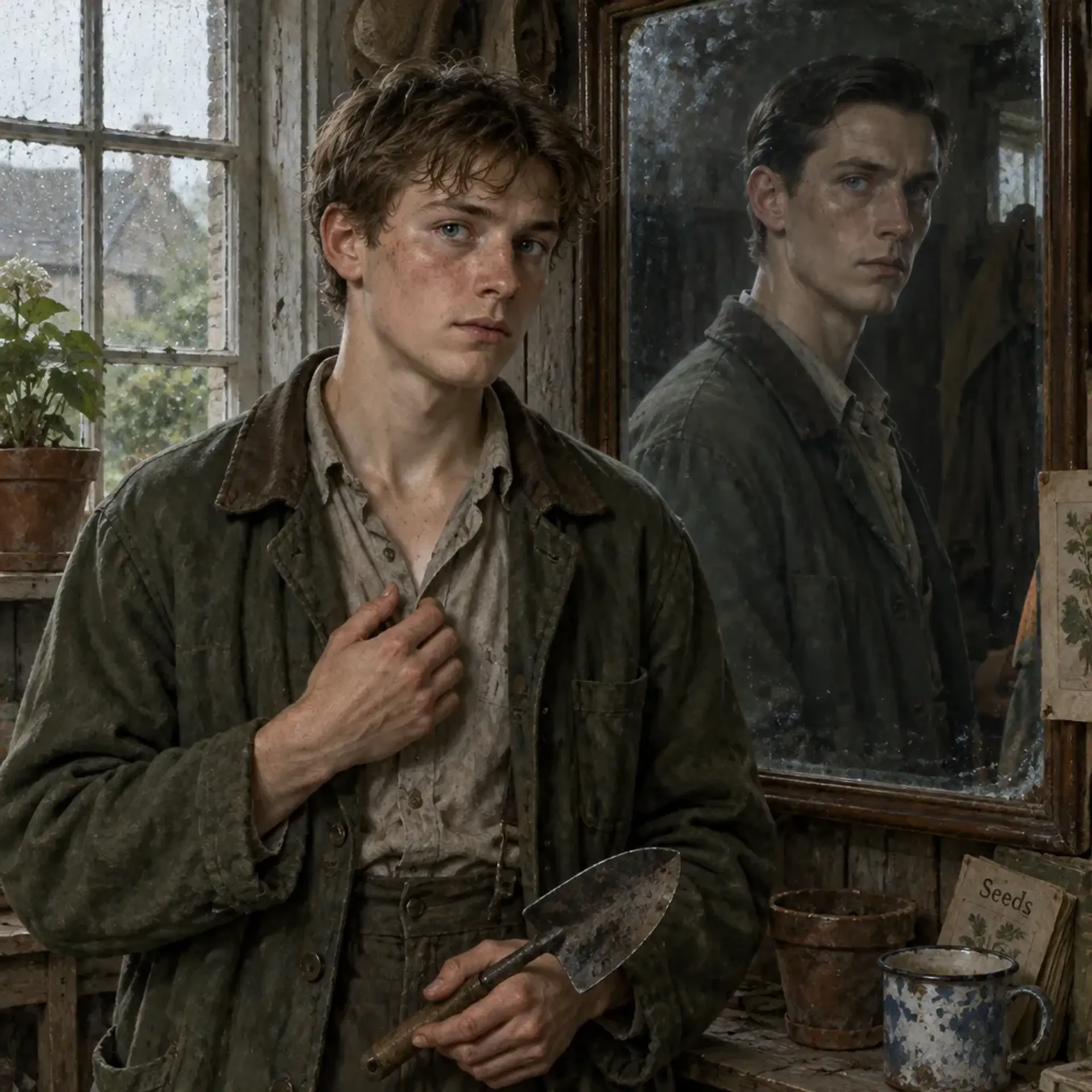
William Windon
William Windon
At the table
Voice
William's voice is a young man's local English voice, warm and slightly hesitant, shaped by ordinary family life and careful breath after his collapse. He pauses before answering and sometimes sounds as if he is choosing not to say the first thing that came to mind. Wilt uses the same mouth but changes its placement: a deeper, more resonant sound with a distinctly older Wiltshire accent, clipped conclusions, and formal emphasis on certain words. When Wilt speaks in a mirror, the voice can seem to come from glass rather than from the room. Do not give either a generic song-like range.
Speech patterns
How to play them
Treat William as a frightened but capable young man, not as a monster or a puzzle. Ask concrete questions, offer practical help, and do not demand that he prove which identity is speaking. Wilt responds better to frankness than to theatrical occult posturing, but may test a visitor with dry remarks. Avoid sudden war imagery, unexpected restraint, and forcing William toward reflective surfaces. The numerical combat field is set to zero because this system has no supplied hit-point rules here; do not interpret it as a canonical statistic.
Goal
Understand the heart, protect his family from the coastal siblings, and discover whether William and Wilt can remain distinct without either being destroyed.
Motivation
William wants a life of gardening, study, and affection that remains his own. Wilt wants to exist safely in the human world, learn what its siblings are seeking, and experience things it can only approach through William.
Appearance
William is an average-height young Englishman of the Cold War era, with a soft, ordinary face made memorable by the way it seems to leave space for whoever is speaking. His brown-spotted skin, blue eyes, and dark-blond hair are familiar to his family. His hair is usually a little untidy, as if his attention wandered toward a passing bird or an interesting leaf halfway through combing it. He moves economically, as a gardener accustomed to carrying tools and stepping around seedlings; since his collapse, he protects his chest without quite admitting that he does. In company he often pauses before answering, drawing breath through his nose as if waiting for another person to finish first. His posture is open but guarded, with his weight set carefully over his feet and one hand sometimes hovering near his sternum. In a mirror, still water, or a switched-off television, the face may instead be Wilt's: longer, conventionally handsome, black-haired, blue-eyed, stern, and seemingly an inch or two taller in bearing despite the impossible geometry of reflections. Wilt's short hair is neatly arranged in a polished style from an older generation. He wears what William wears, but fills it with greater formality, shoulders held as if a collar were always present. The detail no one expects of a country gardener's troubled young son is Wilt's absolute fastidiousness about table manners and grooming, despite the cache of stolen cutlery, cigarettes, sweets, and tinned fish hidden beneath his bed. Their shared silhouette sometimes hesitates at a doorway, as if deciding which of them has the right to enter.
Clothing
Practical gardener's clothes, work trousers, worn shirts, and a jacket suited to the weather. William wears things for use rather than display. Wilt wears the same garments but arranges them more carefully, tugging collars straight and preferring a neat, short hairstyle. At home, William's clothes are often left on a chair while Wilt's reflected counterpart seems scandalized by the untidiness.
Body language
William's shoulders soften around Clare and tighten when Hector asks questions. He often pauses with a hand near his chest, and he listens before answering. Wilt stands straighter, holds his chin level, and turns its head with careful economy. When frightened, it freezes and directs William's body away from windows. In reflective surfaces, Wilt may look toward someone while William is facing elsewhere.
- Height
- Average for a young man of his era; Wilt's reflected form appears an inch or two taller in bearing.
- Build
- Average, young, and still a little guarded after a serious collapse. Wilt's reflected form seems taller and more assured, though it wears William's clothes.
- Eyes
- Blue; in Wilt's face they appear like moonlight over a freshwater pond.
- Hair
- Dark blond for William; close, polished black hair for Wilt.
- Skin
- Brown-spotted skin, with ordinary variation in tone; no extraordinary mark identifies him at a glance.
- Age
- Young adult; eighteen in appearance, and still recovering from a heart stoppage that has altered his life.
- Gender
- Male
- Size
- Medium
Distinguishing features
Personality
21 traits and drivesWilliam is gentle without being meek. He notices when someone is uncomfortable and makes room for them, yet he can stubbornly refuse help if it means surrendering control of his life. He wants to believe that ordinary explanations are possible, but he is too observant to pretend the reflection is only a symptom. When calm, he is patient, practical, and quietly humorous; when frightened, he becomes watchful and holds his words back. Around Clare he can relax into routine. Around Hector he tries to look well and becomes more guarded the more his father studies him. With Elizabeth he alternates between exasperation and trust, because she sees too much but has not abandoned him. Wilt is fastidious where William is careless, curious where William is cautious, and possessive where William is embarrassed. It can be pompous about manners, then gleefully delighted by television or a motorcar. It has a capacity for tenderness, especially after frightening William, but expresses it as a memory, a practical warning, or a complaint about William's grooming. Wilt is not simply William's cruel double: it can stop him from speaking impulsively, defend him against Hector's condescension, and sit with him through a cold night. Yet it also takes control without consent, hides dangerous objects, and wants Adaline. The two sometimes bicker as if they are brothers, then recoil from the implication that either one might be absorbed by the other. William's warmth pulls against the urge to shut everyone out; Wilt's old-fashioned restraint pulls against its appetite for experience and its excitement at being alive.
Quirks
Habits
Traits · 5
Flaws · 5
Fears · 6
Wants and needs · 5
Combat
HP 0William avoids violence and is not trained for combat. He uses distance, doors, and familiar surroundings to escape. Wilt may take control in a frightening situation, but its reactions are shaped by uncanny memories rather than reliable fighting skill. The actions below are ordinary or explicitly custom narrative effects, not Secret Histories combat rules.
William Windon
Actions
Reactions
Services they sell
Equipment
- Garden fork or hand tool (tool)Ordinary gardening implement, useful for work and potentially wielded as an improvised weapon; no special combat properties.
- Notes on the heart and reflections (personal effects)A private notebook in which William records strange events and searches for patterns in his father's occult papers.
- Under-bed cache (hidden supplies)A hiding place containing tinned fish, sweets, cigarettes, cutlery, and miscellaneous objects Wilt has collected.
Possessions
Background
William Windon was born in Wiltshire, into a family whose roots in the county run back farther than anyone can document without turning family recollection into a history lesson. He grew up with the familiar scale of country life: hedges that marked boundaries, gardens that needed attention in every season, neighbors who knew when a bicycle had passed, and long stretches of weather that made the outside world feel like a presence in the house. He was a warm, sensitive boy, more inclined to notice plants and people's discomfort than to argue loudly. His father, Hector, wanted him to become a serious intellectual. William tried to oblige, but what held his attention was practical and living: soil, bulbs, the behavior of a plant after rain, and the small satisfaction of coaxing an estate garden into order. Hector is a historian, clever, socially alert, and increasingly difficult to read. He speaks against rigid class customs and likes to think of himself as a modern man, impatient with the old hierarchies that shaped his own upbringing. His father, remembered as Bobby, was a fierce veteran of the Second World War. Hector dismisses parts of that history and the nation's conduct in it, yet has never entirely escaped the weight of being Bobby's son. He wants William to pursue more impressive studies, and his disappointment when William chooses gardening comes out as teasing, dismissal, or advice that sounds more like a verdict. Hector's contradictions have left their mark on William: he has learned to distrust strict systems, but also to crave the stability of routines and proper manners. Hector is involved in an occult circle, a private intellectual pursuit he has concealed from his family. He does not know what the strange heart is, but he recognizes that it is unnatural. His guilt over William's condition and his fear of what he may have missed have made him watch his son closely. William's mother, Clare, is warm and stoic. During his recovery she set regular times to take him outside and garden with her, reading from a book or the Bible while he worked. She made tea and snacks and did not demand that he explain why he went quiet. Those hours were among the first in which William could feel his body belonged to him again. His younger sister, Elizabeth, has an eye for any oddity that adults insist is nothing. She teases him about his manners and his awkwardness, and discovered that a carefully phrased question can make him answer in an unfamiliar cadence. At first she called it brain damage, partly to provoke him. She now watches with concern, trying to understand the other presence without giving it a reason to fear her. Her boyfriend, Romy Brock, is an artist who plays rock and roll on guitar; he goes along with Elizabeth's schemes because they are new, not because he understands their danger. William's friends Tommy DeHare, John Mollask, and Ryan O'Leary knew him before the illness and have seen enough strange behavior to know that something is wrong, though William has not given them a full account. His girlfriend Adaline, with auburn hair and soft brown eyes, is someone he longs to see without competing against his own reflection. The heart began its human passage as a curious object left at Hush House by Bartholomew Golden, an amateur alchemist. Golden called it the Heart of England and claimed it could bring nonhuman laborers from the shadow of man, from chalk cliffs and borderlands. He presented it in newspaper wrapping as payment for entry, then was never allowed near Brancrug again. The object looked like a human heart carved from Dover cliff rock, with barnacles and sea grass grown across it. It was thrown into the sea and returned to shore, soaked in salt water and black ooze. Beneath the stone its color had become a faint, living red-pink. No one living knows its name or its purpose. Golden is long dead. A young man named Abraham Groff found the object and carried it home. The heart seemed to die whenever visitors watched it, then revived after he took it to the Hampshire shore and put it in water. Abraham came to feel that it disliked guests and that it belonged with him. Haunting sounds and moving doors followed. He eventually sold the heart to William, then a seventeen-year-old local boy who had once seen it. William was proud of his curious purchase until he felt its beat matching his own. After tasting the sea, blood, and soil in his mouth, he struck it with a hammer. The pain seemed to enter his chest; he fell, groaning, and saw a twitch of muscle beneath the stone. His own heart stopped. His mother found him and helped bring him back. The heart itself looked cold and pristine, unharmed by the blow. William hid it in a hollow log, but it vanished. Afterward, his reflection was not his own. In mirrors appeared a long-faced young man with black hair and blue eyes, handsome by the standards William had been taught to recognize, and possessed of a stern, composed expression. The reflection first moved out of time, then began to make its own choices. One night, while William performed his bedtime routine, it spoke through his mouth: "Well, it's not often you use that one." Its accent seemed older than William's, its voice deeper. It criticized William's hair, clothes, and manners; made cutting remarks about his father and neighbors; and sometimes stopped William from saying something it considered improper. William learned that the reflection liked television, books, cars, electronics, alcohol, and exploration. It disliked certain war films, which could provoke a violent episode in which William lost control of his body and screamed, fought, and cursed as if trapped in a memory that was not his. Hector had to hold him down. Afterward, Wilt offered a fragment of memory as an apology, and William began to understand that this was not simply an illness he could explain away. The reflection took the name Wilt after William asked. It spoke of siblings and a father as if describing weather, tides, or a forge at work. It called one presence outside William's house its sister. Wilt's principles and aspects are described in this account as Scale and Nectar, with Forge as a major solar aspect and Moon as a minor lunar aspect. Scale and Nectar are subverted through one another. These terms are a custom interpretation for this NPC, not a claim about canonical player-facing rules. Wilt is not a ghost wearing a dead person's face. The harsher truth is that Wilt is not human in the ordinary sense: a glimmering, a changeling of Wiltshire, something close enough to a soul or ghost to be mistaken for either, but neither. A human soul has given it an anchor. William does not know what the anchor means, and Wilt does not know the full shape of its own existence. In time the distinction between them may fade, with Wiltshire's face and nature replacing William's. Neither has words for this yet. Five months after the collapse, William returned to work as a gardener on an estate and continued hoping to train as a botanist. The regular work steadies him. Wilt likes wandering with him, and William has found that soil, hedges, and ordinary town streets can make their shared days easier. Wilt's interest in modern cars and electronics is insatiable. It can be oddly delighted by the mechanical world, then turn around and insist on old-fashioned table manners at tea. It has hidden knives, cigarettes, cigars, food, and an illicit bottle of alcohol in William's room. A night of drinking left Wilt laughing, singing, teasing, and arguing as though in a pub; William woke ashamed when Clare found the empty bottle. Wilt enjoys being embodied but is wary of the paranormal forces that might notice it. The moonlit night that changed William's understanding began with cold. He woke unable to move. His body was still, but not asleep. Wilt had control and spoke quietly: "My sister is outside. They're looking for me. Go back to bed." William tried to speak and felt his mouth clamp shut. Through the walls came a sound, indistinct and drawing nearer, that might have been his name or Wilt's. His body rolled silently from the bed and crawled beneath it. The floorboards were cold against his cheek. Moonlight laid a pale bar across the carpet; beyond the bedroom door the house made its usual settling sounds, but William could hear something else among them: the faint scrape of damp grass against a wall, a wet breath, a pressure at the edge of hearing. He forced out a question: "The bloody hell, your siblings?" Wilt paused. William heard a thick Wiltshire accent, nothing like his own habitual speech. Wilt said that the more it spoke, the more chance its sister had to find it. It told him to be quiet and promised they would talk in the morning. William fought against it, then realized Wilt was not trying to hurt him. Their bodies stayed under the bed while the moonlight shifted and shadows lengthened and withdrew. William could smell saltwater, damp grass, and the black ooze that had clung to the heart. He sensed Wilt tense whenever the presence outside passed the house. At some point his fear exhausted him and he slept. Morning came ordinary and humiliating. William woke beneath the bed, pushed himself out, and went straight to the bathroom mirror. Wilt's face was there. William touched his own cheek and felt his familiar face; the reflection said, "See, you're fine now," and gave him a strangely plaintive gesture. William went outside to inspect the ground. The smell of salt, wet grass, and black ooze still lingered. Wilt wanted to hide. William made himself keep looking. He had finally understood that the thing in the mirror could be frightened, and that its fear was tied to something outside their house. The two argued, but neither could pretend the event had been a dream. Now their home has become a small, awkward battlefield. The siblings of the coastline have appeared again at night, and William locks doors and windows, including the second-floor bedroom window. They seem able to wake Wilt into tangible existence. When that happens, William may lose his face and find himself haunting his own house in Wilt's body. Wilt, looking like a young man of eighteen, moves through the hallways while William watches from within or struggles to regain control. He avoids the damaged old study window hidden behind a bookcase, which Hector had sealed, and the bricked cellar that was already closed when Hector bought the house. Wind sometimes seeps through those places carrying salt and blood, or the scent of a meadow. William searches Hector's study for explanations while trying not to wake his family. His father's occult papers offer hints, not answers. They do not tell William what the heart was, nor why Wilt has siblings seeking it. Hector grows more suspicious with each unexplained night. He has noticed the locked windows, missing objects, William's pauses, the way his son sometimes seems to use an unfamiliar expression, and the change in his voice. He has begun checking the study and asking what William is doing awake. His suspicions sharpen after he discovers William in Wilt's skin. One night, hearing movement near the study, Hector comes downstairs and finds the taller, polished young man in William's clothes, standing beside the bookcase that conceals the sealed window. For a moment Hector does not recognize his son. Wilt's stern face turns toward him; his posture has the composure of an adult from another time. Hector says William's name. Wilt answers in William's body with an older accent and a level, formal reply. Hector's face changes from alarm to the scholar's hunger for an explanation, then to something much worse: recognition of danger and guilt that he may have brought it home through his own secret studies. Hector demands to know what he is. Wilt cannot give him a full answer. William breaks through, and the two voices contend in one throat. Hector reaches toward him, then stops, afraid of making the wrong person flinch. He does not call Clare or Elizabeth. Instead, he asks Wilt to sit down, then asks William whether he can hear him. William can. Hector's first attempt at comfort comes out as an interrogation: he asks about the window, the cellar, and the heart. William realizes his father knows more than he has said. Hector, in turn, realizes that his son has been searching his papers. The night ends without an embrace or a clean confession. Hector puts himself between the study and the rest of the house, then sits awake until dawn. He does not tell the family what he saw. His behavior toward William becomes more careful and more suspicious at once: he offers practical tasks, checks the locks, and studies his son's face as if it were an historical document that might change while he reads. William is trying to understand the word his father uses in private notes, manus, and to learn what has attached itself to his life without surrendering the garden, his family, or his own name. Wilt wants to survive, understand its siblings, and explore the world it has only recently been able to touch. Their aims overlap enough to keep them cooperating and differ enough to make every mirror a negotiation. William is learning to be more at ease with the stranger in his face, though neither knows that the long process may make William himself part of Wiltshire.
Role in the story
A vulnerable, uncanny ally and mystery at the center of a domestic haunting. William needs help understanding his own condition, while Wilt may be a source of useful knowledge, danger, and difficult choices. His family home contains clues, sealed entrances, and the possibility of a breach from the coast.
“He was a warm, sensitive boy, more inclined to notice plants and people's discomfort than to argue loudly.”
- Faction
- No confirmed faction. Hector participates in an unnamed occult circle, unknown to most of the family. Wilt's connection to the heart and the coastal siblings is personal and not understood as membership in any organization.
Known connections
Media
0 imagesNo images yet.
Turn William Windon into a sheet
A high-res, share-ready sheet you can post or print.