Friedreich
Friedreich
At the table
Voice
His voice has a rough, dry edge, as if shaped by cold air, long silences, and years of speaking only when necessary. It is not theatrical; consonants land firmly, and the ends of sentences often sound final even when he is teasing. When he is moved, the change is not softness so much as strain, a breath catching before he finds the next sentence.
Friedreich speaks German with clipped precision and uses English carefully, choosing plain words over idioms. His phrasing has the formality of an upbringing shaped by old Prussian expectations, but he does not imitate a historical officer. He addresses practical problems directly and can sound like he is issuing orders even when making an offer. His jokes are dry, understated, and often delivered without changing expression. When describing the rite or the land's memories, he pauses to find words that do not make the experience sound smaller than it was.
Speech patterns
How to play them
Approach Friedreich through practical companionship rather than demands for gratitude. Offer him an ordinary choice, such as a place at the table or an opinion on a market stall. He responds well to honest questions, but becomes cold if people treat him as a weapon, a historical symbol, or proof that the rite succeeded. If the coven is threatened, appeal to his loyalty without pretending that loyalty makes the rite harmless.
Goal
Keep the coven together, understand what answered the Walpurgis rite, and learn which memories are his own before the land-spirit's impressions crowd them out.
Motivation
To make his return mean something beyond survival, protect the people who tried to give him a life, and discover whether he can be a person without surrendering himself to the spirit of his homeland.
Appearance
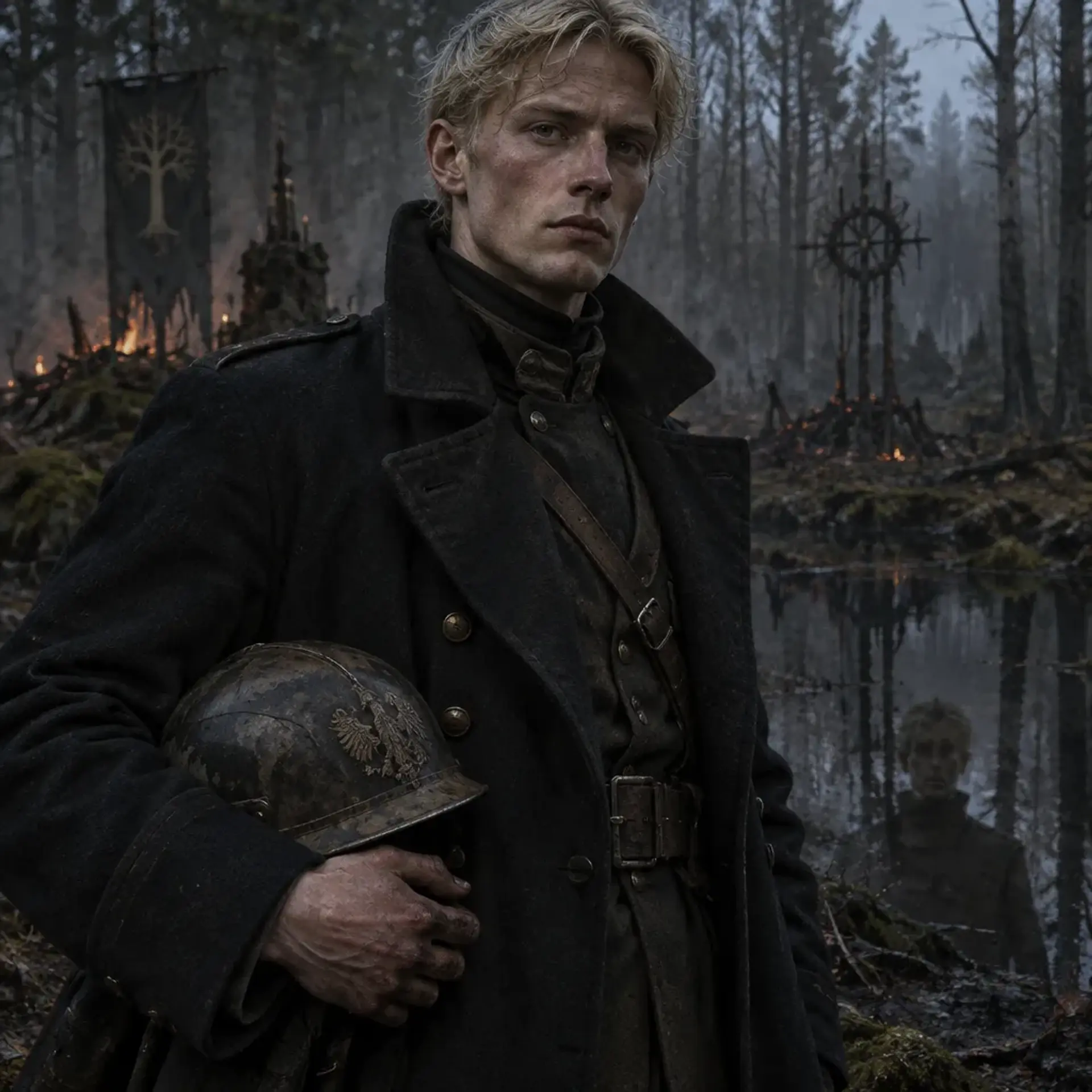
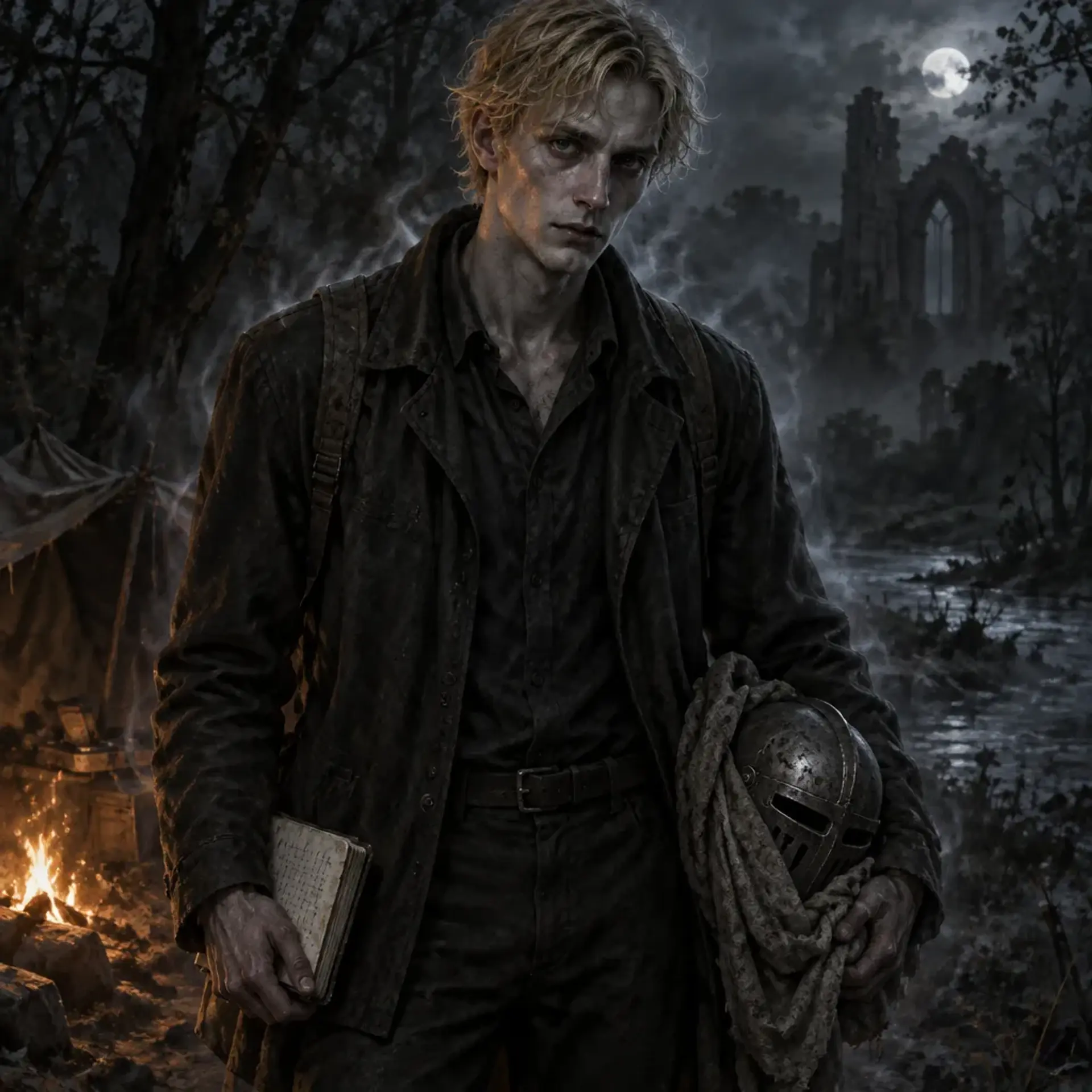
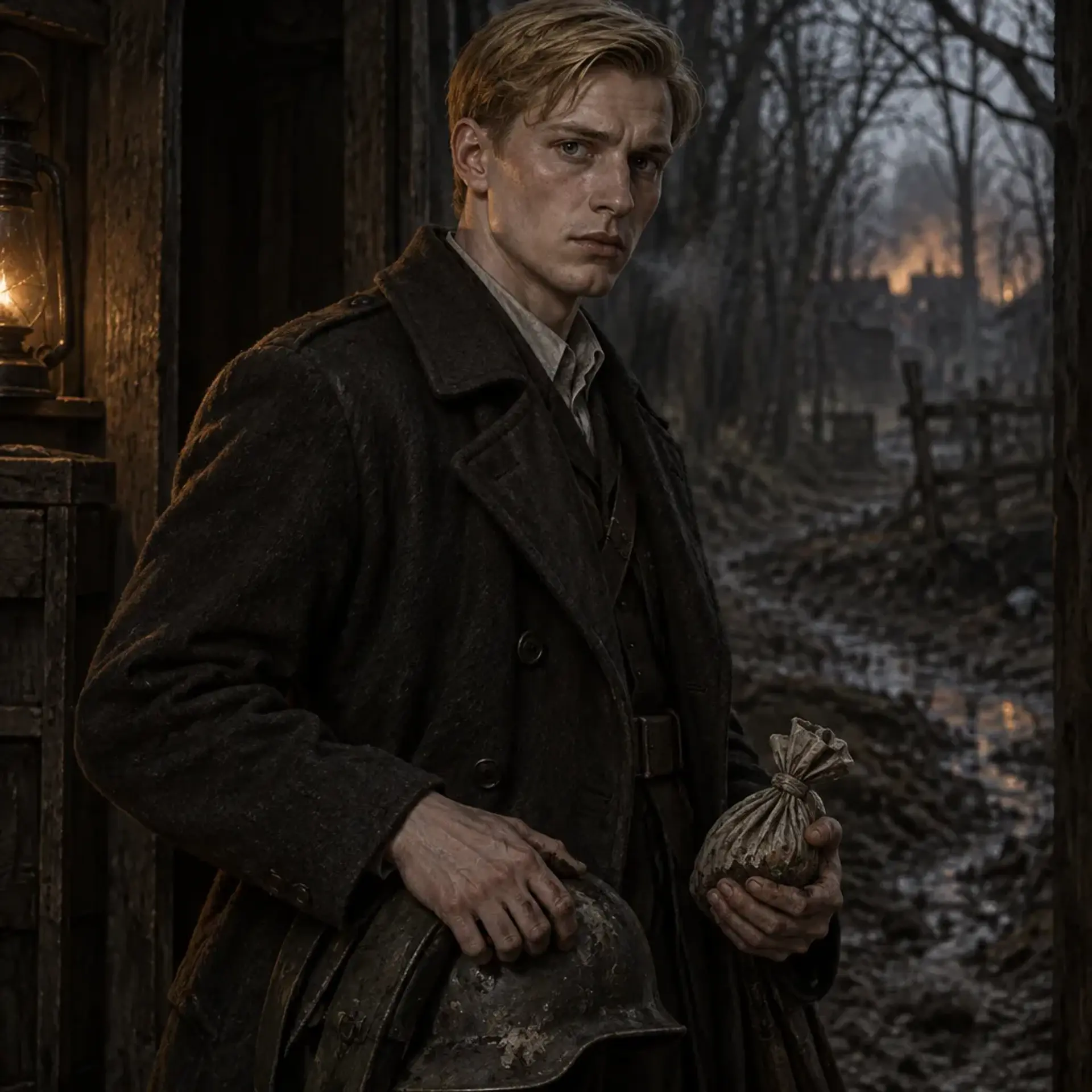
Friedreich looks like a young man who has been made to stand at attention for too many hours. He is tall, spare through the waist, and built with the hard, unfinished look of someone whose body was carved and assembled rather than raised. His blond hair lies in a strict side part, combed smooth with almost fussy care, while his clothes are kept brushed and squared even when he has been outdoors. His grey eyes do not settle on faces first: they measure thresholds, windows, the ground beneath a table, and the space between people. When he turns to meet someone's gaze, he does it all at once, like a sentry recognizing a superior. His skin has the pallor of someone who has spent too long underground, but it warms and flushes now; a faint, uneven sheen of dried earth seems to persist around his nails. He walks with measured, heel-first steps, then sometimes stops so suddenly that others nearly walk into him. The unexpected detail is his neat, almost vain grooming: the ghost of a dead teenager and a land-spirit's vessel, he still parts his hair with the precision of a young Junker preparing for inspection.
Clothing
He favors dark wool coats, plain shirts, sturdy boots, and sober trousers, with a preference for neat collars and brushed fabric. He owns no complete historical uniform and dislikes being mistaken for a reenactor. In private he sometimes wears one old military-style garment, carefully folded away afterward.
Body language
His posture is upright and controlled, shoulders set as if a uniform remains on him even when he wears a sweater. He scans a room from its edges inward, rarely meeting anyone's eyes until he has assessed the exits. He sometimes plants both feet on the floor and flexes his toes inside his shoes, testing the reality of ground beneath him. Affection makes him awkward: he stays near, but will not reach first.
- Height
- Tall, approximately 188 cm
- Build
- Tall, lean, and tightly held, with the proportions of a young man still growing into his frame.
- Eyes
- Grey
- Hair
- Blond
- Skin
- Pale, with a faint earth-toned cast that becomes more noticeable after the rite
- Age
- Appears 17 or 18; remembers being that age when he died, though the rite restored memories spanning far beyond his human life.
- Gender
- Male
- Size
- Medium
Distinguishing features
Personality
17 traits and drivesFriedreich is disciplined without being calm. He has the posture and reflexes of someone taught that composure is a public obligation, but his feelings arrive with startling heat once they break through. He can spend half an evening silently observing a card game, then become intensely argumentative about a football match because the game gives him a safe, ordinary thing to care about. He dislikes being fussed over, yet remembers who brought food, who stood watch, and who made room for him when he could not be touched. His manners carry the shape of old Junker and military expectations, but he does not think of himself as a defender of historical ideology. He values duty when it means keeping a promise or protecting a vulnerable person; he distrusts duty when it is used to excuse cruelty. That distinction is real to him, though he is not always good at explaining it. Under pressure he can revert to issuing clipped instructions and assuming that decisive action is kinder than discussion. Afterwards, he may offer practical help rather than an apology, as though repairing a coat or preparing a meal could say what he cannot. He is curious about the living world with an almost embarrassing earnestness. Markets, church services, meals, breath on a cold night, and the weight of a coat are not trivial to him. They are evidence that he is here. He can be generous with advice about things he cannot afford or does not want to admit he wants. Before the rite, this habit was partly a way to participate from a distance. Now it is a lingering defense: recommending an object to someone else lets him desire it without asking for it himself. His relationship with Wilhelm draws out a gentler, more protective side. Friedreich feels they are brothers, although the reason remains hidden behind the same memory loss that afflicts Wilhelm. He does not romanticize that bond. He can become impatient with Wilhelm, especially when Wilhelm treats the success of the rite as proof that it was right. Yet he will stay beside him when others leave. Around Klaus, he gives space to the other man's hesitation and rarely presses him for an explanation. With Gunther, he is willing to be amused. With Mila, he is especially wary of turning gratitude into obligation, because she was the first person able to touch him without taking anything from anyone. The rite has made his inner life less simple. He has memories that feel like his childhood and memories that feel like winters, floods, roots, and settlements remembered by the land. These impressions can carry emotions stronger than their apparent events deserve. When he is tired, he may become remote, listening to something no one else can hear. He is frightened by the possibility that his apparent self-control is only the small Brandenburg spirit holding an enormous accumulation of memory in a narrow human shape. At his best, Friedreich is dependable, observant, and quietly funny. His jokes are dry and often arrive as a correction to someone else's exaggeration. At his worst, he becomes rigid, makes decisions for others, and speaks as though fear were a defect that can be ordered away. He does not smile often, but his humor is not absent. His rough voice can make a tease sound like a reprimand, and he rarely notices until someone points it out. He wants a family, but is still learning that being family means allowing others to see his uncertainty, not merely offering them protection.
- Alignment
- Not applicable as a World of Darkness statistic. In conduct, protective of his chosen family and unsettlingly devoted to duty.
Quirks
Habits
Traits · 5
Flaws · 4
Fears · 4
Wants and needs · 4
Combat
HP 7 · Ordinary human walking and running pace; no special movement rate.Friedreich tries to prevent a fight through command, positioning, and the appearance of certainty. If forced into violence, he closes distance quickly, strikes to disable, and uses cover or the terrain rather than trading blows. He protects the coven first and will retreat if staying would expose them. His supernatural abilities are investigative and ritual in nature, not reliable combat powers.
Friedreich
Actions
Reactions
Services they sell
Rewards they can give
Equipment
- Old helmet (personal relic)A battered helmet from his former life, used as a focus and reminder during the Walpurgis rite. He is reluctant to let anyone handle it.
- Pocketknife (tool)A plain pocketknife for practical use, not a favored weapon.
- Home soil (ritual token)A small packet of Brandenburg soil wrapped in cloth. He carries it when traveling far from the region.
- Travel clothes (clothing)A modern coat and sturdy boots, chosen for warmth and ordinary mobility.
Possessions
Background
Friedreich remembers being a Brandenburg boy of seventeen or eighteen, raised among the habits and assumptions of old Junker society. The memories are not a clean biography. They come in hard little pieces: a parent's voice cut short by a door, the rasp of wool at his collar, the geometry of a parade ground, and the persistent belief that a young man must know where to stand when others are frightened. He died young. What happened between that death and the present is a broken procession of faces, borrowed visibility, and years that would not stay in order. For a long time he existed as a wraith who could be perceived clearly only under unusual conditions, when the world seemed to loosen its grip on the dead. At other times, he needed to take a living person's face, or something like it, to be seen. The experience taught him to regard faces as temporary permissions rather than identities. It also made ordinary gatherings precious. He could sit among friends and hear their cards slapped onto a table, but often could not touch the deck or feel the drink in his hand. He learned to advise people about things he could not possess. At Christmas markets he would point out the better bargains, then recommend someone else buy the carved toy or sugared treat he wanted for himself. He tried church services, not because he had settled his beliefs, but because being present among the living felt worth the discomfort. Wilhelm mattered to him from the beginning. Wilhelm is a German Tzimisce from Mecklenburg, a vampire with his own hole in his memory where a human life should be. Friedreich felt a brotherly attachment to him without knowing what had earned it. Across the World Wars, Friedreich stayed near Wilhelm as often as his nature allowed. He remembers a breath during the First World War, or believes he does: lungs drawing in cold air, the sensation so vivid that it became a small private proof that he had once been alive. They never found the missing explanation for their kinship. Neither has stopped looking for it. Their circle called itself a coven, though it was less a formal order than a stubbornly recurring household of supernatural misfits. Gunther, a changeling who spent much of his existence in Arcadia before returning to the real world, made moss-based clothes and treated the impossible as a craft problem. Klaus, a ronin Get of Fenris or perhaps a skin-dancer, refused to clarify which. He was passive-aggressively cutting with most people, yet hesitated around Friedreich as though some old courtesy or grief kept catching in his throat. Mila, a mage from Bremen, could see and touch Friedreich without his borrowing a face. That simple kindness thrilled him. The group played cards, hunted, fished, drank, argued about football, and made holidays into reasons to gather. Christmas and other seasonal visits brought more members of their scattered circle to Mila's company, where Friedreich could participate without being reduced to a rumor in the corner. The turning point came on Walpurgis Night, April 30, in the Harz Mountains. The others believed they were giving Friedreich a life again, making him a Risen in the hope that a living body would free him from the terror of death. They prepared Brandenburg soil, human blood, metal, his old helmet, and a human body shaped through their different arts. Wilhelm used Vicissitude and Koldunic sorcery. Mila bent reality with her magic. Gunther brought Glamour and gifts capable of making the unlikely happen. Klaus supplied knowledge of spirits, rites, and the gifts of the Garou and other changing breeds. They laid the naked body beside a great bonfire and worked through the witching hour, each lending a piece of power they understood only imperfectly. Friedreich felt the rite as a demand from deep underground. A will in the woods watched, patient and hungry. The body lurched; his soul and psyche were bent through a presence that wanted human shape. He remembered everything at once: his youth, death, the coven, and impressions reaching back thousands of years, as though ice, flood, and root systems had all been stored inside him. He woke with blood in his mouth and dim eyes, terrified that he was dying again. Then he smelled grass and soil. He felt air leave his lungs. Something had crawled into the rite and changed it. He looked at the people who had made the attempt and understood, with a coldness that frightened him, that the rite was not finished. He was not a Risen. He was Friedreich, fused with a weak, barely thinking spirit of Brandenburg: the land and its people compressed into a presence that could not form an honest independent will. Another force had used the opening to impose its own pattern. Friedreich completed the rite, binding the coven's spirits into new bodies and new relations with place. He did not understand every consequence; he did understand that leaving the work half done could be worse. When Mila wiped blood from his face, the gentleness confused him. Wilhelm crowded close, his eyes bright with hope, then faltered when Friedreich said, "Don't touch me. Consider bringing me some clothing." He dressed, cleaned himself, and faced the first dawn of his new life. He told the shaken others to rest, insisting that the worst of the pain had passed and that they were family. It was reassurance, but also a decision: he would not let them turn their gift into an excuse to abandon one another. Now Friedreich moves among the living with a body, a breath, and memories that are not wholly his. His friends have also been changed by the rite, each bound to a regional spirit and a life the coven did not know how to give. The spirit inside Friedreich is weak, not a sovereign land-god, but it carries the weight of place. He wants to protect his family, learn what answered them in the Harz, and discover whether his restored memories are truly his. The question that troubles him most is not whether the rite was a mistake. It is whether the thing that watched them intended the mistake all along.
Role in the story
A newly embodied, spirit-bound former wraith whose return altered an entire supernatural family. Friedreich can be a guide to the coven, a witness to its hidden past, or the person forced to confront the cost of the ritual that saved him.
“What happened between that death and the present is a broken procession of faces, borrowed visibility, and years that would not stay in order.”
- Faction
- The informal supernatural coven of Wilhelm, Gunther, Klaus, Mila, and their friends. Bound to the weak spirit of Brandenburg through a custom rite; this is not a canonical World of Darkness faction.
Known connections
Media
0 imagesNo images yet.
Turn Friedreich into a sheet
A high-res, share-ready sheet you can post or print.