Friedreich
Friedreich
At the table
Voice
His voice is produced by breath in the returned body, but still carries the strained rasp of someone who spent too long trying to speak across a barrier. It is dry and sharply articulated, shaped by drill-ground commands, wartime noise, and years of being unheard. He does not become quieter when angry; his words become more exact, and the consonants land like clipped orders.
Friedreich speaks German with a strong Brandenburg and Prussian inflection, clipped consonants, and the careful phrasing of someone who learned to make himself understood over noise. His English is serviceable but formal. Under stress, old military commands surface before he notices. While wearing a face, he can imitate its voice well enough to pass at a glance, but his sentence rhythms tend to retain his own habits.
Speech patterns
How to play them
Treat him as a person before treating him as a mystery. Ask permission before touching, borrowing, or discussing a face. He responds well to practical companionship and honest limits. If challenged about Wilhelm, he may become defensive, but a calm question about what he actually remembers can reopen the conversation.
Goal
Learn what the Harz rite made of him and the coven, recover enough of his mortal history to judge Wilhelm fairly, and find a safe way to participate in ordinary life without surrendering his identity.
Motivation
To protect his chosen family and recover a sense of human belonging without becoming a thief of other people's lives.
Appearance
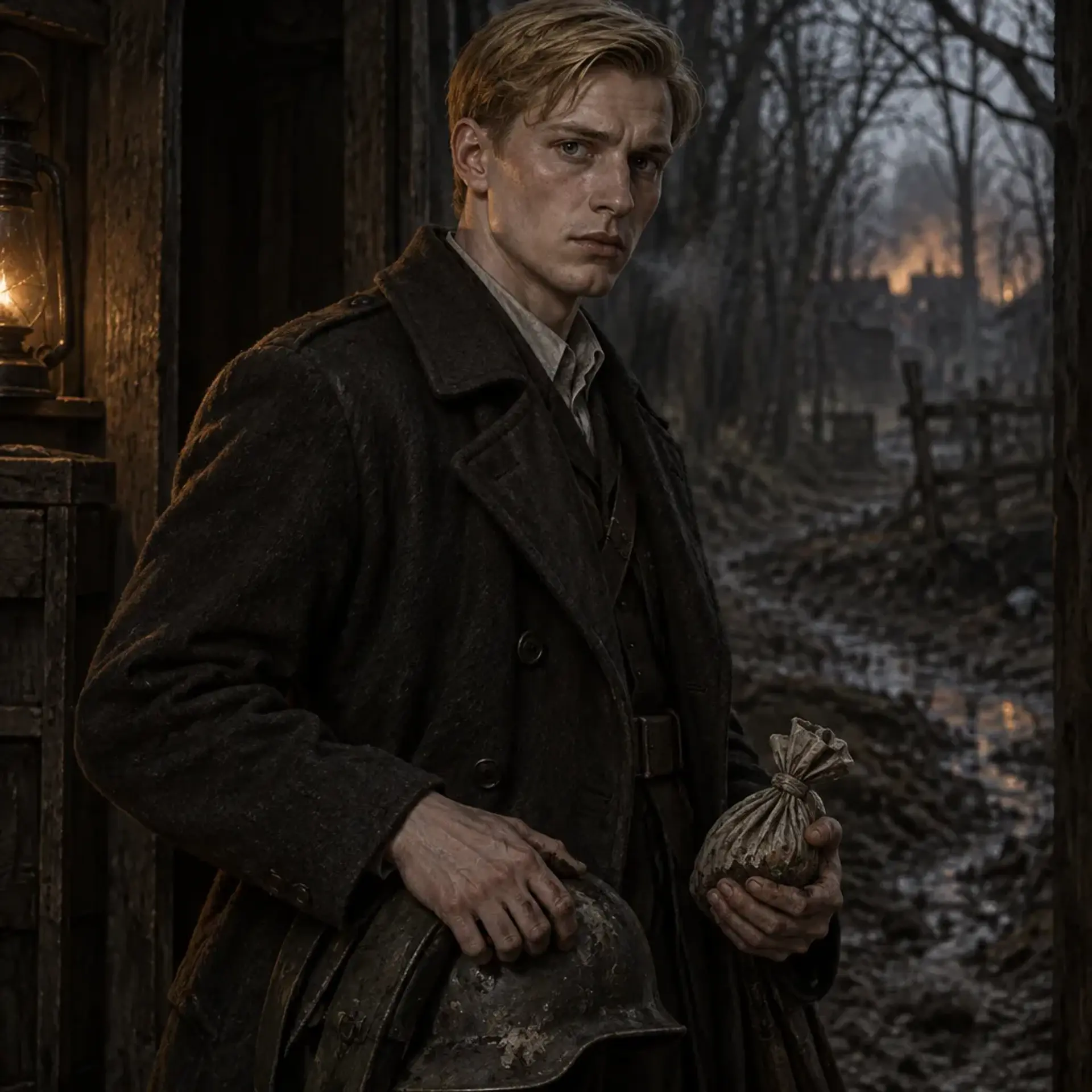
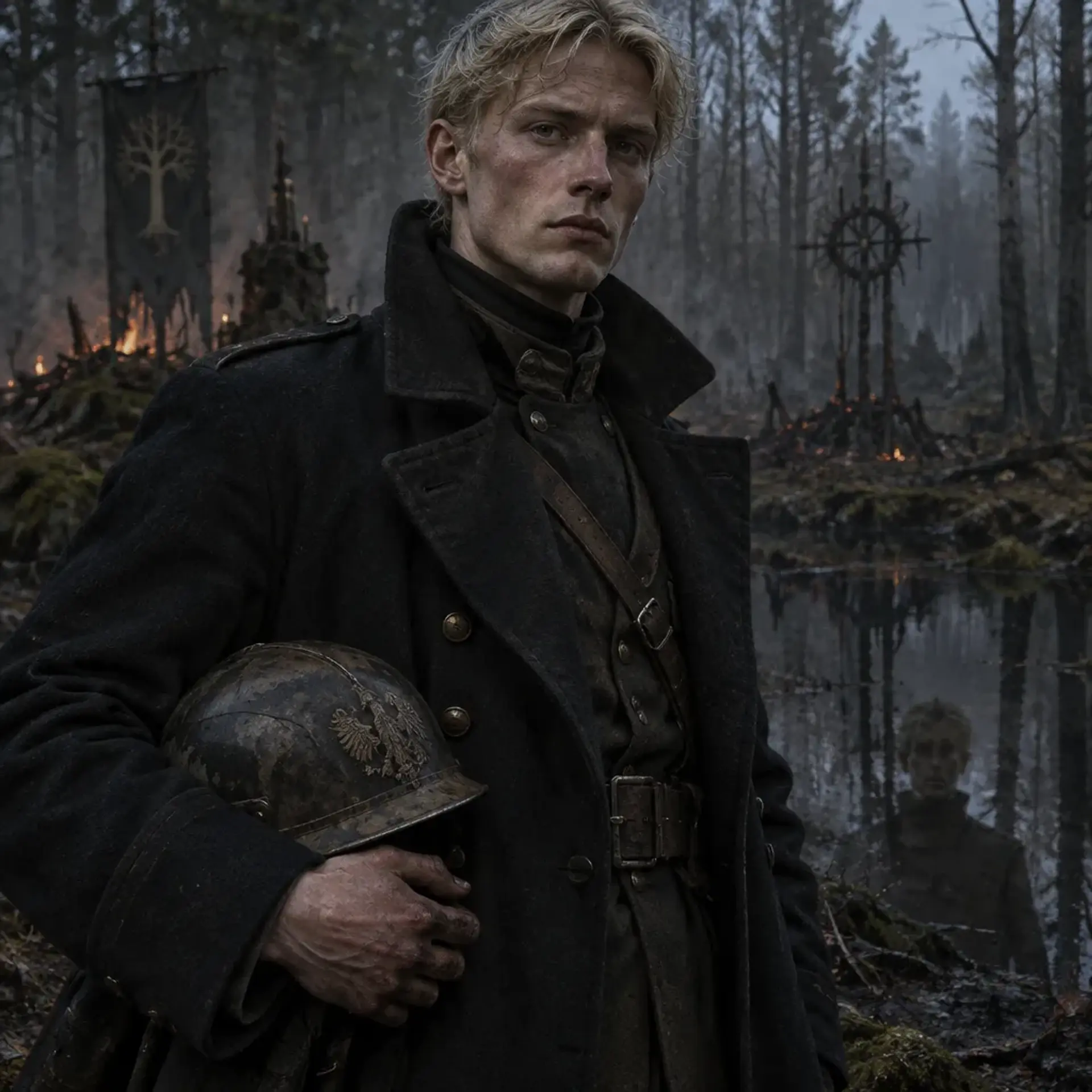
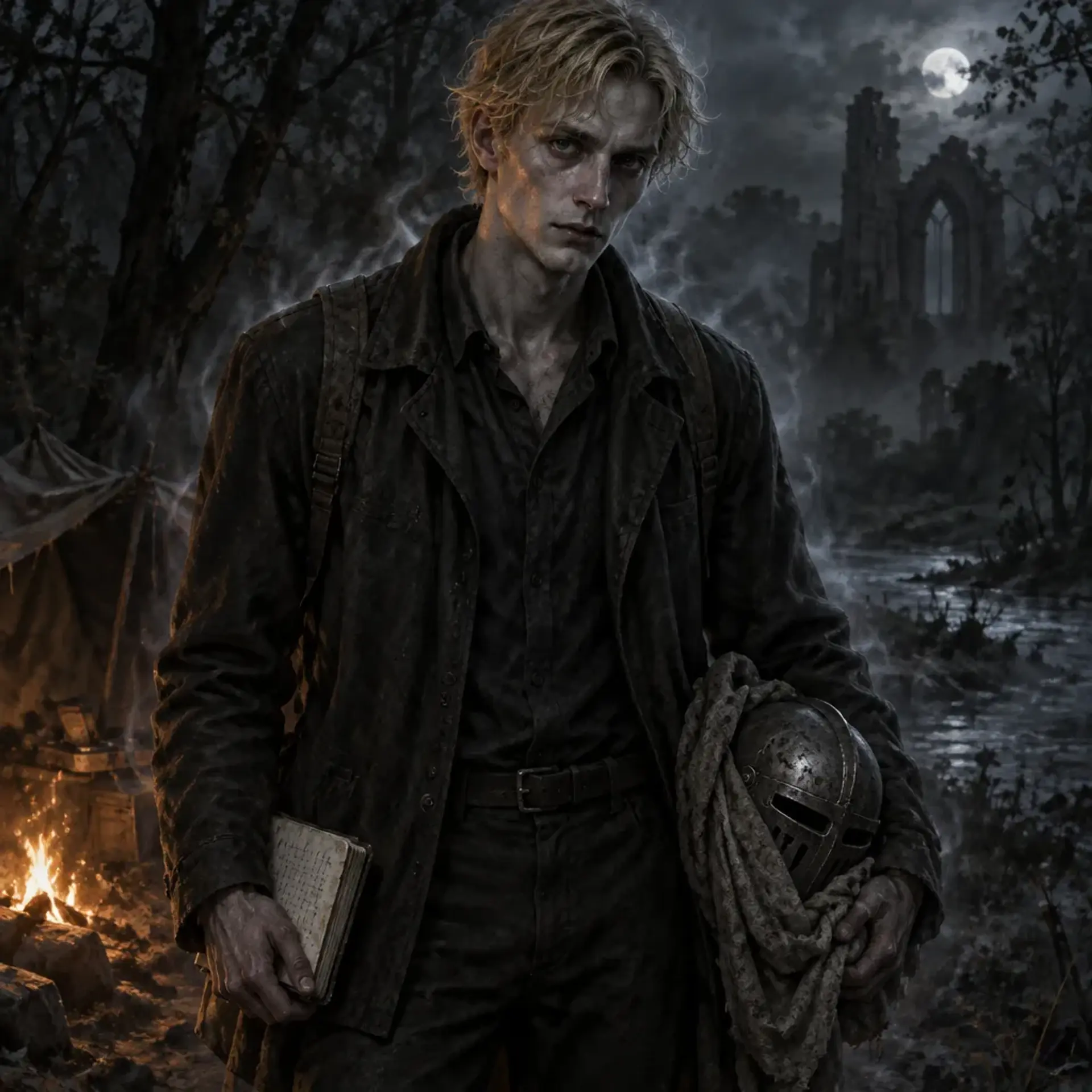
When he is visible without a borrowed face, Friedreich looks like a young man assembled from cold air and the memory of a Prussian portrait. His outline has the soft, wavering edge of heat above a road, and light seems to pass through him unevenly. He wears a close, disciplined posture, but his weight rests slightly forward on the balls of his feet, as if waiting for an order that never comes. He occupies more space than his slight frame should: people unconsciously step around the place he stands, even when they cannot see him. When a face-taking works, he becomes startlingly tangible, with skin that warms, breath that fogs glass, and a body that can eat, sleep, bathe, and be touched. He favors young German men with military, police, or Junker associations, especially faces close to the one Wilhelm says he once had. His own remembered face is not reliable.
Clothing
Before the ritual, he wore a vague, worn impression of an old military coat when visible, never quite settling into a uniform. After the rite, he accepts plain contemporary clothes, often a dark jacket, simple shirt, and boots. He keeps his old helmet wrapped away rather than wearing it.
Body language
Waits with his weight forward and his hands held close to his sides, as though making himself ready to march without taking a step. With a borrowed face he imitates its owner's habits obsessively; when unsettled, he returns to a rigid parade-rest stance.
- Height
- About 183 cm in his new body; his remembered height is unreliable.
- Build
- Lean and upright, with the economical posture of someone trained to keep formation. His new body is taller than his remembered self, which makes him seem faintly uncomfortable in doorways.
- Eyes
- Grey in his newly returned body; the color of his original eyes remains uncertain to him.
- Hair
- Blond in his returned body; uncertain in his original life.
- Skin
- Pale, slightly grey and cold-looking when visible as a wraith; naturally human in the body made by the rite.
- Age
- Appears 17 or 18; died young, with his exact age and mortal chronology uncertain. His apparent youth is most legible on days when the boundary between worlds thins.
- Gender
- Male
- Size
- Medium
Distinguishing features
Personality
18 traits and drivesFriedreich's discipline is real, but it is not the same as calm. He can wait through a long silence with his hands still and his attention fixed on a door, then snap at a friend who fails to notice he has been speaking. He wants to be treated as an equal, yet instinctively arranges himself as a guard at the edge of any group. He is proud of his military bearing and embarrassed by how much of it is imitation, habit, or a memory that may not belong to him. With friends, he is practical and unexpectedly domestic. He remembers who likes which drink, keeps track of football fixtures, and takes Christmas-market shopping seriously. He likes bargaining, the press of a crowd when he can be seen, and the ordinary pleasure of advising someone on a good purchase. He is protective of Mila without assuming she is helpless; he knows she can be more formidable than he is and still feels responsible for walking her home. With Gunther he can laugh at odd questions, until those questions turn toward possession or the boundary between their selves. With Klaus he accepts more bluntness than he would from anyone else, because Klaus's hesitation reads to him as a kind of care. Wilhelm brings out his contradictions most sharply. Friedreich loves him like a brother and believes he has earned the right to demand the truth. He is angry about Wilhelm's actions in the Second World War and about his desertion in the First, yet he knows that the only apology Wilhelm has offered is for that desertion. He wants to believe the apology is sincere and suspects that believing it would be easier than confronting the rest. When Wilhelm offers fragments of Friedreich's old appearance or history, Friedreich listens closely, then tests each detail for evasion. He can be tender one moment and accusatory the next, because affection does not erase the harm he remembers. Friedreich's face-taking began as an answer to isolation, not a desire to deceive for sport. A successful face gives him the astonishing range of an embodied life: breath, touch, food, sleep, and the ability to be heard. Those pleasures make him exuberant and, afterward, ashamed of his dependence on another person's identity. Long use can pull him toward envy and anger. He is careful about using people he believes dead or away, but knows that absence does not make a person's likeness his property. He has considered a job and a hobby group as ways to make his contact with the living routine rather than furtive. He also wonders whether ordinary flirtation is possible when the face he wears has a history of its own. The possession experiments changed him. With Wilhelm, he approached possession as an experiment in intimacy and empathy, hoping to lend Wilhelm emotions or uncover shared memories. The card game was an anchor, each turn a reminder to stay separate. Entering Wilhelm brought not a clean exchange but a collision of Friedreich's longing with a vampiric body that did not answer like a living one. The lack of ordinary bodily response felt less like a puzzle than a refusal. He withdrew, and their later final attempt confirmed that closeness could not force memory or humanity into either of them. With Gunther, curiosity became alarm. Gunther's nature made the experience alien and full of meanings Friedreich could not parse. Friedreich felt his own identity spreading thin; Gunther felt the cold pressure of a stranger's military habits. They stopped. Friedreich's "Never again" was a boundary, not a joke. Before the Harz rite, his temper had not vanished so much as been worn down by distance. He could still flare when ignored, but often felt too remote to sustain anger. The rite changed that. The new body carries an intense flood of sensation and emotion: warmth, breath, grass underfoot, fear, grief, and a cold directive that sits beside his own thoughts. He can be gentle while doing something terrible, then sincerely reassure the people he has hurt. That is the quality he fears most. He is not merely a rigid young soldier, nor simply a frightened dead boy. He is someone who wants to choose his loyalties, and who must now ask whether the land inside him is choosing first.
- Alignment
- Protective but morally compromised; loyalty to his chosen family can eclipse his judgment.
Quirks
Habits
Traits · 5
Flaws · 4
Fears · 4
Wants and needs · 5
Combat
HP 7 · No universal speed value supplied. Use the movement rules for a wraith or manifested character in the chosen Wraith edition and chronicle.He favors surprise, cover, and a quick disabling strike. He protects companions first, uses a borrowed face to confuse pursuers where appropriate, and retreats when a fight risks harming someone he loves. He does not treat his custom face-taking or possession attempts as combat powers that automatically control a target.
Friedreich
Actions
Reactions
Services they sell
Rewards they can give
Equipment
- Old helmet (personal memento)A battered helmet associated with his mortal life, used as a personal link in the Harz rite and kept wrapped away afterward.
- Face list (record)A small notebook recording borrowed faces, aliases, confirmed absences, and intended uses. He avoids writing identifying details that could expose the people involved.
- Service knife (weapon)A plain service knife used only when cornered; it is not a supernatural weapon.
Possessions
Background
Friedreich remembers Brandenburg in fragments: damp drill grounds, the bite of winter under a collar, a horse's steaming flank, and the certainty that a boy ought to stand straight when an adult enters. He cannot reliably recall his family name, his exact age, or the final hours of his life. Wilhelm, a German Tzimisce from Mecklenburg who also lost his mortal memories, says Friedreich had blond hair and grey eyes. Friedreich suspects that Wilhelm is telling the truth and resents him for being the only person who might know it. His first clear memory after death is not of a boatman or a judge. It is of a willow-wisp watching from the edge of a dark wood. Friedreich had been repeating the motions of marching, an empty ritual with no unit and no destination, when something of the land and of human custom opened his Caul. This account is deliberately uncertain: the cause was neither a known wraith nor a mage, and even Friedreich cannot say what the spirit intended. Klaus later described it in Garou terms, as a thing marked by the Wyld, shaped among the Weaver's adopted children, bearing spoils of the Wyrm and a trace of Luna. Friedreich does not know whether Klaus was explaining, warning him, or concealing something. The wisp remained after the Caul opened, and the Shadowlands became the lonely country through which Friedreich learned to move. His first successful face was accidental. During the First World War, while trying to make a sentry hear him, Friedreich clutched a dead young soldier's identity as if it were a uniform. For a short, bewildering interval he had a mouth that could form words, lungs that could make breath, and hands that could grasp a sleeve. He remembers the soldier's wet wool and the shock of warmth more clearly than the man's name. The first time he ate under a borrowed face, he cried over a heel of bread and then felt ashamed of crying. The experience taught him that being seen could feel like being alive, and also that the face was not his. Friedreich and Wilhelm crossed paths through both world wars, as much as a wraith could. Friedreich recalls the First World War as flashes of mud, shouted orders, and a breath he cannot place. Wilhelm deserted; it is the one subject on which he has openly apologized. In the Second World War Friedreich saw enough of Wilhelm's actions to be angry, though he cannot reconstruct every event. He believes Wilhelm committed terrible crimes and hates that Wilhelm will not explain them. He has killed to protect the people he calls family: a Get of Fenris who came for Klaus, and three Hunters who were searching for Wilhelm or the others. He has also fought vampires threatening Wilhelm and changelings threatening Gunther. None of this makes him proud. It makes him certain that he is dangerous when frightened. The coven gave his existence a social shape. Gunther, a changeling who spent much of his life in Arcadia before returning to the world, sells clothes made with moss. Klaus is a guarded ronin Get of Fenris, or perhaps a skin-dancer; he refuses to clarify and can be cutting with almost everyone. With Friedreich he pauses before the cruelty lands. Mila, a mage from Bremen, can see and touch Friedreich without a borrowed face. He thinks of her as a little sister, though she is long-lived and formidable in her own right. The coven meets for cards, fishing, hunting, drinking, football, and holidays. Friedreich especially loves the Christmas market. He advises friends about bargains, points out things he wants but cannot keep, and sometimes tries to attend a church service simply because he misses the human practice of standing among people. His relationship with faces has become methodical. He keeps a handwritten list of people he has confirmed dead or absent from the local area, changes the names he uses, and notes the purpose of each identity. A dead reserve soldier's face is for errands where he wants to seem ordinary; a police officer's appearance is for intimidating a Hunter; a young Junker's likeness is for standing beside Wilhelm without explaining why. He has experimented with normal life through these faces: eating at a table, bathing, sleeping, flirting with women he finds attractive, and imagining a part-time job or hobby group. The success is exhilarating, then corrosive. Prolonged use brings envy of the original person's life and a dread that Friedreich's own memories are being overwritten. He has considered possessing people, but knows that curiosity is not consent. They tested that boundary with Wilhelm. At a card game, Friedreich asked to possess him, hoping to lend his brother the sensations Wilhelm seemed to lack and perhaps recover shared memories. Wilhelm agreed after they set terms. Friedreich entered carefully, using the shuffling cards and their familiar game as an anchor. For a moment the sensations arrived as a crowded confusion: Wilhelm's body, its vampiric stillness, Friedreich's own longing for a pulse, and the emotional pressure of being close to someone he loved and accused. They tested alcohol. Wilhelm's body did not respond as a living body would, and the mismatch made Friedreich feel as if he were trying to breathe through a locked door. Neither recovered a memory. Klaus watched in alarm; Gunther had a dozen questions. Friedreich withdrew before the boundary blurred further. He and Wilhelm agreed to one last attempt later, then kept that promise. It produced no miraculous answer, only a sharper understanding that affection did not make possession harmless. Gunther wanted to know what divided their lives and whether memories could be shared. Friedreich tried once, with Gunther's consent. The experience was nothing like entering Wilhelm. Gunther's fae nature and Glamour turned the crossing into a rush of images and associations that did not behave like human memories. Friedreich felt himself pulled toward meanings he could not name, while Gunther felt invaded by a cold, military certainty that did not belong to him. They stopped quickly. Friedreich said, "Never again," and meant it. Gunther respected the boundary, but remained curious; Klaus was less curious and more watchful. The worst change came on Walpurgis Night, April 30, in the Harz Mountains. Mila, Gunther, Wilhelm, and Klaus meant to give Friedreich a living body as a gift and an easing of death's terror. Their rite brought together Brandenburg soil, human blood, metals, Friedreich's old helmet, and a male body shaped through their combined practices. Wilhelm used Vicissitude and Koldunic sorcery; Mila worked reality-bending magic; Gunther offered Glamour and gifts of wonder; Klaus brought knowledge of spirits, rites, and shapeshifter traditions. They expected a return to life, perhaps as a Risen. They did not understand what answered. As the bonfire burned, Friedreich felt something familiar deep beneath the earth, welcoming him with a demand. The willow-wisp watched. The body breathed as if asleep, then the rite bent his soul, psyche, and Shadow under another will. He felt melting, terror, and an impossible flood of memory. He could remember his mortal youth and death, but also ancient seasons of frozen ground, floodwater carrying away the things people built, and the land's long unhuman attention. He rose, bloody-mouthed, with a faltering heart and a mind made cold by a purpose that was not wholly his. He told the others to stand at ease. Then, in a voice none of them recognized, he said the land had called them to service. He finished a rite he believes was imposed upon them, binding each to a new life and purpose. The precise mechanism remains unclear even to its participants. The coven's wills were broken and remade, their identities joined to spirits that had yearned for human form. A lesser spirit of Brandenburg, the people and land together, now shares him; the watching wisp was not that spirit, but something stronger that manipulated the event. Mila wiped blood from Friedreich's face. Wilhelm came close with hope in his eyes, then heard Friedreich order him not to touch him and fetch clothing. Klaus stood still and said the first words after the silence, neither forgiving nor condemning. Gunther's guise failed, his fae mane flickering. At dawn Friedreich cleaned the site and told them it had only hurt once, that they were family. He had his blond hair and grey eyes now, but the certainty did not comfort him. He is not simply a wraith returned to a body, and the coven may not be what they were before. He still loves them, still knows the difference between love and obedience, and fears that the new thing inside him may not.
Role in the story
A companion, protector, and unsettling witness to the consequences of supernatural good intentions. Friedreich can offer a personal route into the Shadowlands, the coven's history, and a mystery about the Harz rite, while his loyalty and altered nature make him both an ally and a possible source of danger.
“He cannot reliably recall his family name, his exact age, or the final hours of his life.”
- Faction
- The coven of supernatural friends, not a formal faction. Formerly a wraith of the Shadowlands; after the Walpurgis rite, his status is an unresolved custom transformation.
Known connections
Media
0 imagesNo images yet.
Turn Friedreich into a sheet
A high-res, share-ready sheet you can post or print.