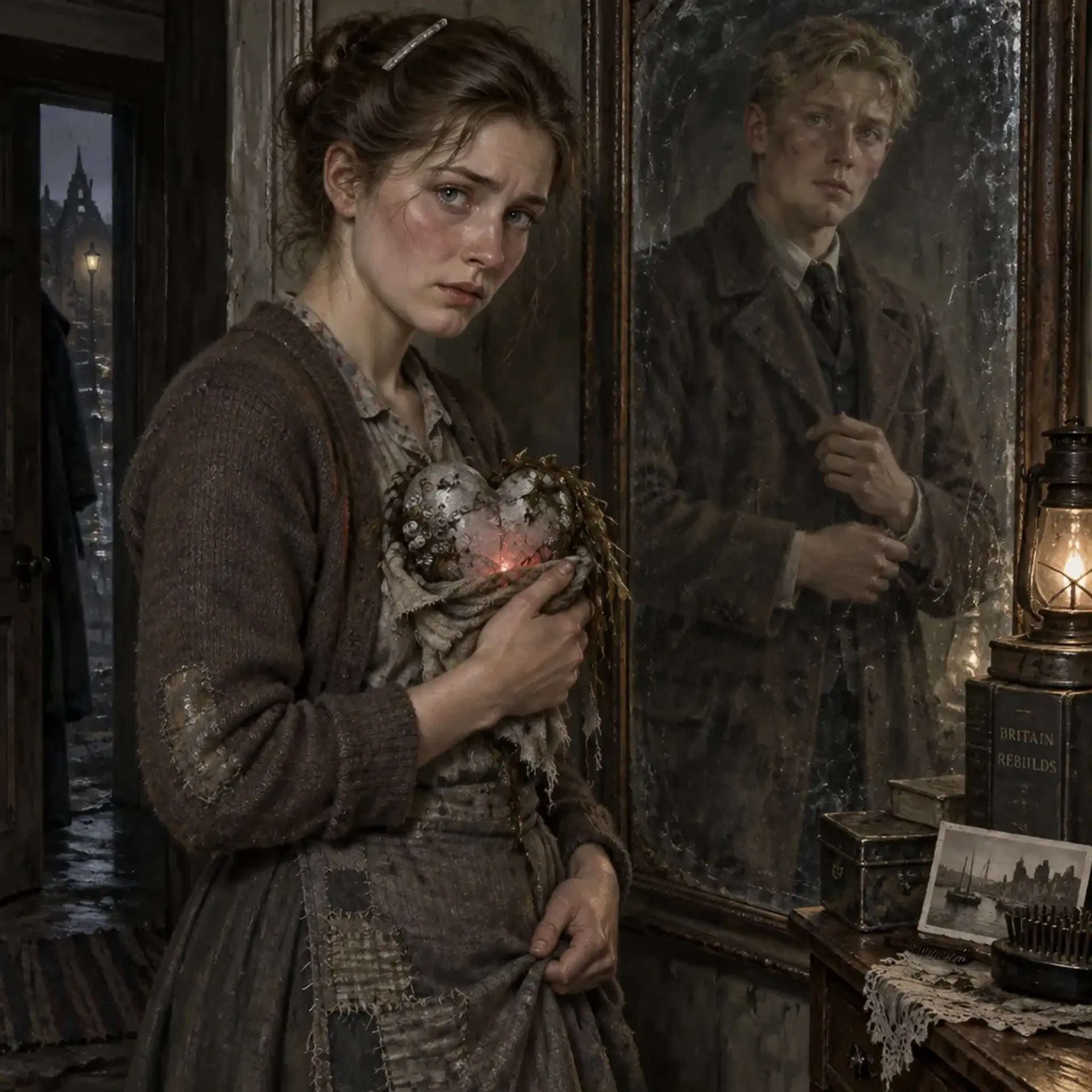
Mary Bell
Mary Bell
At the table
Voice
Mary's voice has a dry, slightly rough edge from calling across rooms and speaking over household noise. Her London-born early years have left traces in her vowels, softened by years in Kent and by the practical shorthand of family life. She speaks quickly when listing jobs, but lets silences stand when she distrusts someone. Kent's voice is the same voice the reflection presents as its own: clearer and more carefully shaped, with a faintly formal, middle-class manner that sounds practiced rather than inherited. He clips a phrase when embarrassed, over-enunciates names he wants to remember, and sometimes betrays excitement by asking questions too quickly.
Speech patterns
How to play them
Treat Mary as busy, perceptive, and hard to impress with promises. Practical help for the younger children earns more trust than flattery. Do not assume she will explain the heart quickly. Kent responds to sincere curiosity and inclusion, but can be overwhelmed by direct scrutiny. Give both of them choices, and let trust develop through concrete acts rather than sudden confession.
Goal
Secure a life in which her younger siblings are safe without surrendering every chance of her own future, while finding out what the heart is asking of her and Kent.
Motivation
Mary wants her siblings to have choices she never had. Kent wants to be noticed as himself, not merely as an oddity or an extension of Mary's troubles.
Appearance
Mary Bell has the compact, practical look of someone who has spent years getting small children washed, fed, and out of the way before anyone notices the work. Her dark-blond hair is usually pinned or tied without a mirror; loose strands escape at her temples and stick to her forehead when she hurries. Her blue-grey eyes keep moving toward doors, stairways, and the nearest child who has gone quiet. She walks with a slight forward pitch, as if she is already reaching for a kettle or catching a falling toddler. She can hold perfectly still when listening through a wall. Her hands are usually chapped from household work, but she has a surprisingly precise way of turning a pebble over, testing its weight with her thumb. When Kent appears in reflective surfaces, the effect is not a simple likeness: there is a young man with short, bright blond hair, malachite-colored eyes, and a handsome, taller face where Mary expects herself. Kent's borrowed clothes and surroundings never quite make him look at home. People struggle to say exactly what is different beyond the obvious fact that Mary is a young woman and Kent looks like a young man. His shoulders seem broader in some reflections, his face longer in others; a neckline or sleeve will sit wrong, then seem to fit if nobody stares. His movements are self-conscious and alert, as though he is waiting for someone to recognize him and dreading it at once.
Clothing
Mary wears serviceable skirts, a plain blouse, a cardigan with darned elbows, and shoes chosen for standing all day. Kent emerges in whatever Mary is wearing, but the clothes may sit oddly on his apparent frame. On excursions he favors a neat collar and tries to look like a respectable young man, sometimes with a borrowed coat that is too large.
Body language
Mary habitually turns her body toward the nearest exit while keeping an eye on whoever needs help. She shifts her weight forward and rubs her thumb over her fingertips when holding back a complaint. Kent stands more upright, shoulders carefully arranged, then forgets the pose when something catches his interest. He watches faces for signs of recognition and becomes very still when he receives it.
- Height
- Mary is of ordinary height; Kent appears taller, though the apparent difference is not consistent.
- Build
- Compact, work-hardened, and quick on her feet. Kent appears taller and longer-limbed, though the difference is inconsistent enough to trouble anyone trying to describe it.
- Eyes
- Blue-grey
- Hair
- Dark blond; Kent's short hair appears brighter blond.
- Skin
- Fair, often reddened or chapped from work and weather.
- Age
- 18
- Gender
- Female, though Kent's appearance and gender presentation differ from Mary's in ways she cannot neatly explain.
- Size
- Medium
Distinguishing features
Personality
17 traits and drivesMary is capable and tender, but competence has become the shape other people use to keep asking more of her. She can be patient with a toddler for an hour and lose her temper at an adult's casual assumption in a single sentence. She is grateful for small kindnesses, then angry with herself for feeling indebted. She tells herself she has no time for the heart's mysteries, yet keeps it close and watches for its pulse. In public she is reserved and alert; with the younger children she can be funny, inventive, and gently bossy. When exhausted, she becomes curt and frighteningly efficient. Afterward she may apologize for the tone without retracting the point. Kent has a different set of contradictions. He is shy about being examined but hungry for people to notice him. He wants to behave with English middle-class propriety, as though good manners might make his presence legitimate, yet he is capable of blurting out blunt opinions when he forgets to monitor himself. He likes being invited into ordinary activities, but often finds the rules of those activities baffling. He can be prim about a drink, then fascinated by a vulgar joke; he will stand stiffly at the edge of a room and resent nobody asking him to join, while also hoping nobody will. He is not simply Mary's disguise or a convenient escape. He has preferences, curiosity, vanity, and fear, and his attachment to Mary is mixed with the wish to have a life that does not depend entirely on her. Their moods do not match reliably. When Mary panics, she makes lists and gives instructions. Kent may ask a question that sounds useless until it reveals what both of them have missed. When Mary is angry with Simon, she becomes sharper and more direct; Kent becomes almost ceremoniously polite, which sometimes makes people underestimate his displeasure. Mary is most at ease when she is doing something useful. Kent is most at ease when someone offers him a small, ordinary task without demanding an explanation of what he is. Each envies the other's apparent freedoms. Mary envies Kent's ability to leave the house; Kent envies the certainty with which Mary belongs to her family, even when that belonging hurts her.
Quirks
Habits
Traits · 5
Flaws · 4
Fears · 4
Wants and needs · 4
Combat
HP 5Mary is not a trained fighter. She uses doors, furniture, distraction, and the need to protect someone else as reasons to break contact and escape. Kent is less likely to flee quickly because he is fascinated by being involved, but will retreat if directly threatened. The heart's effects are custom, uncertain, and not reliable as a weapon.
Mary Bell
Actions
Reactions
Services they sell
Rewards they can give
Equipment
- The Heart of England (uncanny object)A rough, heart-shaped cliff-stone with barnacles and dried sea growth; it weeps salt water and dark ooze and sometimes glows red-pink beneath its surface. Its effects are custom and uncertain.
- Kitchen knife (tool)A serviceable household knife, carried for ordinary work rather than as a weapon.
- Mary's pocket things (everyday possessions)A few coins and a folded scrap of paper listing errands and things the younger children need.
Possessions
Background
Mary Bell is eighteen and has never had much room to be eighteen. She grew up in an isolated house in Kent with seven younger siblings, a mother, Malinda, who could be affectionate and then vanish into drink, and a father, Simon, who took work as far away as he could manage. Mary learned to boil food, stretch money, mend hems, quiet a crying child, and tell from the sound of a footstep whether Simon was home for the night or merely passing through. School happened in gaps. Her lessons were interrupted by errands and by the younger children needing her. She is clever, but not in the manner of someone who has been encouraged to call herself clever. The family is complicated in ways the children understand better than the adults admit. Henry, fourteen, is growing sharp-tongued and cunning, and resents both his parents and Mary, who has become an authority without ever being given the right to be one. Matilda, twelve, is Mary's sweetheart sister and tries to share the chores. Mary watches closely for signs that the adults will turn Matilda into her replacement. Chrissy, nine, has tan skin, freckles, and wavy dark hair; her Jamaican father is unknown to the family, a subject people skirt around until an argument makes it useful. Olympia, ten, is Chrissy's closest friend, with dark hair and grey-blue eyes. Abigail, four, has red hair and bright green eyes, features Simon likes because they remind him of his grandmother. Jonas, five, has bright blond hair and vivid blue eyes; Simon brought him home, and Malinda never forgave the wound that arrival made in the household. Belladonna, five, has black hair and green eyes, and people speculate about her parentage without ever asking what it does to a child to hear them. Hector, two, is dark blond with Simon's steel-grey eyes and follows Mary with his blanket. Mary tries to make time for him, but there is always something else burning, crying, or waiting to be done. On Mary's eighteenth birthday, the family managed a small celebration. Malinda had found a strange stone tucked into a log and gave it to Mary because she liked collecting curious things. It looked like a cliff-stone shaped roughly into a human heart, crusted with barnacles and dried sea growth. It was a poor present, but it was a present chosen for her, and Mary was grateful. She did not tell Malinda she thought it might be jewelry. Malinda was too drunk to care what Mary called it. The heart had already passed through other hands. Bartholomew Golden, an amateur alchemist, had once left it at the Hush House, wrapped in newspaper, as payment for entry. He claimed it was a fossilized living heart, a thing of heart and scale that could bring servants from man's shadow, born from the hearts of chalk cliffs and borderlands to labor for the house. He was never allowed near Brancrug again. After being thrown into the sea, the object washed ashore, weeping seawater and black ooze. Beneath its rough stone surface, a red-pink glow returned. Abraham Groff found it, carried it home, and learned that it seemed to die around visitors and revive at the shore. He tried to show it off; it would go inert in company. It beat and wept in the quiet of his house, where he heard voices, footsteps, and doors moving. He sold it to William Windon, a local boy of seventeen, who had hidden it in a log after striking it with a hammer and stopping its heart. How it came from that log to Malinda is not something Mary knows. At first the stone was only odd. Then it beat in time with Mary's heart. She was too tired to do more than feel uneasy and put it away. Later, she caught a reflection that was not hers: a young man with bright short blond hair and green eyes like polished malachite. She assumed it was a trick of exhaustion, a joke, or a problem with a mirror. The figure moved when she did, but not always at the same moment. Sometimes he looked away while she stared straight at him. Sometimes he seemed to be studying the room behind her. A particularly bad dream changed their arrangement. Mary woke with the reflection looking back as if she had woken inside somebody else's skin. At dawn she found she could leave the house in Kent's appearance and voice, and later return to her own. She did not give it a grand name. She had no time for a grand name. To Mary, it was an inexplicable way to get out of the house without being recognized. To Kent, it was a chance to see things without having to ask permission. His first excursions were little acts of theft from Mary's obligations: a walk to the shore, a climb into a tree, a look inside a disused building. At the beach, Kent stood ankle-deep in the cold water and watched the stones shine under the surface. A boy collecting bait called him a dandy and asked whether he was waiting for a boat. Kent wanted to answer with dignity and instead blurted out that the tide was badly managed. The boy laughed; Kent watched him go, pleased by the attention and mortified that he had wanted it. At an abandoned building, Kent met a woman carrying a basket of laundry who mistook him for a lodger and asked him to help shift a fallen board. He did, awkwardly, then followed her directions through the place while she explained who used to live there. He learned the names people gave rooms and ruins, and how easily a stranger could be trusted with a small task. He wanted to ask her to keep talking. Instead he thanked her in a careful, rather formal way and left before she could ask where he lived. The pub was the most vivid adventure. Mary had been avoiding it because she knew how easily Simon could turn a public place into a private humiliation. Kent went to the Dog's Leg, a narrow, smoky pub near the road, with a warped dartboard and a brass rail polished by generations of elbows. The barman, Mr. Tegg, looked him over and asked whether he was old enough to be there. Kent answered with stiff confidence that he was eighteen, then immediately studied the floor as though it had asked him a question. He ordered a bitter shandy because it sounded respectable and hated the taste of it. A railway porter called Frank Kett sat beside him and talked about a signal failure, a broken boot, and the price of coal. Kent knew little about any of these things, but he listened intently. When Frank asked what he did, Kent said, “I am occupied with domestic matters,” which made the porter laugh so hard he nearly spilled his drink. For once, the evening belonged to Kent's own thoughts. He liked that nobody there needed him to wash a child, find a button, or notice whether Malinda had gone quiet. He liked being asked a question and having time to answer it. He also disliked the smoky room, the rough jokes, and how every person seemed to know where to put their hands. When a woman called Mrs. Kett asked him to join a darts game, he tried too hard to look casual and missed the board entirely. The whole pub saw. He wanted to disappear, but when they laughed with him rather than at him, he stayed. He went home pleased, embarrassed, and privately hungry for another evening in which he was not merely somebody else's reflection. That freedom has brought trouble close to the family. Once Simon came home earlier than expected while Mary was out as Kent. She returned to find the house in uproar and had to invent a reason for being near the back door. Another time, a drunk Matilda saw Kent leaving and asked why a strange young man was in the house. Mary had to lie to her sister, and the look on Matilda's face has stayed with her. Henry later encountered Kent in town. He spoke to him with suspicious familiarity, then turned up at home asking Mary pointed questions about the same young man. Mary is afraid Henry will connect the two, though part of her is relieved that he noticed something unusual before she could explain it. Mary's current problem is not a single villain but the daily pressure of a family that depends on her and rarely notices the cost. She wants a steadier job and enough money to make sure Matilda and the little ones are not left alone with the adults' moods. She wants to understand the heart without letting anyone use it to make servants, tools, or replacements. She cannot tell whether Kent is a person, an echo, a haunting, or something still becoming. She knows only that he has preferences, embarrassments, and a wish to be seen. Her fondness for him frightens her because it might be another responsibility. Her resentment of him frightens her because it feels like a cruelty she has inherited from the adults. Mary's formative change was not the moment the reflection appeared, but the first time she chose to let Kent stay out after she could have called him back. She stood at the window while dawn gathered, listening for the house to wake, and understood that the stranger had been given a little freedom by her choice. She also understood that freedom was something she wanted for herself. Since then, she has begun to distinguish between helping her family and disappearing into their needs. She has not yet learned how to refuse them without guilt. The heart keeps beating, and Mary keeps trying to make a life in the small spaces between its beats.
Role in the story
A young caretaker at the center of a domestic folk-horror mystery. Mary offers an emotional stake in the family and a human reason to investigate the heart; Kent brings an uneasy, curious perspective on the world beyond the house. They can be allies, witnesses, or the source of a difficult choice about freedom and responsibility.
“Her lessons were interrupted by errands and by the younger children needing her.”
- Faction
- None. The heart's earlier connection to the Hush House is a rumor and a source of danger, not a membership.
Known connections
Media
0 imagesNo images yet.
Turn Mary Bell into a sheet
A high-res, share-ready sheet you can post or print.