Mary Bell
Mary Bell
At the table
Voice
Mary speaks in plain, practical phrases, with a local English cadence shaped by family life and work. She starts explanations with what needs doing and only later admits how she feels. Kent's voice is recognizably connected to Mary's but sits awkwardly in the reflected body: a little more rounded and formally enunciated, with careful consonants and an old-fashioned politeness. He sounds as though he has learned conversation by listening at doors. Under stress, both can speak too quickly; Kent tends to add an unnecessary 'if you please' after he has already made his point.
Speech patterns
How to play them
Offer Mary practical help and a private place to speak rather than demanding a confession. She responds to kindness shown to her siblings. Kent is easier to engage through a sincere question or a small courtesy, but attention can overwhelm him. Treat the heart's effects as custom narrative material, not verified system rules.
Goal
Keep her siblings safe, preserve some private life of her own, and understand what the heart is doing before her reflection becomes irreversible.
Motivation
Mary wants to care for her siblings without surrendering every piece of herself. Kent wants to explore, be treated as real, and discover whether his manners and feelings belong to him.
Appearance
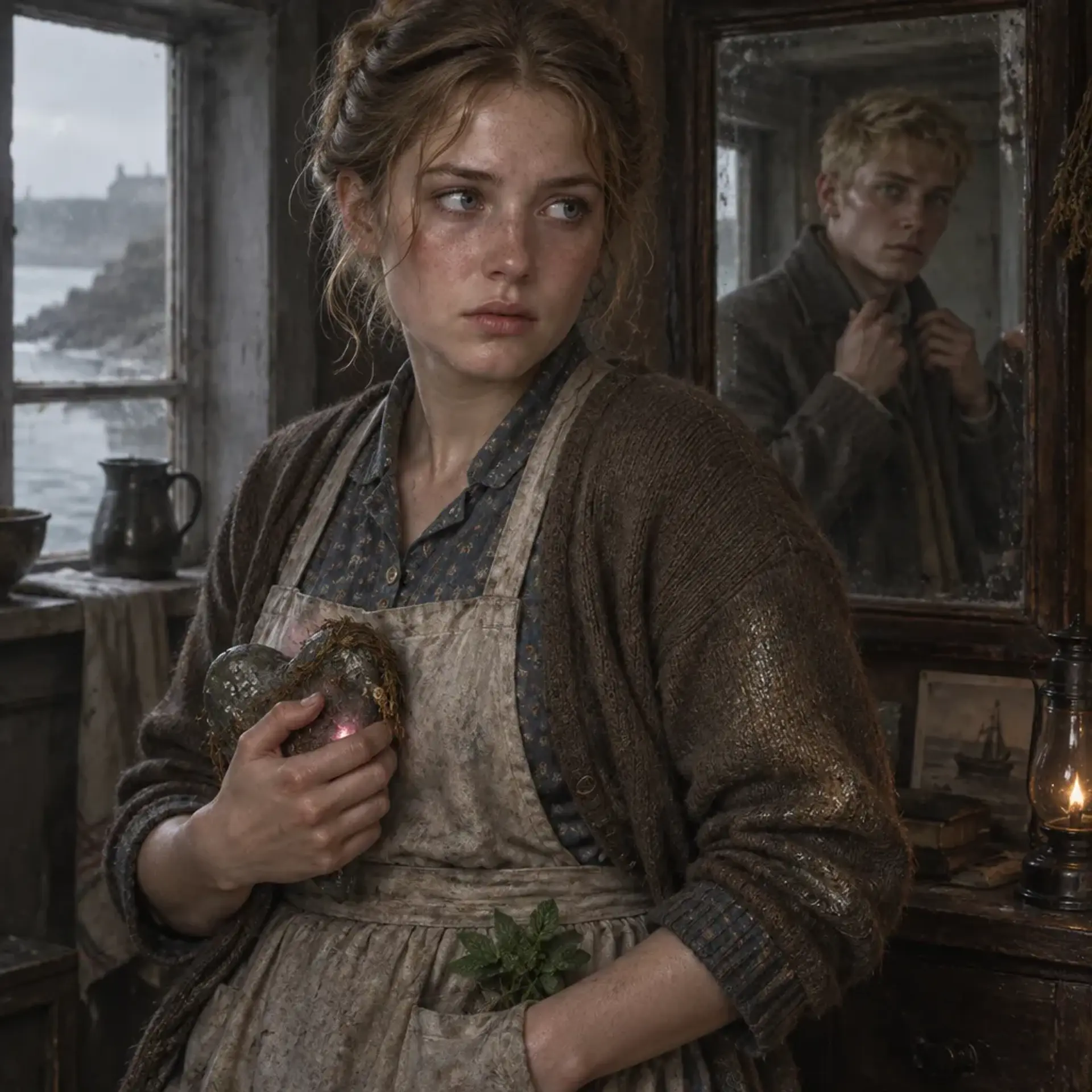
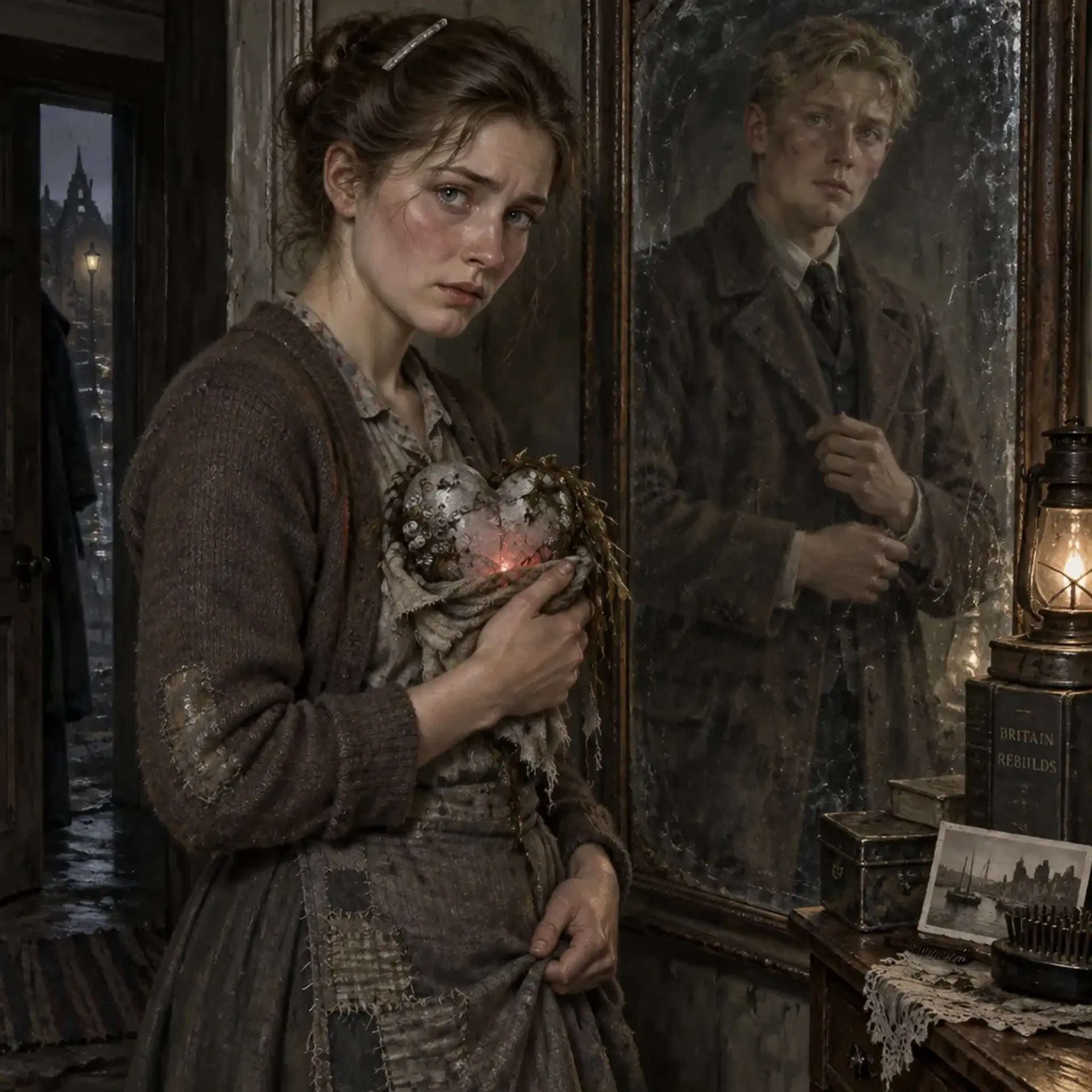
Mary Bell is a young woman with a practical, slightly stooped way of carrying herself, as if listening for the next task before it is asked. Her dark-blond hair is usually pinned up badly, loose wisps catching around her temples; her blue-grey eyes look more alert than rested. When the heart's influence is strong, mirrors show Kent instead: an eighteen-year-old young man, taller and broader in the shoulders, with short bright-blond hair, malachite-green eyes, and a handsome face whose expressions seem to arrive a beat late. The reflected figure holds himself with an awkward, hungry self-consciousness, as if he wants to be noticed and dreads being looked at. Mary's repaired clothes often hang oddly on him. A conspicuous detail: her front teeth are slightly uneven and she presses her lips together when eating in company, while Kent's reflected smile shows an unexpectedly neat, almost formal row of teeth. Both move with the careful economy of people accustomed to making room for others.
Clothing
Mary wears mended skirts, a cardigan shiny at the elbows, and practical shoes; one hairpin is polished and kept in a button tin. As Kent she borrows whatever can be made to fit, usually an oversized coat and badly fastened shirt, with Mary's hems and cuffs betraying the disguise.
Body language
Mary keeps her shoulders angled toward the nearest child or doorway and rubs her thumb along a seam while thinking. Kent stands straighter, but his hands hover uncertainly as if he has rehearsed where to put them. When caught out, he glances toward reflective surfaces rather than toward the person questioning him.
- Height
- Mary is of ordinary height; Kent appears taller than her, though no exact measurement is established.
- Build
- Mary is lean from work and often looks more tired than frail. Kent's reflected form is taller, with a longer reach and broader shoulders, though he moves with conspicuous caution.
- Eyes
- Blue-grey; in reflections occupied by Kent, malachite green
- Hair
- Dark blond; Kent's reflected hair is bright, short blond
- Skin
- Fair, often flushed from work or cold; Kent's reflected skin appears similarly fair
- Age
- 18
- Gender
- Female; Kent appears as a young man in reflections and during the uncanny change
- Size
- Medium
Distinguishing features
Personality
17 traits and drivesMary is capable and tender, but not serenely selfless: she resents being treated as an extra parent, then feels ashamed of the resentment and works harder. With children she becomes briskly warm, making jokes and inventing little games to get chores done. With adults she is guarded and accommodating until someone endangers Matilda or another child, at which point her patience can turn blunt and startling. She is curious about stones and abandoned places, yet dismisses her own curiosity as foolish whenever household demands return. Kent is more shy than Mary, while also craving attention. He offers formal courtesies and waits for approval, then lingers where people can see him. He can be wonderfully attentive to someone else's embarrassment, but his desire to be noticed may make him over-explain or volunteer for things he cannot manage. In the pub, he discovered he wanted to be remembered as kind; that wish pleases and frightens him. Neither Mary nor Kent is consistently brave: each can act boldly when someone else is vulnerable, but both avoid asking for help for themselves.
Quirks
Habits
Traits · 5
Flaws · 4
Fears · 4
Wants and needs · 4
Combat
HP 0Mary avoids violence and looks for exits, witnesses, or a way to protect the children. Kent is reluctant to strike anyone and relies on nerve, deception, or making a scene. No combat procedure is asserted as canonical for Secret Histories; resolve confrontations using the table's chosen rules.
Mary Bell
Actions
Services they sell
Rewards they can give
Equipment
- The supposed fossilized heart (uncanny object)A chalk object carved in the shape of a human heart, crusted with barnacles and sea grass; its behavior is uncanny and not a conventional weapon.
- Repaired everyday clothes (clothing)A worn cardigan, mended skirt, practical shoes, and a borrowed coat when she goes out as Kent.
- Needle and thread (tool)A small parcel of pins and thread used to mend clothes and keep the children presentable.
Possessions
Background
The heart first appeared at the Hush House as a lump of Dover chalk carved roughly into the shape of a human heart, its ridges barnacled and furred with sea grass. Bartholomew Golden, an amateur alchemist, wrapped it in newspaper and offered it as payment for entry. He claimed it was a fossilized living heart, forged from heart and scale, able to bring servants from man's shadow and from chalk cliffs and borderlands. The house barred him from Brancrug afterward. The stone was thrown into the sea. It returned to shore, salt-weeping and smeared with black ooze; beneath its crust something glowed a sickly red-pink. A young Londoner, Abraham Groff, found it and carried it inland to Wiltshire. It beat beneath his coat on the train. At home it fascinated and repelled him. He showed it to neighbors, but in company it went cold and inert. Alone, especially near water, it stirred. Over weeks his house filled with unexplained footfalls, voices, and doors opening onto empty rooms. Abraham sold it to William Windon, a seventeen-year-old local who had seen it before. William hid it in a log and struck it with a hammer; the beating stopped. Years later Malinda Bell found the object in that log and gave it to Mary for her eighteenth birthday. The party was small and distracted. Malinda was often drunk, Simon was away working, and Mary had learned not to expect a present to mean much beyond the moment it changed hands. She kept it because she liked stones and because throwing away a gift felt unkind. At first its pulse seemed to follow her own. Then the mirror began showing a bright-haired young man instead of her. Mary called it a trick of exhaustion and carried on with the work of keeping the Bell household running. Mary is the eldest of eight children in a crowded Rochester home. Her parents, Malinda and Simon, are negligent with each other and unreliable with the children. Simon goes wherever work takes him, sometimes returning unexpectedly; Malinda drinks and can be cruel in the careless way of someone who has stopped noticing what her words do. Mary has become a stand-in parent. She protects Matilda, twelve, from being treated as her replacement; tries to make time for little Oswald, two, who follows her with a blanket; and keeps the others fed and out of trouble when she can. Henry, fourteen, has grown clever and resentful, testing how far he can push Mary. Chrissy, nine, and Olympia, ten, make a close pair. Abigail, four, has red hair and green eyes; five-year-old Jonas and Belladonna have their own complicated places in the household, shaped by Simon's infidelities and Malinda's bitterness. Mary knows the family history through fragments, accusations, and silences rather than a single honest account. The first night Mary became Kent began after a nightmare. She woke in a body that was not hers, staring at her reflection's bright hair and green eyes, with the terrifying sense that her own face had been misplaced. She found the heart warm and beating. By dawn she was herself again. The change did not feel like possession so much as being allowed to step through a door that had always been there. As Kent she could leave the house, explore, and return without waking everyone. She did not think of it as a double life; it was a rare, practical escape from being needed. On the first outing she walked the dark Rochester streets in clothes that did not fit, keeping to the edges of lamplight. She climbed a tree by the river, then explored an abandoned building with broken panes that made every movement seem watched. At the water she felt the heart's beat answer the tide. A watchman called after her; Kent froze, then managed a stilted explanation about being out for air. The encounter left him both frightened and pleased: someone had spoken to him as a person, not a reflection. At dawn Mary returned home, exhausted and exhilarated, with damp hems and a secret she could not name. The house has made the secret difficult to keep. One night Simon came home early from a job, and Mary, then Kent, had to hide in the scullery while Simon searched for a missing coat. Simon noticed the muddy shoes and asked Mary about them the next morning. She lied badly; he was too tired to press her. Another night, drunk and disoriented, Malinda caught Kent leaving. She called him a thief and demanded to know where Mary was. Kent could not explain. Malinda seized his sleeve, then stared at his face as if she recognized something from a dream. Mary eventually got them both through the moment by claiming she was helping a neighbor. The incident made her wary of how easily the heart could turn a private escape into danger. Henry encountered Kent near the river after dark. He did not recognize him as Mary, but he recognized the family coat and followed, curious and suspicious. Henry tried to bluff, then asked whether Kent knew Mary. Kent gave a stiff, overcareful answer that sounded like a schoolmaster's idea of a gentleman. Henry laughed at him and demanded to know what he was doing out. Kent was too proud to run and too shy to threaten him. He offered Henry a cigarette he did not want. In the awkward pause, Henry admitted he had been avoiding home because Simon had promised to take him to work and then forgotten. Kent listened with an attention Mary rarely had time to give. Henry went away unsettled, and afterward he watched Mary more carefully, as though she had somehow acquired a secret friend. Trudy, Mary's short, wiry friend with dirty-blond hair and a self-declared rebel's wardrobe, is the one person who notices how tired Mary is. She helps with the children without making a grand show of kindness. On a later outing she spotted Kent outside a café and recognized the careful, familiar way he kept checking the street for Mary. She did not identify him, but challenged him about whether he was following her friend. Kent tried to be urbane, stumbled over the answer, and ended up carrying a parcel for her. Trudy thought him odd but decent. She told him Mary needed a night off and, without knowing why, asked him to make sure she got one. The pub adventure began when Kent followed the warm pulse of the heart to a public house near the river. He was fascinated by the room's smoky warmth, the clatter of darts, and the ordinary ease with which people occupied space. A man at the bar mistook him for a local lad and asked about work. Kent answered with excessive formality and was teased for it. When two drinkers began mocking a frightened teenager who had dropped a glass, Kent unexpectedly stepped in. He did not fight; he recited, with stiff politeness, the price of the broken glass and offered to pay it from Mary's small savings. The gesture drew attention he had wanted and feared. For the first time, he seemed to form a thought separate from Mary's usual practical calculations: he wanted to be remembered kindly, not merely useful. He told the boy to leave before the men changed their minds, then escaped into the rain, ashamed of the attention and secretly delighted by it. The younger children have also encountered him without understanding. Oswald once followed Kent into the hall, clutching his blanket, and reached up as if expecting Mary to lift him. Kent froze, then carried him back to bed with surprising gentleness. The child fell asleep against his shoulder. Matilda later asked Mary why she had been out of bed; Mary had no answer. Abigail has waved at the mirror when Kent appeared, while Belladonna insists the glass has a boy inside. These small moments frighten Mary more than the grand hauntings because they bring the impossible into the place she is trying hardest to protect. Now the heart is no longer a curiosity she can ignore. Its red-pink glow comes and goes beneath the chalk; saltwater gathers on it even when it has been kept dry. Mary is increasingly afraid that her reflection is becoming less like her and more like Kent. Kent, meanwhile, is shy, eager for company, and possessed of an old-fashioned middle-class sense of manners that does not fit his borrowed clothes or his uncertain place in the world. He wants to explore, to be seen, and to avoid hurting the family whose life he shares. Mary wants the freedom he provides, but not at the cost of losing her own face or making her siblings afraid of her. The heart may be a tool, a visitor, or a hungry inheritance. Neither of them knows what it expects next.
Role in the story
A young caretaker whose uncanny reflection gives her an escape from a difficult home while placing her family and sense of self at risk. She can be an ally, a witness to the heart's effects, or the center of a mystery about the Hush House and the laborers it was said to summon.
“Bartholomew Golden, an amateur alchemist, wrapped it in newspaper and offered it as payment for entry.”
Known connections
Media
0 imagesNo images yet.
Turn Mary Bell into a sheet
A high-res, share-ready sheet you can post or print.