Mary Bell
Mary Bell
At the table
Voice
Mary's voice is clear and work-worn, used to being heard across a room without sounding as though she is making a scene. Years of domestic noise have given it a firm, practical edge. Kent's voice is more deliberate and precisely enunciated, as if he has learned manners from books or overheard conversations and is determined to get them right. He can sound composed while plainly flustered.
Mary's voice is shaped by years of calling over household noise and railway bustle: clear, brisk, and slightly rough at the end of a long day. She clips words when she is working, then adds little apologies she does not always mean. Kent's voice sounds more measured, with careful consonants and a practiced politeness that can make ordinary questions seem like formal inquiries. When surprised, he loses that polish and speaks quickly, with an eager edge he appears to find embarrassing.
Speech patterns
How to play them
Approach Mary with a concrete offer of help rather than a demand for confession. Give her time to assess whether you are safe around her siblings. She responds to honesty and practical kindness, but may test a promise by watching what you do when inconvenienced. Kent is more likely to engage if treated as a person rather than a spectacle, though attention can make him shy and conspicuously eager to please.
Goal
Understand the heart's influence, protect her siblings, and find a way to make room for a life that belongs to her as well as to them.
Motivation
Mary wants the children to have choices she did not have. She also wants a private life, a wish she finds embarrassing when set beside the needs of her family. Kent appears drawn to places and people that invite him to stay, and seems to want acknowledgment as much as freedom.
Appearance
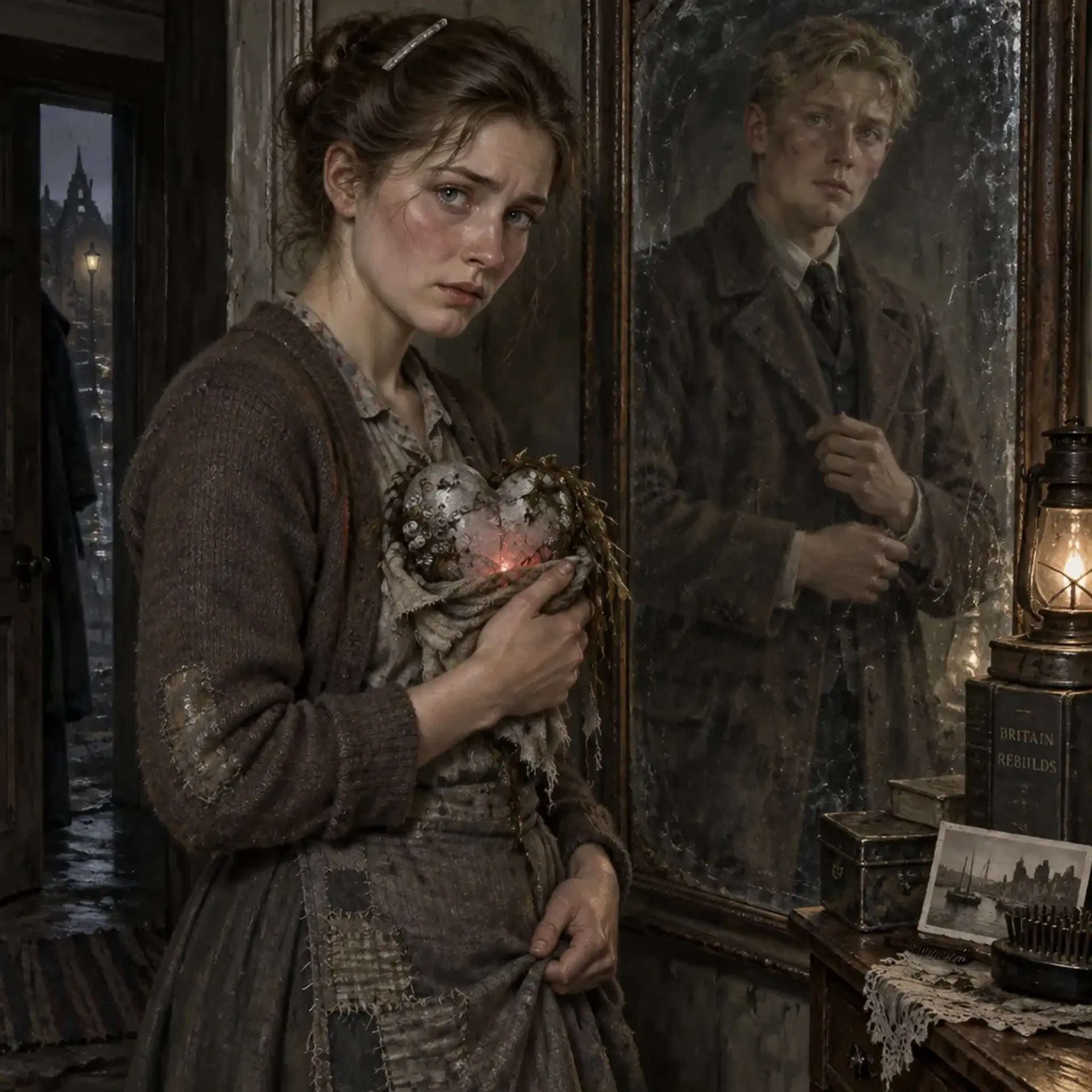
Mary is a young woman with a weathered, watchful look that makes her seem older until she smiles. Her dark-blond hair is usually pinned back in a hurried twist, with loose strands catching on her collar; her blue-grey eyes have the faintly clouded look of someone who sleeps lightly. She moves with a quick, economical step, always angling around people as if leaving a clear route to the door. When she is tired, she hunches as though carrying a basket even when her hands are empty. In a looking glass, her outline sometimes seems to stand straighter and take up more room than she does. The unexpected detail: she keeps a little folded paper packet of sugared fennel seeds in her pocket and offers them to anyone who looks carsick.
Clothing
Mary wears practical postwar clothes repaired at the seams: a plain blouse, cardigan, skirt, sensible shoes, and a coat that has seen too many wet walks. She keeps a scarf and a little sewing kit. As Kent, she assembles borrowed or altered men's clothes that fit badly at first, taking care to avoid anything conspicuously fine.
Body language
Mary keeps her elbows close and moves as if passing through a crowded kitchen, even in open space. She watches doors and other people's hands. Kent stands more upright and seems to take up room by accident, then looks embarrassed when noticed. In either presentation, she rubs her thumb along the side of her forefinger when she wants to disappear.
- Height
- About average as Mary; appears noticeably taller as Kent
- Build
- Lean and wiry from long days of errands and household work, with more stamina than strength.
- Eyes
- Blue-grey as Mary; green like polished malachite as Kent
- Hair
- Dark blond as Mary; bright blond as Kent
- Skin
- Fair, often reddened by cold wind and kitchen heat
- Age
- 18
- Gender
- Female; the appearance Mary calls Kent presents as male
- Size
- Medium
Distinguishing features
Personality
16 traits and drivesMary is resourceful and protective, but not naturally selfless: she resents being needed all the time and then feels guilty for resenting it. She is naive about some dangers because she has had little chance to encounter the world on her own terms, yet she reads moods and household tensions with unnerving accuracy. With her siblings she can be firm, playful, or exhaustedly sharp, depending on how much has gone wrong that day. Around adults she tends to be deferential until someone threatens a child, at which point she becomes startlingly direct. She can be grateful for small kindnesses and suspicious of large promises. She wants adventure but dislikes being treated as foolish for wanting it. Kent is not simply Mary's confidence. He is more shy and more hungry for acknowledgment: he can linger near a group hoping to be invited in, then become flustered when someone actually speaks to him. He has an instinct for middle-class English propriety, fussing over introductions, correct forms of address, and whether he has inconvenienced someone. This formality sits oddly beside a willingness to climb trees, poke around abandoned buildings, or visit a pub on impulse. In a crowd he is cautious, but a moment of welcome can make him talk too much. When mocked, he tries to recover dignity through precise words rather than aggression. Mary sometimes thinks of Kent's impulses as feelings arriving in her own mind, not as a second person giving instructions. That uncertainty makes her both curious and wary.
- Alignment
- Not applicable as a Secret Histories rules statistic. In ordinary terms, protective and practical, with a growing appetite for freedom.
Quirks
Habits
Traits · 4
Flaws · 4
Fears · 4
Wants and needs · 4
Combat
HP 0 · No canonical movement statistic established here; ordinary walking pace, with no special combat movement claimed.Mary avoids a fair fight. She looks for a door, a distraction, a person who might intervene, or an object that can buy her a few seconds. Kent may freeze if directly threatened, particularly when attention turns hostile. These descriptions are narrative guidance, not canonical Secret Histories combat rules.
Mary Bell
Actions
Reactions
Services they sell
Rewards they can give
Equipment
- The chalk heart (uncanny object)A cliff-chalk object shaped like a human heart, rough as a tide-worn stone and occasionally wet with salt water and black ooze. Its claimed powers are unverified; the effects described here are custom fiction, not established Secret Histories rules.
- Mending kit (practical)A needle, dark thread, and scraps for repairing clothes or making quick alterations.
- Fennel sweets (personal)A small packet of sugared fennel seeds, kept for travel sickness and offered to others.
Possessions
Background
Mary Bell was born in Kent and grew up in an isolated household where work was plentiful and care was rationed. She is the eldest of eight children, and long before she was old enough to understand the arrangement, she became the person who remembered meals, school things, clean clothes, and which child needed comforting after a quarrel. Her mother, Malinda, could be affectionate in flashes, but drink and exhaustion often made her unreliable. Her father, Simon, took work far from home whenever he could. Their arguments taught Mary to notice the sound of a key in the door, a change in footsteps, and the difference between a silence that meant peace and one that meant danger. Mary's siblings have never been a simple row of dependants. Henry, fourteen, has become sly and sharp-tongued, resentful of their parents and sometimes of Mary, whose authority he both needs and dislikes. Matilda, twelve, is Mary's closest ally among the children. Mary refuses to let her be quietly trained into taking Mary's place as unpaid housekeeper. Chrissy, nine, is quick to laugh and quicker to spot when an adult is lying. Olympia, ten, is Chrissy's loyal companion. Abigail, four, is red-haired and green-eyed, and Simon treats her resemblance to his grandmother as a small, private delight. Jonas, five, has bright blond hair and blue eyes; Simon brought him home, and Malinda's bitterness over the circumstances has never settled. Belladonna, five, has black hair and green eyes, and her parentage is a subject the family avoids. Oswald, two, follows Mary with his blanket when he can find her. Mary loves them fiercely, but love does not make her tireless. On her eighteenth birthday, Malinda gave Mary a curious object found tucked into a log: a chunk of chalk shaped like a human heart, encrusted with barnacles and tatters of sea grass. It looked like a child's carving left in a tide pool. Mary was grateful for the present, though she suspected her mother had found it more interesting than she had. Before it reached Mary, the object had been wrapped in newspaper and offered as payment by an amateur alchemist named Bartholomew Golden to the people of the Hush House. He called it the Heart of England and claimed it could bring laborers from the shadow of man's heart, from chalk cliffs and borderlands. Golden was never allowed near Brancrug again. The heart was thrown into the sea; it returned to shore, shedding salt water and black ooze, with a red-pink glow under its rock-like crust. It passed through Abraham Groff's hands. Groff, a young Londoner visiting Wiltshire, first showed it to neighbors. In company, its uncanny pulse faded, as if the thing had died. Alone, it beat again. Groff became convinced it disliked guests, and kept it from curious eyes, not out of greed but because he felt it recoiled from being displayed. The house around it grew unsettled: voices where no one stood, doors shifting, steps on empty stairs. Groff sold it to William Windon, a local boy of seventeen who had once struck it with a hammer and found that the blow stopped its beating. William hid it in a log. Malinda found it there and brought it home. For a while Mary treated the stone as an odd present and carried on. Then it began beating in time with her own heart. Her reflection changed first: the image in the glass became a handsome young man with short bright-blond hair and green eyes like malachite. He appeared to be about her age, and at first Mary thought this was a joke or a trick of fatigue. The image did not always imitate her. Sometimes it looked away while she stared. Sometimes its expression seemed to answer a feeling she had not yet admitted to herself. She was too busy to investigate properly. She had started part-time work to help feed and clothe the children, and the family never paused long enough for a private crisis to stay private. Mary's first night as Kent began after a bad dream. She woke with the startling sensation that her body had been replaced, and for several minutes could not make sense of her longer limbs, unfamiliar clothes, or the altered weight of her voice. She found a mirror and saw the young man again, now where she expected her own face. Panic gave way to a practical question: could she get out of the house without waking anyone? She dressed as carefully as she could, borrowed clothes that did not fit, and slipped past the sleeping family. The cold air and the fact of being outside made the fear feel less total. Kent could walk the lanes without being recognized as Mary, and Mary did not yet have language for what that meant. She only knew she could breathe more freely away from the house. The first adventure was not grand. Mary, as Kent, followed the railway line toward the river, crossed an empty yard, and climbed a tree simply because no one had told him not to. He visited the shore and found that wetting the heart brought back its rosy colour. On the way home, he explored an abandoned building with a broken sash window and startled a stray cat from the stairwell. A woman carrying a milk can saw him leave and called after him, mistaking him for a local lad. He answered too formally, then hurried off, embarrassed by his own voice. At dawn Mary returned to herself, exhausted and muddy, with a new knowledge of the town's back ways and a pocketful of small stones she could not remember collecting. The next nights brought less innocent complications. Mary learned to keep a spare shirt and trousers hidden where she could reach them. The changes did not follow a reliable schedule; once, Kent appeared in daylight, forcing Mary to improvise an explanation and retreat to a private place. Bodily surprises made the experience awkward and frightening. Mary handled them with the brisk secrecy she had learned at home, though she had no one she trusted enough to ask for advice. One early morning Simon returned home unexpectedly from a distant job. Mary, already changed as Kent, heard his key and froze in the hall. Simon stopped short at the sight of a young man in borrowed clothes. Kent managed a stiff greeting and claimed to be a visitor who had come to speak with Mary. Simon was suspicious, not because the story was especially convincing, but because he had been away long enough to know how much of the household he did not understand. Mary was able to take over again before the lie collapsed. Afterward, Simon asked Mary who the young man was. She told him she had no idea. It was not entirely a lie. Henry encountered Kent in town. He recognized something familiar in the young man's habits and followed him, then confronted him with the certainty of a boy who has found an interesting secret. Henry asked questions designed to make Kent stumble: where he lived, what he wanted with Mary, why he moved like someone trying not to be noticed. Kent, shy but unexpectedly hungry for attention, answered too much and too formally. He praised Henry's cleverness, which made Henry suspicious, then asked him to keep the meeting private. Henry agreed, but made clear that he expected the truth eventually. Their awkward exchange changed how Mary saw her brother: Henry was not merely a difficult child, but someone capable of choosing what to protect. Malinda's drunken encounter with Kent came on a night when she had been drinking and Mary had slipped out. Malinda came downstairs for water and found Kent near the kitchen, trying to be quiet and failing. She stared at him, then at the heart, and asked whether he was one of Simon's sons. Kent tried to answer with a polite, careful explanation. Malinda laughed, then began to cry, and for a few minutes spoke to him as if he were a guest she had been expecting. She complained about Simon, about the children, and about the way Mary carried too much. Kent listened with an attentiveness that seemed to surprise them both. When Malinda reached for the heart, Kent drew it back. The gesture sobered her. In the morning she remembered only fragments and treated Mary with uncharacteristic suspicion, then with a tenderness she could not explain. Mary's friend Trudy noticed the fatigue and helped her with the younger children. Trudy is short, skinny, hazel-eyed, and proudly calls herself a rebel; her clothes make her stand out in the streets of postwar Kent. She does not know everything, but she knows Mary is keeping something from her. Mary also found that Kent's excursions could be more than escape. He learned the town's rhythms, met people who would never have spoken to Mary in the same way, and returned with impressions that felt partly his and partly hers. The pub adventure was the first time Kent seemed to want something for himself. He entered a local pub near closing, intending only to warm up and listen. A dock worker with a split knuckle assumed he was a young man looking for casual work and offered him a place carrying crates. Kent accepted the conversation more readily than Mary would have, though he kept his shoulders tight and his answers precise. He was captivated by the rituals: the damp wool smell, the wooden counter rubbed smooth by years of elbows, the way people made room for one another without admitting they were doing it. When an older patron mocked his careful manners, Kent's face flushed, but he did not retreat. He asked the man what he thought good manners were for if not to make a room bearable. The table laughed, not cruelly. Kent smiled at the sound, startled by how much he wanted them to keep looking at him. On the walk home, Mary felt a thought that did not seem entirely hers: that a place was made by the people who kept returning to it, even when it was shabby, damp, and unkind. She does not know what to do with that thought. It may be Kent's, or a feeling the heart has stirred in her, or something she has always known and never had space to notice. Now Mary is trying to keep her siblings safe, earn enough money to make the household less precarious, and understand the heart without letting it dictate the terms of her life. The object remains an ugly, salt-weeping lump until it wakes. Sometimes there are footsteps in the house when no one is moving. Sometimes Mary's reflection watches her with an expression she cannot place. She has not told Trudy, Henry, or Simon the whole truth. She is not certain there is a whole truth to tell.
Role in the story
A young caretaker caught between a demanding household and an uncanny second way of moving through the world. Mary can become a grounded ally, a source of local knowledge, or the center of a mystery about the heart and the lives it touches.
“Her mother, Malinda, could be affectionate in flashes, but drink and exhaustion often made her unreliable.”
- Faction
- No known faction. The heart has a history connected to the Hush House and the alchemist Bartholomew Golden.
Known connections
Media
0 imagesNo images yet.
Turn Mary Bell into a sheet
A high-res, share-ready sheet you can post or print.