William Windon
William Windon
At the table
Voice
William's voice comes from a young man's chest and carries a gentle, slightly breathy warmth, sometimes roughened by outdoor work or a recent cold. Wilt's voice uses the same throat but sounds older in its rhythm, deeper without being theatrical, and marked by a firm Wiltshire accent. Before Wilt speaks, William often draws a testing breath through his nose. The sound makes nearby people suspect he is about to object, even when Wilt is only going to comment on the tea.
William speaks in a warm, careful Wiltshire voice, with a habit of qualifying his opinions and apologizing when he thinks he has taken too much conversational space. Wilt's voice comes through the same mouth with a deeper, older-generation cadence and a thicker local accent. It begins with a slight intake of breath, as though the speaker is weighing whether the room deserves an answer. Wilt's name alone carries a clipped, dense sound; otherwise its speech is dry, exact, and often phrased as an observation rather than a confession.
Speech patterns
How to play them
Approach William gently and give him room to answer in his own time. If his reflection begins speaking, do not assume William agrees. Ask which of them is answering, but avoid treating Wilt as a trick or a symptom. William responds to practical help, plant knowledge, and patient honesty. Wilt responds to direct questions, old etiquette, and evidence that someone can keep a confidence. Mentioning the siblings or the war film may provoke a sharp change in posture and voice. William is likely to ask the characters to help investigate the study window and Hector's occult papers, while insisting that his family not be frightened.
Goal
Learn what the Heart of England made Wilt, keep the searching siblings out of his home, and find a way for William and Wilt to coexist without either being erased.
Motivation
William wants a normal life and a future in botany. Wilt wants to remain embodied, avoid its siblings, and understand the modern world without surrendering its own will. Both want the household to survive the coming nights, though neither trusts the other to define what survival requires.
Appearance
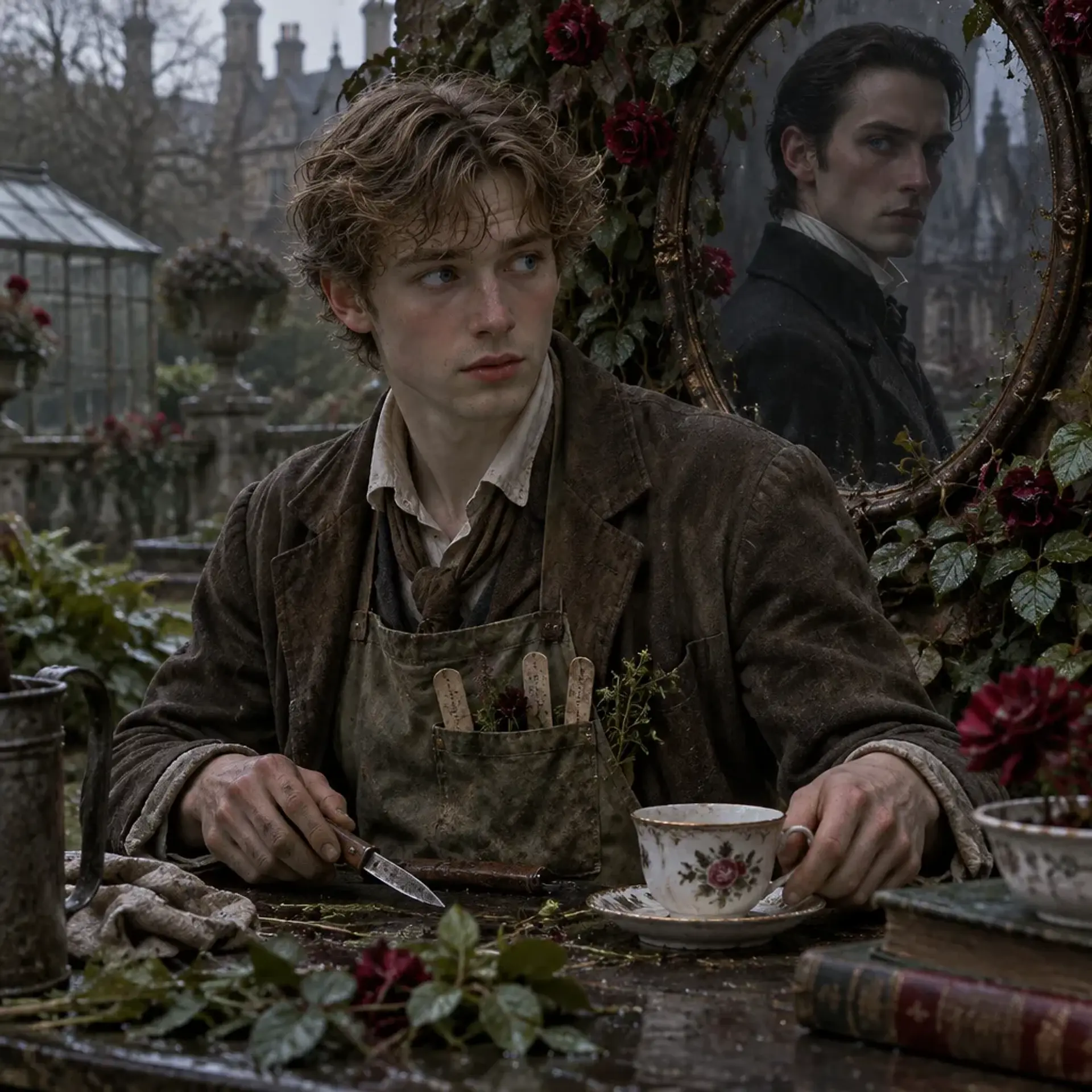
William is a young, fair-skinned gardener with a soft, open face, blue eyes, and dark-blond hair that never stays as neatly combed as he intends. His clothes usually carry the evidence of work: damp cuffs, green smears at the knees, and a clean, faintly earthy smell from the estate gardens. He favors one side when rising from a chair, as if remembering a pain that has mostly gone. His steps are normally light and considerate, but when Wilt is near the surface he becomes unnervingly still, then moves with crisp, economical precision. In glass, still water, and polished metal, the face looking back is taller, long-faced, handsome, stern, and unmistakably not William's. It has blue eyes like moonlight on a pond and short black hair combed back from trimmed sides. The stranger wears whatever William wears, but carries it as if the garments belong to a more formal age. People notice that William sometimes pauses before speaking, drawing a breath through his nose as if testing the air for salt. The unexpected detail is his almost meticulous care for small domestic courtesies: even muddy from the garden, he will arrange a cup and saucer precisely, a habit Wilt enforces with the air of an outraged old host.
Clothing
William wears practical shirts, wool trousers, work boots, and a weathered jacket, often with a gardening apron or a pocket full of plant labels. He tries to keep his hair neat and his clothes clean for visits with Adaline, but the cuffs usually betray his work. Wilt insists on a more exact standard: buttons done properly, collar straight, shoes brushed, and tea clothes treated with formal care.
Body language
William tends to incline toward whoever is speaking and gives people time to finish. He rubs a thumb along his fingertips when anxious, as though feeling for soil that is no longer there. Wilt straightens his spine, lifts his chin, and holds still with a formal, assessing poise. When Wilt is frightened, William's shoulders lock and his head turns slightly, listening to something others cannot hear. Their shared body sometimes makes a movement William did not intend: a hand correcting a collar, a mouth beginning a cutting smile, or a step toward a mirror.
- Height
- 5 feet 8 inches; Wilt's reflected form appears several inches taller.
- Build
- Lean and work-conditioned, with the light strength of someone accustomed to digging, carrying pots, and walking estate grounds. Wilt's reflection appears taller and carries the same body with an unnaturally erect posture.
- Eyes
- Blue, though Wilt's reflected eyes look like moonlight over still freshwater.
- Hair
- Dark blond, usually combed into place; Wilt's reflected hair is black, short, and slicked back.
- Skin
- Fair, with a healthy outdoor flush that can look gray and cold when Wilt is frightened.
- Age
- Adult by the standards of his community, but physically 17. Five months have passed since his heart stopped.
- Gender
- Male
- Size
- Medium
Distinguishing features
Personality
19 traits and drivesWilliam is gentle without being meek. He notices when people are left out, remembers small preferences, and will stay late to help a friend repot a plant or carry a heavy basket. Yet he resents being handled as fragile since his heart stopped. He will accept care from Clare and then bristle when Hector offers it, because one feels like love and the other feels like an assessment. He likes the structure of gardening, the honest answer of a plant to light and soil, but hates being told that his interests are too small to matter. He can be earnest to the point of embarrassment, especially with Adaline, and then unexpectedly stubborn if someone laughs at his plans. Wilt is not a simple villain or a second personality that can be dismissed as a symptom. It is a person with its own fear, pride, preferences, and unknown history, forced to experience the world through William's senses. It is formal where William is casual, severe where William is forgiving, and curious where William is cautious. It corrects William's grooming and table manners with the confidence of a household authority, then steals alcohol and food with the shamelessness of a bored teenager. Wilt claims to despise impropriety, but enjoys movies, machines, and sneaking into places where it does not belong. It is capable of cruelty, particularly when it thinks someone is foolish or rude, but has shown tenderness in brief, uncomfortable gestures. Its reluctance to insult Clare and its embarrassment at being seen bathing suggest rules of feeling it refuses to explain. They pull against each other constantly. William wants to be kind; Wilt wants to be safe. William wants to tell his family the truth; Wilt believes speaking too freely will summon its siblings. William sees Adaline as someone he loves; Wilt sees her as “interesting,” and does not understand why that word feels like a threat. When they are calm, their arguments have the intimacy of people who know each other's habits too well. When danger approaches, their shared body becomes a battlefield: William pushes toward the door, Wilt pulls away from the window, and neither can be sure which impulse belongs to fear and which to instinct. In company, William tries to seem ordinary. He asks questions, listens, and makes a small joke if he senses tension. If his reflection is visible, he may glance at it as though checking his appearance, while actually negotiating. Wilt sometimes lets William speak, but interrupts when it considers his phrasing weak or his manners unacceptable. It can be charming in a dry, old-fashioned way, especially when discussing books, tea, history, or the workings of a machine. It can also make an unkind remark and then look genuinely puzzled when the room turns cold. In private, William is more candid and sometimes angry. Wilt is most conversational at bedtime, when the house is quiet and there is no audience to impress. The war film exposed a depth of distress neither of them had acknowledged. Wilt's sudden loss of control was not theatrical. It was a traumatic reaction to sounds and images that seemed to belong to a memory. It avoids similar films now, though it will not admit that avoidance is fear. William wants to understand what happened; Wilt fears that remembering too much will make the siblings find it. After the episode, Wilt offered an apology and a memory as consolation. William accepted neither fully, but he kept the memory close. Their trust grows in such awkward exchanges, never in declarations. William's humor is self-effacing, often aimed at his own awkwardness. Wilt's humor is dry and pointed, and it enjoys provoking William when he is trying to act composed. Drunken Wilt was louder, playful, and almost companionable, which William found both funny and alarming. The morning after, shame and domestic consequences returned. The contrast matters: Wilt can be sociable and curious, but its ordinary warmth is hidden beneath rules and fear. His relationship with Hector is now a careful contest of observation. William knows his father is watching. Hector notices unexplained movements in the study and William's strange knowledge. William notices Hector's questions, his pauses, and the books he leaves open. Neither has named the suspicion. Hector's contempt for old systems sits uneasily beside his occult affiliations and his desire for an intellectually impressive son. William is both hurt by that contradiction and tempted to exploit it. Wilt finds Hector's manners inconsistent and has already delivered one cutting remark that earned William extra work. William knows that Wilt's wit can do real harm, but he is also relieved when it says aloud what he has never dared say. Clare is the household's steadier center. William can garden beside her without explaining every silence. Wilt answers her scripture with strange passages and does not mock her faith. That restraint comforts William more than he admits. Elizabeth is less safe because she enjoys testing the boundary between her brother and the reflection. William loves her, but her jokes can feel like an interrogation. He fears she will discover enough to become a target for the siblings, or that she will tell Hector at the wrong time. Wilt's strongest impulses are protection and self-preservation, which are not always distinguishable. It has locked William under the bed to keep him quiet, stolen a knife, and concealed supplies. It has also let him drink the hidden sloe gin when they were trapped in darkness. Wilt can be selfish, but its fear is real. It speaks of siblings as a weather front or a tide because naming them directly seems to make them nearer. It calls them “outside” even when William cannot see them. Its face in the mirror remains composed until the siblings approach; then its mouth tightens and its eyes seem to look past William toward a point behind the glass. The moonlit night changed William's understanding of their arrangement. Before, he thought Wilt's greatest danger was taking control of his body. Beneath the bed, with the moon laying a pale stripe across the room and the smell of salt and black ooze seeping in, William understood that Wilt was also afraid of being found. Wilt's warning was not an attempt to dominate him for its own sake. It was a plea made in the only way Wilt knew how: by holding the body still and ordering him to be quiet. William still resents the forced silence, but he no longer believes Wilt is merely using him. In the morning, seeing Wilt still present in the mirror brought no relief so much as a temporary truce. William asked its name, and Wilt answered. The admission was small, but it gave William a person to address rather than a phenomenon to fight. They have not become friends. William still wants the heart removed, Wilt still wants to remain, and both know that the siblings may make those questions urgent. Their growing familiarity is a fragile arrangement, punctuated by arguments over tea, shaving, Adaline, stolen food, and whether Hector is about to discover the damaged window. When relaxed, William is affectionate, curious, and easy to draw into conversation about plants or the estate. When embarrassed, he turns pink and fiddles with his cuffs. When angry, his words become more direct, though Wilt may lend them a sharper edge. Wilt's anger is less an increase in volume than a sudden certainty: it names the insult, identifies the person responsible, and proposes a response with alarming speed. Its fear, by contrast, makes William's body cold and still. Both can be surprised into laughter. They have laughed together over television and over Wilt's drunken argument, then disagreed about whether the laughter meant anything. A player character may meet William during daylight, where he is trying to return to normal work, or encounter Wilt's face in the hallway after midnight. The same body can be hospitable and unsettling, apologetic and imperious. The key to understanding him is to ask what he is trying to protect at that moment. William protects his family, his freedom, and the possibility of a future. Wilt protects its continued existence and the secrets attached to the heart. Sometimes those are the same thing. Sometimes they are not.
- Alignment
- Neutral, with William's compassion and Wilt's severe, self-protective pragmatism pulling in different directions.
Quirks
Habits
Traits · 4
Flaws · 5
Fears · 5
Wants and needs · 5
Combat
AC 13 · HP 32 · 30 feetWilliam tries to avoid a fight, using cover, retreat, and appeals to reason. If trapped, he uses a gardener's knife defensively and aims to create an opening to escape. Wilt is more decisive but not a brawler; it uses Salt in the Ear to break an enemy's focus, then moves William toward a doorway or protected position. Wilt will take control when it believes the siblings are near, when William is threatened, or when a trigger evokes its violent memories. It dislikes paranormal opponents and may hesitate rather than attack a creature it recognizes as kin.
William Windon
Actions
Reactions
Services they sell
Rewards they can give
Equipment
- Gardener's Knife (weapon)A small, well-kept gardening knife, used for pruning and carried more often than William admits.
- Gardening Clothes (clothing)Work clothes, heavy boots, and a jacket with pockets Wilt uses for concealed odds and ends.
- Pocket Mirror (tool)A pocket mirror William carries to check whether Wilt is present before he speaks in public.
- Hand Torch (tool)A small torch for checking the hall, cellar, and study without waking the household.
- Under-bed Stash (supplies)A few hidden tins of food, sweets, and a bottle Wilt insists is apple juice.
Possessions
Background
William Windon was born in Wiltshire to a family whose roots in the county reach back through generations of parish records, family stories, and land that changed hands without ever quite changing its local names. He grew up in a house where his father, Hector, treated history as an argument to be revised and his mother, Clare, treated daily care as a form of faith. William was a warm, sensitive boy, inclined to take another person's embarrassment seriously and more interested in plants than in proving himself clever. Hector wanted his son to pursue intellectual work, but William's fascination with gardening seemed to him a modest ambition. William, in turn, learned from Hector both a suspicion of rigid class customs and a tendency to mistake dismissiveness for open-mindedness. Hector is a historian, an articulate critic of old hierarchies, and a man who speaks readily about the folly of inherited privilege. He is also a member of a private occult circle, a fact he has kept from Clare and the children. His father, remembered in the family as Bobby, was a fierce veteran of the Second World War. Hector resists the old man's glorification of wartime conduct and dislikes being treated as the keeper of a national legend. That conflict has made him prickly about patriotism, class, and anyone he thinks is being sentimental about the past. He was proud when William studied seriously, then disappointed when the boy chose botany over the kinds of historical and intellectual pursuits Hector considered substantial. Their disagreement rarely becomes a clean argument. Hector makes a cutting remark, William withdraws, and each later insists the other was being unreasonable. William's mother Clare has always been more quietly dependable. She reads books and the Bible while he works in the garden, bringing him tea and snacks and allowing silence to be companionable rather than a test. William has found that Wilt will answer some of her Bible passages with quotations of his own, though the references are often obscure and delivered as if they described weather, tides, or the behavior of a forge. Wilt does not insult Clare. William cannot tell whether that restraint comes from respect, fear, or a feeling the reflection cannot name. His sister Elizabeth is younger, perceptive, and delighted by any chance to unsettle her brother. She asks about the boy she likes, Romy Brock, and about clothes, manners, and what looks nice. She has discovered that certain questions make William hesitate or answer in a way that does not sound like himself. She calls the difference brain damage, partly as a joke and partly because she knows no safer explanation. She has not been told what happened to the heart. When Wilt responds directly to her, Elizabeth treats it as another oddity to prod, though she has begun to watch William's face more carefully afterward. The first turning point began with a visitor to the Hush House, a place whose name has survived locally though no one agrees on its origin. Bartholomew Golden, an amateur alchemist, had tried to enter Brancrug and was never allowed near it again. As payment for his brief admission to the Hush House, he left a newspaper-wrapped object he called the Heart of England. He claimed it could bring servants from humanity's shadow, born of the hearts of chalk cliffs and borderlands. It looked like a rough piece of Dover chalk carved in the shape of a human heart. Barnacles and sea grass clung to its uneven surface. It was a strange gift, and no one who handled it knew whether Golden meant a warning, a joke, or a genuine explanation. The heart was thrown into the sea. It washed back ashore, gray and waterlogged, with black ooze leaking from its crevices. Beneath its chalky surface, a muted red-pink light returned, like blood seen through thin skin. A young man named Abraham Groff found it and carried it home. The heart beat beneath his coat after he boarded the train. Abraham was from London and found the object repulsive, but could not stop studying it. When he showed it to neighbors, it seemed to die in their presence. After weeks of inactivity, he took it to a shore in Hampshire and dropped it into the water. Its inner color returned. Abraham decided it was special, and that it belonged to him. He did not keep it from others out of ordinary greed. He felt that the heart disliked company. The house around Abraham grew strange. Voices spoke in rooms where no one stood; doors moved; footsteps crossed the hall and climbed the stairs. The heart wept salt water. Abraham eventually sold it to William, then a local youth who had been among the people who saw it appear inert. William was proud of his curious purchase until he felt its pulse in his own chest. He began to taste ocean water, blood, and soil. Believing it a rock that could be broken, he struck it with a hammer. Pain flared through his chest. He fell, groaning in a voice that was not his, and saw a muscle twitch beneath the stone for an instant before he himself seemed to stop. He woke with Clare's hands on his face. His heart had stopped. William hid the heart in a hollow log. It looked cold and pristine after the blow, despite the force of the hammer. In the days that followed, his reflection ceased to be his. It showed a stern young man with a long face, carefully maintained black hair, and moonlit blue eyes. At first the reflection merely annoyed him, turning its expression severe while William groomed himself or moving out of step. Then it spoke through William's mouth: “Well, it's not often you use that one.” Its voice was deeper, its accent belonged to an older generation, and it sounded as if it had been waiting a very long time to comment on William's habits. The reflection came to have its own preferences. It criticized his clothes and hair, objected to bad manners, and made inappropriate remarks about family and neighbors when it thought no one else could hear. William once had to muck out a neighbor's stable after Wilt used a slur about the Welsh neighbor's child, who had accidentally bumped him with a toy wagon and then cried while apologizing. William was horrified by the insult and by the fact that Wilt had used his mouth. He was also frustrated that Wilt could sound so certain of its own judgment and so indifferent to the hurt it caused. The first time William's friends Tommy DeHare, John Mollask, and Ryan O'Leary visited, the reflection reacted to them physically and spoke without relying on the glass. William learned it was not a trick of mirrors. The experience made him cautious with Adaline, his auburn-haired girlfriend with soft brown eyes. Wilt saw her and became openly interested. William had never expected his hardest romantic competition to be a stranger who wore his clothes and used his face. Wilt calls Adaline “interesting,” which is not reassuring. William returned to work as a gardener for a local estate and continued training toward becoming a botanist. His recovery was slow. At one point he woke cold and shivering and went into the hall with a small light. When he spoke to Elizabeth, the words came out in Wilt's voice and accent. On another night he fell asleep near a private fireplace in the study after feeling unusually cold. Hector found him there in the morning, with the strange look of someone who has recognized a problem without deciding how to name it. The war film was worse. When it played on the television, William lost control of his body. Wilt reacted as if the images had opened a door into a memory of violence. William screamed and cursed, fighting against his father's attempt to hold him still. Clare and Hector thought his heart had failed again. Elizabeth changed the channel and watched with wide-eyed concern. When William regained control, Hector looked at him differently. Wilt later offered a mumbled apology and a fragment of memory in explanation. It was not a tidy confession. It was a sensation of noise, metal, orders, and a terror that had no clear date. William does not know whether the memory belonged to Wilt, to the heart, or to something older that the heart carried. The reflection enjoys books and television, especially stories about machines, journeys, and old conflicts, but avoids some war films and people whose presence triggers its distress. It is fascinated by cars and electronics, which it describes with the curiosity of someone encountering unfamiliar tools. It sometimes moves William's body toward a screen without asking. Bathing is awkward because the water shows Wilt. Both William and Wilt are prudish enough to resent the situation, although Wilt has occasionally taken over the task of grooming when William is too embarrassed. Wilt comments sarcastically on William's body but takes shaving and hair care seriously. William once felt Wilt blush, a moment that made the reflection seem less like a parasite and more like an uncomfortable person trapped in a shared life. One night, after Hector left scotch and bourbon for William's health without understanding who would drink it, Wilt became drunk. It argued, teased, yelled, and sang as if they were in a pub together. It took off William's shirt in a gesture of rebellion, though they agreed that going farther would be too much. When William asked whether Wilt was the stone, Wilt scoffed and said, “Dad isn't here.” William was ashamed the next morning when Clare found the empty bottle. Hector first shouted, then shifted into quiet offers of household tasks, as if work might restore order. Clare began setting regular times for William to go out with her and garden. The steadiness helped. Five months after his recovery, William has returned to the estate and become more practiced at keeping ordinary life intact. His father, however, has grown suspicious. Hector notices William's pauses, his changed diction, his uncanny knowledge of historical details, and his unexplained interest in the study. He is already involved in an occult circle and has begun to wonder whether his son is connected to something he has encountered through that secret life. He does not know about the stone's origin, and he does not know that William has found hints of his private occult work while searching the study at night. Hector's suspicion is not yet open accusation. He watches William during tea, asks questions that sound casual but are too precisely phrased, and sometimes leaves a book open to see whether it has been moved. His liberal contempt for inherited manners clashes with Wilt's strict, old-fashioned rules at the table. Their arguments make the household feel smaller. The worst change began on a cold night when William woke unable to move. Wilt spoke quietly through his mouth: “My siblings are outside. They're looking for me. Go back to bed.” It clamped William's mouth shut when he tried to answer. Through the walls came broken words, including “Wilt” and “there.” William fought to speak, and for one moment he heard himself produce a thick Wiltshire accent. Wilt rolled the body from the bed and dragged it beneath the frame. William felt another face under his hand when he reached up to touch himself. He would have screamed if Wilt had not held his mouth closed. Wilt said that the more it spoke, the greater the chance its siblings would find them. William asked, “Your siblings?” They remained beneath the bed for what felt like hours. Moonlight crossed the floor, exposing the dust and the hem of William's hanging blanket. Somewhere beyond the house, a presence moved through the night without footsteps. William could smell salt water, wet grass, and black ooze. Wilt's body, William's body, remained rigid with a fear that was not entirely William's. The moon made the room look ordinary, which somehow made the waiting worse. William tried to reach for the knife he had tucked away, but Wilt let him. That small permission unnerved him more than the restraint. He found a bottle of sloe gin hidden beneath the bed, disguised as apple juice, and drank while keeping watch on the dark. Wilt had stolen it from a neighbor at some earlier time. William could not remember when. Eventually exhaustion took him. He woke on the floor beneath the bed, crawled out, and went straight to the bathroom mirror. Wilt was still there. William pressed his palm to his own cheek and felt his own familiar face again. Wilt said, “See, you're fine now,” with an oddly plaintive gesture. It refused to explain what the siblings had said or why they were searching. William argued, then went outside. The ground smelled of salt water, damp grass, and black ooze. This time he forced himself to keep looking, even as he felt Wilt's fear tighten his shoulders. That morning, he asked if its name was Wilt. After a long pause, it said yes. Wilt has since admitted that it has siblings, and that there are more than the five that have appeared nearby. The five are the ones currently searching the house and its grounds. They pass at night, trying to draw Wilt into a tangible form. William locks doors and windows, including the bedroom window on the second floor. A damaged study window concealed behind a bookcase is especially dangerous. Hector sealed it shut, though William does not know how securely. Sometimes a draft brings the smell of blood and salt, and sometimes it carries the scent of a meadow. Wilt says little about the siblings, describing them as if they were weather, a change in the tide, or a forge becoming too hot. William now haunts his own home in Wilt's face. During the night, when the family sleeps, Wilt's features and posture settle over him. He moves through the corridors with a light, checks the locks, studies Hector's occult notes, and looks for evidence of how the study window was sealed. He avoids looking through windows. He keeps doors closed, tries not to wake Clare or Elizabeth, and listens for voices outside. His father has begun to notice disturbed dust, the shifted bookcase, and the different way “William” walks when seen in the hall. William needs the information hidden in Hector's study, but every visit risks making Hector more certain that something is wrong. Wilt wants to keep the siblings out and refuses to say whether it fears them because they might destroy it, reclaim it, or remind it of what it was before the heart gave it a face.
Role in the story
A troubled ally and living mystery whose home has become the front line of a supernatural search. William can guide characters toward the origin of the Heart of England, while Wilt's fear and divided loyalty complicate any attempt to destroy or remove it. The household offers interpersonal stakes, and Hector's growing suspicion gives the characters a ticking social danger alongside the siblings outside.
“Hector wanted his son to pursue intellectual work, but William's fascination with gardening seemed to him a modest ambition.”
- Faction
- No formal faction. William has indirect ties to the estate where he gardens. Hector belongs to a secret occult circle, but William has not joined it.
Known connections
Media
0 imagesNo images yet.
Turn William Windon into a sheet
A high-res, share-ready sheet you can post or print.