Oru
Oru
At the table
Voice
Oru's voice has the dry rasp of breath passing over a throat accustomed to dust and river wind. Their consonants land cleanly, like a staff set on stone, while their vowels stretch slightly in the river dialect. When rattled, their breath catches for one beat and a faint click follows at the back of the throat; they do not disguise it or explain it.
Oru's sentences are plain, carefully paced, and built around concrete comparisons. They rarely raise their voice to dominate a room; instead, they repeat the exact point at issue until evasion becomes awkward. Their words carry old river terminology and occasional measures of distance or time. When speaking of Ishnari, they use the past tense without euphemism.
Speech patterns
How to play them
Oru offers practical help before asking for trust. They let people finish, identify who will bear the consequences of a proposed choice, and avoid issuing commands. They respond warmly to honest uncertainty and coolly to certainty used to excuse harm. If asked for a miracle, they ask what ordinary work the petitioner is willing to do alongside it.
Goal
Prevent the Silt Reach dam from transferring danger onto downstream settlements, while helping Tavi choose whether and how to reveal the falsified survey.
Motivation
To preserve continuity without confusing it with mere survival, and to learn when intervention is wiser than patient witness.
Appearance
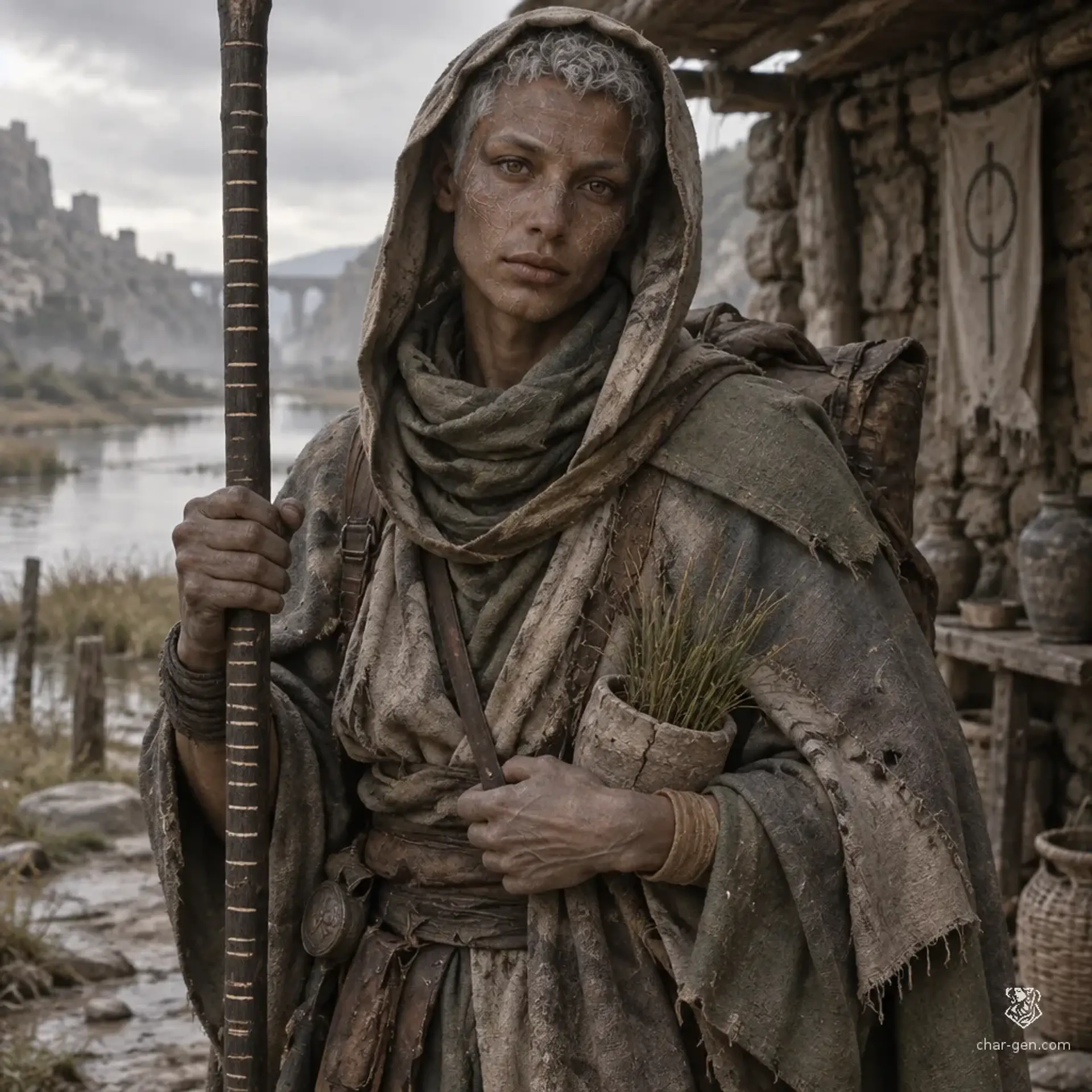
A slender traveler whose face changes by degrees with every passing hour: the brow eases, the mouth lengthens, a shallow crease migrates beside one nostril. The changes are subtle enough to invite a second look, yet too steady to dismiss as fatigue. Their skin has the dry, finely crazed texture of river clay after a long drought, and wind has left faint pale tracks across the bridge of their nose. Oru walks with a staff held vertically, placing each foot as if testing a floor for its true level. Their breathing is normally slow and unremarkable, but when startled it catches for one clean beat, then resumes with deliberate care. An unexpected detail: Oru keeps a tiny, carefully tended pot of sour marsh grass tucked inside their travel cloak, and will stop in the middle of a divine pronouncement to check its soil.
Clothing
A layered, dust-colored travel coat patched with cloth from several regions, a weatherproof shoulder mantle, and soft boots built for mud rather than speed. The hems are marked with tiny, practical repairs. Nothing is ceremonial except the staff, and even that looks like a tool first.
Body language
Oru stands as though balancing a pole across their shoulders, even when carrying nothing. They turn their whole body toward whoever speaks, rarely fidget, and set the notched staff down with careful precision. Anger does not make them loom; it makes their breathing hitch once and their jaw work as if finding a level surface. Their face continues its hourly drift regardless of the room's mood.
- Height
- 6 feet 2 inches
- Build
- Slender and long-limbed, with the wiry balance of a traveler accustomed to crossing slick stones.
- Eyes
- Muted brown with a fine ring of amber that seems to shift as their face changes.
- Hair
- Pale gray, worn close to the scalp and usually hidden beneath a travel hood.
- Skin
- Warm gray-brown, dry-textured like river clay in late summer, with pale wind tracks over the nose and cheekbones.
- Age
- Older than recorded calendars; their face changes by the hour, not by age.
- Gender
- Not applicable; Oru is an outsider deity and does not claim a mortal gender.
- Size
- Medium
Distinguishing features
Personality
13 traits and drivesDetached but not cruel, Oru regards rage as weather and mortal rebellion as a long season. They can seem distant when others want immediate reassurance, yet notice small practical needs and quietly meet them. In calm discussion they invite competing views; when a vulnerable person is in immediate danger, their deliberation ends without ceremony. They mourn Ishnari with the steady habits of someone who expects grief to endure.
- Alignment
- Neutral, devoted to patience, continuity, and measure rather than mortal law.
Quirks
Habits
Traits · 4
Flaws · 3
Fears · 3
Wants and needs · 3
Combat
AC 22 · HP 420 · 40 ft.Oru prefers to stop a fight rather than win it. They use Mark the Interval to contain a dangerous aggressor, Long Season to break a coordinated advance, and their staff to push combatants away from vulnerable bystanders. They avoid pursuing fleeing enemies and offer a clear chance to withdraw. If a foe threatens a community or a sacred site, Oru becomes immovable and uses their restorative power to keep defenders standing.
Oru
Spells
Actions
Reactions
Legendary Actions
Services they sell
Rewards they can give
Equipment
- The Notched Staff (custom divine implement)A straight, dark staff marked with evenly spaced notches. It serves as a walking aid, measuring tool, and divine focus.
- Marsh Grass Pot (personal keepsake)A chipped travel pot containing tough marsh grass. Oru replaces the soil and water whenever the plant needs them.
- Road Clothes (clothing)A weatherproof mantle and layered travel clothes, repaired repeatedly with cloth from places Oru has visited.
Possessions
Background
Oru was once worshipped at a chain of river shrines whose keepers measured flood seasons with notched poles. Their closest companion was Ishnari, a mortal keeper who argued that a measurement mattered only if it helped someone survive. When a ruler ordered the river gates held shut to preserve a wealthy valley's harvest, Ishnari broke the gates open and drowned the ruler's granaries to save the downstream villages. Oru watched the decision unfold and did not intervene until the water had already taken Ishnari. That delay became the wound at the center of their long patience. Oru has mourned Ishnari ever since, without claiming that grief will end or that the choice was wrong. In the centuries afterward, the old shrines thinned into roadside shelters. Oru now travels between them, maintaining their marks and listening to people who mistake endurance for consent. They are currently trying to prevent the Silt Reach, a floodplain community, from rebuilding a dam that will protect its present fields by displacing three smaller settlements. The local surveyor, Tavi, has found evidence that the proposed measures were falsified. Oru wants Tavi to speak openly, but will not force the mortal to do so.
Role in the story
A powerful but restrained witness who can guide a party through a dispute about risk, fairness, and the consequences of waiting. Oru offers aid without solving the moral problem for the characters. Their history with Ishnari mirrors the campaign's central question: when is patience a virtue, and when is it a failure to act?
“Their closest companion was Ishnari, a mortal keeper who argued that a measurement mattered only if it helped someone survive.”
- Faction
- Oru is the patron and caretaker of scattered river-measure shrines, but claims no authority over their keepers. They oppose the Silt Reach dam proposal without formally joining either side of its dispute.
Known connections
Media
0 imagesNo images yet.
Turn Oru into a sheet
A high-res, share-ready sheet you can post or print.