Pieter Goldwater
Pieter Goldwater
At the table
Voice
A clear, slightly rasped voice with the dry catch of a throat accustomed to workshop dust and hot metal. It has a faint breathy edge when his wings ache, and he often takes one measured breath before speaking to a stranger. His volume stays steady when angry; the change is in his pacing, which turns brisk and exact, like a craftsman listing faults in a badly fitted part.
He speaks with the clipped clarity of someone used to calling measurements over workshop noise. His breath catches faintly before he says his own name, a habit that began when people first started staring at his wings. He uses plain words, precise craft terms, and comparisons to tools or fittings. When anxious, he over-explains the practical details; when furious, his sentences become short and blunt, with no softening or apology.
Speech patterns
How to play them
Approach him as a young adult rather than a curiosity. Ask before touching his wings or tail, and do not assume he wants a cure or a public celebration. Earn his trust by being direct about risks and by treating his siblings as people with their own choices. He responds well to practical help, honest questions, and anyone who respects his craft.
Goal
Build an honest life as a craftsperson, document the Aureate Turning on his own terms, and make sure Anji and Nils are allowed to choose how they face their changes.
Motivation
Pieter wants his body's changes to be understood as inheritance, not treated as a family disgrace. More than anything, he wants to protect his siblings without repeating the same controlling fear that hurt him.
Appearance
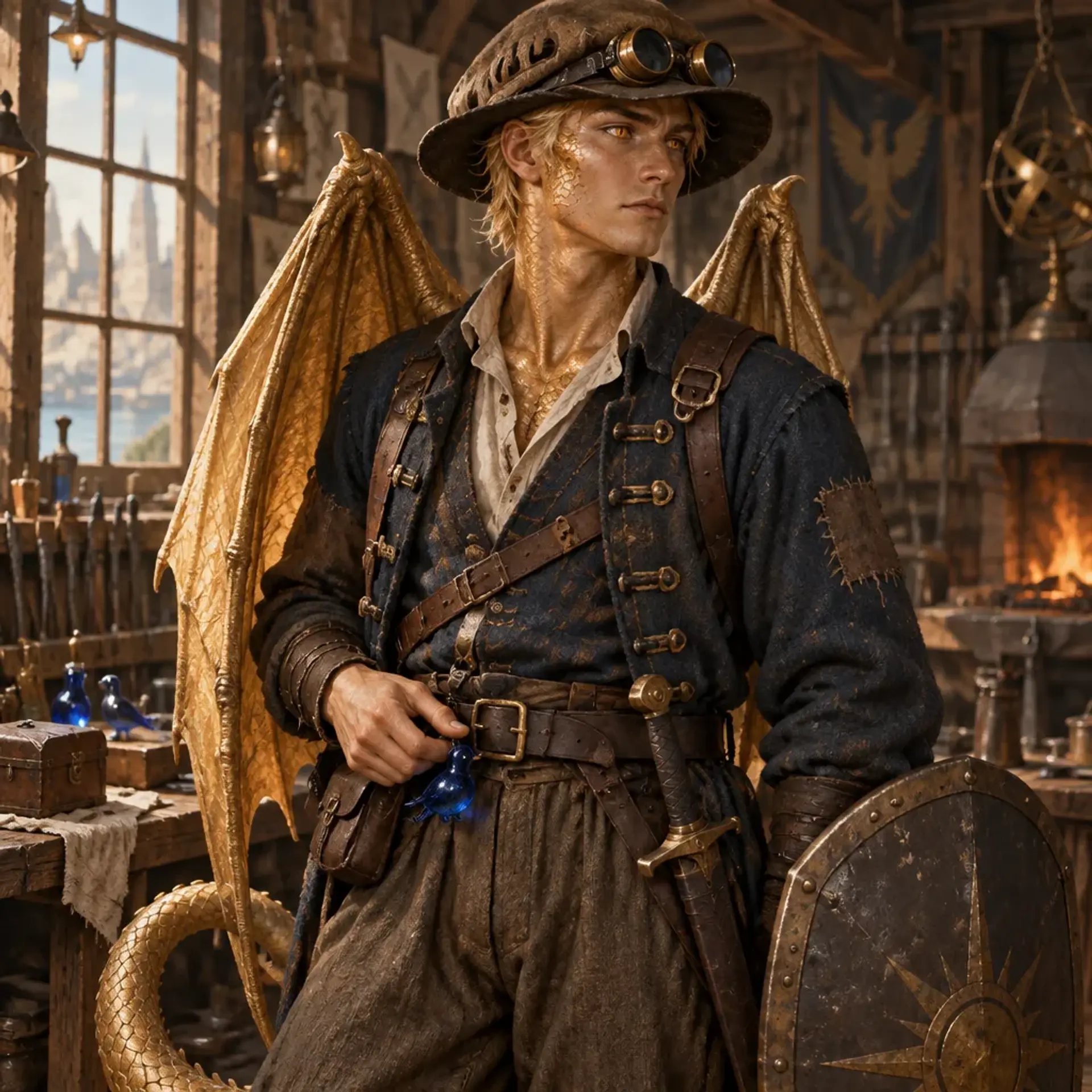
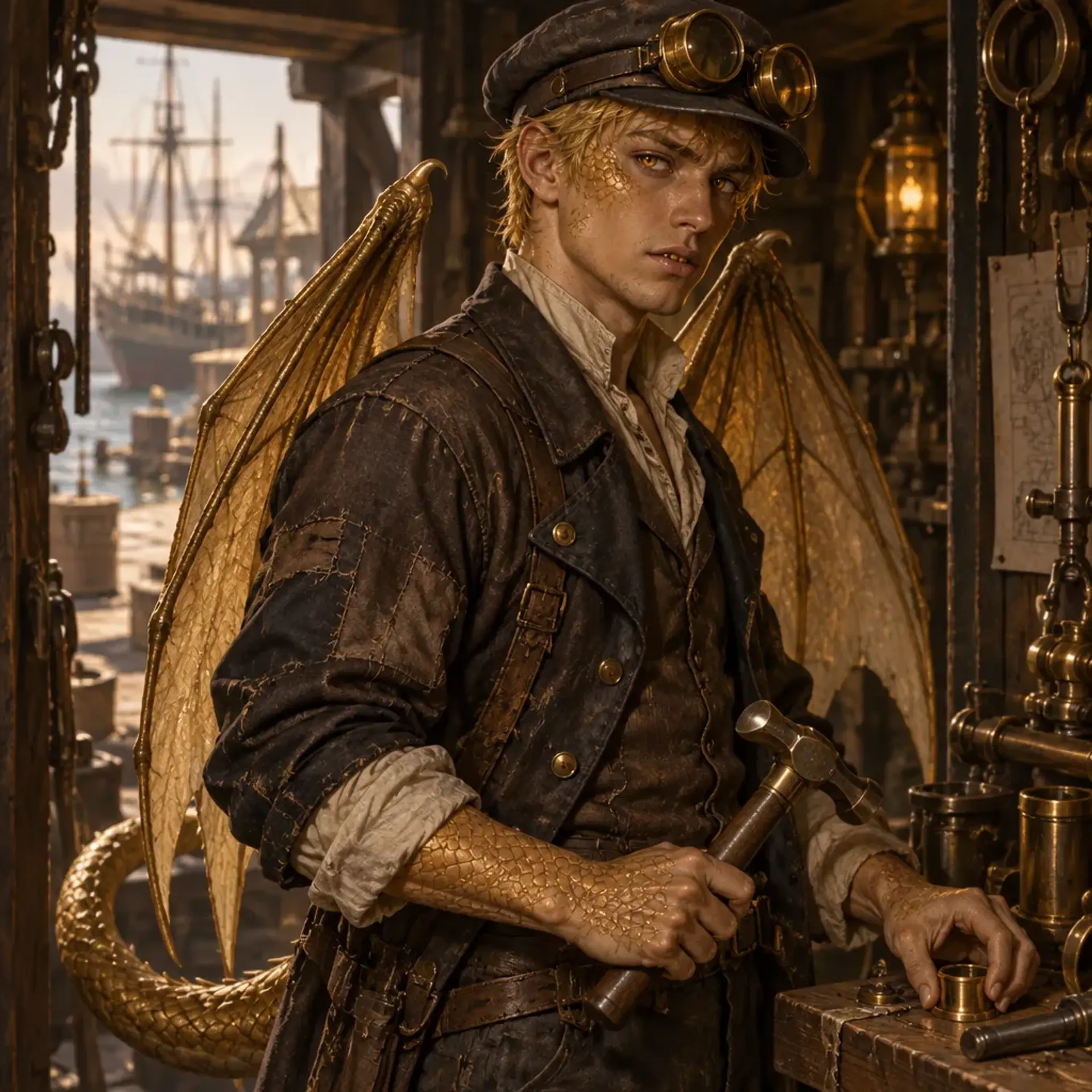
Pieter stands a little over six feet, long-limbed and newly grown into a body that still seems to be catching up with itself. Fine gold scales lie close to his skin along his temples, shoulders, ribs, and the backs of his hands, more like hammered leaf than reptile hide. A pair of broad, gold-skinned wings rise from his shoulder blades, their thin membranes webbed with darker veins; they fold badly beneath a coat and are usually held half-open to keep their joints from aching. His long tail sways behind him with a deliberate counterbalance, occasionally knocking a stool or tool from its place. His face retains a few faint gnomish traces, but his high cheekbones, bright slit-pupiled eyes, and metallic-looking teeth carry the unmistakable weight of a gold dragon inheritance. He moves carefully through cramped rooms, as if measuring every doorway, then crosses open ground with startling, prowling ease. His work clothes are neatly mended, but his hat is absurdly over-cared-for: a broad, practical Dutch-style cap with a polished brass buckle and goggles he cleans whenever he is anxious. The impression he leaves is of someone trying very hard to be ordinary while taking up far more space than ordinary allows.
Clothing
Durable work trousers, a high-collared linen shirt, a patched waistcoat, and a short coat altered with hidden gussets for his wings. He wears a broad Dutch-style cap with brass goggles, thick socks, and reinforced boots. His clothing is practical, carefully repaired, and never chosen to conceal his tail.
Body language
His shoulders turn sideways through narrow spaces and his wings tuck in with visible effort. When listening, his tail coils around a chair leg or steadies against the floor. He tries to hold still during tense conversations, but the wing joints twitch when someone calls his body a curse.
- Height
- 6 ft. 2 in.
- Build
- Tall, lean, and wiry, with long limbs and the newly developed musculature of someone still adapting to a sudden growth spurt.
- Eyes
- Bright amber-gold with narrow, draconic pupils.
- Hair
- Short, practical, bright flax-gold hair, usually flattened beneath his cap.
- Skin
- Warm pale gold with fine, close-set scales that blend into his skin.
- Age
- 18, in the painful and unsettled years of the Aureate Turning.
- Gender
- Male
- Size
- Medium
Distinguishing features
Personality
16 traits and drivesPieter Goldwater has never learned the art of making himself smaller. He knows people look at his wings, his tail, and the scales that catch the light along his skin. He knows how quickly a curious glance can become a whisper, and how easily a whisper can turn into a decision made about him without his consent. Still, he would rather be stared at than hidden. If someone wants to ask about his body, they can ask him directly. If they cannot manage that, Pieter is perfectly capable of supplying an answer they will remember. His defiance is not effortless. It takes energy to hold his chin up when a physician speaks of concealment as if it were kindness, or when a patron praises his heritage while suggesting he cover the parts that make other guests uncomfortable. In those moments Pieter grows formal. His words become careful and exact, each one set down like a fitted brass plate. He asks what, precisely, the person means by cure. He asks whether they have evidence, or only a preference for what is easier to look at. He does not raise his voice unless someone mistakes his restraint for agreement. At home, he has a less reliable sort of courage. Around his parents, Pieter tries to speak with the composed authority of an adult who has considered every possible outcome. He lays out his reasons, one after another, as if a well-organized argument can keep anyone from being hurt. Then his voice catches, or he repeats a point he already made, and he sounds like the frightened boy who first understood that his parents were afraid of what he was becoming. He resents that fear, but he also knows it comes from love. Knowing that does not make it painless. Sometimes he leaves the room before he says something cruel. Sometimes he says it anyway and spends the next hour repairing a hinge he has already repaired twice. Pieter dislikes pity more than bluntness. Bluntness gives him something to answer. Pity makes him feel like a broken fitting someone has decided to keep out of sentiment. If a person fusses over him, he is likely to make a joke about the difficulty of finding a shirt that fits his wings, then change the subject before the joke can turn into concern. He will accept practical help if it is offered without ceremony. He will remember who brought food, who gave him room to rest, who looked at his face while speaking to him, and who did not ask him to be grateful for basic decency. His memory for kindness is almost as precise as his memory for the sound of a failing latch. With people who treat him as a person rather than an emblem, he can be warm and quick-witted. Apprentices in particular bring out his patience. He likes showing someone how a mechanism works, especially when they are willing to make a mistake and examine it instead of pretending they understood. He explains with his hands, taking apart a catch or lock and arranging the pieces in order. He makes room for questions, and he is generous with praise when a learner notices something subtle. His humor tends toward dry observations and little teasing challenges. He might tell an apprentice that a stubborn screw is easier to reason with than a stubborn supervisor, then quietly take over when the apprentice's hands begin to shake. He does not always notice when his own hands are shaking. Pieter is good at enduring pain and less good at admitting when endurance has stopped being useful. He watches his symptoms with an attention that can look like worry, though he prefers to call it measurement. He records changes in appetite, sleep, temperature, pain, scales, and magic. A new ache is not a prophecy, he tells himself. A strange day is not proof of anything. Still, he remembers the order in which his own changes came, and every unfamiliar symptom in his siblings feels like a question he should have answered sooner. That vigilance makes him difficult to reassure. A casual claim that everything will be fine only convinces him that the speaker has not been paying attention. He wants honest uncertainty more than comforting certainty. If someone says they do not know what a symptom means, Pieter may respect them more than a trained professional who offers a smooth answer without explaining its limits. He asks follow-up questions, takes notes, and notices when a physician's description changes. When advice sounds like concealment dressed up as treatment, he becomes distant and impeccably polite. His courtesy in those moments is not warmth. It is a locked door with a very good mechanism. Pieter is curious about the old dragon-blood rite, but he has little patience for people who turn it into a grand legend. Stories of ancient splendor do not tell him how to sleep with sore wings, how to tell a harmless fever from a dangerous one, or what to say to a sibling who is afraid. He wants the rite's history, its practical consequences, and the parts that have been softened or omitted. He listens carefully when someone has real knowledge, even if the account unsettles him. What he cannot stand is reverence used to silence questions. The blood may be old, but his body is happening now. His protectiveness toward Anji and Nils can become overbearing. He tries to make the difference between being watchful and taking control, but fear makes that boundary hard to see. Pieter wants his siblings to have information before they need it. He wants them to know that pain does not make them shameful, that appetite and fatigue are worth mentioning, and that no one should decide what their bodies mean without listening to them. Yet he sometimes watches too closely, asks too many questions, or reacts to a minor complaint as though it confirms the worst possibility. When Nils pushes back, Pieter may answer with a joke and then spend the rest of the day feeling guilty. He knows his siblings deserve room to make their own choices. He is still learning how to give it without feeling that he has abandoned them. In a crisis, Pieter's courage is direct and physical. He does not pause to consider whether he will look heroic. He sees a person in danger, a jammed door, a beam coming loose, or a task no one else can reach, and moves toward it. His body is strong, his instincts are quick, and he trusts his hands. He can be startlingly calm while the danger is present, issuing short instructions and putting himself where he is needed. He does not think of this as bravery. To him, it is simply the work in front of him. Afterward, when everyone is safe, his composure often falls apart. His wings may tremble, his hands may shake, and the delayed fear can leave him unable to speak for a few minutes. He dislikes an audience for that part. He is more likely to recover if someone offers him a plain task: sort screws, clean a tool, fetch water, or help check the doors. Ordinary work gives him a way back into himself. He may make a weak joke once his voice returns, and the joke is often his quiet request for everyone else to stop treating him as a spectacle. Pieter wants a life shaped by skill, curiosity, and the people he loves, not by the attention his blood attracts. He can be stubborn, suspicious, and too ready to turn concern into a problem he must solve alone. He can also be funny, careful, and deeply generous with what he has learned. He does not want anyone to tell him that the changes are beautiful if they are unwilling to hear that they hurt. He does not want his family to choose between loving him and worrying about him. What he wants, though he rarely says it so simply, is to be trusted with the truth, allowed to make his own decisions, and met as Pieter before anyone decides what his wings mean.
- Alignment
- Neutral Good
Quirks
Habits
Traits · 4
Flaws · 4
Fears · 4
Wants and needs · 4
Combat
AC 13 · HP 32 · 30 ft.Pieter keeps distance and uses control spells to prevent enemies reaching him or his siblings. He favors fire bolt, shield, and misty step, and uses sleep or hold person when a fight can end without bloodshed. He is protective rather than aggressive, and will spend a spell slot to create an escape route. His wings are not capable of flight.
Pieter Goldwater
Spells
Actions
Reactions
Services they sell
Rewards they can give
Equipment
- Brass-handled hammer (weapon)A sturdy one-handed workshop hammer, useful for craftwork and an improvised weapon.
- Workshop goggles (tool)Protective lenses in a brass frame, regularly polished when he is nervous.
- Turning journal (personal)A leather-bound notebook tracking his own Turning and observations about his siblings.
- Craft tools (tools)A small set of picks, files, and measuring calipers for repair work.
- Wing-gusseted work coat (clothing)A fitted, altered coat with reinforced seams and openings that let his wings rest naturally.
Possessions
Background
The Goldwaters are respected craftsmen in a busy harbor town, known for making brass fittings, clockwork catches, and weatherproof hardware for ships. They are Aureate gnomes, but Low-blooded: their family carries the old golden-dragon rite in diluted form, visible in occasional warm complexions and unusually long lives, not in wings or horns. Pieter was their first child, and his childhood gave them every reason to think the family line had settled into a manageable inheritance. He was a quick, ordinary-looking gnome boy with a habit of taking apart household tools and putting them back together with one screw left over. His Turning began at thirteen. First came deep aches that made his legs feel too long for his bed, then an appetite that emptied the pantry before dawn. He grew rapidly, his voice roughened, and tiny gold scales appeared at his hairline. His parents treated these as familiar family troubles, setting aside work for him and piling food beside his bed. What they did not expect was how much of the old blood had gathered in their firstborn. At sixteen, the scales spread over his shoulders and ribs. By seventeen, a tail had emerged, followed weeks later by folded wings that tore his shirt and left him frightened, feverish, and unable to sleep on his back. His parents, Mevrouw and Bram Goldwater, took him to a discreet physician and then to a ritual specialist. Both advised concealment while they searched for a cure. Their fear was not simple shame. Their family depended on trust, and strangers already stared at Pieter as though a dragon had walked into the market wearing a young man's cap. His parents worried about hostile gossip, the family's business, and whether Pieter's changes meant their younger children would suffer. Pieter heard the word cure as a verdict that he was a mistake. He refused to hide his wings or tail, and the arguments at home became a daily ache sharper than the growth pains. The turning point came during a fire in the family's workshop. A furnace vent failed while Pieter was alone inside, and hot metal, smoke, and panic crowded the room. He could have run. Instead, he braced a sagging beam with his tail, hauled a younger apprentice out, and used a burst of fire magic to melt a jammed latch. The fire scorched tools and ruined a week of orders, but no one died. His family saw that his strange body could save someone; Pieter saw that being useful did not mean he had to be grateful for every painful change. Afterward, he began studying the spark in his blood with a carefulness that resembles his craft. His younger sister Anji, seventeen, is now entering her own Turning. Her symptoms are subtler: sudden fatigue, a temper that surprises her, and gold-flecked patches at her wrists. She jokes about them in public, then privately asks Pieter what is normal. Their younger brother Nils, fifteen, is the one who keeps Pieter awake. Nils has begun to wake hungry and aching, and sometimes his eyes catch the light with the same narrow gold glint Pieter saw in himself. Pieter fears the family will try to conceal Nils before Nils has words for what is happening. He watches his brother too closely, which makes Nils bristle and their parents accuse Pieter of turning a possibility into a prophecy. Pieter has begun taking small commissions from shipwrights and neighbors, repairing locks and fittings while learning to control his magic. He is not yet a master craftsman, and the wings make workshop work awkward, but customers return because he remembers how every hinge sounds when it is about to fail. He has also started keeping notes on the Turning, recording changes in appetite, temperature, pain, and scales. His parents think the journal is evidence for a cure. Pieter intends it as a record his siblings can use to understand their bodies without being frightened into silence. Outside the family, he is caught between people who celebrate draconic blood as a badge of prestige and people who see visible dragon traits as dangerous. A local patron has offered to sponsor him if he attends a private consultation and keeps his wings covered. Pieter suspects the offer is less generous than it sounds. He wants to make a life as a craftsperson, not become a family emblem or a curiosity displayed in a patron's hall. His immediate problem is practical: the shop needs his hands, his siblings need his attention, and the family's efforts to protect them may become a form of control. Pieter is trying to prove that the old blood belongs to the family, not the other way around.
Role in the story
A young artisan confronting the cost of inherited power, and a personal link to the setting's draconic ancestry. He can offer practical help, a family conflict, and a moral question about whether care becomes control.
“Pieter was their first child, and his childhood gave them every reason to think the family line had settled into a manageable inheritance.”
- Faction
- The Goldwater family workshop and the local shipwright community; no formal political or adventuring faction.
Known connections
Media
0 imagesNo images yet.
Turn Pieter Goldwater into a sheet
A high-res, share-ready sheet you can post or print.